‘Director of ambience’ Arman Naféei’s LA pad is a crucible for cool
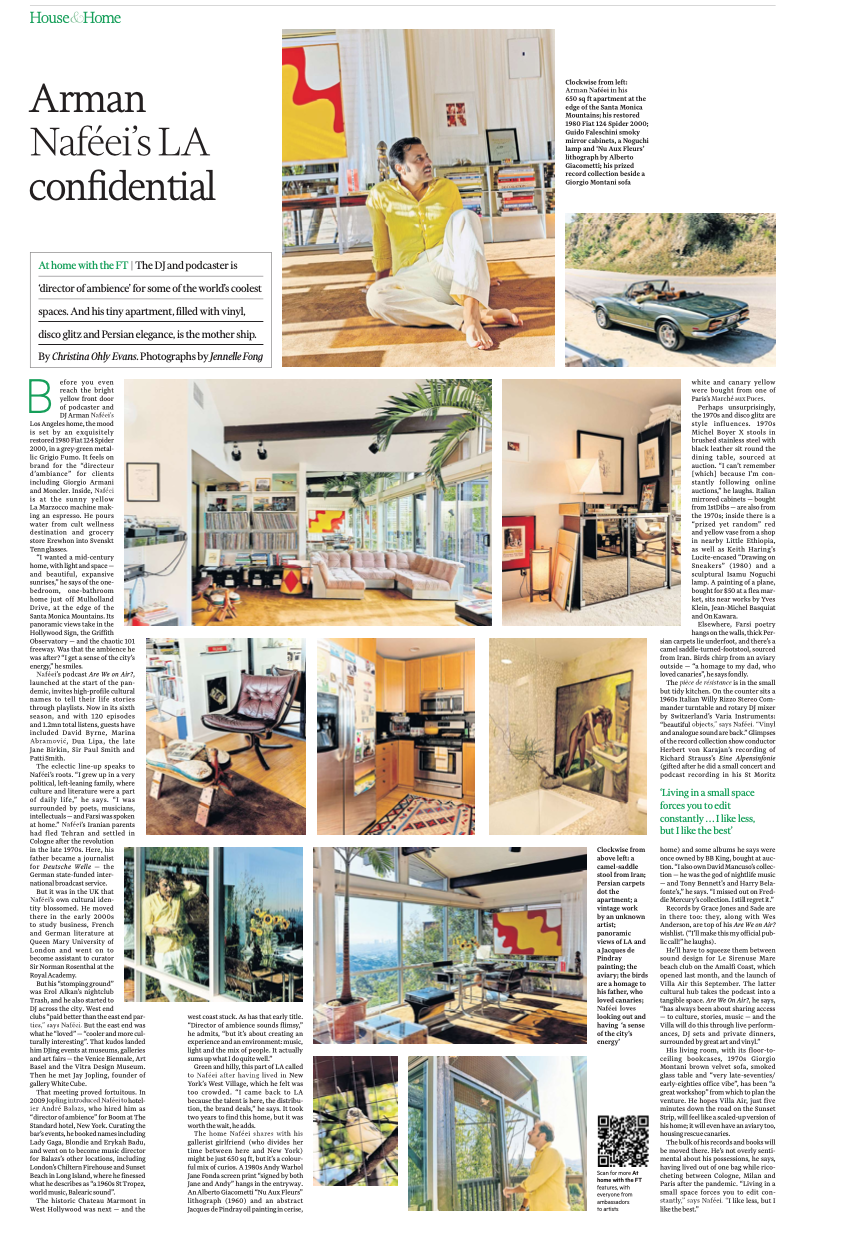
Before you even reach the bright yellow front door of podcaster and DJ Arman Naféei’s Los Angeles home, the mood is set by an exquisitely restored 1980 Fiat 124 Spider 2000, in a grey-green metallic Grigio Fumo. It feels on brand for the “directeur d’ambiance” for clients including Giorgio Armani and Moncler. Inside, Naféei is at the sunny yellow La Marzocco machine making an espresso. He pours water from cult wellness destination and grocery store Erewhon into Svenskt Tenn glasses. “I wanted a mid-century home, with light and space — and beautiful, expansive sunrises,” he says of the one-bedroom, one-bathroom home just off Mulholland Drive, at the edge of the Santa Monica Mountains. Its panoramic views take in the Hollywood Sign, the Griffith Observatory — and the chaotic 101 freeway. Was that the ambience he was after? “I get a sense of the city’s energy,” he smiles.
He sets the mood for some of the world’s hippest spaces. And his tiny LA apartment, filled with vinyl, disco glitz and Persian elegance, is the mother ship
Before you even reach the bright yellow front door of podcaster and DJ Arman Naféei’s Los Angeles home, the mood is set by an exquisitely restored 1980 Fiat 124 Spider 2000, in a grey-green metallic Grigio Fumo. It feels on brand for the “directeur d’ambiance” for clients including Giorgio Armani and Moncler. Inside, Naféei is at the sunny yellow La Marzocco machine making an espresso. He pours water from cult wellness destination and grocery store Erewhon into Svenskt Tenn glasses. “I wanted a mid-century home, with light and space — and beautiful, expansive sunrises,” he says of the one-bedroom, one-bathroom home just off Mulholland Drive, at the edge of the Santa Monica Mountains. Its panoramic views take in the Hollywood Sign, the Griffith Observatory — and the chaotic 101 freeway. Was that the ambience he was after? “I get a sense of the city’s energy,” he smiles.
Naféei’s podcast Are We On Air?, launched at the start of the pandemic, invites high-profile cultural names to tell their life stories through playlists. Now in its sixth season, and with 120 episodes and 1.2mn total listens, guests have included David Byrne, Marina Abramović, Dua Lipa, the late Jane Birkin, Sir Paul Smith and Patti Smith. The eclectic line-up speaks to Naféei’s roots. “I grew up in a very political, left-leaning family, where culture and literature were a part of daily life,” he says. “I was surrounded by poets, musicians, intellectuals — and Farsi was spoken at home.” Naféei’s Iranian parents had fled Tehran and settled in Cologne after the revolution in the late 1970s. Here, his father became a journalist for Deutsche Welle — the German state-funded international broadcast service.
But it was in the UK that Naféei’s own cultural identity blossomed. He moved there in the early 2000s to study business, French and German literature at Queen Mary University of London and went on to become assistant to curator Sir Norman Rosenthal at the Royal Academy. But his “stomping ground” was Erol Alkan’s nightclub Trash, and he also started to DJ across the city. West end clubs “paid better than the east end parties,” says Naféei. But the east end was what he “loved” — “cooler and more culturally interesting”. That kudos landed him DJing events at museums, galleries and art fairs — the Venice Biennale, Art Basel and the Vitra Design Museum. Then he met Jay Jopling, founder of gallery White Cube.
That meeting proved fortuitous. In 2009 Jopling introduced Naféei to hotelier André Balazs, who hired him as “director of ambience” for Boom at The Standard hotel, New York. Curating the bar’s events, he booked names including Lady Gaga, Blondie and Erykah Badu, and went on to become music director for Balazs’s other locations, including London’s Chiltern Firehouse and Sunset Beach in Long Island, where he finessed what he describes as “a 1960s St Tropez, world music, Balearic sound”. The historic Chateau Marmont in West Hollywood was next — and the west coast stuck. As has that early title. “Director of ambience sounds flimsy,” he admits, “but it’s about creating an experience and an environment: music, light and the mix of people. It actually sums up what I do quite well.”
Architect Omar Gandhi’s guide to Nova Scotia
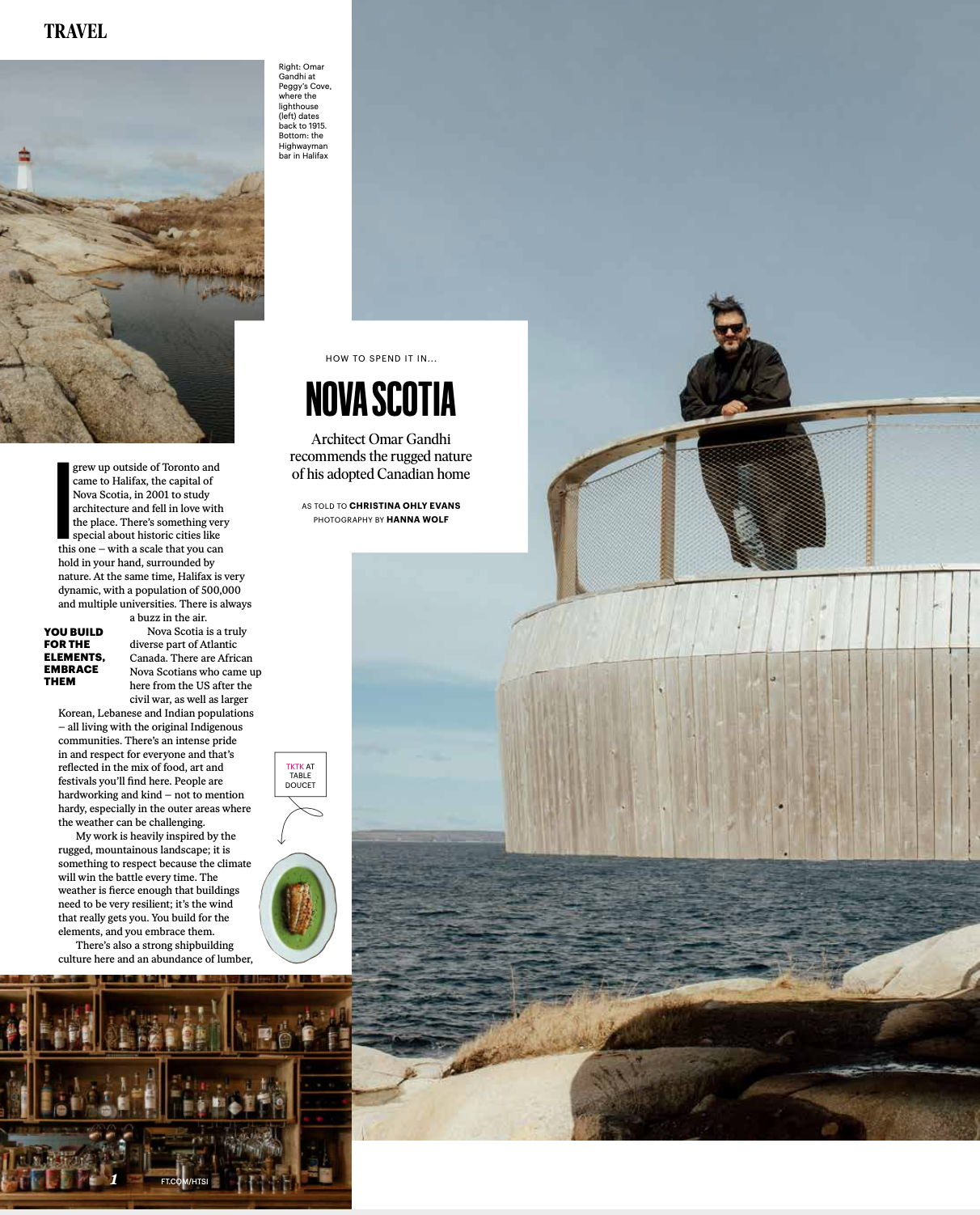
I grew up outside of Toronto and came to Halifax, the capital of Nova Scotia, in 2001 to study architecture – and fell in love with the place. There’s something very special about historic cities like this one, with a scale that you can hold in your hand, surrounded by nature. At the same time, Halifax is very dynamic, with a population of 500,000 and multiple universities. There is always a buzz in the air.
Why the Toronto native made wild, windy Halifax his home
I grew up outside of Toronto and came to Halifax, the capital of Nova Scotia, in 2001 to study architecture – and fell in love with the place. There’s something very special about historic cities like this one, with a scale that you can hold in your hand, surrounded by nature. At the same time, Halifax is very dynamic, with a population of 500,000 and multiple universities. There is always a buzz in the air.
Nova Scotia is a truly diverse part of Atlantic Canada. There are African Nova Scotians who came up here from the US after the civil war, as well as larger Korean, Lebanese and Indian populations – all living with the original Indigenous communities. There’s an intense pride in and respect for everyone and that’s reflected in the mix of food, art and festivals you’ll find here. People are hardworking and kind – not to mention hardy, especially in the outer areas where the weather can be challenging.
My work is heavily inspired by the rugged, mountainous landscape; it is something to respect because the climate will win the battle every time. The weather is fierce enough that buildings need to be very resilient; it’s the wind that really gets you. You build for the elements, and you embrace them. There’s also a strong shipbuilding culture here and an abundance of lumber, so we use a lot of locally sourced white cedar, pine, spruce and red oak. The houses are still primarily clad in wood, even in downtown Halifax, and many are painted in vibrant colours: a tradition that goes back to when sailors and fishermen used them to help navigate.
In the centre of Halifax you’ll find one of the nicest hotels in the country, Muir, which is right on the waterfront. For something more laidback – and very small – I recommend Brewery Park Hotel in the North End of the city, where I live; it has a great energy. There’s a culture of rentable architecture throughout Nova Scotia so definitely check out places such as Shobac, a collection of modern cottages and historic buildings by architect Brian MacKay-Lyons. The campus is set just south of Halifax, near the coastal town of Lunenburg, a picturesque Unesco World Heritage Site. We are very food-focused – maybe not quite as much as in Montreal, but there’s no shortage of interesting cafés and restaurants. It’s all about farm-to-table food served in intimate spaces with local wines. For great coffee and baked goods, Suda Table is owned by a Korean family and hand-makes outstanding dumplings and French pastries; everything is beautifully presented. And there is a pair of restaurants less than a minute away from each other in North End that are both very cool. Magnolia does great cocktails and Highwayman serves Spanish-inspired seafood and tapas.
Bar Kismet has been one of the most awarded restaurants in Canada for the past 10 years, with spectacular small dishes such as fresh raw scallops and tuna tartare. Another place that’s very special – but a bit of a drive – is Table Doucet in coastal Chéticamp. It’s very French-Acadian: everything on its tasting menus has been locally foraged, including the seafood. In the 1970s, this part of Canada drew in lots of artists, many of whom taught at the Nova Scotia College of Art and Design. Richard Serra lived here, and Philip Glass and later Ethan Hawke found refuge here too. Architecture and design have flourished. One standout architect is Keith Graham, a masterful modernist who designed the most beautiful public projects in Halifax, including the Nova Scotia Archives, the Halifax police station and the North End Library.
The Museum of Natural History is also wonderful, as is the Halifax Central Library, which is like the living room of the city. Libraries are magical places where people go to hang out: old people, young kids – it’s comfortable for all ages. The Art Gallery of Nova Scotia on the waterfront has objects from all over the country including Indigenous art, as well as a large collection of Annie Leibovitz photographs. And for Titanic enthusiasts there’s the Maritime Museum of the Atlantic, which has a vast collection of the ship’s memorabilia because Halifax was the closest major port to where the ship sank in 1912.
For an adventure, I recommend driving the scenic Cabot Trail to Inverness in Cape Breton, where you’ll find Cabot Links, one of the best links-style golf courses in the world (at Cabot Cape Breton resort). It’s not just gorgeous, it’s intense; there’s wind, so it’s tricky – just like being in the Scottish Highlands. Or head south of Halifax to Chester, a fun sailing centre where you can rent a boat and spend a day on the water. Be sure to visit Peggy’s Cove, a quaint fishing village and lighthouse that’s set on a granite outcrop on St Margaret’s Bay. It’s an iconic spot for kayaking and eating lobster rolls with rocky coastal views.
I have lived here more than half my life at this point, and I’m also raising my son here. I feel deeply ingrained in the place and wouldn’t want to live anywhere else. Halifax isn’t trying to become a big city, so I hope it just continues to embrace its historic fabric. Moving here changed my life, so I share it with everyone I can.
BARS, CAFÉS & RESTAURANTS Bar Kismet barkismet.com Highwayman highwaymanhfx.com Magnolia magnoliahfx.com Suda Table sudatable.com Table Doucet tabledoucet.com
THINGS TO DO Art Gallery of Nova Scotia agns.ca Cabot Cape Breton cabot.com Chester Yacht Club chesteryachtclub.ca Halifax Central Library halifaxcentrallibrary.ca Maritime Museum of the Atlantic maritimemuseum.novascotia.ca Museum of Natural History naturalhistory.novascotia.ca Neil Depew Gallery neildepew.com
WHERE TO STAY
Brewery Park Hotel brewerypark.ca
Muir muirhotel.com
Shobacplaces2b.ca/shobac
Born to give – the philanthropic urge of Phoebe Gates
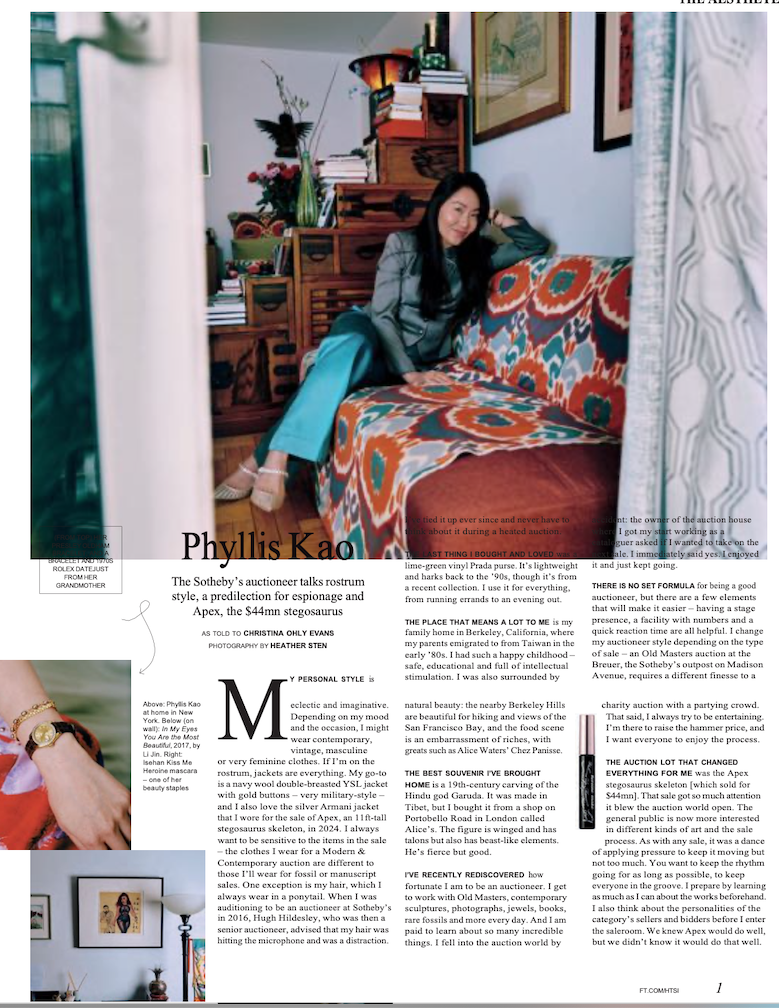
My personal style is eclectic and imaginative. Depending on my mood and the occasion, I might wear contemporary, vintage, masculine or very feminine clothes. If I’m on the rostrum, jackets are everything. My go-to is a navy wool double-breasted YSL jacket with gold buttons – very military-style – and I also love the silver Armani jacket that I wore for the sale of Apex, an 11ft-tall stegosaurus skeleton, in 2024. I always want to be sensitive to the items in the sale – the clothes I wear for a Modern & Contemporary auction are different to those I’ll wear for fossil or manuscript sales. One exception is my hair, which I always wear in a ponytail. When I was auditioning to be an auctioneer at Sotheby’s in 2016, Hugh Hildesley, who was then a senior auctioneer, advised that my hair was hitting the microphone and was a distraction. I’ve tied it up ever since and never have to think about it during a heated auction.
The youngest member of the Gates clan is following her family’s calling. But her healthcare mission comes with a uniquely Gen Z edge
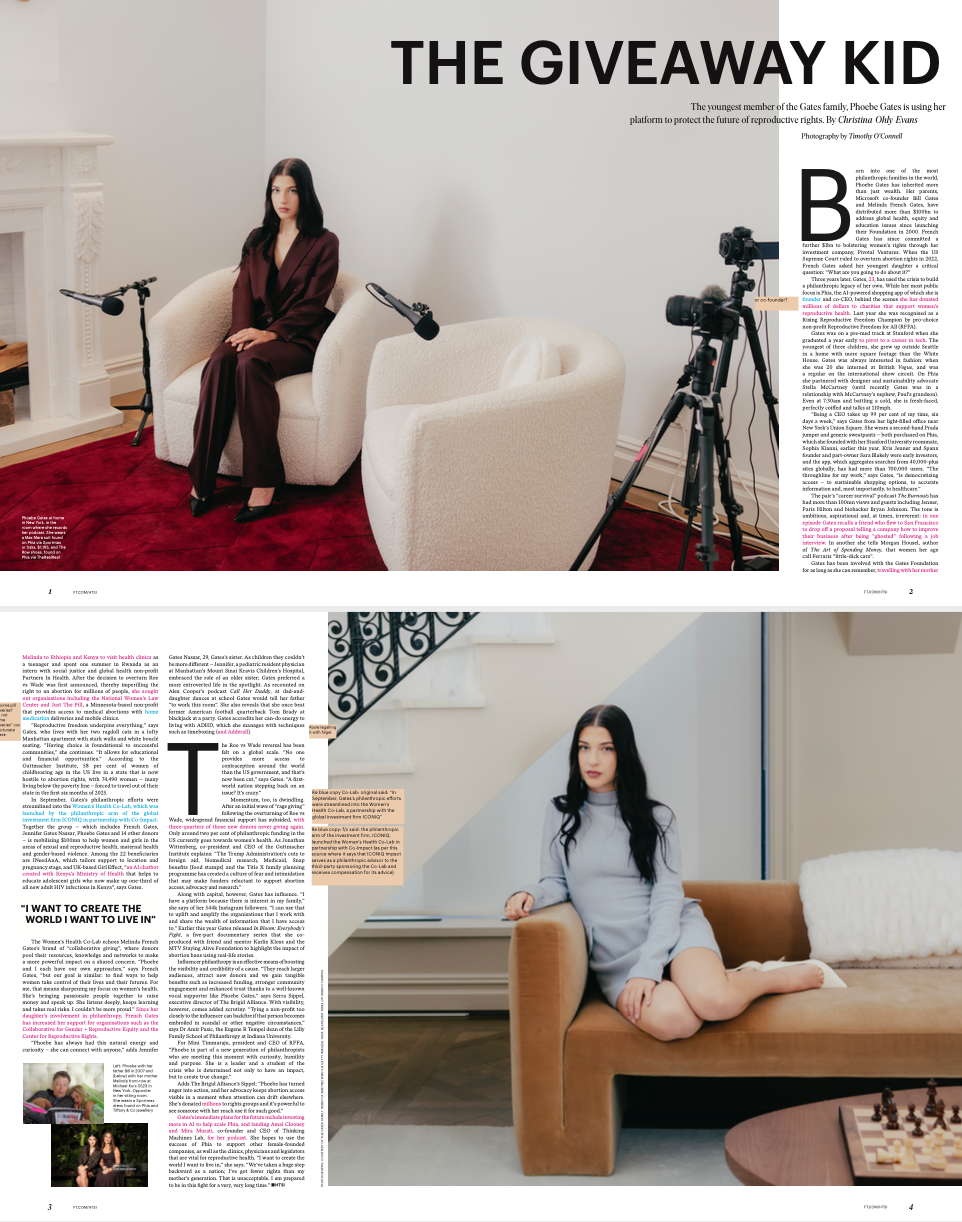
Born into one of the most philanthropic families in the world, Phoebe Gates has inherited more than just wealth. Her parents, Microsoft co-founder Bill Gates and Melinda French Gates, have distributed more than $100bn to address global health, equity and education issues since launching their Foundation in 2000. French Gates has since committed a further $1bn to bolstering women’s rights through her investment company, Pivotal Ventures. When the US Supreme Court ruled to overturn abortion rights in 2022, French Gates asked her youngest daughter a critical question: “What are you going to do about it?” Three years later, Gates, 23, has used the crisis to try to find the answer. Her most public focus is Phia, the AI‑powered shopping app of which she is co-founder and co‑CEO; behind the scenes she has donated millions of dollars to charities that support women’s reproductive health (although, when asked, her team do not disclose a precise amount). Last year she was recognised as a Rising Reproductive Freedom Champion by pro-choice non-profit Reproductive Freedom for All (RFFA).
Gates was on a pre-med track at Stanford University when she graduated a year early to pivot to a career in tech. The youngest of three, she grew up outside Seattle in a home with more square footage than the White House. Gates was always interested in fashion: when she was 20 she interned at British Vogue, and was a regular on the international show circuit. On Phia she partnered with designer and sustainability advocate Stella McCartney (until recently Gates was in a relationship with McCartney’s nephew, Paul’s grandson). Even at 7.30am and battling a cold, she is fresh-faced, perfectly coiffed and talks at 110mph.
“Being a CEO takes up 99 per cent of my time, six days a week,” says Gates from her light-filled office near New York’s Union Square. She wears a second-hand Prada jumper and generic sweatpants – both purchased on Phia, which she founded with her Stanford roommate, Sophia Kianni, earlier this year. Kris Jenner and Spanx founder and part-owner Sara Blakely were early investors, and the app, which aggregates searches from 40,000-plus sites globally, has had more than 700,000 users and – as of December – a $180mn valuation. “The throughline for my work,” says Gates, “is democratising access – to sustainable shopping options, to accurate information and, most importantly, to healthcare.” The pair’s “career survival” podcast The Burnouts has had more than 100mn views and guests including Jenner, Paris Hilton and biohacker Bryan Johnson. The tone is ambitious, aspirational and, at times, irreverent: in one episode Gates recalls a friend who flew to San Francisco to drop off a proposal telling a company how to improve their business after being “ghosted” following a job interview. In another, she tells Morgan Housel, author of The Art of Spending Money, that women her age call Ferraris “little-dick cars”.
Gates has been involved with the Gates Foundation for as long as she can remember, travelling as a child with her mother to Ethiopia and Rwanda, where she returned as a teenager to volunteer at a pre-school. While at college, she also spent three weeks with the non-profit Partners In Health at a health clinic. After the decision to overturn Roe vs Wade was first announced – thereby imperilling the right to an abortion for millions of people – she sought out organisations including the Repro Legal Defense Fund and Just The Pill, a Minnesota-based non-profit that provides access to medication abortions with home pill deliveries and mobile clinics. “Reproductive freedom underpins everything,” says Gates, who lives with her two ragdoll cats in a lofty Manhattan apartment with stark walls and white bouclé seating. “Having choice is foundational to successful communities,” she continues. “It allows for educational and financial opportunities.” According to the Guttmacher Institute, 58 per cent of women of childbearing age in the US live in a state that is now hostile to abortion rights, with 74,490 women – many living below the poverty line – forced to travel out of their state in the first six months of 2025.
Auctioneer Phyllis Kao talks taste
The Sotheby’s star on stage presence, the San Francisco Giants and selling a $45mn stegosaurus.
Please use the sharing tools found via the share button at the top or side of articles. Copying articles to share with others is a breach of FT.com T&Cs and Copyright Policy. Email licensing@ft.com to buy additional rights. Subscribers may share up to 10 or 20 articles per month using the gift article service. More information can be found on the Help FAQ on gift articles.
https://www.ft.com/content/2a88a285-9d38-4983-bc0a-9db294d9117e
My personal style is eclectic and imaginative. Depending on my mood and the occasion, I might wear contemporary, vintage, masculine or very feminine clothes. If I’m on the rostrum, jackets are everything. My go-to is a navy wool double-breasted YSL jacket with gold buttons – very military-style – and I also love the silver Armani jacket that I wore for the sale of Apex, an 11ft-tall stegosaurus skeleton, in 2024. I always want to be sensitive to the items in the sale – the clothes I wear for a Modern & Contemporary auction are different to those I’ll wear for fossil or manuscript sales. One exception is my hair, which I always wear in a ponytail. When I was auditioning to be an auctioneer at Sotheby’s in 2016, Hugh Hildesley, who was then a senior auctioneer, advised that my hair was hitting the microphone and was a distraction. I’ve tied it up ever since and never have to think about it during a heated auction.
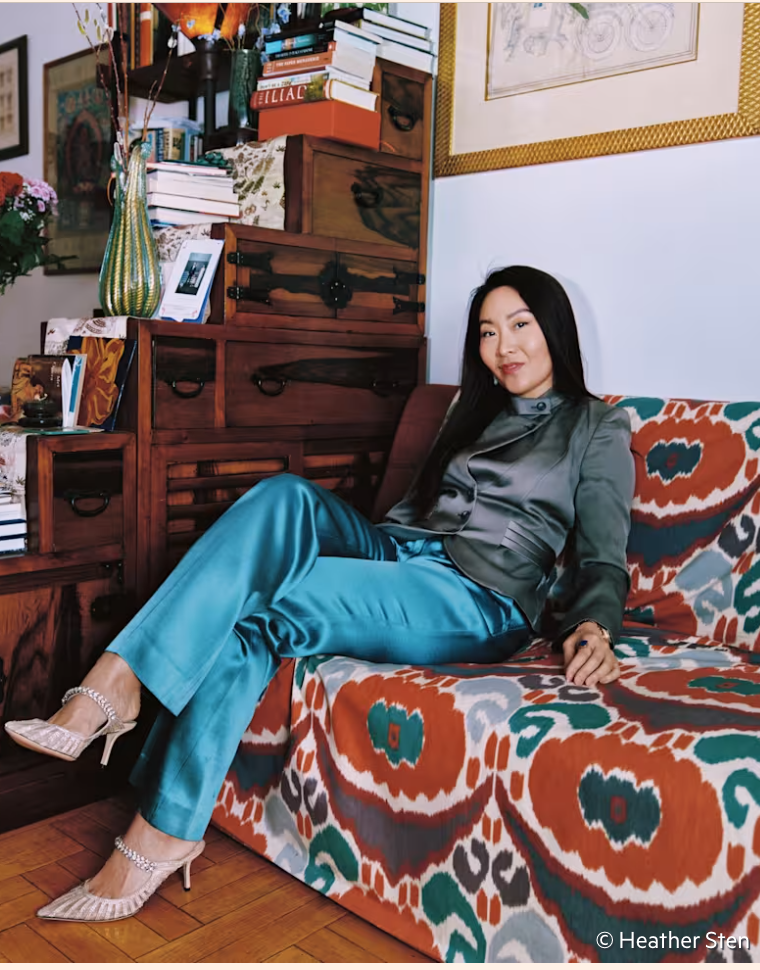
The Sotheby’s star on stage presence, the San Francisco Giants and selling a $45mn stegosaurus
My personal style is eclectic and imaginative. Depending on my mood and the occasion, I might wear contemporary, vintage, masculine or very feminine clothes. If I’m on the rostrum, jackets are everything. My go-to is a navy wool double-breasted YSL jacket with gold buttons – very military-style – and I also love the silver Armani jacket that I wore for the sale of Apex, an 11ft-tall stegosaurus skeleton, in 2024. I always want to be sensitive to the items in the sale – the clothes I wear for a Modern & Contemporary auction are different to those I’ll wear for fossil or manuscript sales. One exception is my hair, which I always wear in a ponytail. When I was auditioning to be an auctioneer at Sotheby’s in 2016, Hugh Hildesley, who was then a senior auctioneer, advised that my hair was hitting the microphone and was a distraction. I’ve tied it up ever since and never have to think about it during a heated auction. The last thing I bought and loved was a lime-green vinyl Prada purse. It’s lightweight and harks back to the ’90s, though it’s from a recent collection. I use it for everything, from running errands to an evening out.
The place that means a lot to me is my family home in Berkeley, California, where my parents emigrated to from Taiwan in the early ’80s. I had such a happy childhood – safe, educational and full of intellectual stimulation. I was also surrounded by natural beauty: the nearby Berkeley Hills are beautiful for hiking and views of the San Francisco Bay, and the food scene is an embarrassment of riches, with greats such as Alice Waters’ Chez Panisse. The best souvenir I’ve brought home is a 19th-century carving of the Hindu god Garuda. It was made in Tibet, but I bought it from a shop on Portobello Road in London that’s now closed. The figure is winged and has talons but also has beast-like elements. He’s fierce but good.
I’ve recently rediscovered how fortunate I am to be an auctioneer. I get to work with Old Masters, contemporary sculptures, photographs, jewels, books, rare fossils and more every day. And I am paid to learn about so many incredible things. I fell into the auction world by accident: the owner of the auction house where I got my start working as a cataloguer asked if I wanted to take on the next sale. I immediately said yes. I enjoyed it and just kept going.
There is no set formula for being a good auctioneer, but there are a few elements that will make it easier – having a stage presence, a facility with numbers and a quick reaction time are all helpful. I change my auctioneer style depending on the type of sale – an Old Masters auction at the Breuer, the Sotheby’s outpost on Madison Avenue, requires a different finesse to a charity auction with a partying crowd. That said, I always try to be entertaining. I’m there to raise the hammer price, and I want everyone to enjoy the process.
The auction lot that changed everything for me was the Apex stegosaurus skeleton [which sold for $44.6mn]. That sale got so much attention, it blew the auction world open. The general public is now more interested in different kinds of art and the sale process. As with any sale, it was a dance of applying pressure to keep it moving but not too much. You want to keep the rhythm going for as long as possible, to keep everyone in the groove. I prepare by learning as much as I can about the works beforehand. I also think about the personalities of the category’s sellers and bidders before I enter the saleroom. We knew Apex would do well, but we didn’t know it would do that well.
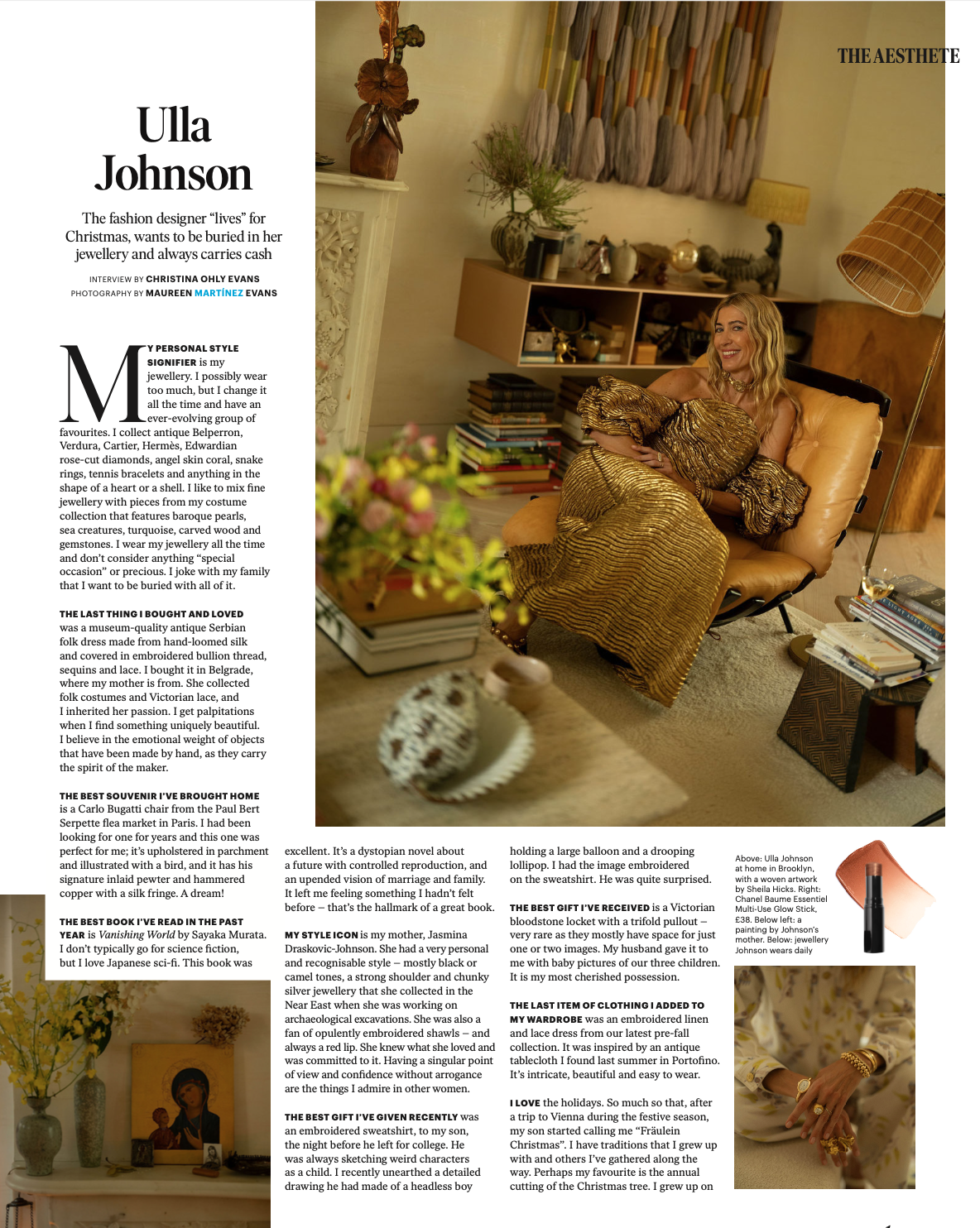
Fashion designer Ulla Johnson talks taste
The founder of the clothes brand loves Ruinart champagne, loathes minimalism and ‘lives for Christmas’
My personal style signifier is my jewellery. I possibly wear too much, but I change it all the time and have an ever-evolving group of favourites. I collect antique Belperron, Verdura, Cartier, Hermès, Edwardian rose-cut diamonds, angel skin coral, snake rings, tennis bracelets and anything in the shape of a heart or a shell. I like to mix fine jewellery with pieces from my costume collection that features baroque pearls, sea creatures, turquoise, carved wood and gemstones. I wear my jewellery all the time and don’t consider anything “special occasion” or precious. I joke with my family that I want to be buried with all of it.
The founder of the clothes brand loves Ruinart champagne, loathes minimalism and ‘lives for Christmas’
My personal style signifier is my jewellery. I possibly wear too much, but I change it all the time and have an ever-evolving group of favourites. I collect antique Belperron, Verdura, Cartier, Hermès, Edwardian rose-cut diamonds, angel skin coral, snake rings, tennis bracelets and anything in the shape of a heart or a shell. I like to mix fine jewellery with pieces from my costume collection that features baroque pearls, sea creatures, turquoise, carved wood and gemstones. I wear my jewellery all the time and don’t consider anything “special occasion” or precious. I joke with my family that I want to be buried with all of it.
The last thing I bought and loved was a museum-quality antique Serbian folk dress made from hand-loomed silk and covered in embroidered bullion thread, sequins and lace. I bought it in Belgrade, where my mother is from. She collected folk costumes and Victorian lace, and I inherited her passion. I get palpitations when I find something uniquely beautiful. I believe in the emotional weight of objects that have been made by hand, as they carry the spirit of the maker.
The best souvenir I’ve brought home is a Carlo Bugatti chair from the Paul Bert Serpette flea market in Paris. I had been looking for one for years and this one was perfect for me; it’s upholstered in parchment and illustrated with a bird, and it has his signature inlaid pewter and hammered copper with a silk fringe. A dream!
The best book I’ve read in the past year is Vanishing World by Sayaka Murata. I don’t typically go for science fiction, but I love Japanese sci-fi. This book was excellent. It’s a dystopian novel about a future with controlled reproduction, and an upended vision of marriage and family. It left me feeling something I hadn’t felt before – that’s the hallmark of a great book.
My style icon is my mother, Jasmina Draskovic-Johnson. She had a very personal and recognisable style – mostly black or camel tones, a strong shoulder and chunky silver jewellery that she collected in the Near East when she was working on archaeological excavations. She was also a fan of opulently embroidered shawls – and always a red lip. She knew what she loved and was committed to it. Having a singular point of view and confidence without arrogance are the things I admire in other women.
The best gift I’ve received is a Victorian bloodstone locket with a trifold pullout – very rare as they mostly have space for just one or two images. My husband gave it to me with baby pictures of our three children. It is my most cherished possession. The best gift I’ve given recently was an embroidered sweatshirt, to my son, the night before he left for college. He was always sketching weird characters as a child. I recently unearthed a detailed drawing he had made of a headless boy holding a large balloon and a drooping lollipop. I had the image embroidered on the sweatshirt. He was quite surprised.
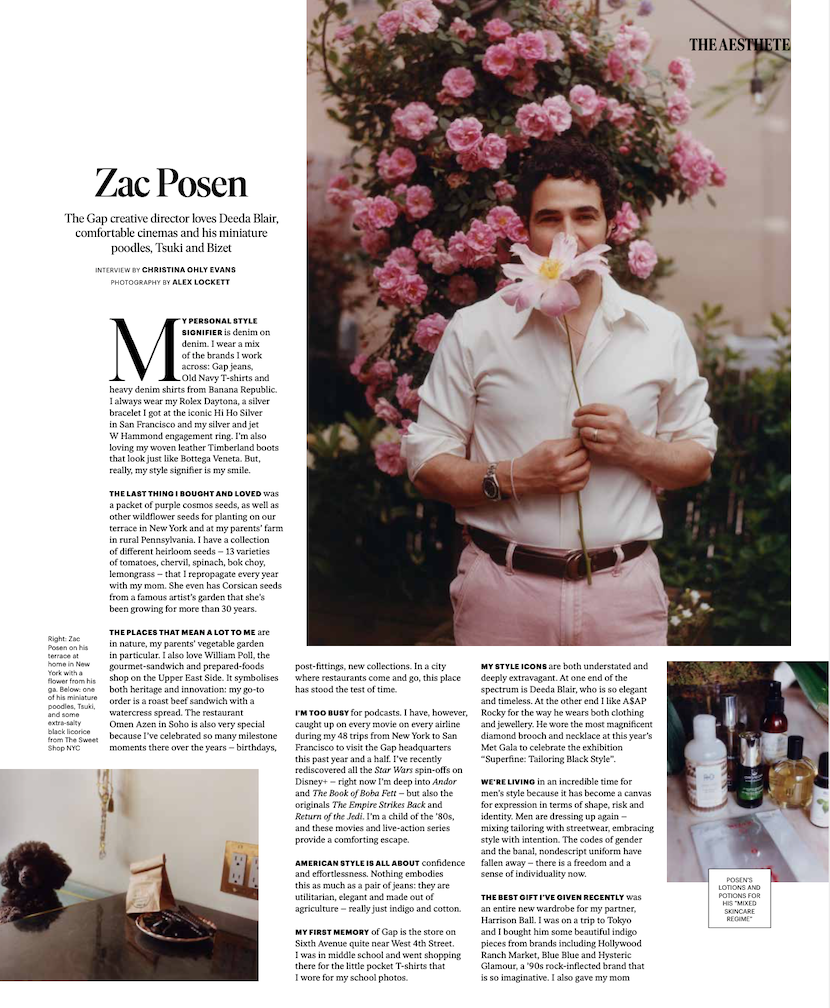
Zac Posen: ‘My style signifier is my smile’
My personal style signifier is denim on denim. I wear a mix of the brands I work across: Gap jeans, Old Navy T-shirts and heavy denim shirts from Banana Republic. I always wear my Rolex Daytona, a silver bracelet I got at the iconic Hi Ho Silver in San Francisco and my silver and jet W Hammond engagement ring. I’m also loving my woven leather Timberland boots that look just like Bottega Veneta. But, really, my style signifier is my smile.
The creative director of Gap Inc loves Deeda Blair, comfortable cinemas and his miniature poodles, Tsuki and Bizet
My personal style signifier is denim on denim. I wear a mix of the brands I work across: Gap jeans, Old Navy T-shirts and heavy denim shirts from Banana Republic. I always wear my Rolex Daytona, a silver bracelet I got at the iconic Hi Ho Silver in San Francisco and my silver and jet W Hammond engagement ring. I’m also loving my woven leather Timberland boots that look just like Bottega Veneta. But, really, my style signifier is my smile. The last thing I bought and loved was a packet of purple cosmos seeds, as well as other wildflower seeds for planting on our terrace in New York and at my parents’ farm in rural Pennsylvania. I have a collection of different heirloom seeds — 13 varieties of tomatoes, chervil, spinach, bok choy, lemongrass — that I repropagate every year with my mom. She even has Corsican seeds from a famous artist’s garden that she’s been growing for more than 30 years.
The places that mean a lot to me are in nature, my parents’ vegetable garden in particular. I also love William Poll, the gourmet-sandwich and prepared-foods shop on the Upper East Side. It symbolises both heritage and innovation: my go-to order is a roast beef sandwich with a watercress spread. The restaurant Omen Azen in SoHo is also very special because I’ve celebrated so many milestone moments there over the years — birthdays, post-fittings, new collections. In a city where restaurants come and go, this place has stood the test of time.
I’m too busy for podcasts. I have, however, caught up on every movie on every airline during my 48 trips from New York to San Francisco to visit the Gap headquarters this past year and a half. I’ve recently rediscovered all the Star Wars spin-offs on Disney+ — right now I’m deep into Andor and The Book of Boba Fett — but also the originals The Empire Strikes Back and Return of the Jedi. I’m a child of the ’80s, and these movies and live-action series provide a comforting escape. American style is all about confidence and effortlessness. Nothing embodies this as much as a pair of jeans: they are utilitarian, elegant and made out of agriculture — really just indigo and cotton. My first memory of Gap is the store on Sixth Avenue quite near West 4th Street. I was in middle school and went shopping there for the little pocket T-shirts that I wore for my school photos.
My style icons are both understated and deeply extravagant. At one end of the spectrum is Deeda Blair, who is so elegant and timeless. At the other end I like A$AP Rocky for the way he wears both clothing and jewellery. He wore the most magnificent diamond brooch and necklace at this year’s Met Gala to celebrate the exhibition “Superfine: Tailoring Black Style”. We’re living in an incredible time for men’s style because it has become a canvas for expression in terms of shape, risk and identity. Men are dressing up again — mixing tailoring with streetwear, embracing style with intention. The codes of gender and the banal, nondescript uniform have fallen away. There is a freedom and a sense of individuality now.
The best gift I’ve given recently was an entire new wardrobe for my partner, Harrison Ball. I was on a trip to Tokyo and I bought him some beautiful indigo pieces from brands including Hollywood Ranch Market, Blue Blue and Hysteric Glamour, a ’90s rock-inflected brand that is so imaginative. I also gave my mom the navy Gap shirtdress with polka dots — aka the “Anne Hathaway dress” — from my first collection for Gap, which made me very happy. And the best gift I’ve received is an enormous bouquet of yellow and orange tulips from my florist, Zeze. They were cut from his own garden and the blossoms were the size of teacups. We’re talking Victor Fleming Munchkinland size.
The last music I downloaded was Chan Marshall’s Cat Power Sings Dylan: The 1966 Royal Albert Hall Concert, a live recreation of Bob Dylan’s 1966 concert at the Manchester Free Trade Hall — mistakenly attributed to the Royal Albert Hall — that includes such classics as “Mr Tambourine Man” and “Like a Rolling Stone”. I also download a lot of the music that Harrison listens to for his work as a choreographer, including New Ancient Strings by Malian musicians Toumani Diabaté and Ballaké Sissoko, which is almost hypnotic.
The best way to spend $20 is to go to the movies by yourself, preferably one with comfortable seats. The Film Forum in Greenwich Village is always nostalgic, as is the Angelika Film Center for indie and foreign films. The Film Forum has a great Summer Double Feature series with pairings like The Big Lebowski and The Last Picture Show, and Open City with Voyage to Italy. I’m hoping to see one of these. In my fridge you’ll find everything: apple cider vinegar, eggs, clementines, apples, yoghurt, chicken stock, leeks, thyme, bay leaves, nuts, dashi, nori and sea moss. I’m a real cook, and live on soups made in a Breville pressure cooker.
I do not believe in life after death, but I do believe in a creative spirit taking other forms. This is a bigger conversation about the definition of life in the time of AI and supercomputers. I couldn’t do without my miniature poodles, Tsuki and Bizet, who travel with me from coast to coast and have a very good life. I’m also very attached to my Gingher Left-hand Knife-edge Dressmaker Shears, as well as my dress form and mannequin.
I am a lotions-and-potions person and have a mixed skincare regime that includes SkinCeuticals’ toner and an Orveda serum and face cream. I also like the body oil from my friend’s company, Monastery Made, and the Meder Masks I get from Knockout Beauty; they are incredibly moisturising. Meder Beauty Science Hydra-Fill Mask, $115 for a pack of five, knockoutbeauty.com. Monastery Made Lapiz body oil, $59. Orveda Vital Sap, £165, and Firm Brew Botanical Cream, £350. SkinCeuticals Equalizing Toner, £46 The works that changed everything for me were the clothes of Issey Miyake, Azzedine Alaïa and Yohji Yamamoto that I saw at Charivari Workshop as a kid growing up in SoHo. I later interned at The Costume Institute at The Metropolitan Museum of Art and saw the works of Madeleine Vionnet and Cristóbal Balenciaga — especially his gowns in taffeta — that totally changed my life.
My grooming gurus include Thom Priano, who cuts my hair on the East Coast, and Dennis Gots, who cuts it on the West. I get regular facials at Monastery in San Francisco and with Ludmila at Knockout Beauty in New York. I also take a lot of vitamins: black seed oil to reduce inflammation, CoQ10 for heart health, and NACs, which support the immune system.
In another life, I would have been a film or theatre director — anything that involves storytelling and costumes. I’ve done some of this in the past: with the costumes for Christopher Wheeldon’s Within the Golden Hour for the San Francisco Ballet, for the Broadway production Lady in the Dark and for Graham Moore’s film The Outfit. I love the research, character development and artistic collaboration. Never say never.
The best bit of advice I ever received was something that Stephen Sondheim said: “Opportunity is not a lengthy visitor.” Take advantage of things presented to you.
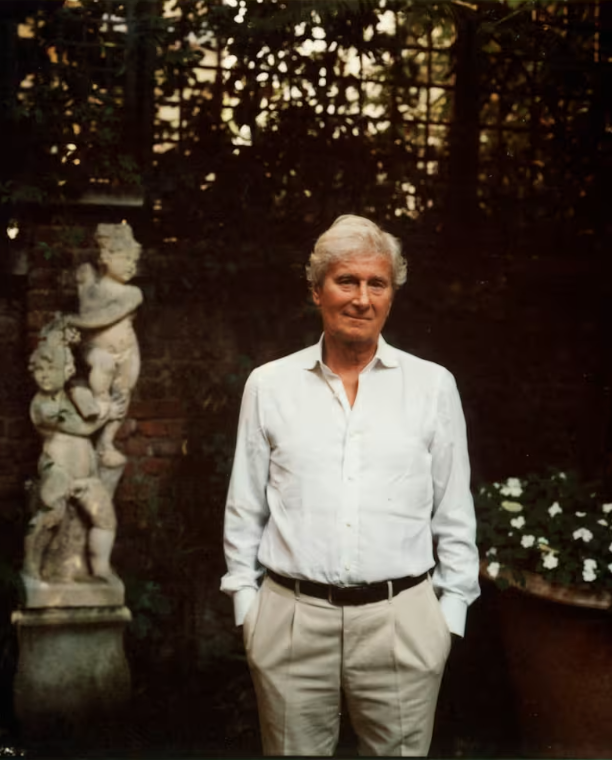
Kartell’s Claudio Luti on skis, sculpture and slim-cut suits
My personal style signifiers are custom Caraceni slim-cut suits – very English – in classic colours such as navy and grey. My shirts are custom E Marinella. I’m a typical Milanese man and I like to work so I’m very comfortable in a suit, though my style has changed over the years. In my previous career I worked with Gianni Versace as managing director to help build the brand, and I only wore his clothes. Today’s dress is more traditional.
The CEO of the Italian design company talks taste
My personal style signifiers are custom Caraceni slim-cut suits – very English – in classic colours such as navy and grey. My shirts are custom E Marinella. I’m a typical Milanese man and I like to work so I’m very comfortable in a suit, though my style has changed over the years. In my previous career I worked with Gianni Versace as managing director to help build the brand, and I only wore his clothes. Today’s dress is more traditional. The last thing I bought and loved was a light-blue hand-knit cashmere sweater at the weekend market in Forte dei Marmi, a seaside town in Tuscany. It’s an excellent spot for high-quality shopping because it caters largely to tourists. It’s nice walking there – there are beautiful flowers and excellent vendors selling everything from ceramics to local leather goods.
The place that means a lot to me is the Mediterranean Sea, aboard my 80ft Wally sailboat. It was built in 1999 and stays in Genoa during the winter. From May until September, though, it’s easy to explore the islands of Italy and Greece. I especially love Bolza and Capri and the Aeolian Islands in July, and the island of Symi – just off Turkey – in August when Italy is crowded. There are so many beautiful bays and places to anchor in this part of the world. The waters off Rhodes are very special too.
The best book I’ve read in the past year is The Count of Virtue: Giangaleazzo Visconti, Duke of Milan by ER Chamberlin. It’s a biography of a fascinating man who took Milan to the pinnacle of power in terms of politics and culture at the beginning of the Renaissance. It is also a story of a despot who ultimately succumbed to the plague that decimated so many at the time. And the best souvenir I’ve brought home is a warrior sculpture from a recent sailing trip through the Solomon Islands in the South Pacific. Local people arrived by canoe to sell us crafts and trinkets, and I bought this sculpture in black wood. He resides in my living room in Forte dei Marmi.
My style icon is Beppe Modenese, the former honorary president of the Camera Nazionale della Moda Italiana, a non-profit that helps promote the Italian fashion industry. When I worked in fashion as a young man out of university, I thought he was the epitome of elegance, good manners and good taste. He was known as “The Gentleman” and “Italy’s Prime Minister of Fashion”, and his suits, ties, pocket squares – everything – were perfection. The best gifts I’ve given recently were 20 Christmas presents to my wife last year. It’s a family tradition and I pick them out with my children and grandchildren. From jewellery and clothing to art books, there are gifts from every category, at all prices. One of the best was a gold floral necklace; I went to the store to buy a small necklace for my granddaughter and ended up getting a much grander version for my wife. Another favourite was a sculpture by the Calabrian artist Pino Deodato, inspired by Giorgio de Chirico’s Mysterious Baths sculpture.
The best way to spend €20 is on a stack of newspapers – preferably to read first thing in the morning. I still like to touch the paper versions. And the best gift I’ve received is a “patino” rowing boat from my wife. It is a simple, traditional boat that is typical in Forte dei Marmi and I love it for casual paddling. It says “Claudio & Maria” on the side and was the perfect present. I have a collection of skis and also tennis rackets. I started doing both of these sports when I was very young. Back then, we had really long skis, so those are like antiques now. I also have short skis that turn much more easily, and a rotating selection of newer, high-performance demo skis that I trial, all for downhill skiing, not Nordic, where the terrain is flat. They are all different colours and brands, but my favourites are Atomic. It’s the same for my rackets; I love to play and I always like to try new models.
A way to make me laugh is my golden retriever, Jack. He is always amusing. He goes everywhere with me – to the office, to Forte dei Marmi in summer, to St Moritz in the winter – everywhere but the boat. In my fridge you’ll always find fresh pasta and ragù, some type of fish, herbs, cheeses, aubergine, all kinds of berries and freshly squeezed orange juice. I also have tea and brioche, but not in the fridge, of course. To be honest, I don’t do much cooking.
I’ve recently discovered Laos. I spent my last vacation there and found it to be so beautiful and different from other countries in that part of the world. The people were so kind and well educated, and the trip was full of culture. Amantaka is a spectacular hotel in the Unesco-protected town of Luang Prabang. Being near the Mekong River, the Buddhist temples and the famous night market made for an incredible visit. I don’t know if I believe in life after death because I went to Catholic school and Catholic university, where I studied ethics. It’s difficult to say, so I’ll go with maybe.
The last items of clothing I added to my wardrobe were several ski jackets – a grey Moncler one and two from the Norwegian brand Kjus. They are in brighter colours – cherry red and blue – and I keep them at my home in St Moritz. I choose a jacket according to the weather. An object I would never part with is a vintage blue Porsche Cabriolet that my wife gave me 24 years ago. I’m too old for this car, but it’s such a dream – and it’s special because she purchased it with her own money. It lives in our garage here in Milan and no one else is allowed to drive it. My other cars, yes, fine. But this one? Never.
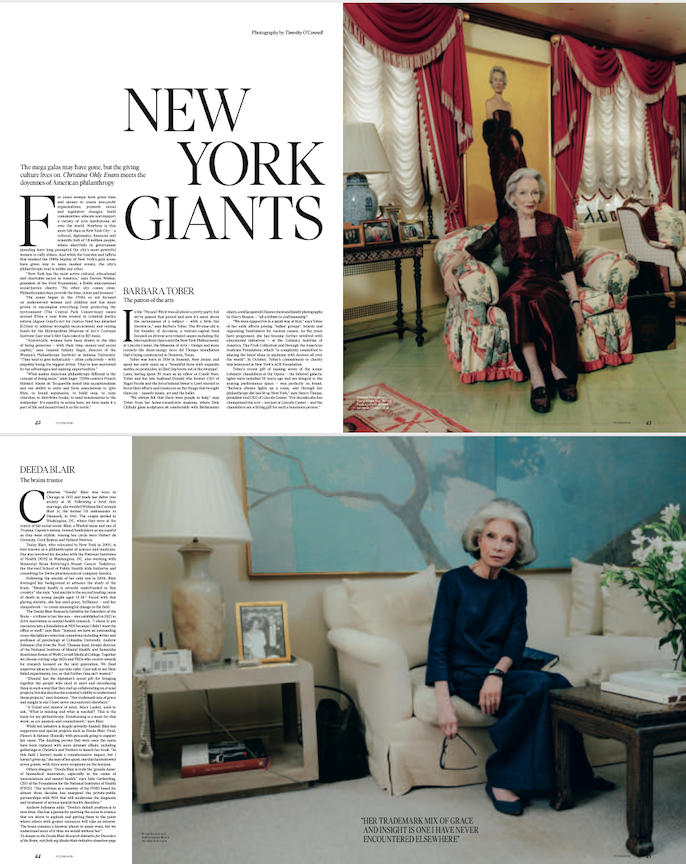
The queens of NYC philanthropy
For years women have given time and money to create non-profit organisations, promote social and legislative changes, build communities, educate and support a variety of arts institutions all over the world. Nowhere is this more felt than in New York City – a cultural, diplomatic, financial and scientific hub of 7.8 million people, where shortfalls in government spending have long prompted the city’s most powerful women to rally others. And while the tuxedos and taffeta that marked the 1980s heyday of New York’s gala scene have given way to more modest events, the city’s philanthropic zeal is unlike any other.
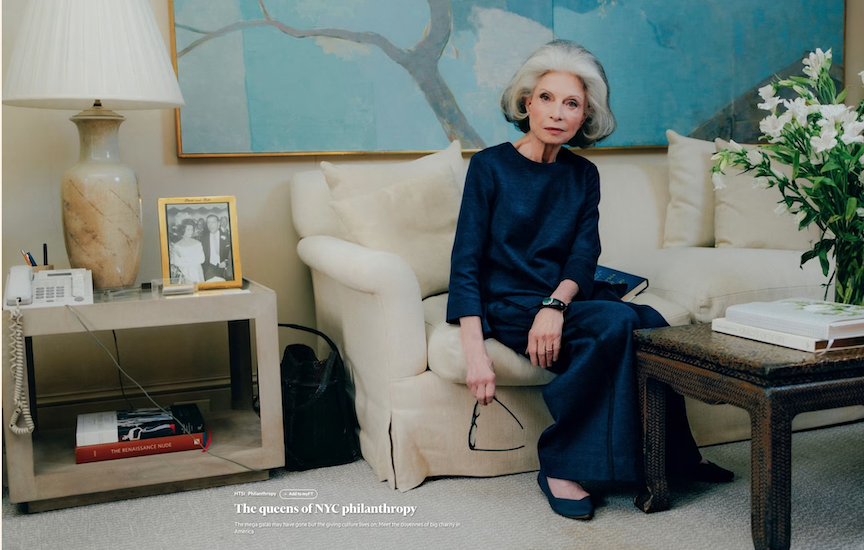
Deeda Blair
The mega galas may have gone but the giving culture lives on. Meet the doyennes of big charity in America
For years women have given time and money to create non-profit organisations, promote social and legislative changes, build communities, educate and support a variety of arts institutions all over the world. Nowhere is this more felt than in New York City – a cultural, diplomatic, financial and scientific hub of 7.8 million people, where shortfalls in government spending have long prompted the city’s most powerful women to rally others. And while the tuxedos and taffeta that marked the 1980s heyday of New York’s gala scene have given way to more modest events, the city’s philanthropic zeal is unlike any other. “New York has the most active cultural, educational and charitable sector in America,” says Darren Walker, president of the Ford Foundation, a $16bn international social-justice charity. “No other city comes close. Philanthropists here provide the time, talent and treasure.” The scene began in the 1700s as aid focused on underserved women and children and has since grown to encompass everything from protecting the environment (The Central Park Conservancy raises around $7mn a year from events) to criminal justice reform (Agnes Gund’s Art for Justice fund has awarded $125mn to address wrongful incarceration) and raising funds for the Metropolitan Museum of Art’s Costume Institute (last year’s Met Gala raked in $17.4mn).
“Historically, women have been drawn to the idea of being generous – with their time, money and social capital,” says Jeannie Infante Sager, director of the Women’s Philanthropy Institute at Indiana University. “They tend to give holistically – often collectively – with empathy being the biggest driver. They’re less motivated by tax advantages and naming opportunities.” “What makes American philanthropy different is the concept of doing more,” adds Sager. “[19th-century French thinker] Alexis de Tocqueville noted this exceptionalism and our ability to unite and form associations to ‘give fêtes, to found seminaries, to build inns, to raise churches, to distribute books, to send missionaries to the Antipodes’. It’s equality in action here; we have made it a part of life and incentivised it as the norm.”
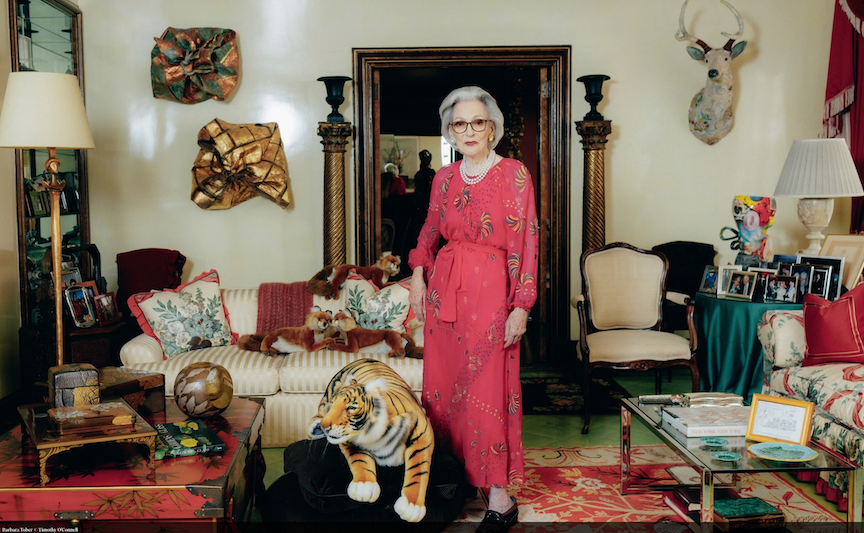
Barbara Tober
BARBARA TOBER
“In the ’70s and ’80s it was all about a pretty party, but we’ve passed that period and now it’s more about the seriousness of a subject – with a little fun thrown in,” says Barbara Tober. The 89-year-old is the founder of Acronym, a venture-capital fund focused on diverse arts-related causes including the Metropolitan Opera and the New York Philharmonic at Lincoln Center, the Museum of Arts + Design and more recently the clean-energy Arco del Tiempo installation that’s being constructed in Houston, Texas. Tober was born in 1934 in Summit, New Jersey, and spent her early years on a “beautiful farm with exquisite moths, no pesticides, in [her] hip boots out in the swamps”. Later, having spent 30 years as an editor at Condé Nast, Tober and her late husband Donald (the former CEO of Sugar Foods and the force behind Sweet’n Low) started to focus their efforts and resources on the things that brought them joy – namely music, art and the ballet. “We always felt that there were people to help,” says Tober from her home-turned-arts museum, where Dale Chihuly glass sculptures sit comfortably with Biedermeier chairs, a red lacquered Chinese chest and family photographs by Harry Benson – “all a tribute to craftsmanship”.
“We were supportive in a small way at first,” says Tober of her early efforts joining “ladies’ groups”, boards and organising fundraisers for various causes. As the years have progressed, she has become further involved with educational initiatives – at the Culinary Institute of America, The Frick Collection and through the American Austrian Foundation, which “is completely committed to sharing the latest ideas in medicine with doctors all over the world”. In October, Tober’s commitment to charity was honoured at New York’s ACE Foundation.
Tober’s recent gift of naming seven of the iconic Lobmeyr chandeliers at the Opera – the beloved galactic lights were installed 50 years ago and are integral to the soaring performance space – was perfectly on brand. “Barbara always lights up a room, and through her philanthropy she has lit up New York,” says Henry Timms, president and CEO of Lincoln Center. “For decades she has championed the arts – not just at Lincoln Center – and the chandeliers are a fitting gift for such a luminous person.”
DEEDA BLAIR
Catherine “Deeda” Blair was born in Chicago in 1931 and made her debut into society at 18. Following a brief first marriage, she wedded William McCormick Blair Jr, the former US ambassador to Denmark, in 1961. The couple settled in Washington, DC, where they were at the centre of the social scene. Blair, a Warhol muse and one of Truman Capote’s swans, hosted fundraisers as successful as they were stylish. Among her circle were Hubert de Givenchy, Cecil Beaton and Helmut Newton. Today Blair, who relocated to New York in 2005, is best known as a philanthropist of science and medicine. She was involved for decades with the National Institutes of Health (NIH) in Washington, DC, also working with the Breast Cancer Taskforce at the National Cancer Institute of the NIH, the Harvard School of Public Health Aids Initiative and consulting for Swiss pharmaceutical company Sandoz. Following the suicide of her only son in 2004, Blair leveraged her background to advance the study of the brain. “Mental health is severely underfunded in this country,” she says, “and suicide is the second leading cause of death in young people aged 15-34.” Faced with this glaring statistic, she has used grace, brilliance – and her chequebook – to create meaningful change in the field.
The Deeda Blair Research Initiative for Disorders of the Brain – a tribute to her late son – was established in 2021 to drive innovation in mental-health research. “I chose to put resources into the Foundation for the National Institutes of Health [FNIH] because I didn’t want the office or staff,” says Blair. “Instead, we have an outstanding cross-disciplinary selection committee including writer and professor of psychology at Columbia University, Andrew Solomon (Far from the Tree); Thomas Insel, former director of the National Institute of Mental Health; and Samantha Boardman Rosen of Weill Cornell Medical College. Together we choose cutting-edge MDs and PhDs who receive awards for research focused on the next generation. We fund unproven ideas so they can take risks. I just ask to see their failed experiments, too, so that further time isn’t wasted.”
“[Deeda] has the diplomat’s social gift for bringing together the people who need to meet and introducing them in such a way that they end up collaborating on crucial projects; but she also has the scientist’s ability to understand those projects,” says Solomon. “Her trademark mix of grace and insight is one I have never encountered elsewhere.”
“A friend and mentor of mine, Mary Lasker, used to ask, ‘What is missing and what is needed?’ This is the basis for my philanthropy. Fundraising is a must for this work, as are passion and commitment,” says Blair. While her initiative is largely privately funded, Blair has supporters and special projects such as Deeda Blair: Food, Flowers & Fantasy (Rizzoli), with proceeds going to support her cause. The dazzling parties that were once the norm have been replaced with more intimate affairs, including gatherings at Christie’s and Verdura to launch her book. “In this field I haven’t made a transformative impact, but I haven’t given up,” she says of her quest, one that has bestowed seven grants, with three more recipients on the horizon.
Others disagree. “Deeda Blair is truly the ‘grande dame’ of biomedical innovation, especially in the realm of neurosciences and mental health,” says Julie Gerberding, CEO of the FNIH. “Her activism as a member of the FNIH board for almost three decades has energised the private-public partnerships with NIH that will modernise the diagnosis and treatment of serious mental-health disorders.” Andrew Solomon adds: “Deeda’s default position is to save lives. She has a genius for spotting the areas in science that are about to explode and getting them to the point where others with greater resources will take an interest. The brain remains a faraway planet in many ways, but we understand more of it than we would without her.” To donate to the Deeda Blair Research Initiative for Disorders of the Brain, visit fnih.org/deeda-blair-initiative-donation-page
SUSAN FALES-HILL
The lady of the dance
Italian-born Susan Fales-Hill is an author, television writer and producer (she is currently a consulting writer/producer of Max’s And Just Like That...). She’s also an International Best Dressed List Hall of Famer and an ardent advocate for the arts and education. Fales-Hill’s passions are many, including St Paul’s School in New Hampshire,
Harvard College and the American Ballet Theatre (ABT), in particular its diversity effort ABT Rise. “There’s nothing like the communal, ephemeral experience of dance,” says Fales-Hill. “I grew up going to the ballet, so it’s in my heart and blood.” Understanding that “ballet has traditionally not been by or for people of colour”, she has been on a “crusade for the inclusion of marginalised people – dancers, teachers and choreographers – so that the ballet is accessible to a wider audience”. Every year she brings 10-20 African-American women to the ballet – this year to Christopher Wheeldon’s Like Water for Chocolate. “It’s important for the dancers to see diversity, too,” she says.
As co-chair of ABT’s trustees emeriti, Fales-Hill is involved with decision-making around fundraising and expenditures, and has previously worked on the glamorous Spring and Fall Galas. Events like these raise approximately seven per cent of ABT’s annual budget, and are among the organisation’s most important – not to mention some of the city’s most festive.
Her efforts are paying off. “Susan is a master networker, organiser and connector – this is her superpower,” says Darren Walker, president of the Ford Foundation. “She uses her boundless energy to benefit the cultural landscape of New York City, particularly at American Ballet Theatre, where she’s had a material impact on the diversity of the organisation. She mentors dancers and is a compelling proselytiser for the cause.”
Together with other New Yorkers – socialites Muffie Potter Aston and Blaine Trump, and film producer Sarah Arison among them – Fales-Hill is committed to adding “kids of colour to the school, as well as dancers of colour to the corps and as principals”, she says.
“IT’S IMPORTANT FOR THE DANCERS TO SEE DIVERSITY, TOO”
MARIFÉ HERNÁNDEZ
The grande dame of music
Long a staple of the New York charity circuit, Marifé Hernández has worked for the arts, voter rights, New York Presbyterian Hospital and countless other civic organisations for more than 40 years.
A Puerto Rican-born only child, she was raised in Argentina and France, with summers spent in Salzburg and Vienna, where she was steeped in classical music. Hernández has always been impressed by “the exceptional level of doing in the United States”, a trait she attributes to the fact that everyone is a transplant in one way or another. “In other countries – South America, Asia – families care for families, but here we take care of one another. It’s just ingrained in the American psyche,” she says. This is especially heightened in New York, which serves as a hub for finance, immigration,entrepreneurship, the United Nations and more.
After years as a television producer and on-air personality for WPIX in New York, as well as in marketing and, later, politics (she was the chief of protocol at the State Department during the Carter administration, where she entertained Margaret Thatcher and Pierre Trudeau), Hernández has devoted her life to giving back to the city she loves. A particular passion project is the Vienna Philharmonic. The orchestra performs at Carnegie Hall every year and has an academy for young musicians in Austria that she has helped to support financially, as well as through gilded parties andconcerts on both sides of the Atlantic. “She is the face of the Vienna Philharmonic Society in America,” explains Daniel Froschauer, the orchestra’s chairman and first violinist. “It’s more than just money – it’s a personal relationship with the orchestra, our musicians and our academists. She’s widening our audience, bringing groups and significant individuals to hear our concerts both in New York and in Europe. She’s explained to us the stratagem for enlarging our presence abroad including hosting press lunches for us at Carnegie Hall. Her commitment to the Vienna Philharmonic is rivalled only by her enthusiasm for music and arts. Marifé is ensuring a future for the unique sound of the Vienna Philharmonic.”
“I believe in the importance of art for children,” says Hernández. When music education was cut in the 1970s, she started to fill the void through work with the Opera Lafayette and the National Symphony Orchestra, among other institutions. “I learned early on – at Wellesley College – about the power of committees and women’s ability to raise money,” she says. She applies her well- honed skills to a fundraiser she hosts annually at a private club on Manhattan’s Upper East Side that benefits the Vienna Philharmonic Society. “We can only fit 150 people, but that makes it a smaller, more intimate party,” she says of the black-tie affair. “It’s not lavish, but personal. When it comes to lavish: been there, done that.”
ELIZABETH KURPIS
As the founder of her eponymous fashion-focused legal practice – Kurpis Legal – Elizabeth Kurpis is accustomed to balancing clients including Loeffler Randall, Tenoverten nails and influencer Stephanie Hill (aka The Style Bungalow). But it’s her work on behalf of The Frick Collection and Memorial Sloan Kettering Cancer Center (MSK) that is closest to her heart. “I’ve been involved with the Young Fellows Ball at The Frick over the years – curating guest lists, working with fashion and spirits sponsors – and it’s one of the few black-tie galas left,” says the 41-year-old lawyer and mother of two from her home in Saddle River, New Jersey. “I miss being in gowns; everything has got more and more casual,” adds Kurpis, who is dressed in a vintage Gucci skirt, cashmere turtleneck and over-the-knee Manolo Blahnik boots. In addition to the Young Fellows Ball being a glittery affair, the annual party provides “essential support for the Frick’s Art Reference Library and education department, which serves students from New York City public schools as well as digital audiences around the world”, explains Rowan Moody, head of individual giving at The Frick Collection. The museum raised more than $30mn during its 2022 fiscal year alone, and recently announced it has received $235mn in private donations for its renovation.
Other causes are more personal. “My mother was treated for leukaemia [at MSK] and received best-in-class care,” she says of her work on behalf of the hospital. “They handled everything so graciously.” She joined the Associates Committee shortly after her mother’s death and has remained involved with everything from the Winter Luncheon held at the iconic Rainbow Room at the top of Rockefeller Center to the Fall Party at The Plaza (“that one is cocktail attire”, she says). In between these, she works on Halloween parties and paediatric proms, physician talks and the annual family-friendly favourite, the Bunny Hop, a children’s day party that benefits cancer research and patient care programs at MSK Kids.
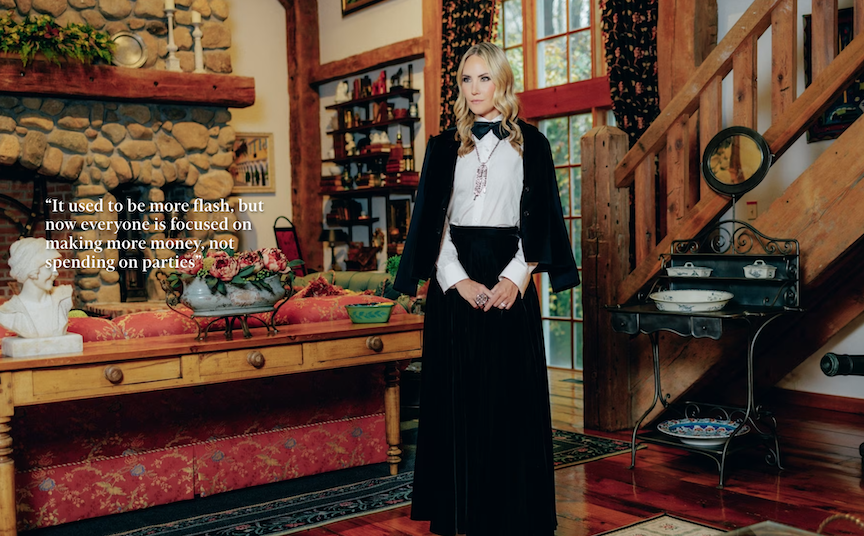
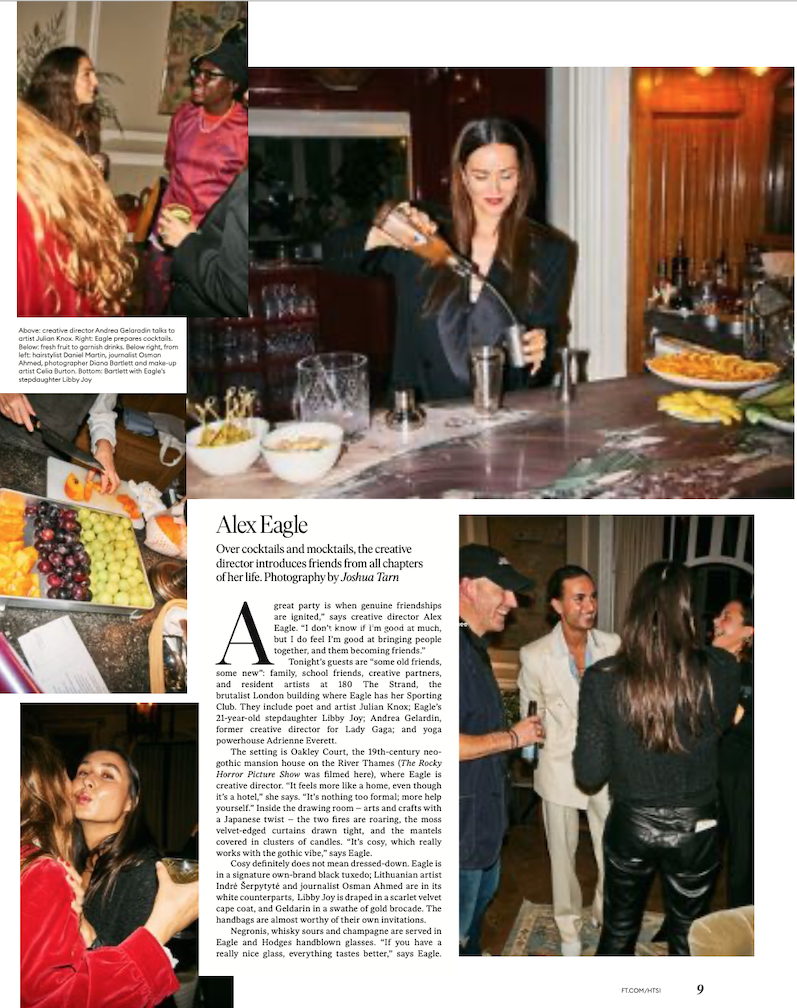
Alex Eagle: ‘It’s cosy, which really works with the gothic vibe’
“A great party is when genuine friendships are ignited,” says creative director Alex Eagle. “I don’t know if I’m good at much, but I do feel I’m good at bringing people together, and them becoming friends.”
The creative director opens the stately Oakley Court to a wide circle of friends
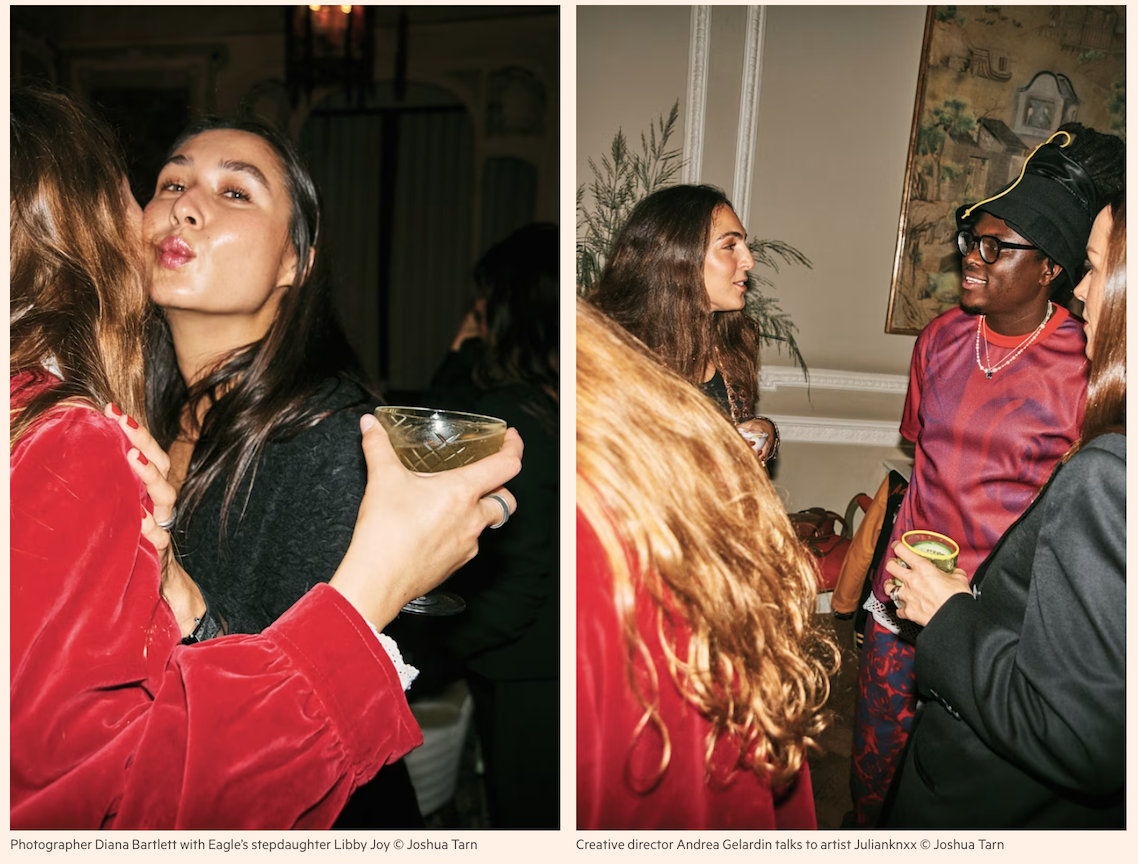
“A great party is when genuine friendships are ignited,” says creative director Alex Eagle. “I don’t know if I’m good at much, but I do feel I’m good at bringing people together, and them becoming friends.”
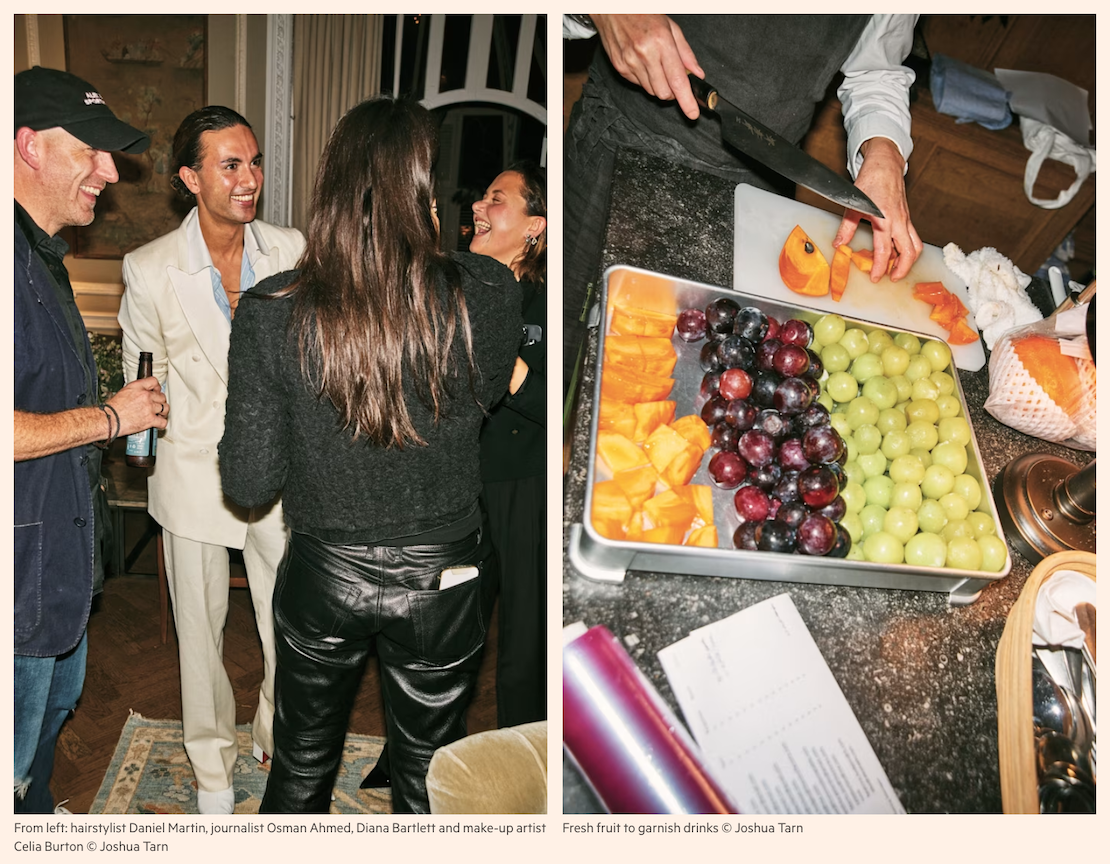
Tonight’s guests are “some old friends, some new”: family, school friends, creative partners, and resident artists at 180 The Strand, the brutalist London building where Eagle has her Sporting Club. They include poet and artist Julianknxx; Eagle’s 21-year‑old stepdaughter Libby Joy; Andrea Gelardin, former creative director for Lady Gaga; and yoga powerhouse Adrienne Everett.
The setting is Oakley Court, the 19th-century neo-gothic mansion house on the River Thames (The Rocky Horror Picture Show was filmed here), where Eagle is creative director. “It feels more like a home, even though it’s a hotel,” she says. “It’s nothing too formal; more help yourself.” Inside the drawing room – arts and crafts with a Japanese twist – the two fires are roaring, the moss velvet-edged curtains drawn tight, and the mantels covered in clusters of candles. “It’s cosy, which really works with the gothic vibe,” says Eagle.
Cosy definitely does not mean dressed-down. Eagle is in a signature own-brand black tuxedo; Lithuanian artist Indrė Šerpytytė and journalist Osman Ahmed are in its white counterparts, Libby Joy is draped in a scarlet velvet cape coat and Geldarin is in a swathe of gold brocade. The handbags are almost worthy of their own invitations.
Negronis, whisky sours and champagne are served in Eagle and Hodges handblown glasses. “If you have a really nice glass, everything tastes better,” says Eagle. And “nothing too matchy-matchy,” she scoffs. “And lots of different kinds of glasses – I don’t necessarily use a wine glass for wine or a Martini glass for a Martini.” Eagle herself is sipping a (non-alcoholic) Tanqueray Zero and tonic with a sprig of rosemary from the kitchen garden. “Enough bloody elderflower and fizzy water! Now lots of people don’t drink, it’s important to have really good mocktails.” Non-alcoholic Palomas, with fresh grapefruit and soda, are also a “delicious” substitute.
Canapés decorate low tables around the room; small in number but substantial in size. “I’d rather have a plate of less, but where each one is generous. That feels really sumptuous and luxurious,” says Eagle. Tonight’s snacks are jewel-like Japanese bites from Oakley Court’s chef Akira: slivers of salmon and tuna tied with edible ribbons. Each could be one course from the omakase menu he leads in the dining room.
In the corner is a stack of records. “We never have music piped out of the speaker,” says Eagle, “My husband owns the old EMI vinyl pressing plant; he’s mad about vinyl, it’s always records playing. Vinyl makes a big difference; people always interact, choosing records.” It’s one more way for new friendships to begin.
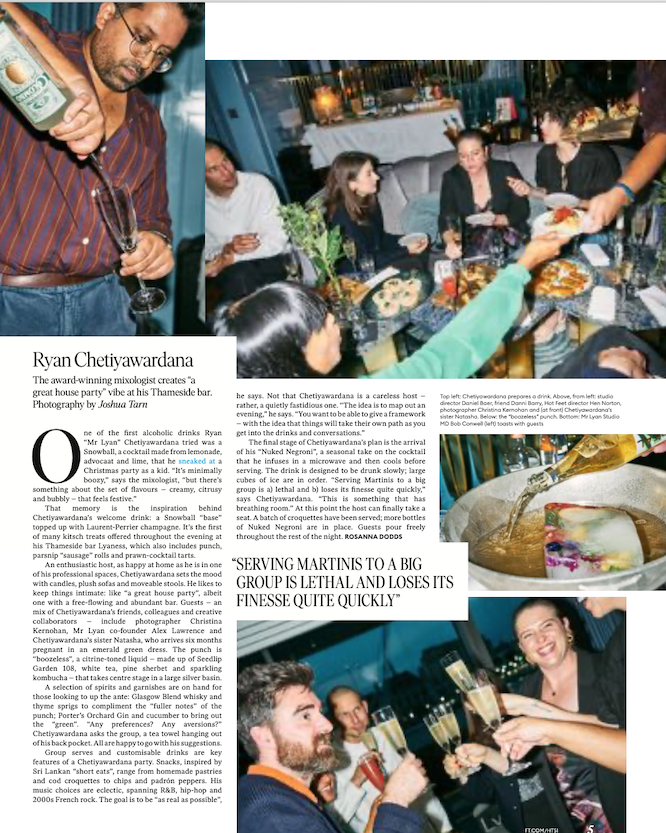
Ryan Chetiyawardana creates a ‘house party’ mood at his Thameside bar
One of the first alcoholic drinks Ryan “Mr Lyan” Chetiyawardana tried was a Snowball, a cocktail made from lemonade, advocaat and lime, that he sneaked at a Christmas party as a kid. “It’s minimally boozy,” says the mixologist, “but there’s something about the set of flavours – creamy, citrusy and bubbly – that feels festive.”
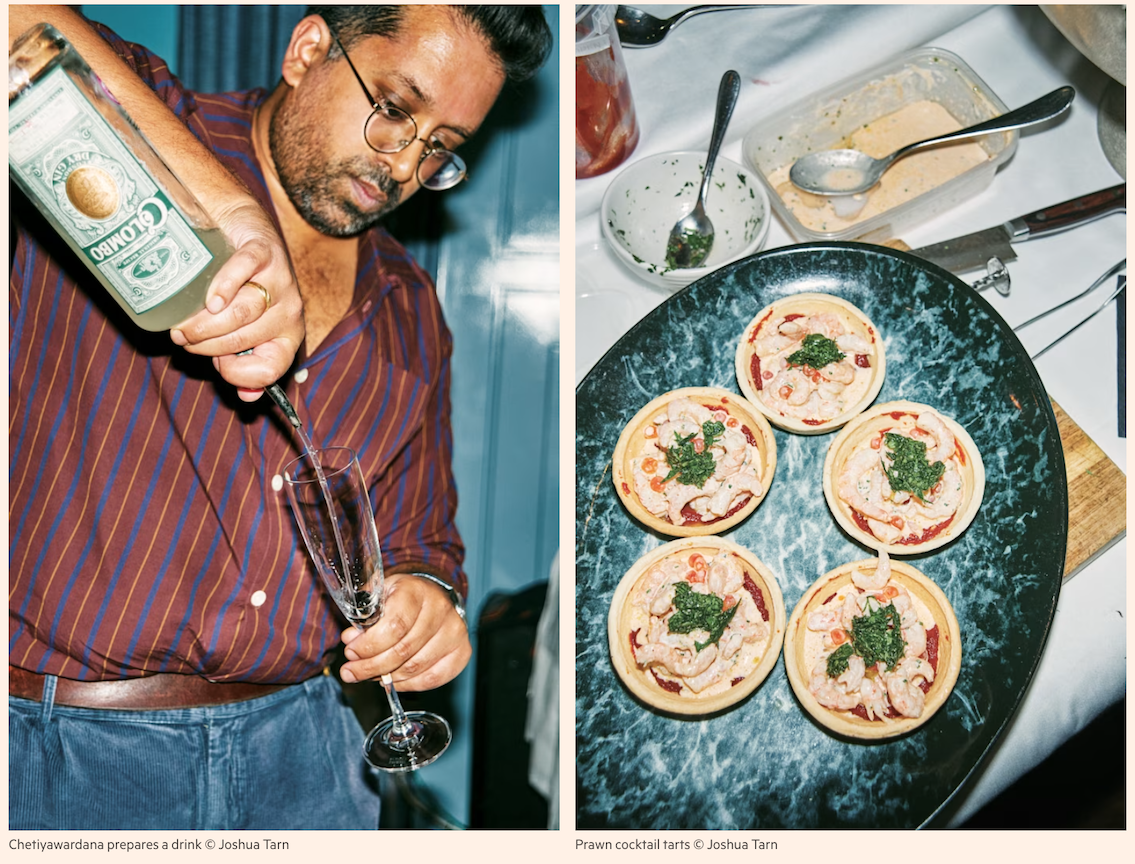
‘Serving Martinis to a big group loses its finesse quite quickly’
One of the first alcoholic drinks Ryan “Mr Lyan” Chetiyawardana tried was a Snowball, a cocktail made from lemonade, advocaat and lime, that he sneaked at a Christmas party as a kid. “It’s minimally boozy,” says the mixologist, “but there’s something about the set of flavours – creamy, citrusy and bubbly – that feels festive.”
That memory is the inspiration behind Chetiyawardana’s welcome drink: a Snowball “base” topped up with Laurent-Perrier champagne. It’s the first of many kitsch treats offered throughout the evening at his Thameside bar Lyaness, which also includes punch, parsnip “sausage” rolls and prawn-cocktail tarts.
An enthusiastic host, as happy at home as he is in one of his professional spaces, Chetiyawardana sets the mood with candles, plush sofas and moveable stools. He likes to keep things intimate: like “a great house party”, albeit one with a free-flowing and abundant bar. Guests – a mix of Chetiyawardana’s friends, colleagues and creative collaborators – include photographer Christina Kernohan, Mr Lyan co-founder Alex Lawrence and Chetiyawardana’s sister Natasha, who arrives six months pregnant in an emerald green dress. The punch is “boozeless”, a citrine-toned liquid – made up of Seedlip Garden 108, white tea, pine sherbet and sparkling kombucha – that takes centre stage in a large silver basin.
A selection of spirits and garnishes are on hand for those looking to up the ante: Glasgow Blend whisky and thyme sprigs to compliment the “fuller notes” of the punch; Porter’s Orchard Gin and cucumber to bring out the “green”. “Any preferences? Any aversions?” Chetiyawardana asks the group, a tea towel hanging out of his back pocket. All are happy to go with his suggestions.
Group serves and customisable drinks are key features of a Chetiyawardana party. Snacks, inspired by Sri Lankan “short eats”, range from homemade pastries and cod croquettes to chips and padrón peppers. His music choices are eclectic, spanning R&B, hip-hop and 2000s French rock. The goal is to be “as real as possible”, he says. Not that Chetiyawardana is a careless host – rather, a quietly fastidious one. “The idea is to map out an evening,” he says. “You want to be able to give a framework – with the idea that things will take their own path as you get into the drinks and conversations.”
The final stage of Chetiyawardana’s plan is the arrival of his “Nuked Negroni”, a seasonal take on the cocktail that he infuses in a microwave and then cools before serving. The drink is designed to be drunk slowly; large cubes of ice are in order. “Serving Martinis to a big group is a) lethal and b) loses its finesse quite quickly,” says Chetiyawardana. “This is something that has breathing room.” At this point the host can finally take a seat. A batch of croquettes have been served; more bottles of Nuked Negroni are in place. Guests pour freely throughout the rest of the night.
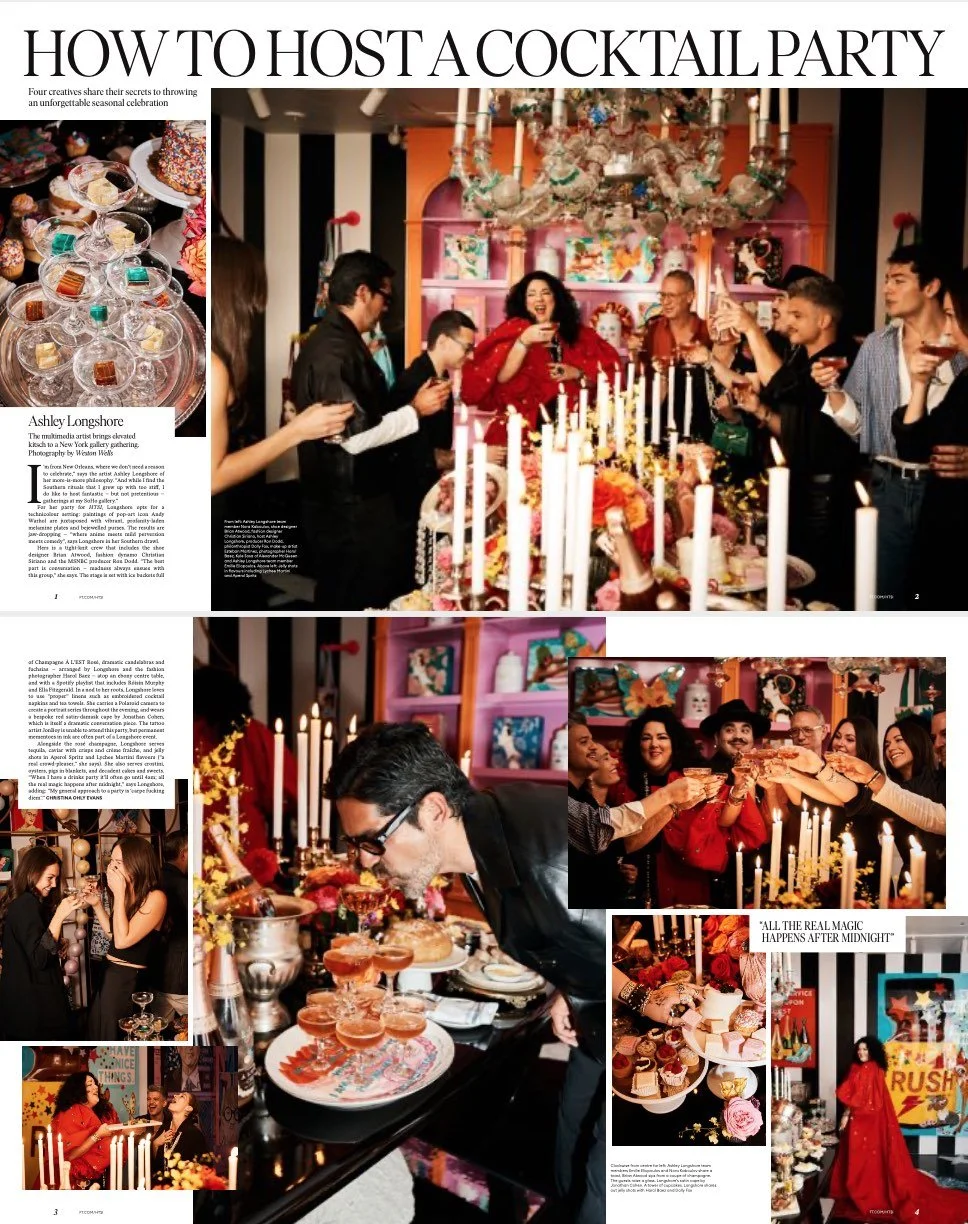
Ashley Longshore ‘All the real magic happens after midnight’
“I’m from New Orleans, where we don’t need a reason to celebrate,” says the artist Ashley Longshore of her more-is-more philosophy. “And while I find the Southern rituals that I grew up with too stiff, I do like to host fantastic – but not pretentious – gatherings at my SoHo gallery.”
The multimedia artist brings elevated kitsch to a New York gallery gathering
“I’m from New Orleans, where we don’t need a reason to celebrate,” says the artist Ashley Longshore of her more-is-more philosophy. “And while I find the Southern rituals that I grew up with too stiff, I do like to host fantastic – but not pretentious – gatherings at my SoHo gallery.”
For her party for HTSI, Longshore opts for a technicolour setting: paintings of pop-art icon Andy Warhol are juxtaposed with vibrant, profanity-laden melamine plates and bejewelled purses. The results are jaw-dropping – “where anime meets mild perversion meets comedy”, says Longshore in her Southern drawl.
Hers is a tight-knit crew that includes the shoe designer Brian Atwood, fashion dynamo Christian Siriano and the MSNBC producer Ron Dodd. “The best part is conversation – madness always ensues with this group,” she says. The stage is set with ice buckets full of Champagne À L’EST Rosé, dramatic candelabras and fuchsias – arranged by Longshore and the fashion photographer Harol Baez – atop an ebony centre table, and with a Spotify playlist that includes Róisín Murphy and Ella Fitzgerald.
In a nod to her roots, Longshore loves to use “proper” linens such as embroidered cocktail napkins and tea towels. She carries a Polaroid camera to create a portrait series throughout the evening, and wears a bespoke red satin-damask cape by Jonathan Cohen, which is itself a dramatic conversation piece. The tattoo artist JonBoy is unable to attend this party, but permanent mementoes in ink are often part of a Longshore event.
Alongside the rosé champagne, Longshore serves tequila, caviar with crisps and crème fraîche, and jelly shots in Aperol Spritz and Lychee Martini flavours (“a real crowd-pleaser,” she says). She also serves crostini, oysters, pigs in blankets, and decadent cakes and sweets. “When I have a drinks party it’ll often go until 4am; all the real magic happens after midnight,” says Longshore, adding: “My general approach to a party is ‘carpe fucking diem’.”
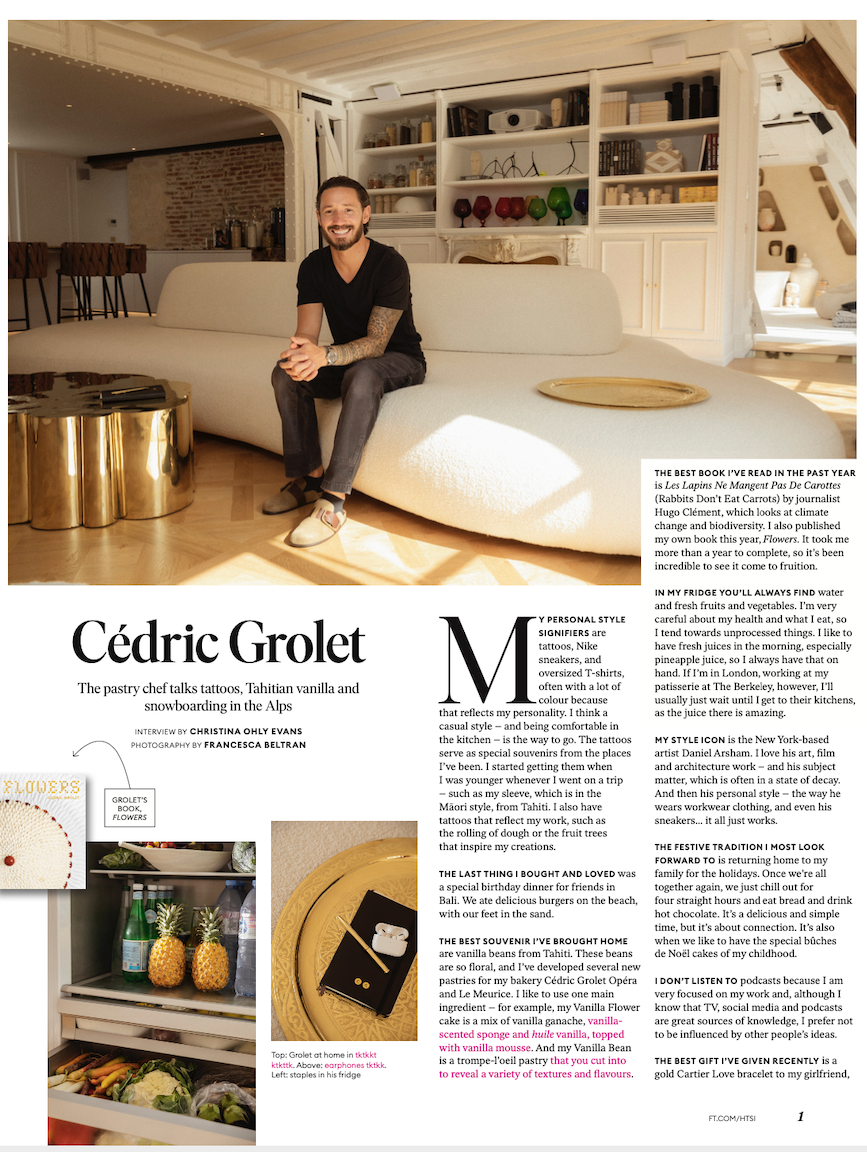
Master pâtissier Cedric Grolet talks taste
The pastry chef Cedric Grolet loves his tattoos, snowboarding in the Alps and Tahitian vanilla
My personal style signifiers are tattoos, Nike sneakers, and oversized T-shirts, often with a lot of colour because that reflects my personality. I think a casual style – and being comfortable in the kitchen – is the way to go. The tattoos serve as special souvenirs from the places I’ve been. I started getting them when I was younger whenever I went on a trip – such as my sleeve, which is in the Māori style, from Tahiti. I also have tattoos that reflect my work, such as the rolling of dough or the fruit trees that inspire my creations.
The last thing I bought and loved was a special birthday dinner for friends in Bali. We ate delicious burgers on the beach with our feet in the sand. The best souvenir I’ve brought home are vanilla beans from Tahiti. These beans are so floral, and I’ve developed several new pastries for my bakery Cédric Grolet Opéra and Le Meurice. I like to use one main ingredient – for example, my Vanilla Flower cake is a mix of vanilla ganache, vanilla almond biscuit, vanilla milk jam and vanilla cream. And my Vanilla Bean is a trompe-l’oeil pastry that you cut into to reveal a variety of textures.
The best book I’ve read in the past year is Les Lapins Ne Mangent Pas De Carottes (Rabbits Don’t Eat Carrots) by journalist Hugo Clément, which looks at climate change and biodiversity. I also published my own book this year, Flowers. It took me more than a year to complete, so it’s been incredible to see it come to fruition. In my fridge you’ll always find water and fresh fruits and vegetables. I’m very careful about my health and what I eat, so I tend towards unprocessed things. I like to have fresh juices in the morning, especially pineapple juice, so I always have that on hand. If I’m in London, working at my patisserie at The Berkeley, however, I’ll usually just wait until I get to their kitchens, as the juice there is amazing.
My style icon is the New York-based artist Daniel Arsham. I love his art, film and architecture work – and his subject matter, which is often in a state of decay. And then his personal style – the way he wears workwear clothing, and even his sneakers… it all just works. The festive tradition I most look forward to is returning home to my family for the holidays. Once we’re all together again, we just chill out for four straight hours and eat bread and drink hot chocolate. It’s a delicious and simple time, but it’s about connection. It’s also when we like to have the special bûches de Noël cakes of my childhood.
I don’t listen to podcasts because I am very focused on my work and, although I know that TV, social media and podcasts are great sources of knowledge, I prefer not to be influenced by other people’s ideas.