Born to give – the philanthropic urge of Phoebe Gates
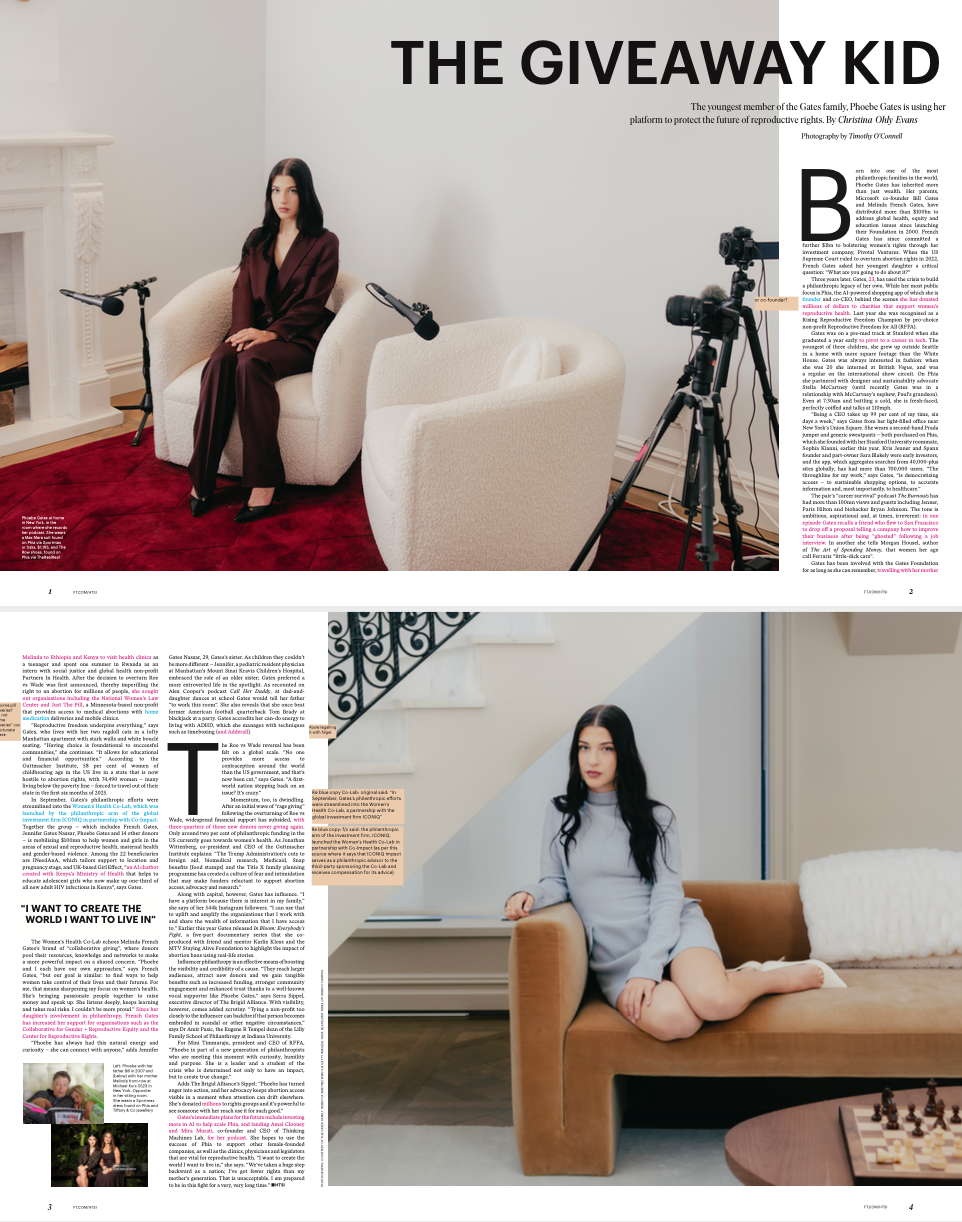
The youngest member of the Gates clan is following her family’s calling. But her healthcare mission comes with a uniquely Gen Z edge
Born into one of the most philanthropic families in the world, Phoebe Gates has inherited more than just wealth. Her parents, Microsoft co-founder Bill Gates and Melinda French Gates, have distributed more than $100bn to address global health, equity and education issues since launching their Foundation in 2000. French Gates has since committed a further $1bn to bolstering women’s rights through her investment company, Pivotal Ventures. When the US Supreme Court ruled to overturn abortion rights in 2022, French Gates asked her youngest daughter a critical question: “What are you going to do about it?” Three years later, Gates, 23, has used the crisis to try to find the answer. Her most public focus is Phia, the AI‑powered shopping app of which she is co-founder and co‑CEO; behind the scenes she has donated millions of dollars to charities that support women’s reproductive health (although, when asked, her team do not disclose a precise amount). Last year she was recognised as a Rising Reproductive Freedom Champion by pro-choice non-profit Reproductive Freedom for All (RFFA).
Gates was on a pre-med track at Stanford University when she graduated a year early to pivot to a career in tech. The youngest of three, she grew up outside Seattle in a home with more square footage than the White House. Gates was always interested in fashion: when she was 20 she interned at British Vogue, and was a regular on the international show circuit. On Phia she partnered with designer and sustainability advocate Stella McCartney (until recently Gates was in a relationship with McCartney’s nephew, Paul’s grandson). Even at 7.30am and battling a cold, she is fresh-faced, perfectly coiffed and talks at 110mph.
“Being a CEO takes up 99 per cent of my time, six days a week,” says Gates from her light-filled office near New York’s Union Square. She wears a second-hand Prada jumper and generic sweatpants – both purchased on Phia, which she founded with her Stanford roommate, Sophia Kianni, earlier this year. Kris Jenner and Spanx founder and part-owner Sara Blakely were early investors, and the app, which aggregates searches from 40,000-plus sites globally, has had more than 700,000 users and – as of December – a $180mn valuation. “The throughline for my work,” says Gates, “is democratising access – to sustainable shopping options, to accurate information and, most importantly, to healthcare.” The pair’s “career survival” podcast The Burnouts has had more than 100mn views and guests including Jenner, Paris Hilton and biohacker Bryan Johnson. The tone is ambitious, aspirational and, at times, irreverent: in one episode Gates recalls a friend who flew to San Francisco to drop off a proposal telling a company how to improve their business after being “ghosted” following a job interview. In another, she tells Morgan Housel, author of The Art of Spending Money, that women her age call Ferraris “little-dick cars”.
Gates has been involved with the Gates Foundation for as long as she can remember, travelling as a child with her mother to Ethiopia and Rwanda, where she returned as a teenager to volunteer at a pre-school. While at college, she also spent three weeks with the non-profit Partners In Health at a health clinic. After the decision to overturn Roe vs Wade was first announced – thereby imperilling the right to an abortion for millions of people – she sought out organisations including the Repro Legal Defense Fund and Just The Pill, a Minnesota-based non-profit that provides access to medication abortions with home pill deliveries and mobile clinics. “Reproductive freedom underpins everything,” says Gates, who lives with her two ragdoll cats in a lofty Manhattan apartment with stark walls and white bouclé seating. “Having choice is foundational to successful communities,” she continues. “It allows for educational and financial opportunities.” According to the Guttmacher Institute, 58 per cent of women of childbearing age in the US live in a state that is now hostile to abortion rights, with 74,490 women – many living below the poverty line – forced to travel out of their state in the first six months of 2025.