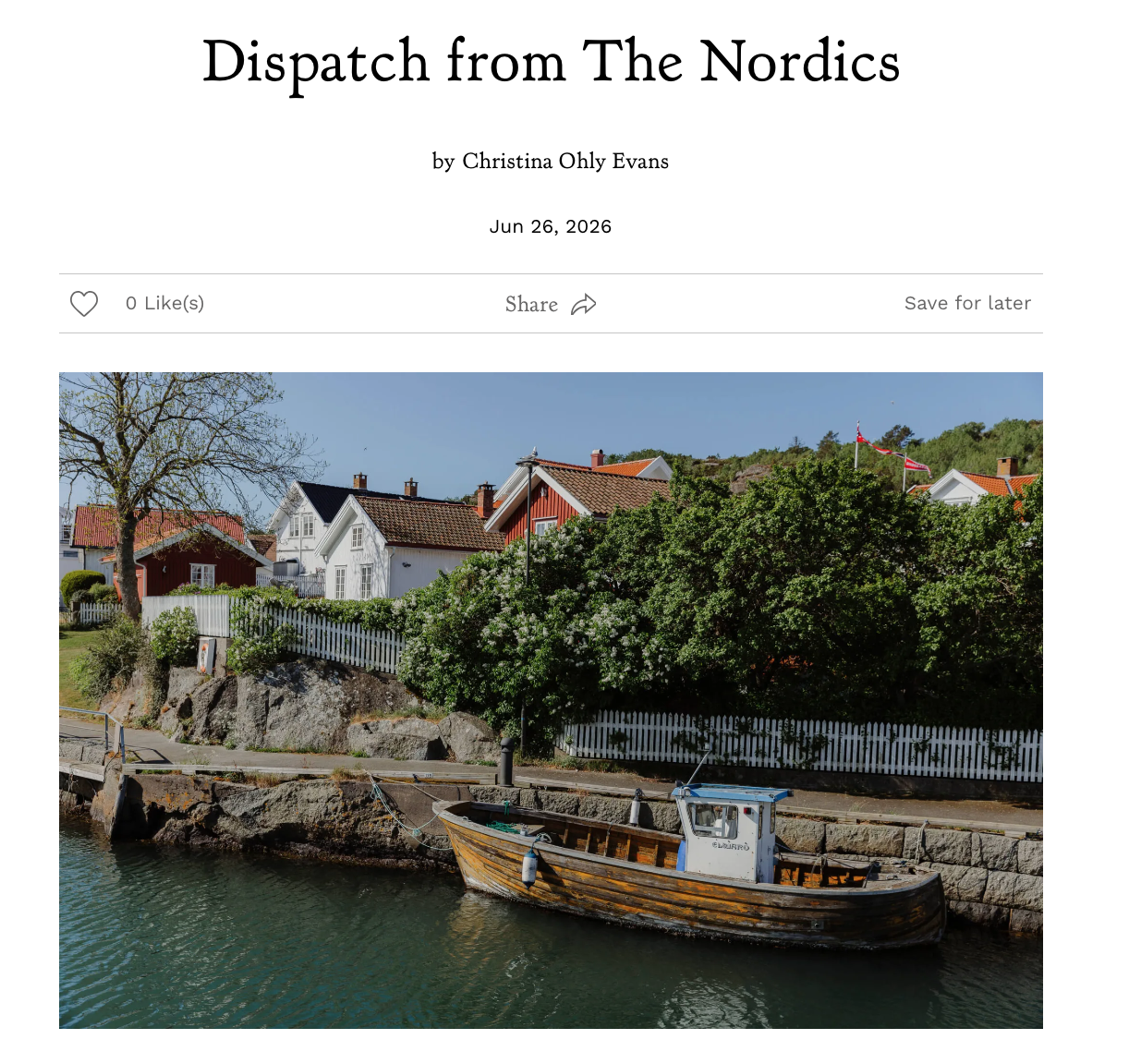
Dispatch from The Nordics
Growing up in Vermont, I was always drawn to Scandinavia—the climate, the colors, the can-do spirit of people habituated to serious weather. I was also steeped early in Danish and midcentury design by a family that traveled frequently to northern Europe. Other people’s grandparents went to Florida; mine went to Finland.
An August adventure of some kind has become a family tradition, and increasingly, I’m looking for cooler places (both aesthetically and weatherwise) with few tourists. In addition I like comfort, so when I was connected with Torunn Tronsvang, owner of Up Norway, I knew I could delegate the planning of our 8-day escape to her connected team.
by Christina Ohly Evans
Growing up in Vermont, I was always drawn to Scandinavia—the climate, the colors, the can-do spirit of people habituated to serious weather. I was also steeped early in Danish and midcentury design by a family that traveled frequently to northern Europe. Other people’s grandparents went to Florida; mine went to Finland.
An August adventure of some kind has become a family tradition, and increasingly, I’m looking for cooler places (both aesthetically and weatherwise) with few tourists. In addition I like comfort, so when I was connected with Torunn Tronsvang, owner of Up Norway, I knew I could delegate the planning of our 8-day escape to her connected team.
Largely due to flights, we wanted to start in Copenhagen and end in Oslo. After an introductory phone call where we detailed our preferences—outdoor activities but not too hardcore; luxurious-but-not-fancy hotels; art and culture, but not too many museums; “local color” in terms of neighborhoods, cafes, restaurants, shops and so forth—we were all on the same planning page. Torunn then set about executing the most meticulous, fun, slightly outside the box (in the best way) holiday for our group of four. I am used to handling all of my own travel arrangements, so it was hard and strange to let it go, but Torunn assured me that she knew exactly what we were looking for, our fitness levels, food allergies and so forth. The result was a unique road trip that is still so vivid—with all kinds of boats, museums, and memorable meals that will be tough to top this summer.
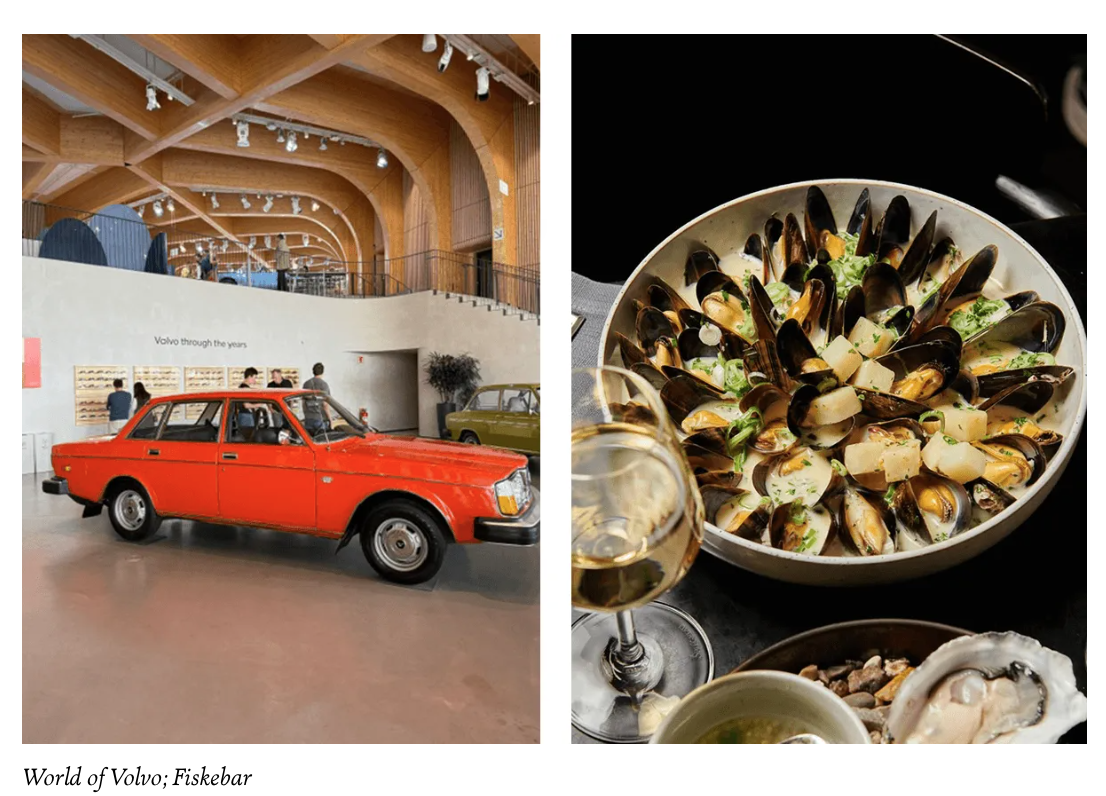
Gothenburg
We spent a packed 24 hours in Copenhagen wandering Nyhavn and the King’s Garden, followed by an unforgettable meal outside at Fiskebar at 10 pm. Then it was time to head north. After swallowing the sticker shock of the rental car (beware one-way, cross-border, strict mileage limits and a 25% VAT), we made our first stop: Gothenburg, Sweden. We had visited Stockholm once years earlier, but knew very little about the country’s west coast and were quickly taken by this quieter, more manageable “second city.” Nature is everywhere, as are hipster coffee places and vintage clothing shops, so I highly recommend a day spent wandering. But we were really there so my traveling companions could hit the World of Volvo. I am no car enthusiast, but this new museum (opened last year) is an immersion in great Swedish design, from the earliest ambulances and safety vehicles to the iconic 740 series to state-of-the-art models available for purchase. Kids ages 5-12 will love Traffic School—an outdoor driving track where they learn the basics and earn a souvenir driver’s license. The building, by Danish architecture firm Henning Larsen, is an homage to the Swedish idea of Allemansrätten (the right to roam), with spaces made of sustainable wood that makes it feel like a light-filled forest. Pro tips: both the café and the gift shop are worthwhile stops before trying the driving game, Distractville, where reflexes and judgement are tested.
Pater Noster
We spent our first night at Pater Noster—a decommissioned lighthouse and keeper’s house that was built in 1868. I will never stop thinking about this place, and largely for the experience of getting there. We parked the car in the town of Marstrand, where we were met by the amiable Carl, who captained us over to Pater Noster. I knew we were in for an exciting journey, as the RIB boat was outfitted with all kinds of stirrups and straps. It was Captain Carl (straight out of Viking central casting) handing us each an inflatable suit that really got my attention: getting wet was inevitable, but I had no idea what we were in for (think “Deadliest Catch”). The wind and waves were howling, but 5 nautical miles and 30 minutes later, we arrived at this incredible rocky outcropping. I swore I wouldn’t get back on that terror ride for our return trip, and yet 24 short hours later I was a hearty, seafaring Swede myself.
A stay at Pater Noster is unlike anything I’ve experienced before or since. A cozy main house (there are 9 guest rooms), a few outbuildings including the communal dining room, a hot tub and sauna with sea views are the extent of this scraggly island that is the size of a soccer field. That said, every touch is magical: from the freshly baked scones to the Pater Noster wines and beer (made on the mainland), to the just-caught lobster, mussels and cod, a stay here is simple yet exquisite. The sounds of wind and crashing waves—not to mention the total isolation—make Pater Noster a rare reset, where you’ll come to know the small, attentive staff as well as the knowledgeable CEO/storyteller, Mirja Lilja Hagsjö, well into the night.
Kristiansand
After heading back to the mainland, we flew from Gothenburg to Kristiansand in southern Norway. Incidentally, the only other guests we met at Poster Noster were two women, Norwegian designers, who were impressed that we Americans were even going to southern Norway, as most people head straight for the fjords. They raved about its tiny coastal towns, and it was wonderful to find ourselves in this lesser-known countryside.
Just ten minutes from the Kristiansand Airport, we arrived at Boen Gård, a 16th century estate and manor that opened to the public in 2012. Once owned by King Christian II, it has hosted countless statesmen and was long a draw for Britons who came to fish salmon on the river below it. The furniture and art have been meticulously sourced to preserve traditions that began in 1520, and have since hosted kings and avid anglers, while guest rooms have a Scandi, clean-lined feel. Set in a beautiful park at the edge of the Tovdalselva River, Boen Gård is well known for its Michelin-starred cuisine—think tasting menus featuring herbs, honey, berries, and more grown on the estate. Everything else, including the meat and fish, comes from within a 90-mile radius and they are deeply committed to “New Nordic” sustainable everything—think peonies and geraniums sourced from the organic gardens; freshly caught salmon from the Tovdal river; a house-made flatbread of emmer flour, with smoked cod roe taramasalata and fresh dill; and not a single piece of plastic in sight.
The next day after breakfast in the bright dining room (designed that way to maximize natural light in the long, dark winters), decorated simply with local wildflowers, activities included fishing with the very personable Ryan (+4790915846), followed by a private tour of the Kunstilo museum in Kristiansand. A former 1930s grain silo, it now houses the world’s largest collection of Nordic modernism, and the building is the ultimate adaptive reuse project with soaring spaces and a cathedral-like feel.
Often called the “Summer City” because of its sunny maritime climate, Kristiansand is considered the cultural hub of southern Norway and there seemed to be art and music at every turn. Stroll along the Fiskebrygga (The Fish Quay) and on to the Fountain Park, the city beach and Posebyen, aka the “old town.” Kristiansand Cathedral is one of the largest in Norway and is a beautiful stop for lunch, before heading to Smag & Behag for dinner in an old school gymnasium. If you’ve had enough fish, Mother India is a colorful, family-run classic for butter chicken and excellent naan.
Coastal Lillesand
Our next stop was Lillesand, a tiny coastal village just 30 minutes from Boen Gård, which has a very Maine-esque feel. The main objective here was to do a guided tour of the archipelago by kayak with seasoned pro, Haakem Teland. A literal pro—he was on Norway’s national kayaking team and competed in the World Cup and European Championships—Teland is now the owner of Padlegleden, an outfitter dedicated to the stretch of coastline.
Once suited up, we headed off on a three-hour gentle paddle through islands and inlets and learned about everything from the white summer cabins belonging to affluent Osloveians that dot the sparse islands, to the crystal-clear water (thanks to a strong current and a rocky seabed), to Norwegian politics. (I especially loved learning about their consensus-based, stable model of government, and about the Norwegian Sovereign Wealth Fund, the largest in the world, that supports the country’s welfare state). Haakem is delightful, and I highly recommend seeing the area from the water while stopping on the sandy shores for refreshments and environmental highlights. After a thorough workout, we walked back to the harbor and ate lunch at Strandhaven—a charming restaurant with a patio, more water views and excellent pizza. Perfection on a warm summer afternoon.
Risør
Our next stop, an hour away, was the town of Risør, where our Norwegian friends from Pater Noster grew up going as children. It turns out this stretch of coastline is referred to as the “Norwegian Riviera” for its beautiful summer homes and fleets of sailboats that arrive in summer.
We stayed at Det Lille, which is actually a series of apartments plus one central hotel that are spread throughout the former fishing village. We were possibly the only tourists there—and certainly the only Americans—as Norwegian children head back to school in mid-August. Our base was the small mustard yellow hotel in the center of town, one with the tiniest rooms but the most expansive views of the harbor. The management are proud of their traditions and the head chef led us in a fish soup-making class (which I am sure I will never use again!), complete with Norwegian tunes. Risør is a lovely place, with a harbor filled with classic wooden skiffs and fishing vessels; I would highly recommend it for sailing enthusiasts and cold plungers alike, especially in shoulder season. With the wood-fired pizza spot humming with locals and the sun setting at 10 pm, it’s idyllic.
Before our return to Oslo, we spent the following day aboard the Risør 2, a beautifully restored rescue vessel that was built here in 1914. Like something out of a movie (think rigging, weathered sails, two non-English speaking deck hands), the ship plied the waters of a small fjord past tiny lighthouses and more summer homes accessible only by boat. Our final stop was Moen Trebåtverksted, a remote boatyard specializing in the construction and repair of traditional wooden boats. The enormous picnic lunch provided by the hotel—with sandwiches, smoked salmon, and fruit—made for a magical day spent on the water.
Oslo proved the perfect last stop. It’s a peaceful, outdoorsy city with excellent food and just the right amount of culture. We stayed at the Hotel Amerikalinjen, an iconic building designed in 1919, which previously served as the headquarters of the Norwegian America Line cruise company. The property has been reimagined to retain its maritime ethos, but with contemporary, design-led touches (their breakfast buffet remains one the best in recent memory). From this very central location, you’re next to the famous Oslo Opera House designed by acclaimed Norwegian architecture firm Snøhetta (a walk on this massive, marble-clad roof is a must), the Munch Museum, and best of all, the floating KOK saunas, where locals and tourists alike soak in the clean city views.
The highlight of our 24 hours in Oslo, however, was lunch at a tiny island restaurant called Lille Herbern. The two women—both Oslo residents—we’d met at Pater Noster invited us to join them at this “insider” favorite. A quick, minute-long ferry ride landed us at this truly local spot on a tiny island just off the shore at Bygdøy. A long lunch of oysters, Norwegian lobster, jerk chicken, and corn on the cob with chili and salt—with friends, in this gorgeous setting—was the perfect end to our Scandinavian journey.
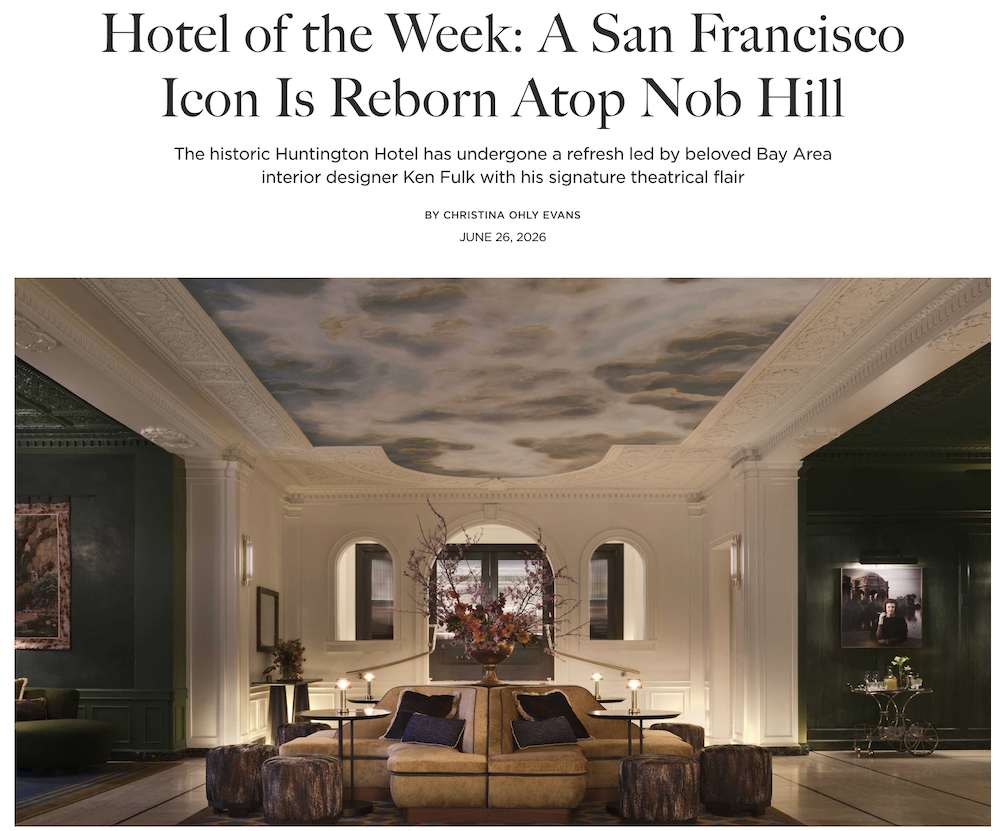
Hotel of the Week: A San Francisco Icon Is Reborn Atop Nob Hill
Founded in 1924 and named after Collis P. Huntington—one of the “Big Four” California railroad magnates of the time—the 12-story Georgian-style Huntington Hotel has welcomed worldly, loyal guests ever since. A shutdown at the beginning of Covid in 2020 provided an opportune moment for Flynn Properties and Highgate, a hospitality and investment management firm, to undertake a thorough reimagining of the hotel’s sumptuous rooms and suites.
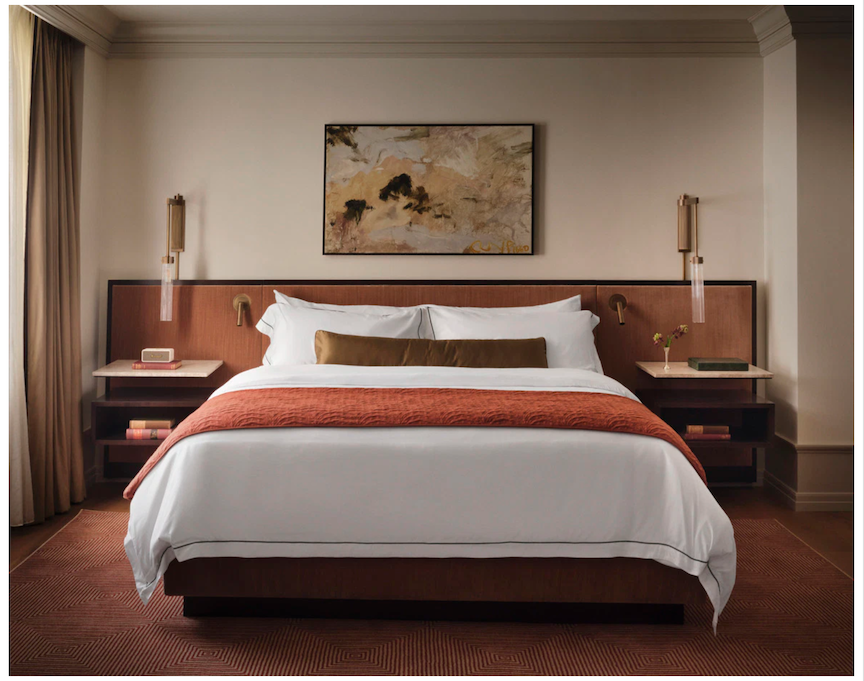
The historic Huntington Hotel has undergone a refresh led by beloved Bay Area interior designer Ken Fulk with his signature theatrical flair
Founded in 1924 and named after Collis P. Huntington—one of the “Big Four” California railroad magnates of the time—the 12-story Georgian-style Huntington Hotel has welcomed worldly, loyal guests ever since. A shutdown at the beginning of Covid in 2020 provided an opportune moment for Flynn Properties and Highgate, a hospitality and investment management firm, to undertake a thorough reimagining of the hotel’s sumptuous rooms and suites.
Together with interior designer Ken Fulk—a colorful creator synonymous with cinematic experiences and luxury hospitality—the team has also reinvigorated The Big Four restaurant and the luxurious Nob Hill Spa. The results of their combined efforts are flawless; from the elegant reception desk to the in-room amenities (hyperlocal snacks and sumptuous linens) to the indoor-outdoor pool deck where light lunch is served, no detail has been overlooked at this unique urban oasis.
Long favored by savvy tourists and local tech types, the Huntington has retained its collegial, old-world elegance, but with added comfort and flair. Each of the 143 guest rooms—72 are spacious suites—are appointed in soothing hues of cream and olive, with original plasterwork ceilings and boiserie panels, and with endless light-filled views of Grace Cathedral, the San Francisco Bay, and the Pacific Ocean beyond. “The Huntington has a built-in legacy for gracious suites, a beloved restaurant, and the most luxurious spa in town,” explains Fulk, of the hotel-as-neighborhood-nexus. “Our design reflects Nob Hill’s residential character, presenting a destination with the comfort and charm of a grand residence for repeat visitors and locals alike.”
In addition to cossetting overnight stays, visitors are returning to The Big Four—the hotel’s all-day dining destination—for everything from morning breakfast meetings to evenings with the signature Chicken Pot Pie (a comforting classic, with a delicate puff pastry crust) and a perfectly chilled Vesper or Cable Car cocktail. In addition to the main 72-seat dining room with its leather banquettes, rich green palette, and walls lined with historical imagery, there is the adjacent Crimson Room—the ultimate clubby private dining space with rich wool and felt wall coverings, and original stained-glass elements.
For intimate evenings and the best drinks in town, the bijou 25-seat Arabella’s salon is just steps from the lobby. Named for the effervescent Arabella Duval Huntington—once one of the wealthiest women in America—the theatrical, art-filled space channels her exuberant spirit through murals and more. Rich mahogany wainscotting and a trompe l’oeil ceiling add to the enveloping atmosphere—one where guests are immersed in Gilded Age romance.
“When I first discovered Arabella’s story, I was struck by both the life she lived and the mark she left on the city,” says project developer Greg Flynn. “This space is our way of honoring that legacy—an experience shaped by true storytelling, elevated hospitality, and a sense of occasion from the very moment you enter the room.”
Nob Hill Spa at the Huntington Hotel.Photo: Douglas Friedman
In addition to wining and dining, The Huntington is now home to the destination-worthy Nob Hill Spa, which offers 9,000 square feet of luxurious treatment rooms, a terrace with sweeping city views, and that rarest of city amenities, a swimming pool. Encompassing12 treatment rooms, saunas, and steam rooms, and a state-of-the-art fitness facility, this luxurious oasis is the perfect place to retreat for a relaxing afternoon.
The Huntington remains the grand dame of Nob Hill and sets guests up for everything from sailing on the Bay to exploring nearby Chinatown—always in discreet elegance.
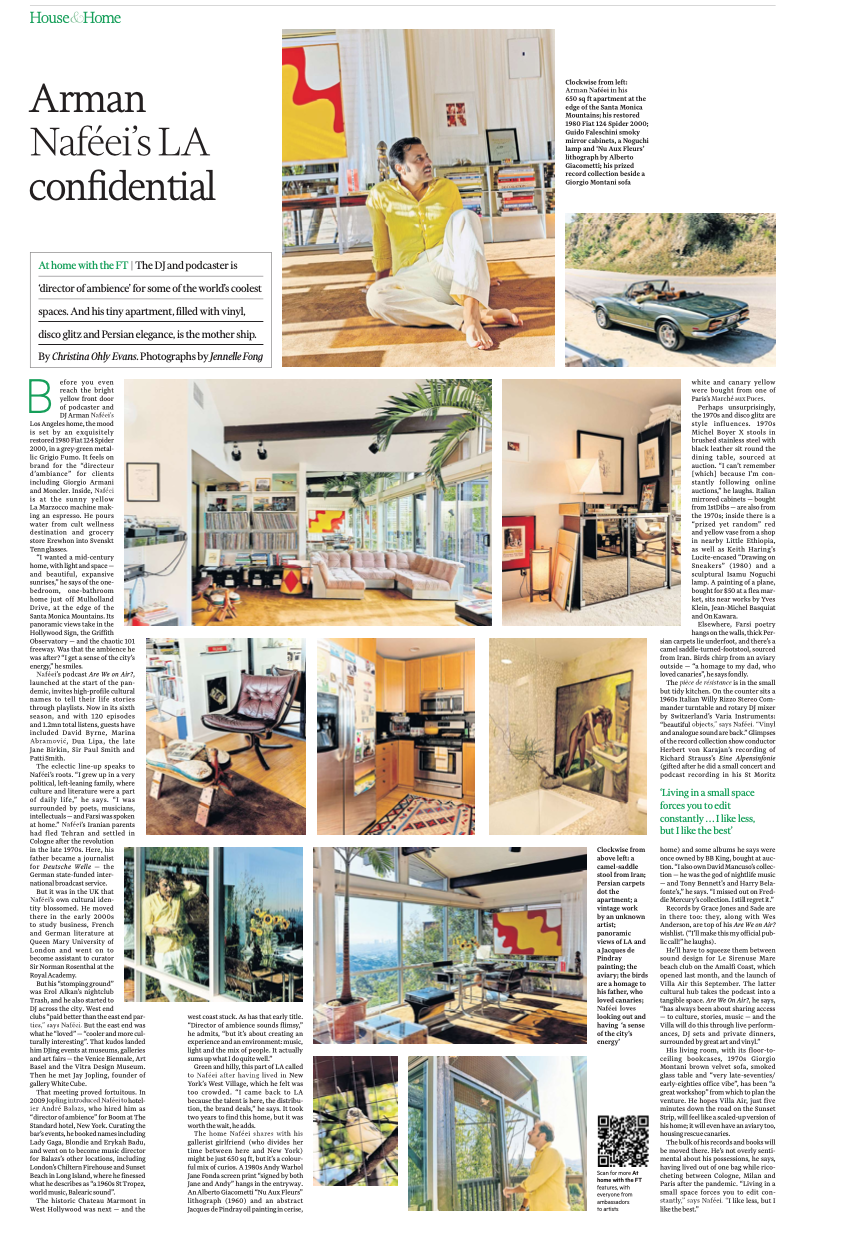
‘Director of ambience’ Arman Naféei’s LA pad is a crucible for cool
Before you even reach the bright yellow front door of podcaster and DJ Arman Naféei’s Los Angeles home, the mood is set by an exquisitely restored 1980 Fiat 124 Spider 2000, in a grey-green metallic Grigio Fumo. It feels on brand for the “directeur d’ambiance” for clients including Giorgio Armani and Moncler. Inside, Naféei is at the sunny yellow La Marzocco machine making an espresso. He pours water from cult wellness destination and grocery store Erewhon into Svenskt Tenn glasses. “I wanted a mid-century home, with light and space — and beautiful, expansive sunrises,” he says of the one-bedroom, one-bathroom home just off Mulholland Drive, at the edge of the Santa Monica Mountains. Its panoramic views take in the Hollywood Sign, the Griffith Observatory — and the chaotic 101 freeway. Was that the ambience he was after? “I get a sense of the city’s energy,” he smiles.
He sets the mood for some of the world’s hippest spaces. And his tiny LA apartment, filled with vinyl, disco glitz and Persian elegance, is the mother ship
Before you even reach the bright yellow front door of podcaster and DJ Arman Naféei’s Los Angeles home, the mood is set by an exquisitely restored 1980 Fiat 124 Spider 2000, in a grey-green metallic Grigio Fumo. It feels on brand for the “directeur d’ambiance” for clients including Giorgio Armani and Moncler. Inside, Naféei is at the sunny yellow La Marzocco machine making an espresso. He pours water from cult wellness destination and grocery store Erewhon into Svenskt Tenn glasses. “I wanted a mid-century home, with light and space — and beautiful, expansive sunrises,” he says of the one-bedroom, one-bathroom home just off Mulholland Drive, at the edge of the Santa Monica Mountains. Its panoramic views take in the Hollywood Sign, the Griffith Observatory — and the chaotic 101 freeway. Was that the ambience he was after? “I get a sense of the city’s energy,” he smiles.
Naféei’s podcast Are We On Air?, launched at the start of the pandemic, invites high-profile cultural names to tell their life stories through playlists. Now in its sixth season, and with 120 episodes and 1.2mn total listens, guests have included David Byrne, Marina Abramović, Dua Lipa, the late Jane Birkin, Sir Paul Smith and Patti Smith. The eclectic line-up speaks to Naféei’s roots. “I grew up in a very political, left-leaning family, where culture and literature were a part of daily life,” he says. “I was surrounded by poets, musicians, intellectuals — and Farsi was spoken at home.” Naféei’s Iranian parents had fled Tehran and settled in Cologne after the revolution in the late 1970s. Here, his father became a journalist for Deutsche Welle — the German state-funded international broadcast service.
But it was in the UK that Naféei’s own cultural identity blossomed. He moved there in the early 2000s to study business, French and German literature at Queen Mary University of London and went on to become assistant to curator Sir Norman Rosenthal at the Royal Academy. But his “stomping ground” was Erol Alkan’s nightclub Trash, and he also started to DJ across the city. West end clubs “paid better than the east end parties,” says Naféei. But the east end was what he “loved” — “cooler and more culturally interesting”. That kudos landed him DJing events at museums, galleries and art fairs — the Venice Biennale, Art Basel and the Vitra Design Museum. Then he met Jay Jopling, founder of gallery White Cube.
That meeting proved fortuitous. In 2009 Jopling introduced Naféei to hotelier André Balazs, who hired him as “director of ambience” for Boom at The Standard hotel, New York. Curating the bar’s events, he booked names including Lady Gaga, Blondie and Erykah Badu, and went on to become music director for Balazs’s other locations, including London’s Chiltern Firehouse and Sunset Beach in Long Island, where he finessed what he describes as “a 1960s St Tropez, world music, Balearic sound”. The historic Chateau Marmont in West Hollywood was next — and the west coast stuck. As has that early title. “Director of ambience sounds flimsy,” he admits, “but it’s about creating an experience and an environment: music, light and the mix of people. It actually sums up what I do quite well.”
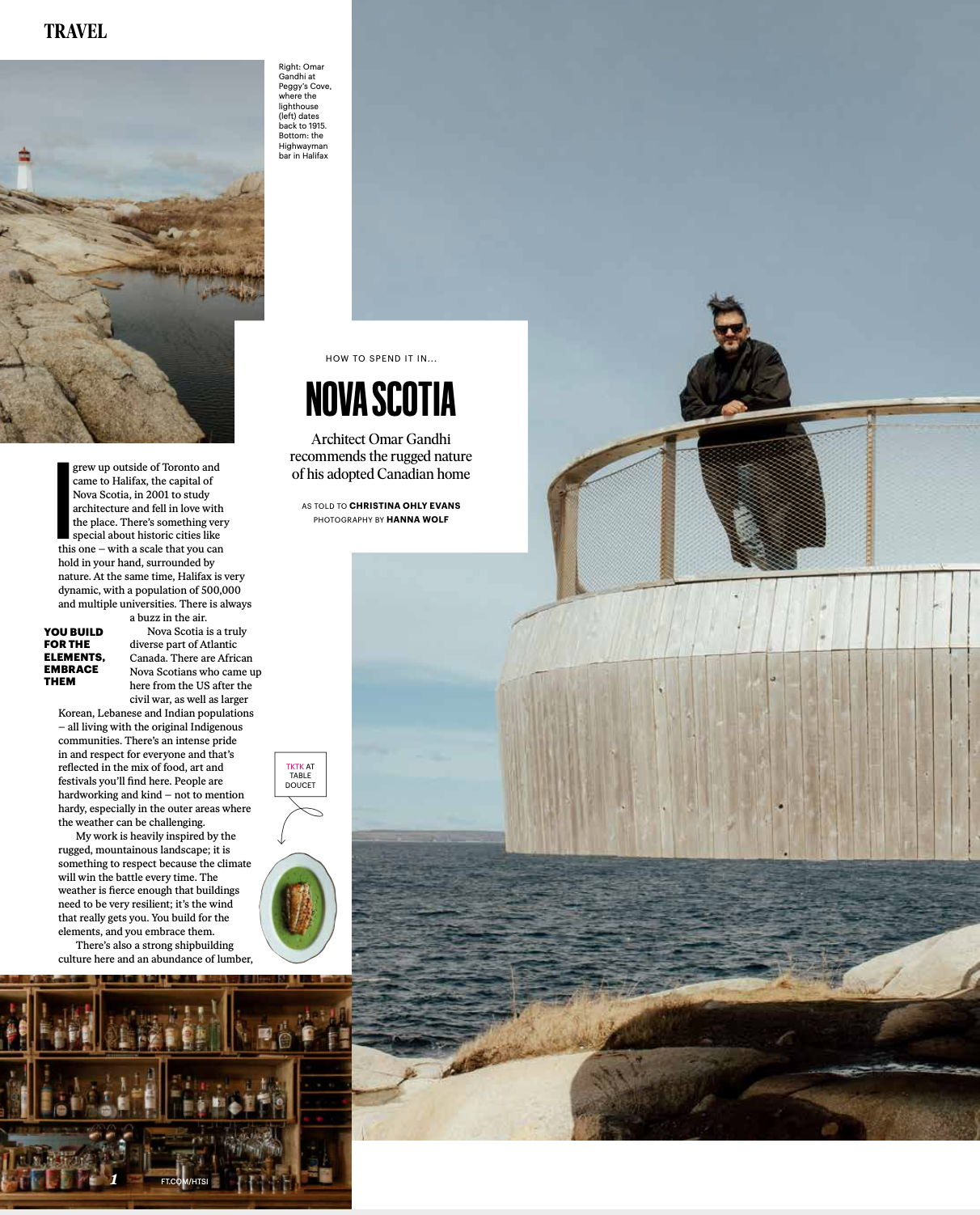
Architect Omar Gandhi’s guide to Nova Scotia
I grew up outside of Toronto and came to Halifax, the capital of Nova Scotia, in 2001 to study architecture – and fell in love with the place. There’s something very special about historic cities like this one, with a scale that you can hold in your hand, surrounded by nature. At the same time, Halifax is very dynamic, with a population of 500,000 and multiple universities. There is always a buzz in the air.
Why the Toronto native made wild, windy Halifax his home
I grew up outside of Toronto and came to Halifax, the capital of Nova Scotia, in 2001 to study architecture – and fell in love with the place. There’s something very special about historic cities like this one, with a scale that you can hold in your hand, surrounded by nature. At the same time, Halifax is very dynamic, with a population of 500,000 and multiple universities. There is always a buzz in the air.
Nova Scotia is a truly diverse part of Atlantic Canada. There are African Nova Scotians who came up here from the US after the civil war, as well as larger Korean, Lebanese and Indian populations – all living with the original Indigenous communities. There’s an intense pride in and respect for everyone and that’s reflected in the mix of food, art and festivals you’ll find here. People are hardworking and kind – not to mention hardy, especially in the outer areas where the weather can be challenging.
My work is heavily inspired by the rugged, mountainous landscape; it is something to respect because the climate will win the battle every time. The weather is fierce enough that buildings need to be very resilient; it’s the wind that really gets you. You build for the elements, and you embrace them. There’s also a strong shipbuilding culture here and an abundance of lumber, so we use a lot of locally sourced white cedar, pine, spruce and red oak. The houses are still primarily clad in wood, even in downtown Halifax, and many are painted in vibrant colours: a tradition that goes back to when sailors and fishermen used them to help navigate.
In the centre of Halifax you’ll find one of the nicest hotels in the country, Muir, which is right on the waterfront. For something more laidback – and very small – I recommend Brewery Park Hotel in the North End of the city, where I live; it has a great energy. There’s a culture of rentable architecture throughout Nova Scotia so definitely check out places such as Shobac, a collection of modern cottages and historic buildings by architect Brian MacKay-Lyons. The campus is set just south of Halifax, near the coastal town of Lunenburg, a picturesque Unesco World Heritage Site. We are very food-focused – maybe not quite as much as in Montreal, but there’s no shortage of interesting cafés and restaurants. It’s all about farm-to-table food served in intimate spaces with local wines. For great coffee and baked goods, Suda Table is owned by a Korean family and hand-makes outstanding dumplings and French pastries; everything is beautifully presented. And there is a pair of restaurants less than a minute away from each other in North End that are both very cool. Magnolia does great cocktails and Highwayman serves Spanish-inspired seafood and tapas.
Bar Kismet has been one of the most awarded restaurants in Canada for the past 10 years, with spectacular small dishes such as fresh raw scallops and tuna tartare. Another place that’s very special – but a bit of a drive – is Table Doucet in coastal Chéticamp. It’s very French-Acadian: everything on its tasting menus has been locally foraged, including the seafood. In the 1970s, this part of Canada drew in lots of artists, many of whom taught at the Nova Scotia College of Art and Design. Richard Serra lived here, and Philip Glass and later Ethan Hawke found refuge here too. Architecture and design have flourished. One standout architect is Keith Graham, a masterful modernist who designed the most beautiful public projects in Halifax, including the Nova Scotia Archives, the Halifax police station and the North End Library.
The Museum of Natural History is also wonderful, as is the Halifax Central Library, which is like the living room of the city. Libraries are magical places where people go to hang out: old people, young kids – it’s comfortable for all ages. The Art Gallery of Nova Scotia on the waterfront has objects from all over the country including Indigenous art, as well as a large collection of Annie Leibovitz photographs. And for Titanic enthusiasts there’s the Maritime Museum of the Atlantic, which has a vast collection of the ship’s memorabilia because Halifax was the closest major port to where the ship sank in 1912.
For an adventure, I recommend driving the scenic Cabot Trail to Inverness in Cape Breton, where you’ll find Cabot Links, one of the best links-style golf courses in the world (at Cabot Cape Breton resort). It’s not just gorgeous, it’s intense; there’s wind, so it’s tricky – just like being in the Scottish Highlands. Or head south of Halifax to Chester, a fun sailing centre where you can rent a boat and spend a day on the water. Be sure to visit Peggy’s Cove, a quaint fishing village and lighthouse that’s set on a granite outcrop on St Margaret’s Bay. It’s an iconic spot for kayaking and eating lobster rolls with rocky coastal views.
I have lived here more than half my life at this point, and I’m also raising my son here. I feel deeply ingrained in the place and wouldn’t want to live anywhere else. Halifax isn’t trying to become a big city, so I hope it just continues to embrace its historic fabric. Moving here changed my life, so I share it with everyone I can.
BARS, CAFÉS & RESTAURANTS Bar Kismet barkismet.com Highwayman highwaymanhfx.com Magnolia magnoliahfx.com Suda Table sudatable.com Table Doucet tabledoucet.com
THINGS TO DO Art Gallery of Nova Scotia agns.ca Cabot Cape Breton cabot.com Chester Yacht Club chesteryachtclub.ca Halifax Central Library halifaxcentrallibrary.ca Maritime Museum of the Atlantic maritimemuseum.novascotia.ca Museum of Natural History naturalhistory.novascotia.ca Neil Depew Gallery neildepew.com
WHERE TO STAY
Brewery Park Hotel brewerypark.ca
Muir muirhotel.com
Shobacplaces2b.ca/shobac
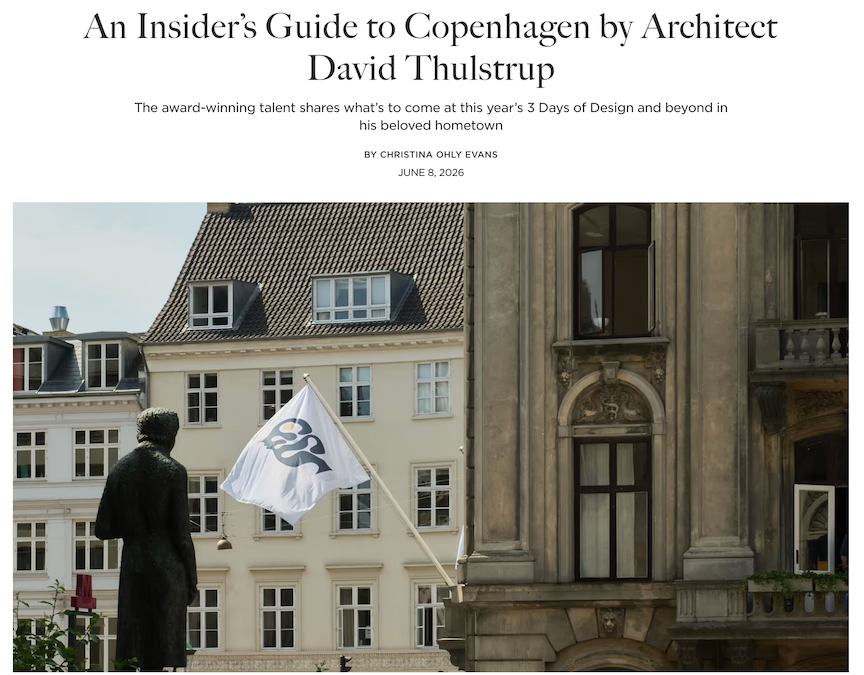
An Insider’s Guide to Copenhagen by Architect David Thulstrup
For award-winning architect David Thulstrup, his hometown of Copenhagen is at its very best during 3 Days of Design—a three-day design festival that is free and open to all. With immersive art and sound experiences, exhibitions, and talks spread throughout eight design districts, the city is sure to highlight the best of furniture, lighting, and design. With Nordic summer as a backdrop—and 17.5 hours of daylight and endless gardens in bloom—Thulstrup’s city is a design-lover’s dream.
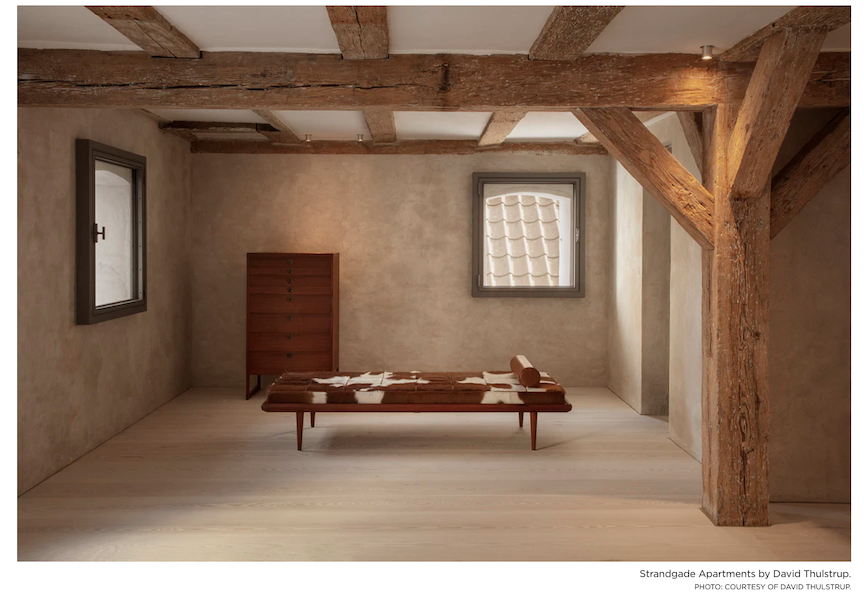
The award-winning talent shares what’s to come at this year’s 3 Days of Design and beyond in his beloved hometown
For award-winning architect David Thulstrup, his hometown of Copenhagen is at its very best during 3 Days of Design—a three-day design festival that is free and open to all. With immersive art and sound experiences, exhibitions, and talks spread throughout eight design districts, the city is sure to highlight the best of furniture, lighting, and design. With Nordic summer as a backdrop—and 17.5 hours of daylight and endless gardens in bloom—Thulstrup’s city is a design-lover’s dream.
What is special about Copenhagen during 3daysofdesign?
The city is transformed by this major international art fair now. It’s not Milan, but it’s pretty close. It’s in June, so people are outdoors, swimming, and you’re close to nature—all while walking and biking to galleries and events. It’s great that it’s condensed and is for three days only; it’s limited, and that makes it feel special and intimate. It is also nice that it hasn’t been overtaken by fashion companies—it’s a pure design industry show, very curated, and Copenhagen, as a design-centric city, is the best place to showcase talent on a manageable scale.
Are there shows and installations that you are particularly interested in?
There are more and more curated shows every year, and this year promises some exciting new venues and collaborations. Different talent, agencies, and brands coming together. I look forward to seeing what Tadaima does—they opened up a new beautiful showroom exhibiting everything from furniture to small Japanese handcrafted ceramics, it feels like walking into a beautiful home with unique craft and objects. Other things I am looking forward to seeing include the design at E15 and fabrics at Magniberg, the Dinesen exhibition, and the Knife, Fork, Spoon exhibition by Dung Ngo and Marta LA.
How does the city influence your work?
I love Copenhagen! I start my days with morning walks either in the nearby park or down towards the water. It’s a very green, safe city, and we use the water. Then there is the food scene; this city has some of the best anywhere in the world. I am always inspired here—we have it so good as Danes, and I try to take my social conscience with me for projects from San Francisco to Shanghai. Danes are humble people, and I try to take an appreciation of this paradise to my work.
Are there places that you recommend visitors stay?
We have a mix of everything—from five-star luxury hotels to small apartments or boutique hotels, but what we are missing are more design-led, material-driven hotels. In the meantime, I recommend Hotel Sanders and The Darling Art & Design Guest House, which both offer an excellent location with all the comforts.
Do you have favorite spaces—public parks, bike paths, places on the water—that you can share?
For color and classical architecture, both Nyhavn and Christianshavn are quintessential Copenhagen, with very walkable, scenic streets and harbor fronts in the city center. One of the newer, more interesting areas is Nordhavn—pronounced Nor-how in English—which was an old industrial port and is now full of Scandinavian architecture. It gives a glimpse into real waterfront living, and there are a lot of design showrooms as well. I live in Østerbro, which is very green and residential, with many cafes and bakeries. This area is also very close to the iconic Little Mermaid statue and the Kastellet fortress. These are places where people really live. Wherever you are, you are close to the water. Copenhagen harbor has platforms for swimming, but I prefer to swim and go to the sauna year-round in Nordhavn.
In terms of parks, one of the most romantic is Ørstedparken, very near the busy Nørreport Station. The King’s Garden is also very central and has so much history, with the Rosenborg Castle and Nordic Renaissance gardens. The Opera Park, designed by architecture design studio Cobe, is an entire harbor-front park scheme with six gardens, a central greenhouse, a reflecting pool, and much more. And because it is so centrally located. right next to the Danish Royal Opera, this is a fantastic place to explore during 3 Days of Design.
What are the best restaurants, cafes and bars now?
My absolute favorite is Restaurant Alf in Frederiksberg. It’s a French-Nordic restaurant where the food is just so beautiful, and while it’s a small, intimate place, they serve some of the best food in Copenhagen. Another favorite is akmē, which just won a Michelin star. They serve wonderful fusion cuisine—Asian, Nordic, with a lot of raw fish, but it’s not sushi.
I was just in Paris last week, and I mean it when I say you will not find a better croissant than you will here. We have the best bread makers in the world! My two favorite bakeries are Anderson & Maillard and Hart—the latter was founded by former Noma and Tartine bakers Richard Hart and Søren Westh. They are famous for their cinnamon buns and cardamom buns. Here, it is all about the baking element versus sweet pastry-making. La Cabra is another outstanding coffee option.
Are there cultural spots that are not to be missed?
I recommend Copenhagen Contemporary, which is a modern exhibition space, and also Cisternerne, which is an underground art space that’s set in an old water reservoir. Thorvaldsens Museum is a tribute to the artist Bertel Thorvaldsen’s Neoclassical sculptures and an interesting collection. I also love going to galleries: we’ve got Nicolai Wallner, which is excellent, and then you’ll find galleries throughout different parts of the city. For midcentury Danish design, there are many galleries and shops along Bredgade Street including, Dansk Møbelkunst Gallery and KLASSIK Moderne Møbelkunst.
Are there shops that are worth a detour?
One of the best shops is Dansk Furniture Art for pieces by Arne Jacobsen, Finn Juhl, Kaare Klint and many others. There is also Room 58, which is a great resource for furniture, ceramics, and lighting, and Secher Fine Art & Design are specialists in 20th-century Scandinavian mid-century furniture and European fine art.
Are there any day trips outside of the city that you recommend?
Just outside of the city, near the airport, you’ll find Dragør, which is a perfectly preserved 12th-century fishing village that looks like something from a Hans Christian Andersen fairytale. Further north, just 20 minutes from Copenhagen, you have Bellevue, a beautiful beach at Klampenborg, that also has some Modernist design elements. There is Finn Juhl’s house, Ordrupgaard, and further away, the iconic Louisiana Art Museum. Lastly, there’s the Rudolph Tegners Museum—a unique, self-funded museum devoted to the plaster sculptures of the artist of the same name.
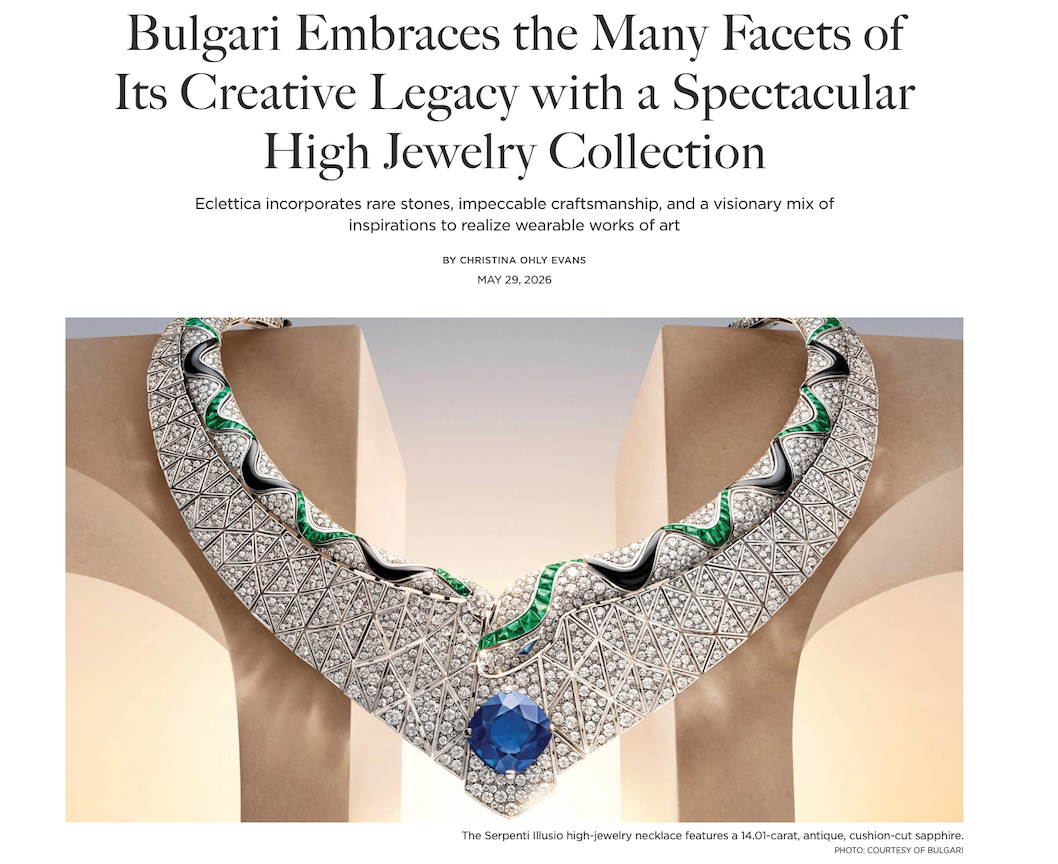
Bulgari Embraces the Many Facets of Its Creative Legacy with a Spectacular High Jewelry Collection
Long synonymous with the glamour of la dolce vita, Bulgari has introduced its latest wildly imaginative collection, aptly named Eclettica to reflect the rich depth and range of Roman art and design that inform each of the exquisite pieces. Under the guidance of creative director Lucia Silvestri, the array includes 15 transformable high-jewelry masterpieces as well as 50 “millionaire pieces,” all of which are evocative of the chromatic vocabulary of painting, the dimensionality of sculpture, and the precise balance and proportion of Italian architecture.
Eclettica incorporates rare stones, impeccable craftsmanship, and a visionary mix of inspirations to realize wearable works of art.
Long synonymous with the glamour of la dolce vita, Bulgari has introduced its latest wildly imaginative collection, aptly named Eclettica to reflect the rich depth and range of Roman art and design that inform each of the exquisite pieces. Under the guidance of creative director Lucia Silvestri, the array includes 15 transformable high-jewelry masterpieces as well as 50 “millionaire pieces,” all of which are evocative of the chromatic vocabulary of painting, the dimensionality of sculpture, and the precise balance and proportion of Italian architecture.
A natural evolution for Bulgari, Eclettica is the pinnacle of bold aesthetics and technical prowess with innovation at its core. “The concept of ‘artsmanship’ is central to this collection,” explains Silvestri. “It’s an even closer dialogue between artistic intuition and exceptional craftsmanship. The result is an assortment that feels incredibly vivid, cohesive, and, above all, authentically reflective of who we are.”
Particularly captivating are the nine Capolavori, the most spectacular examples of the collection, each set with brilliantly colored, extremely rare gemstones to produce dynamic objets d’art. “Each creation here embodies the harmony of contrast, born of multiplicity and transformed into wearable art,” explains Silvestri.
Eclettica includes such stunning bijoux as the Seres Scarf necklace in white gold with 1,180 individual components that mimic the flow of fabric and a 31.90-carat sugarloaf sapphire from Sri Lanka, which can be detached and positioned on various points. The adornment is “inspired by iconic Art Deco textiles and the vibrant palette of Tamara de Lempicka’s paintings,” says Silvestri. “The modular design allows it to transform into multiple styles, from a sautoir to a choker. It is a true expression of Eclettica, where different inspirations and disciplines coalesce in a unique artistic creation.”
Equally eye-catching is the Secret Garden necklace, which is anchored by an ultrarare 26.65-carat padparadscha sapphire that references the coral-tinged warmth of an Italian courtyard garden at sunset. “It was love at first sight,” says Silvestri of the stone she pursued for years. “Its balance of pink and orange is simply extraordinary.” Surrounded by onyx, diamonds, emeralds, purple sapphires, and pavé-set diamonds, the necklace appears to glow.
Other standouts include the Incontro Segreto ring, informed by Francesco Hayez’s The Kiss. Comprising two stones—a 7.85-carat, antique, pear-shaped diamond and a 5.42-carat Colombian emerald—and further embellished with pavé diamonds, step-cut diamonds, and buff-top emeralds, the piece gets its true sparkle from the Toi et Moi setting, a Bulgari signature since the 1980s.
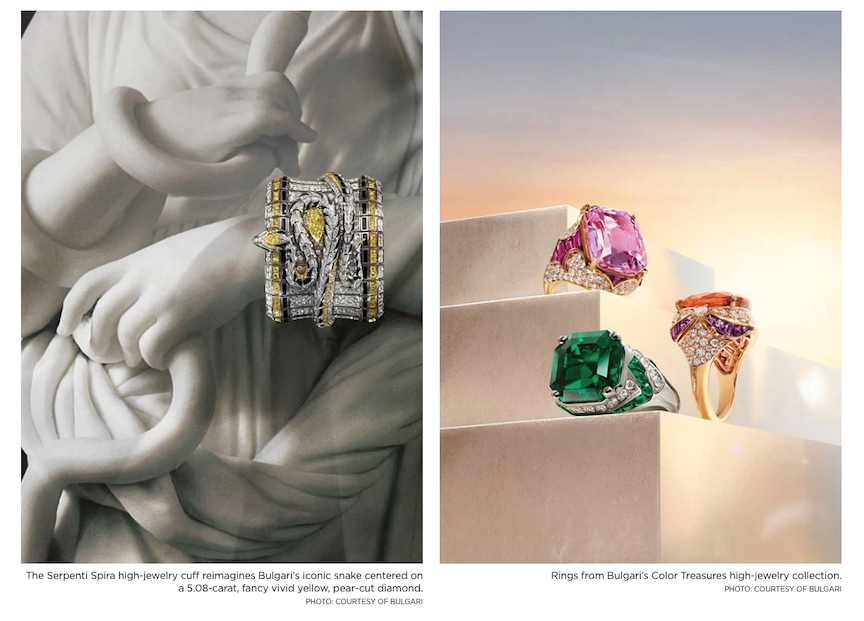
Also striking is the Serpenti Imperial Heart necklace, with a flawless 30.75-carat Golconda-type diamond that is believed to have once belonged to a maharaja. The dazzling stone serves as the serpent’s head, while 180 superbly linked elements form its sinuous body, an effort that required over 1,400 hours of meticulous craftsmanship. In a similarly sculptural vein, the Serpenti Spira cuff—with its luminescent, 5.08-carat, fancy vivid yellow, pear-cut diamond—is a work of precise technical genius. Influenced by the symmetry and strength of Roman columns, the white-gold, clasp-free bracelet features pavé diamonds and onyx details that coalesce to shape an uninterrupted swirling snake.
Continuing in the star-studded Bulgari tradition, several Eclettica jewels made their red-carpet debut at the Academy Awards ceremony in March, worn by stylish brand ambassadors Priyanka Chopra Jonas and Anne Hathaway. For Chopra Jonas, the Serpenti Illusio necklace, with a 14.01-carat, antique, cushion-cut sapphire from Madagascar, served as a showstopping accessory. A constellation of brilliant diamonds, buff-top emeralds and sapphires, and onyx, the choker fuses precise geometry with an illustrious serpent in 235 individual segments that required 1,300 hours to create. Similarly enchanting was the Neoclassical Starlight necklace, chosen by Hathaway for its stunning 8.02-carat, pear-cut, fancy vivid yellow diamond set in platinum. An homage to the great neoclassical sculptor Antonio Canova, the magnificent creation paired perfectly with her statement-making diamond Bulgari high-jewelry earrings and Valentino haute couture gown.
The sheer creativity and the range of impressive stones and rare materials, as well as the masterful craftsmanship that are found throughout the Eclettica collection—which also includes remarkable watches, bags, and fragrances—are what continue to make Bulgari the height of opulent, ever-exuberant luxury. “Our approach is rooted in constant cross-pollination,” explains Silvestri. “We draw inspiration from different eras, cultures, architectural forms, and artistic expressions, allowing them to come together in a dialogue that feels both dynamic and harmonious. Eclettica represents the ultimate expression of this philosophy, a celebration of the maison’s ability to blend diverse influences into a singular, unmistakable identity.
VIEW PDF
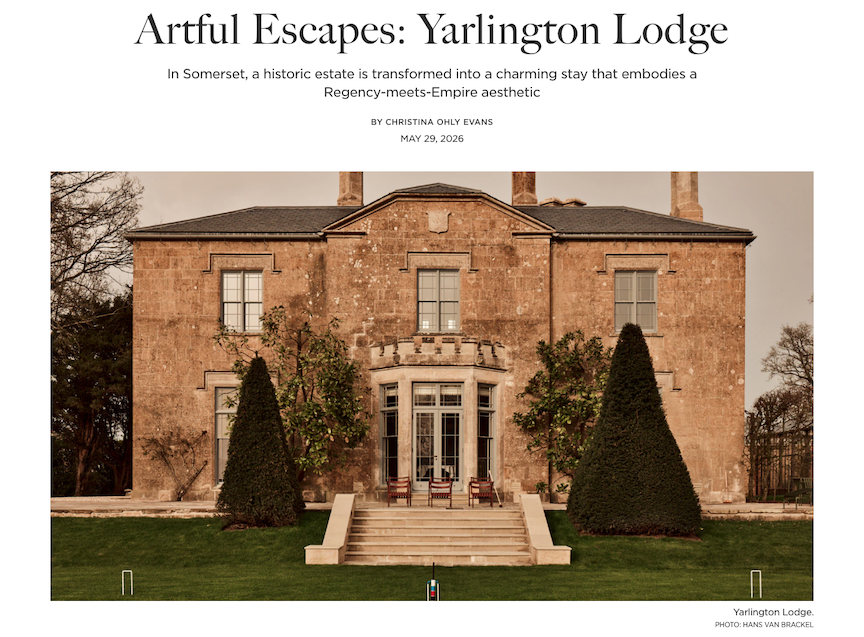
Artful Escapes: Yarlington Lodge
The landmark Yarlington Lodge, situated on an estate allegedly gifted by Henry VIII to his wife Katherine Parr, has been superbly metamorphosed into a sprawling compound. The expansive property—which includes an eight-bedroom manor house, a four-bedroom coach house in the former stables, and a four-bedroom gardener’s cottage as well as a lush walled garden—is the passion project of Karen Roos, co-owner of The Newt.
In Somerset, a historic estate is transformed into a charming stay that embodies a Regency-meets-Empire aesthetic
The landmark Yarlington Lodge, situated on an estate allegedly gifted by Henry VIII to his wife Katherine Parr, has been superbly metamorphosed into a sprawling compound. The expansive property—which includes an eight-bedroom manor house, a four-bedroom coach house in the former stables, and a four-bedroom gardener’s cottage as well as a lush walled garden—is the passion project of Karen Roos, co-owner of The Newt.
Working with Richard Parr Associates, she has created sumptuous, fabric-swathed rooms with canopy-tented ceilings and period paintings that embody a Regency-meets-Empire aesthetic that’s juxtaposed with stylish design touches.
A spacious library, a drawing room, and a formal dining room—all with views of the gardens beyond—invite guests (a maximum of 32) to linger, while a cozy cinema is ideal for screening current films. But it’s the grounds, boasting an arbor of laburnum and wisteria, a sleek swimming pool, and a charming greenhouse, that really dazzle.
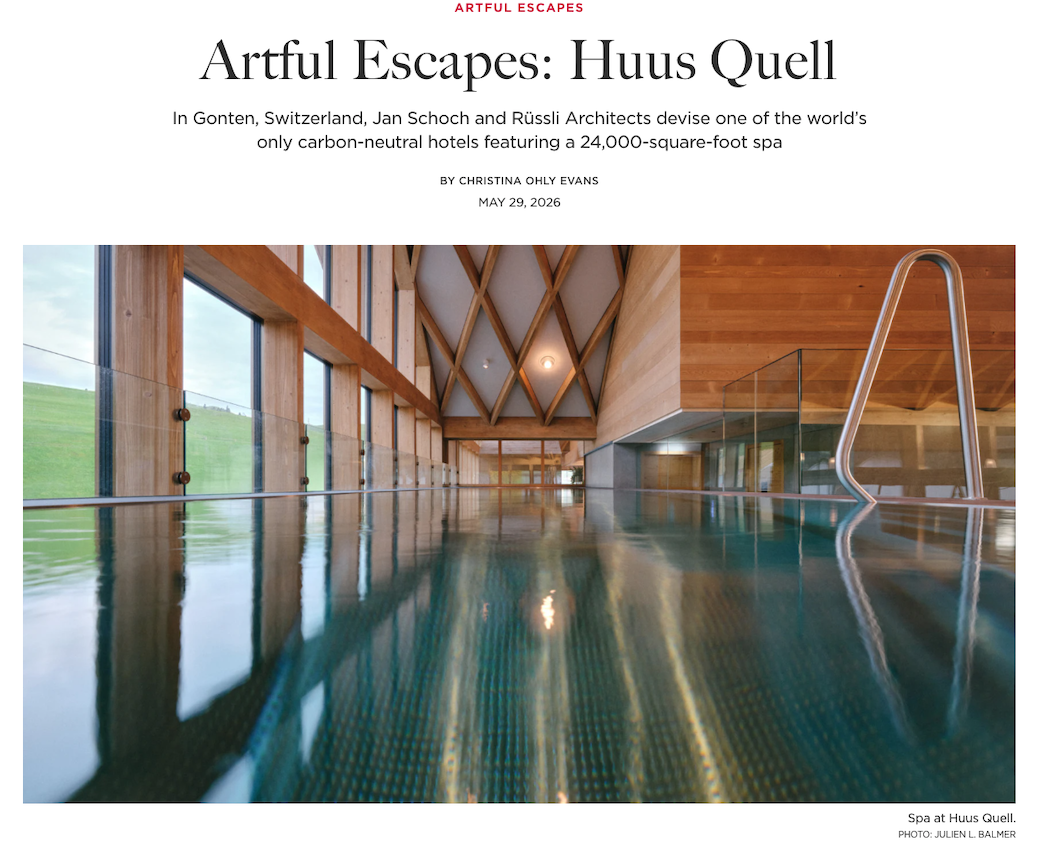
Artful Escapes: Huus QuellIn Gonten,
A biohacking devotee, former fintech mogul turned healthful hotelier, Jan Schoch devised Huus Quell alongside Lucerne-based Rüssli Architects as one of the world’s only carbon-neutral hotels, with wood sourced from local larch and pine trees, geothermal wells, and lime-based plaster that absorbs carbon dioxide.
Switzerland, Jan Schoch and Rüssli Architects devise one of the world’s only carbon-neutral hotels featuring a 24,000-square-foot spa
A biohacking devotee, former fintech mogul turned healthful hotelier, Jan Schoch devised Huus Quell alongside Lucerne-based Rüssli Architects as one of the world’s only carbon-neutral hotels, with wood sourced from local larch and pine trees, geothermal wells, and lime-based plaster that absorbs carbon dioxide.
Comprising 30 rooms and a 24,000-square foot spa, this Leading Hotel of the World invites guests to experience cryotherapy, hyperbaric oxygen therapy, and rhythmic movement that targets the lymphatic system as well as eight saunas and an impressive floating yoga platform with stunning views of the Alpstein massif.
Artful Escapes: Palazzo Santa Croce
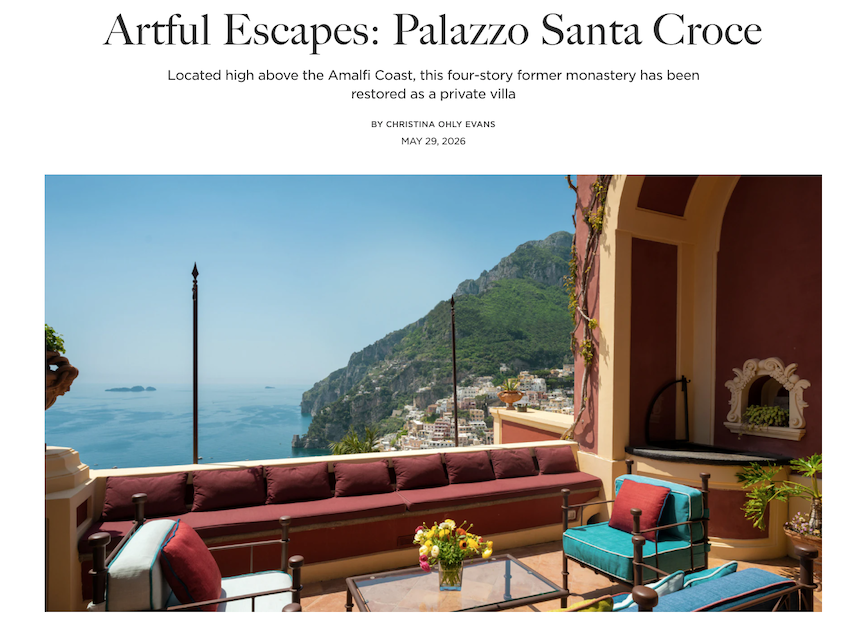
A four-story former monastery high above the Amalfi Coast has been lovingly restored by the Cinque family, owners of the nearby Il San Pietro hotel, and now operates as a private villa with full use of the hotel’s amenities. Palazzo Santa Croce comprises five bedrooms, including two main suites with original frescoes.
Located high above the Amalfi Coast, this four-story former monastery has been restored as a private villa
A four-story former monastery high above the Amalfi Coast has been lovingly restored by the Cinque family, owners of the nearby Il San Pietro hotel, and now operates as a private villa with full use of the hotel’s amenities. Palazzo Santa Croce comprises five bedrooms, including two main suites with original frescoes.
Living spaces are lavish, with Neapolitan rococo mirrors, silk, and velvet fabrics, and antique furniture. In the kitchen, chefs prepare seafood-centric meals using ingredients from the surrounding gardens. Of special note is an adjoining spa inspired by a Roman bath, which features an indoor pool, a sauna, a Turkish bath, and an outdoor jacuzzi with sweeping sea views.
Artful Escapes: The Huntington Hotel
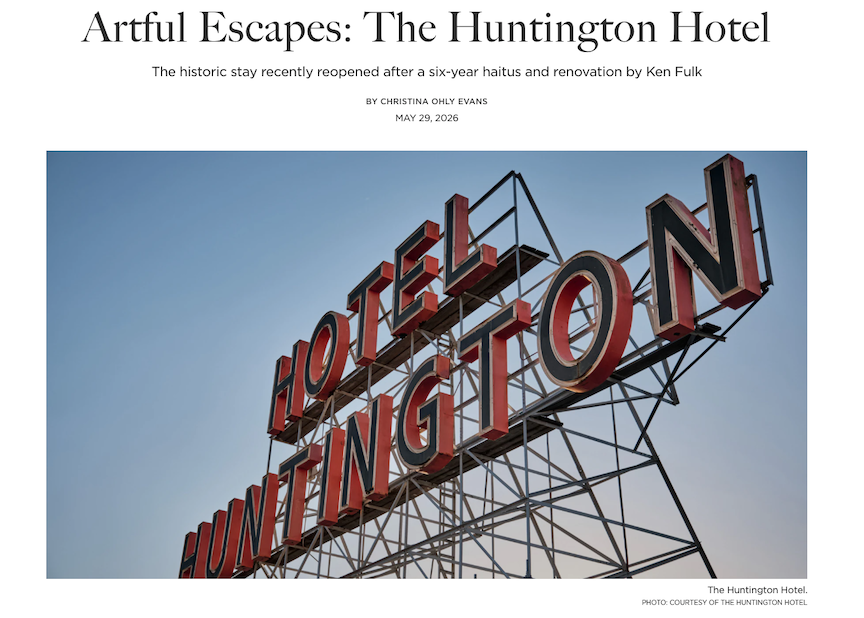
Built in 1922 as a luxury apartment building, The Huntington Hotel has reopened following a six-year hiatus and renovation by noted designer and Bay Area resident Ken Fulk. Plasterwork, boiserie panels, and celestial ceilings enliven public spaces, while marble, polished wood, brass, and deep cognac leather add to the grand environment. The new Arabella’s bar is an Art Nouveau jewel, complete with murals and excellent martinis.
The historic stay recently reopened after a six-year haitus and renovation by Ken Fulk
Built in 1922 as a luxury apartment building, The Huntington Hotel has reopened following a six-year hiatus and renovation by noted designer and Bay Area resident Ken Fulk. Plasterwork, boiserie panels, and celestial ceilings enliven public spaces, while marble, polished wood, brass, and deep cognac leather add to the grand environment. The new Arabella’s bar is an Art Nouveau jewel, complete with murals and excellent martinis.
Relaxing RETREATS
While travel can feel hectic—not to mention expensive—these days, adventures and relaxing escapes are in higher demand than ever. From design-led properties with a focus on wellness to sumptuous estates in remote winemaking regions, there are offerings for every age and interest. Whether you’re looking for an art-filled escape or an adrenaline-charged break, the time is now to book a summer holiday to remember.
From Mallorca to Mexico, a new crop of design-led hotels are their opening doors
BY CHRISTINA OHLY EVANS
While travel can feel hectic—not to mention expensive—these days, adventures and relaxing escapes are in higher demand than ever. From design-led properties with a focus on wellness to sumptuous estates in remote winemaking regions, there are offerings for every age and interest. Whether you’re looking for an art-filled escape or an adrenaline-charged break, the time is now to book a summer holiday to remember.
Amalfi Coasting;
LE SIRENUSE MARE
A beach club extraordinaire is the latest stylish addition to the Italian Riviera
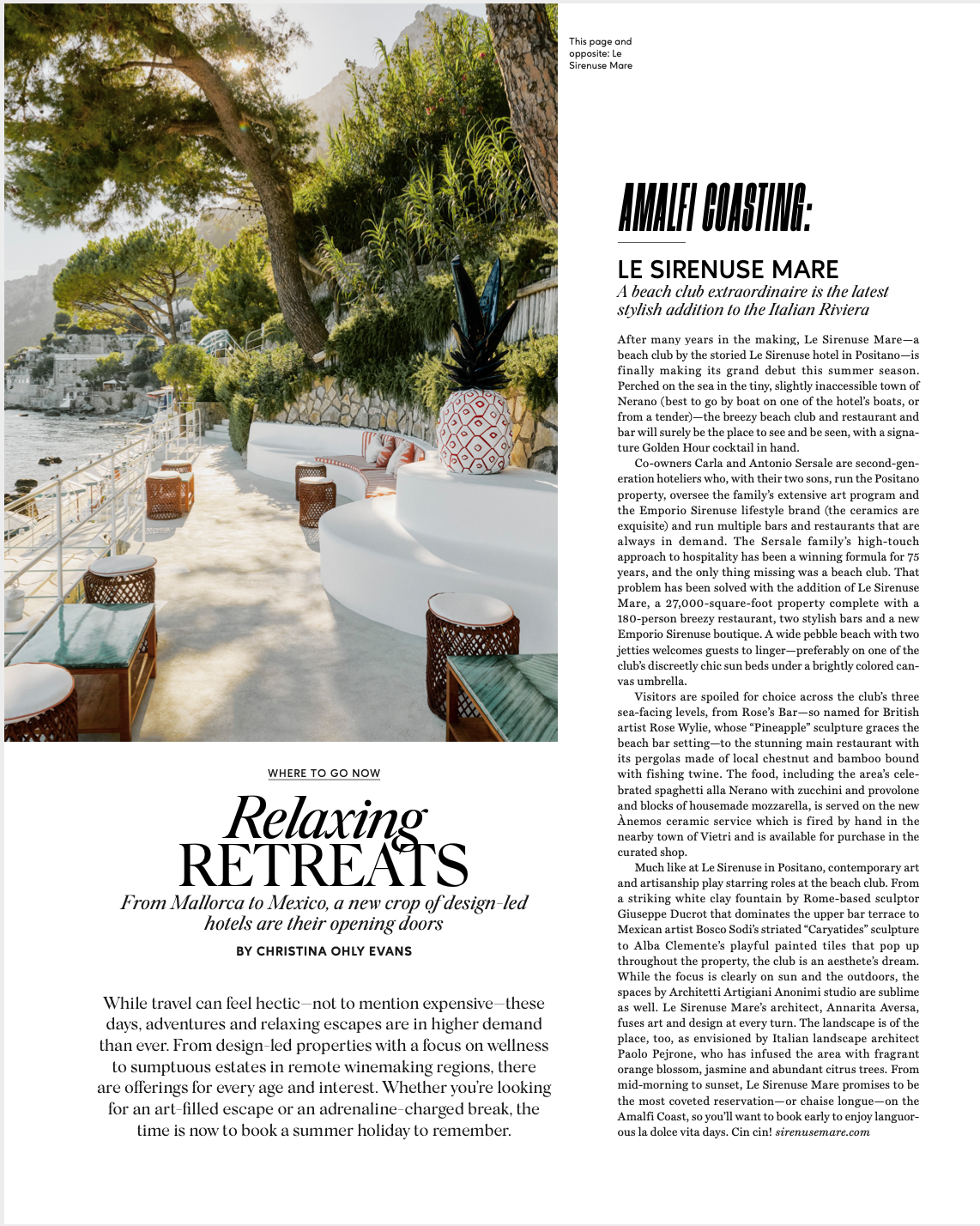
After many years in the making, Le Sirenuse Mare—a beach club by the storied Le Sirenuse hotel in Positano—is finally making its grand debut this summer season. Perched on the sea in the tiny, slightly inaccessible town of Nerano (best to go by boat on one of the hotel’s boats, or from a tender)—the breezy beach club and restaurant and bar will surely be the place to see and be seen, with a signa- ture Golden Hour cocktail in hand.
Co-owners Carla and Antonio Sersale are second-gen- eration hoteliers who, with their two sons, run the Positano property, oversee the family’s extensive art program and the Emporio Sirenuse lifestyle brand (the ceramics are exquisite) and run multiple bars and restaurants that are always in demand. The Sersale family’s high-touch approach to hospitality has been a winning formula for 75 years, and the only thing missing was a beach club. That problem has been solved with the addition of Le Sirenuse Mare, a 27,000-square-foot property complete with a 180-person breezy restaurant, two stylish bars and a new Emporio Sirenuse boutique. A wide pebble beach with two jetties welcomes guests to linger—preferably on one of the club’s discreetly chic sun beds under a brightly colored can- vas umbrella.
Visitors are spoiled for choice across the club’s three sea-facing levels, from Rose’s Bar—so named for British artist Rose Wylie, whose “Pineapple” sculpture graces the beach bar setting—to the stunning main restaurant with its pergolas made of local chestnut and bamboo bound with fishing twine. The food, including the area’s cele- brated spaghetti alla Nerano with zucchini and provolone and blocks of housemade mozzarella, is served on the new Ànemos ceramic service which is fired by hand in the nearby town of Vietri and is available for purchase in the curated shop.
Much like at Le Sirenuse in Positano, contemporary art and artisanship play starring roles at the beach club. From a striking white clay fountain by Rome-based sculptor Giuseppe Ducrot that dominates the upper bar terrace to Mexican artist Bosco Sodi’s striated “Caryatides” sculpture to Alba Clemente’s playful painted tiles that pop up throughout the property, the club is an aesthete’s dream. While the focus is clearly on sun and the outdoors, the spaces by Architetti Artigiani Anonimi studio are sublime as well. Le Sirenuse Mare’s architect, Annarita Aversa, fuses art and design at every turn. The landscape is of the place, too, as envisioned by Italian landscape architect Paolo Pejrone, who has infused the area with fragrant orange blossom, jasmine and abundant citrus trees. From mid-morning to sunset, Le Sirenuse Mare promises to be the most coveted reservation—or chaise longue—on the Amalfi Coast, so you’ll want to book early to enjoy languor- ous la dolce vita days. Cin cin! sirenusemare.com
ORIENT EXPRESS VENEZIA
Opened to coincide with this year’s Venice Biennale, Orient Express Venezia brings the storied brand to the Cannaregio dis- trict in an exquisitely restored palazzo originally designed by Filippo Calendario. Blending neo-gothic and baroque ele- ments, and with interiors by Aline Asmar d’Amman, the 47-room property evokes both grandeur and intimacy, with ele- gantly frescoed salons, a dramatic octago- nal staircase and an opulent ballroom all adding to the feeling of a (very) luxurious private home stay. Dining spans a fine- dining restaurant, a leafy courtyard café and the signature Wagon Bar that captures the romance of the golden age of travel. orient-express.com
THE LAKE COMO EDITION
Set within a restored 19th-century palazzo overlooking the lake, The Lake Como Edition has expanded its wellness offering with the debut of The Longevity Spa this season. Developed in part- nership with The Longevity Suite, the spa introduces a scientific approach to wellbeing, blending biohacking technologies with holistic treatments such as the Iki-Sabi Ritual and personalized skin therapies using locally sourced ingredients. Multiple sau- nas, steam rooms, a Technogym-equipped fitness space and outdoor experiences like sunrise yoga and guided hikes make this a wellness destination rooted in both the traditional setting and next-gen innovative therapies. editionhotels.com
CASA J.K. PLACE ROMA
From hotelier Ori Kafri comes an exten- sion of the wildly popular J.K. Place Roma: the 12-apartment Casa J.K. Place Roma, which is set to open this summer. Set in a 17th-century palazzo in Via dei Prefetti, the exclusive club will be perfect for extended stays as well as guests in search of truly bespoke services. A dedicated con- cierge, butler, all-day restaurant and state- of-the-art gym will all be available—all just steps from the Piazza di Spagna and the Piazza Navona. jkplaces.com
LA TIARA DI CERVO, SARDINIA
Set high above Porto Cervo, La Tiara di Cervo introduces a more private, residential- style approach to the bustling Costa Smeralda. Set within a protected park, the Mediterranean estate offers 26 grand suites (available in one-, two- and three-bed- room configurations) designed for seamless indoor-outdoor living—each with a connected concierge and a private chef. Blending residential living with the comforts of a luxury hotel (including two infinity pools and a fitness center), the property offers a quieter, more intimate alternative to the region’s traditional glamour—but with the same stunning azure views. latiaradicervo.it
LA GIARDINA GUEST HOUSE, PIEDMONT
Opened this spring, La Giardina Guest House in off-the-beaten-track Turin offers an intimate, art-driven retreat in a restored 12th-century convent in the hills of Piedmont. With just four unique suites (each with its own theme), the boutique property emphasizes thoughtful design, warm hospitality and a deep sense of narrative. At its heart is the work of Italo-Canadian artist Bruno Billio, whose interdisciplinary creations shape the hotel’s identity by blending bold sculpture, installations and layered design into an atmospheric experience that’s rooted in family and creativity. lagiardina.com
Guest House
ARA MARIS HOTEL & SPA, SORRENTO
Perched high above the Gulf of Naples, Ara Maris Hotel & Spa intro- duces a fresh vision of Mediterranean luxury in the heart of Sorrento. As the destination’s only fully design-led contemporary boutique hotel—and its only adults-focused property—the 49-room retreat offers a serene escape defined by sleek architectural lines, destination- driven gastronomy and an immersive wellness program rooted in the landscape. Now entering its third season, Ara Maris blends modern elegance with a strong sense of place, offering a quiet retreat on the otherwise bustling peninsula. aramarishotel.com
An Insider’s Guide to Venice by Peter Marino
As president and chairman of the board of Venetian Heritage, Peter Marino is deeply committed to historical preservation—of art, architecture, and culture—in the most magical of Italian cities. In addition to his architectural design work for clients including Dior, Chanel, and Louis Vuitton, Marino is an avid collector of everything from Egyptian art to 17th-century French books to Renaissance bronzes to photography and modern painting and sculpture. For this consummate aesthete, the floating city made of 118 islands and endless canals and bridges never ceases to amaze and delight—especially during the vibrant Venice Biennale, on view from May 9—November 22, 2026.
The world-renowned architect, who is behind a number of the city’s most beautiful renovations, shares his favorite spots and what he’s most looking forward to at this year’s Biennale.
As president and chairman of the board of Venetian Heritage, Peter Marino is deeply committed to historical preservation—of art, architecture, and culture—in the most magical of Italian cities. In addition to his architectural design work for clients including Dior, Chanel, and Louis Vuitton, Marino is an avid collector of everything from Egyptian art to 17th-century French books to Renaissance bronzes to photography and modern painting and sculpture. For this consummate aesthete, the floating city made of 118 islands and endless canals and bridges never ceases to amaze and delight—especially during the vibrant Venice Biennale, on view from May 9—November 22, 2026.
What makes the city so special for you?
Venice is eternally magical. It aligns in a unique way with one of my main fascinations: light. I want light in all my work, and the light on the water in the quiet canals makes me absolutely crazy with joy. The quality of the light—and the way it interacts with material—is fundamental to its beauty. It’s something I’ve explored through my textile collections for Rubelli, and in my vases and lighting collections with the Murano glassmaker Venini. This city is where craft and architecture come together in a very direct way.
How did you come to be involved with Venetian Heritage?
Venetian Heritage was founded by Larry Lovett in 1999. My love for Venice began when Larry called me to lead the design project for the 19th-century Palazzo Sernagiotto. He taught me so much and opened so many doors for me. My involvement with Venetian Heritage comes from a long-standing commitment to Venice and its cultural legacy.
Venetian Heritage focuses on restoration projects that are both historically significant and urgently in need of support—whether it be architectural elements, sculpture, or major works of art. The goal is not only preservation, but ensuring these works remain part of a living cultural context. Restorations have included the Gallerie dell’ Accademia, Palazzo Grimani, and now the Ca’ d’Oro—in addition to countless paintings, sculptures, and important churches.
What are your first memories of the Venice Biennale?
I remember visiting in the ‘90s and there was always this ‘which are the best pavilions to visit’ discussion. As the Biennale is so vast, I remember thinking that this smorgasbord of art is the most varied, universal, and interesting thing in the world.
Are there particular editions or exhibitions that stand out for you over the years?
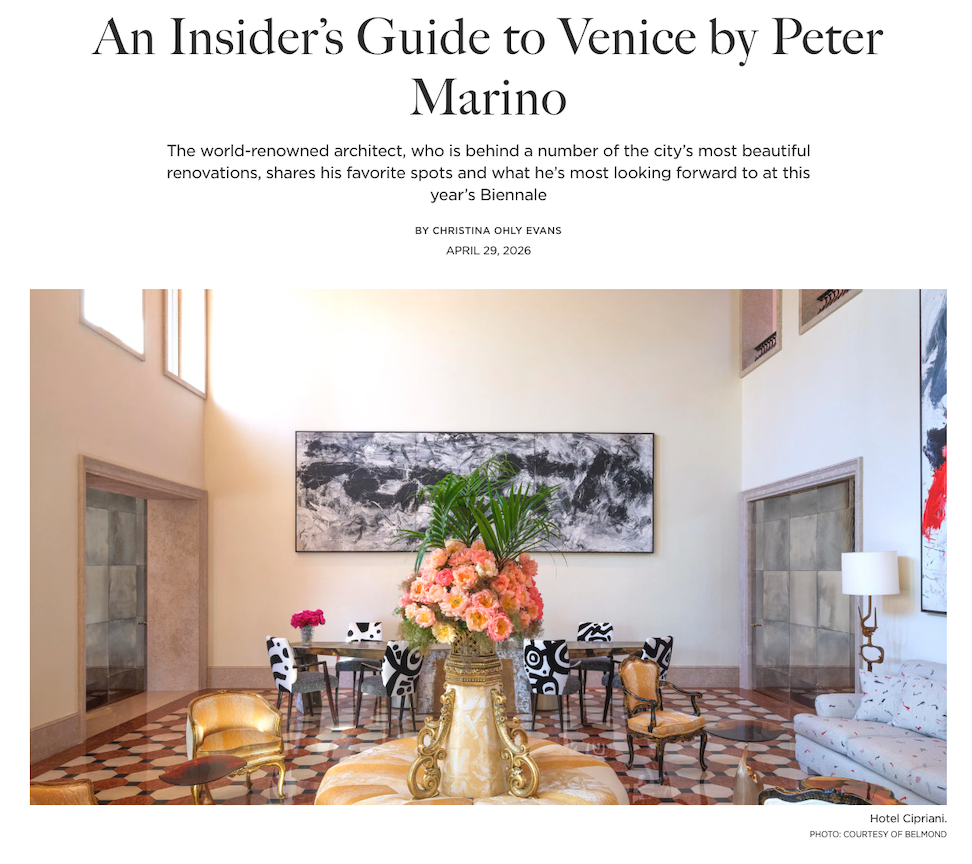
Michal Rovner—the Israeli Pavilion—in 2003 was a standout. Erwin Wurm at the Austrian Pavilion in 2017 is another highlight, and Anselm Kiefer at the German Pavilion in 1980. I missed Warhol in 1976. I am now assembling a large collection of artists who represented Italy in the ‘50s and ‘60s for the legendary Hotel Cipriani’s renovation.
What are you excited about for this year’s Biennale, from installations to activations to museums and parties?
The Biennale is always about the contrast—the most contemporary work in one of the most historic cities in the world. This year, I’m especially focused on the way cultural programming is being anchored in historic Venetian settings. Through my work with Venetian Heritage, we’ve structured a series of events that move between conservation, contemporary art, and the social life of the Biennale.
There are moments that are very focused—like the visit to the restoration of Bellini’s San Giobbe Altarpiece at the Accademia—and others that activate historic buildings and spaces, such as the dinner at the Biblioteca Marciana or the reopening of Oro restaurant at Hotel Cipriani on Giudecca.
And then, of course, there’s the more theatrical dimension of Venice. This year’s collaboration with Dior culminates in the Casino Royale Ball on May 9 at the Palazzo del Casinò on the Lido—a setting that still retains its 1930s interiors, including gilded mosaics and Murano chandeliers.
What’s interesting to me is that all these moments—whether intimate or large-scale— are part of the same continuum. The Biennale isn’t just about exhibitions; it’s about how the city itself is experienced during that time.
Where do you recommend visitors stay?
Hotel Cipriani offers something rare in Venice—space, light, and a sense of retreat while remaining connected to the city. For my redesign, the intention was to create a world that belongs to Venice but also to the 21st-century traveler. When it was founded in 1958, the idea was to create a joyful place, different from the formal hotels of the city…imperfect but authentic.
Guests today crave a unique experience and authenticity. Art and architecture provide that. The future is about cultural specificity—bringing the DNA of a city alive through the combination of art and design.
Are there particular palazzos, churches or neighborhoods that aren’t to be missed?
The Galleria Giorgio Franchetti alla Ca’ d’Oro is a must-visit. It’s one of the great Late Gothic palazzos, and its ongoing restoration is a major focus of Venetian Heritage. The building itself—and its collection—offers a complete expression of Venetian culture at a very high level.
San Francesco della Vigna, where the architectural layering—from Sansovino to Palladio—is extraordinary as well. The cloisters and vineyard have also been the subject of careful restoration and enhancement, which brings a deeper understanding of how these spaces functioned historically.
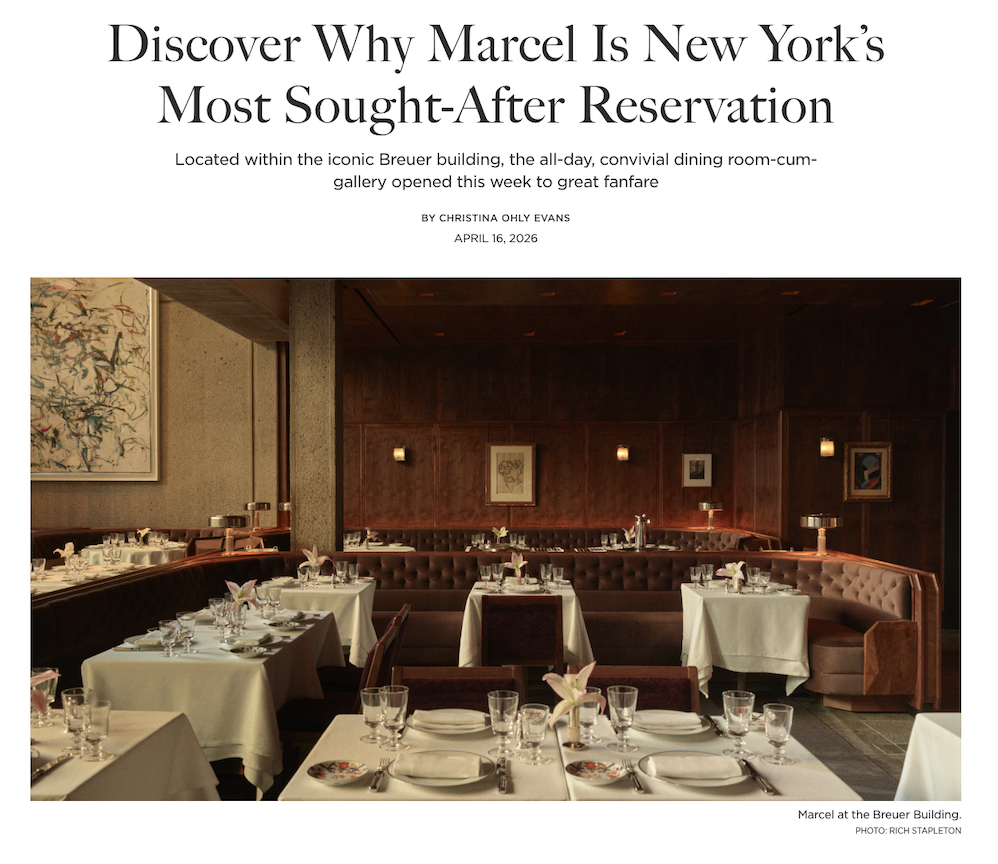
Discover Why Marcel Is New York’s Most Sought-After Reservation
This week marks the highly anticipated opening of Marcel in the iconic Breuer building on New York’s Upper East Side. Set within Marcel Breuer’s 1966 brutalist masterpiece that was once home to the Whitney Museum of American Art, and now serves as Sotheby’s New York headquarters, it is already the most sought-after reservation in town. A vibrant setting for Modern and Contemporary marquee sales, the site will now house an all-day, convivial dining room-cum-gallery where art—and objects for sale—will meet French-inflected cuisine.
Located within the iconic Breuer building, the all-day, convivial dining room-cum-gallery opened this week to great fanfare.
This week marks the highly anticipated opening of Marcel in the iconic Breuer building on New York’s Upper East Side. Set within Marcel Breuer’s 1966 brutalist masterpiece that was once home to the Whitney Museum of American Art, and now serves as Sotheby’s New York headquarters, it is already the most sought-after reservation in town. A vibrant setting for Modern and Contemporary marquee sales, the site will now house an all-day, convivial dining room-cum-gallery where art—and objects for sale—will meet French-inflected cuisine.
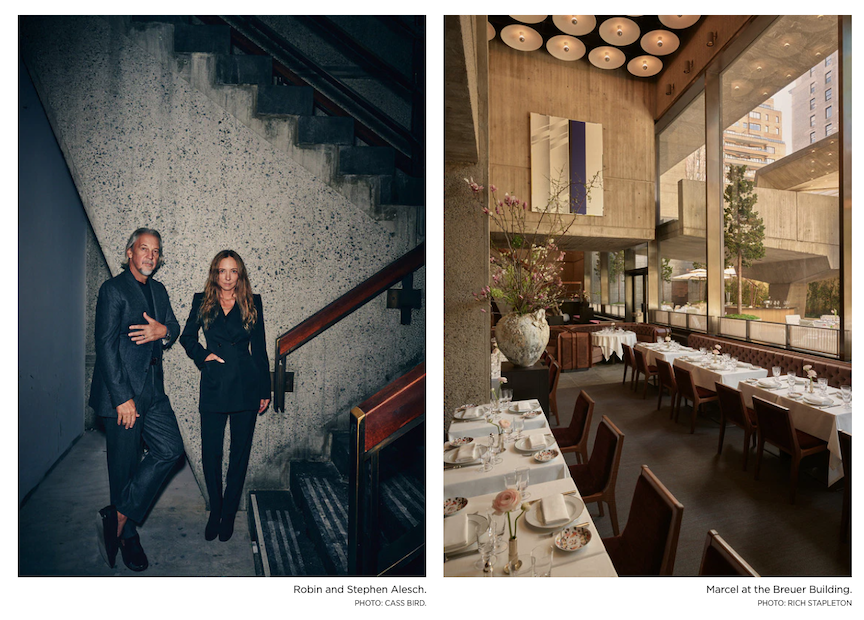
A partnership between Roman and Williams founders Robin and Stephen Alesch – the duo behind celebrated hospitality venues including Soho’s La Mercerie and the sublime Estelle Manor in the English countryside—and Sotheby’s, the restaurant named for the Bauhaus-trained architect, will welcome diners from morning through elegant evenings. The pair have embraced the midcentury aesthetic of the space and enhanced it with rich, walnut-paneled walls, warm candlelight (a Roman and Williams forte), and an open plan kitchen that adds to the theatrical hum.
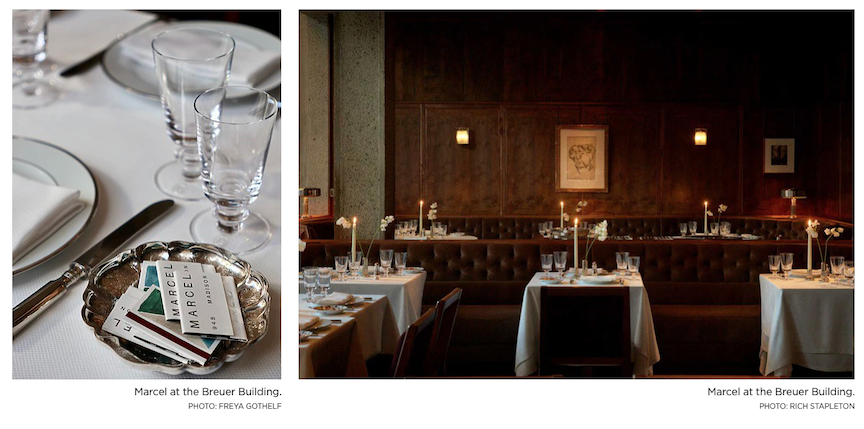
A new, dedicated entry welcomes visitors with touches of walnut and bronze that set the stage for the big reveal downstairs. A central dining room highlights Breuer’s bush-hammered concrete columns, with all original lighting details thoughtfully preserved. The kitchen serves as the room’s focal point—one with space for 140 guests—with walls paneled in book-matched Black Figured and Claro walnut and sumptuous banquettes swathed in cocoa-tinged Pierre Frey mohair that are ideal for intimate conversation. A mirrored bar highlights vintage steel and leather Bauhaus stools paired with original Breuer lamps sourced at auction. Art takes center stage as well with objects displayed in Goppion-designed vitrines, and works of art hung on steel picture hangers—always in rotation like an ever-changing, dynamic gallery.
Equally spectacular is the food—from a dedicated La Mercerie Patisserie for all-day madeleines and casual coffee, to lunch and dinner that’s overseen by chef-partner Marie-Aude Rose. With menus conceived by executive chef Juan Moncalvo, continental classics such as ham and comté tartines at lunch and confit de canard will appear throughout the day—often with wine pairings in partnership with Sotheby’s specialists. Every tabletop detail has been thought through, from midcentury typefaces that appear on menus and packaging to the Roman and Williams-designed Hyssop vases and candlesticks that highlight the room in patinated bronze. Handcrafted flatware and exquisite glassware from Japan, as well as Arita porcelain in a slight silver hue, all add to the serene atmosphere.
Of special note is the original sculpture garden, which will now seat 70 additional guests for breakfast, lunch, and dinner. Just steps off bustling Madison Avenue and yet surrounded by nature and art, this garden oasis is the perfect spot for a casual morning coffee or plein air dinner. For lovers of great design—midcentury and contemporary—as well as delicious, creative cuisine, Marcel is New York’s new top table.
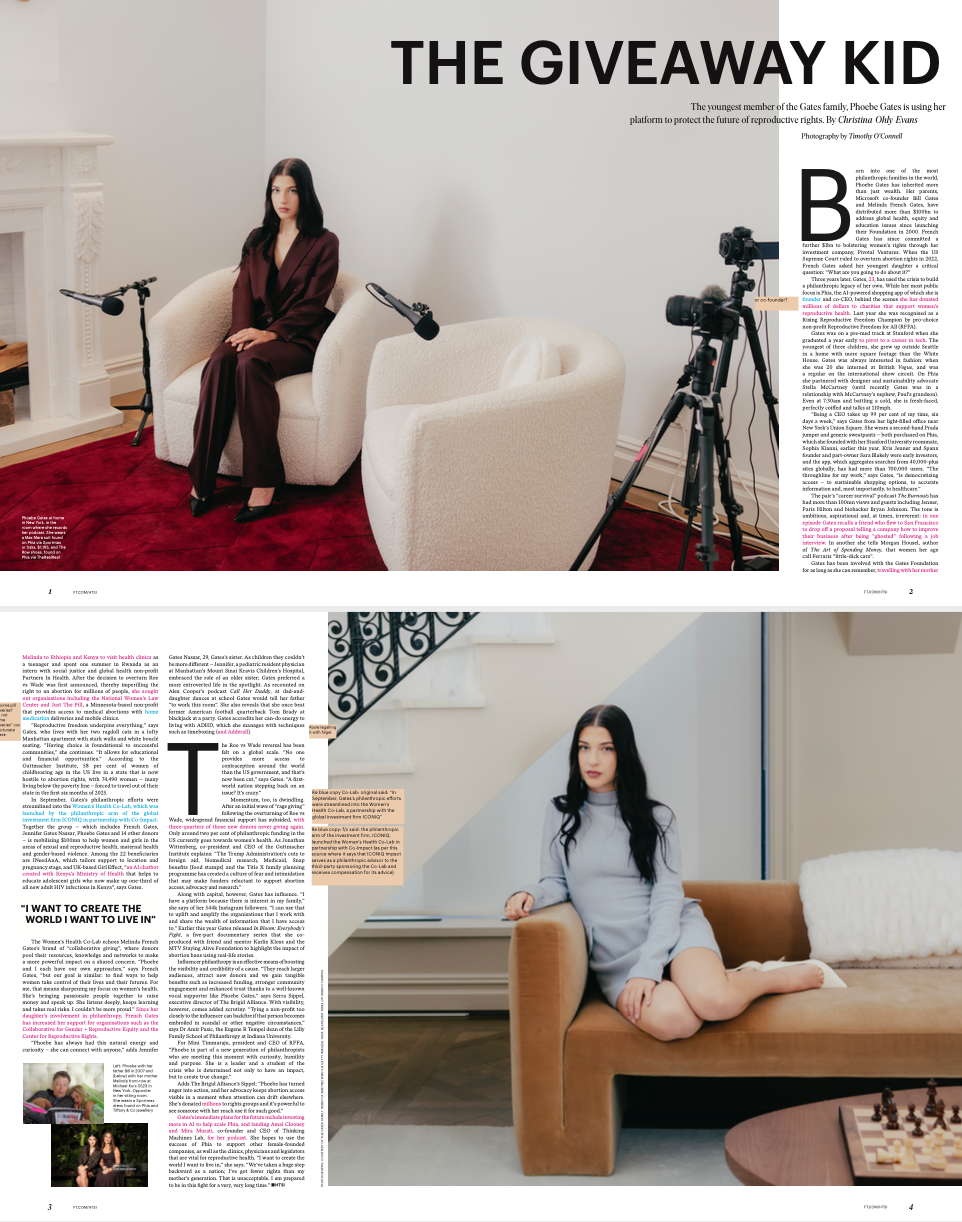
Born to give – the philanthropic urge of Phoebe Gates
My personal style is eclectic and imaginative. Depending on my mood and the occasion, I might wear contemporary, vintage, masculine or very feminine clothes. If I’m on the rostrum, jackets are everything. My go-to is a navy wool double-breasted YSL jacket with gold buttons – very military-style – and I also love the silver Armani jacket that I wore for the sale of Apex, an 11ft-tall stegosaurus skeleton, in 2024. I always want to be sensitive to the items in the sale – the clothes I wear for a Modern & Contemporary auction are different to those I’ll wear for fossil or manuscript sales. One exception is my hair, which I always wear in a ponytail. When I was auditioning to be an auctioneer at Sotheby’s in 2016, Hugh Hildesley, who was then a senior auctioneer, advised that my hair was hitting the microphone and was a distraction. I’ve tied it up ever since and never have to think about it during a heated auction.
The youngest member of the Gates clan is following her family’s calling. But her healthcare mission comes with a uniquely Gen Z edge
Born into one of the most philanthropic families in the world, Phoebe Gates has inherited more than just wealth. Her parents, Microsoft co-founder Bill Gates and Melinda French Gates, have distributed more than $100bn to address global health, equity and education issues since launching their Foundation in 2000. French Gates has since committed a further $1bn to bolstering women’s rights through her investment company, Pivotal Ventures. When the US Supreme Court ruled to overturn abortion rights in 2022, French Gates asked her youngest daughter a critical question: “What are you going to do about it?” Three years later, Gates, 23, has used the crisis to try to find the answer. Her most public focus is Phia, the AI‑powered shopping app of which she is co-founder and co‑CEO; behind the scenes she has donated millions of dollars to charities that support women’s reproductive health (although, when asked, her team do not disclose a precise amount). Last year she was recognised as a Rising Reproductive Freedom Champion by pro-choice non-profit Reproductive Freedom for All (RFFA).
Gates was on a pre-med track at Stanford University when she graduated a year early to pivot to a career in tech. The youngest of three, she grew up outside Seattle in a home with more square footage than the White House. Gates was always interested in fashion: when she was 20 she interned at British Vogue, and was a regular on the international show circuit. On Phia she partnered with designer and sustainability advocate Stella McCartney (until recently Gates was in a relationship with McCartney’s nephew, Paul’s grandson). Even at 7.30am and battling a cold, she is fresh-faced, perfectly coiffed and talks at 110mph.
“Being a CEO takes up 99 per cent of my time, six days a week,” says Gates from her light-filled office near New York’s Union Square. She wears a second-hand Prada jumper and generic sweatpants – both purchased on Phia, which she founded with her Stanford roommate, Sophia Kianni, earlier this year. Kris Jenner and Spanx founder and part-owner Sara Blakely were early investors, and the app, which aggregates searches from 40,000-plus sites globally, has had more than 700,000 users and – as of December – a $180mn valuation. “The throughline for my work,” says Gates, “is democratising access – to sustainable shopping options, to accurate information and, most importantly, to healthcare.” The pair’s “career survival” podcast The Burnouts has had more than 100mn views and guests including Jenner, Paris Hilton and biohacker Bryan Johnson. The tone is ambitious, aspirational and, at times, irreverent: in one episode Gates recalls a friend who flew to San Francisco to drop off a proposal telling a company how to improve their business after being “ghosted” following a job interview. In another, she tells Morgan Housel, author of The Art of Spending Money, that women her age call Ferraris “little-dick cars”.
Gates has been involved with the Gates Foundation for as long as she can remember, travelling as a child with her mother to Ethiopia and Rwanda, where she returned as a teenager to volunteer at a pre-school. While at college, she also spent three weeks with the non-profit Partners In Health at a health clinic. After the decision to overturn Roe vs Wade was first announced – thereby imperilling the right to an abortion for millions of people – she sought out organisations including the Repro Legal Defense Fund and Just The Pill, a Minnesota-based non-profit that provides access to medication abortions with home pill deliveries and mobile clinics. “Reproductive freedom underpins everything,” says Gates, who lives with her two ragdoll cats in a lofty Manhattan apartment with stark walls and white bouclé seating. “Having choice is foundational to successful communities,” she continues. “It allows for educational and financial opportunities.” According to the Guttmacher Institute, 58 per cent of women of childbearing age in the US live in a state that is now hostile to abortion rights, with 74,490 women – many living below the poverty line – forced to travel out of their state in the first six months of 2025.
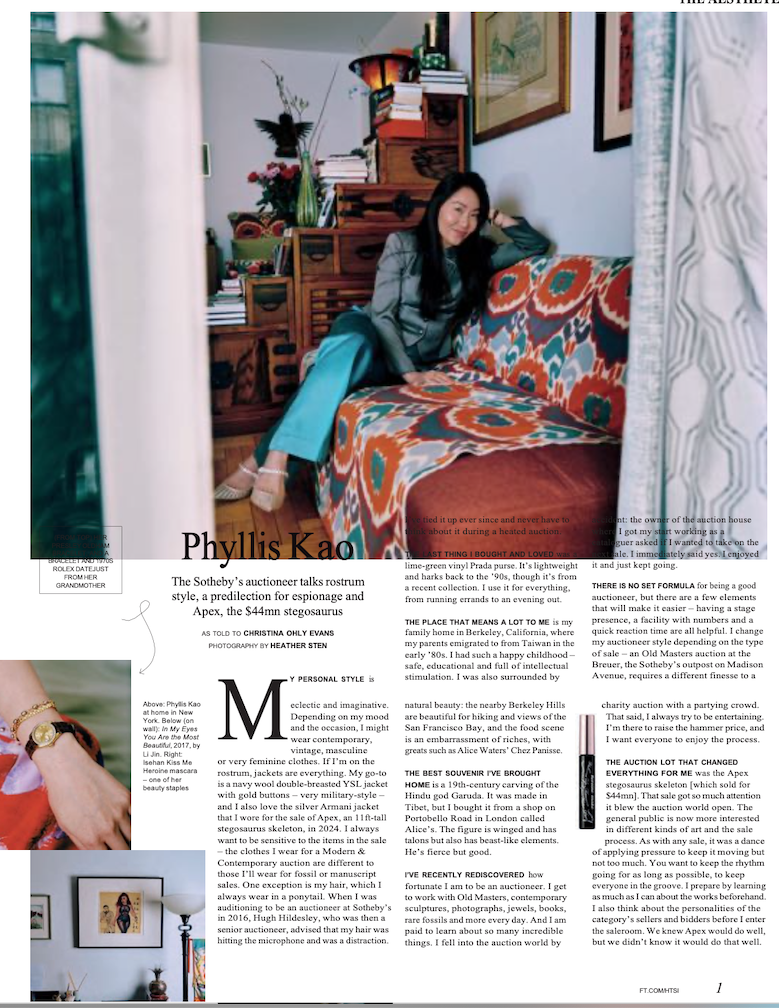
Auctioneer Phyllis Kao talks taste
The Sotheby’s star on stage presence, the San Francisco Giants and selling a $45mn stegosaurus.
Please use the sharing tools found via the share button at the top or side of articles. Copying articles to share with others is a breach of FT.com T&Cs and Copyright Policy. Email licensing@ft.com to buy additional rights. Subscribers may share up to 10 or 20 articles per month using the gift article service. More information can be found on the Help FAQ on gift articles.
https://www.ft.com/content/2a88a285-9d38-4983-bc0a-9db294d9117e
My personal style is eclectic and imaginative. Depending on my mood and the occasion, I might wear contemporary, vintage, masculine or very feminine clothes. If I’m on the rostrum, jackets are everything. My go-to is a navy wool double-breasted YSL jacket with gold buttons – very military-style – and I also love the silver Armani jacket that I wore for the sale of Apex, an 11ft-tall stegosaurus skeleton, in 2024. I always want to be sensitive to the items in the sale – the clothes I wear for a Modern & Contemporary auction are different to those I’ll wear for fossil or manuscript sales. One exception is my hair, which I always wear in a ponytail. When I was auditioning to be an auctioneer at Sotheby’s in 2016, Hugh Hildesley, who was then a senior auctioneer, advised that my hair was hitting the microphone and was a distraction. I’ve tied it up ever since and never have to think about it during a heated auction.
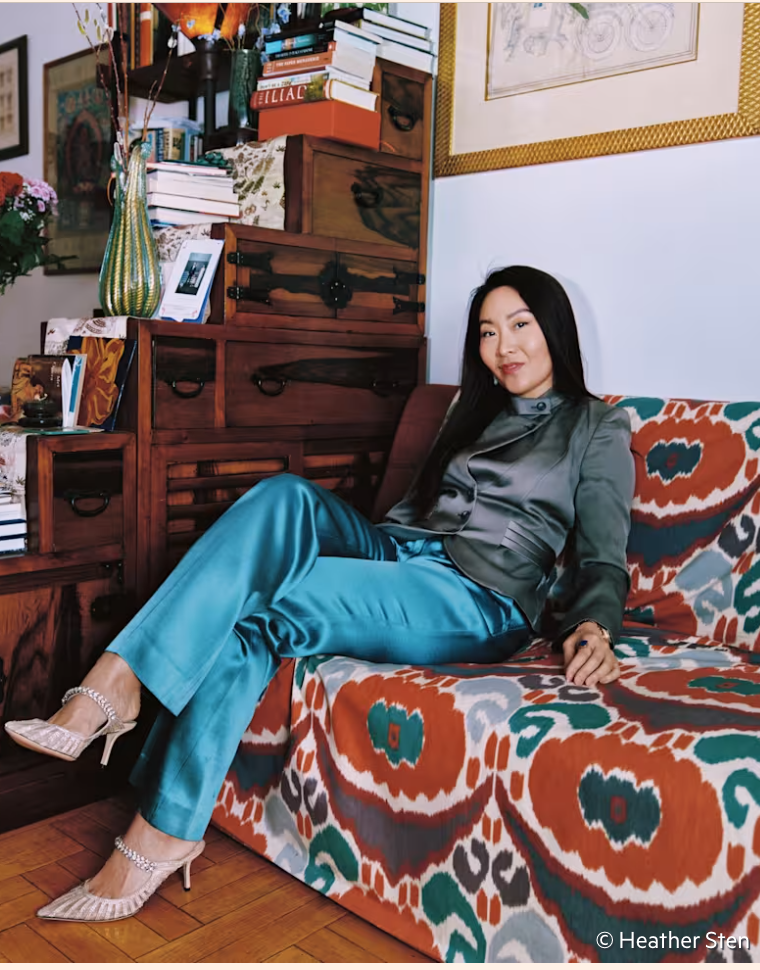
The Sotheby’s star on stage presence, the San Francisco Giants and selling a $45mn stegosaurus
My personal style is eclectic and imaginative. Depending on my mood and the occasion, I might wear contemporary, vintage, masculine or very feminine clothes. If I’m on the rostrum, jackets are everything. My go-to is a navy wool double-breasted YSL jacket with gold buttons – very military-style – and I also love the silver Armani jacket that I wore for the sale of Apex, an 11ft-tall stegosaurus skeleton, in 2024. I always want to be sensitive to the items in the sale – the clothes I wear for a Modern & Contemporary auction are different to those I’ll wear for fossil or manuscript sales. One exception is my hair, which I always wear in a ponytail. When I was auditioning to be an auctioneer at Sotheby’s in 2016, Hugh Hildesley, who was then a senior auctioneer, advised that my hair was hitting the microphone and was a distraction. I’ve tied it up ever since and never have to think about it during a heated auction. The last thing I bought and loved was a lime-green vinyl Prada purse. It’s lightweight and harks back to the ’90s, though it’s from a recent collection. I use it for everything, from running errands to an evening out.
The place that means a lot to me is my family home in Berkeley, California, where my parents emigrated to from Taiwan in the early ’80s. I had such a happy childhood – safe, educational and full of intellectual stimulation. I was also surrounded by natural beauty: the nearby Berkeley Hills are beautiful for hiking and views of the San Francisco Bay, and the food scene is an embarrassment of riches, with greats such as Alice Waters’ Chez Panisse. The best souvenir I’ve brought home is a 19th-century carving of the Hindu god Garuda. It was made in Tibet, but I bought it from a shop on Portobello Road in London that’s now closed. The figure is winged and has talons but also has beast-like elements. He’s fierce but good.
I’ve recently rediscovered how fortunate I am to be an auctioneer. I get to work with Old Masters, contemporary sculptures, photographs, jewels, books, rare fossils and more every day. And I am paid to learn about so many incredible things. I fell into the auction world by accident: the owner of the auction house where I got my start working as a cataloguer asked if I wanted to take on the next sale. I immediately said yes. I enjoyed it and just kept going.
There is no set formula for being a good auctioneer, but there are a few elements that will make it easier – having a stage presence, a facility with numbers and a quick reaction time are all helpful. I change my auctioneer style depending on the type of sale – an Old Masters auction at the Breuer, the Sotheby’s outpost on Madison Avenue, requires a different finesse to a charity auction with a partying crowd. That said, I always try to be entertaining. I’m there to raise the hammer price, and I want everyone to enjoy the process.
The auction lot that changed everything for me was the Apex stegosaurus skeleton [which sold for $44.6mn]. That sale got so much attention, it blew the auction world open. The general public is now more interested in different kinds of art and the sale process. As with any sale, it was a dance of applying pressure to keep it moving but not too much. You want to keep the rhythm going for as long as possible, to keep everyone in the groove. I prepare by learning as much as I can about the works beforehand. I also think about the personalities of the category’s sellers and bidders before I enter the saleroom. We knew Apex would do well, but we didn’t know it would do that well.
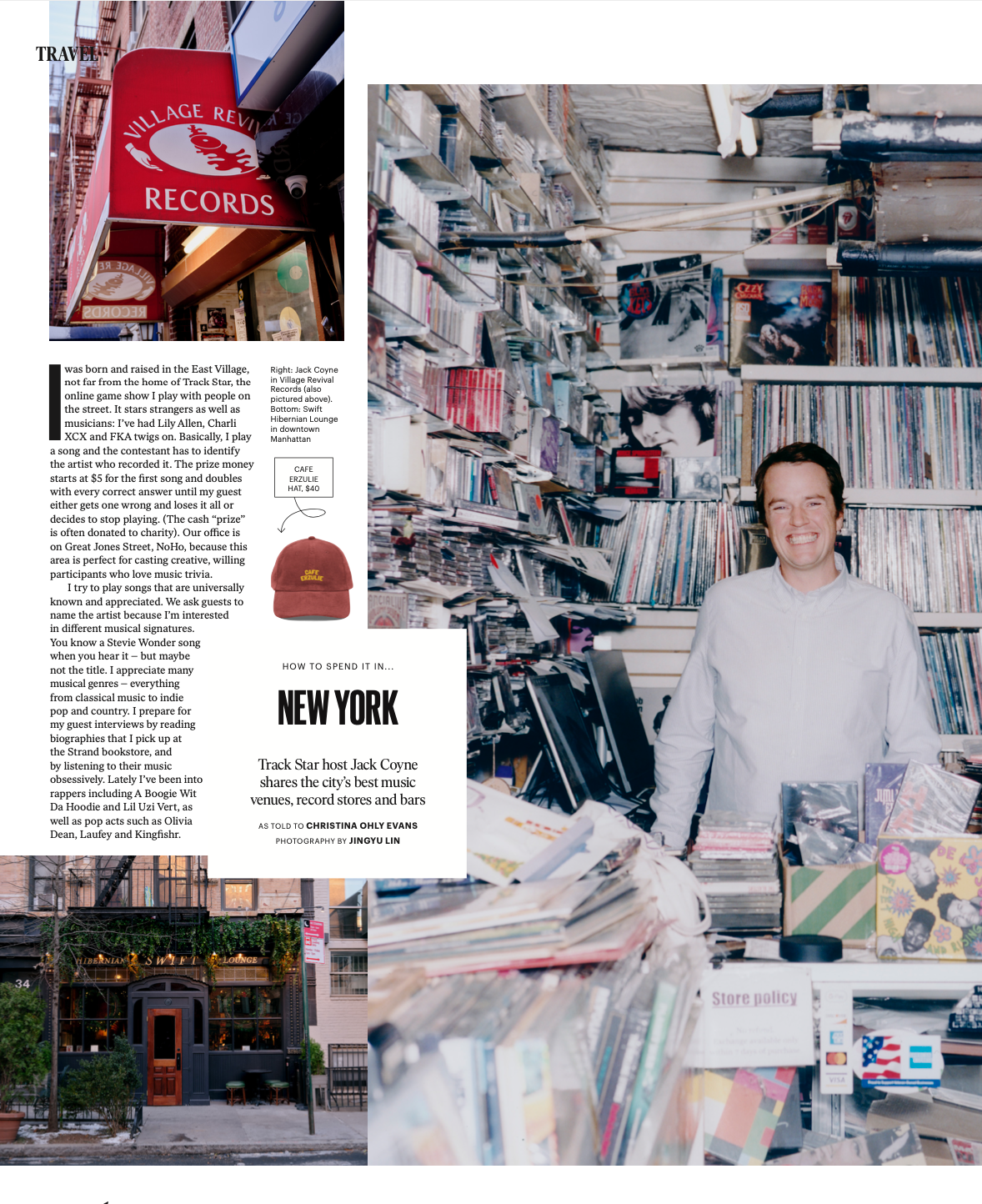
Track Star’s Jack Coyne leads a musical tour of New York
I was born and raised in the East Village, not far from the home of Track Star, the online game show I play with people on the street. It stars strangers as well as musicians: I’ve had Lily Allen, Charli XCX and FKA Twigs on. Basically, I play a song and the contestant has to identify the artist who recorded it. The prize money starts at $5 for the first song and doubles with every correct answer until my guest either gets one wrong and loses it all or decides to stop playing. (The cash “prize” is often donated to charity.) Our office is on Great Jones Street, in NoHo, because this area is perfect for casting creative, willing participants who love music trivia.
The TikTok host takes us to the jazz clubs, concert venues, bars and record stores that keep the city swinging
I was born and raised in the East Village, not far from the home of Track Star, the online game show I play with people on the street. It stars strangers as well as musicians: I’ve had Lily Allen, Charli XCX and FKA Twigs on. Basically, I play a song and the contestant has to identify the artist who recorded it. The prize money starts at $5 for the first song and doubles with every correct answer until my guest either gets one wrong and loses it all or decides to stop playing. (The cash “prize” is often donated to charity.) Our office is on Great Jones Street, in NoHo, because this area is perfect for casting creative, willing participants who love music trivia.
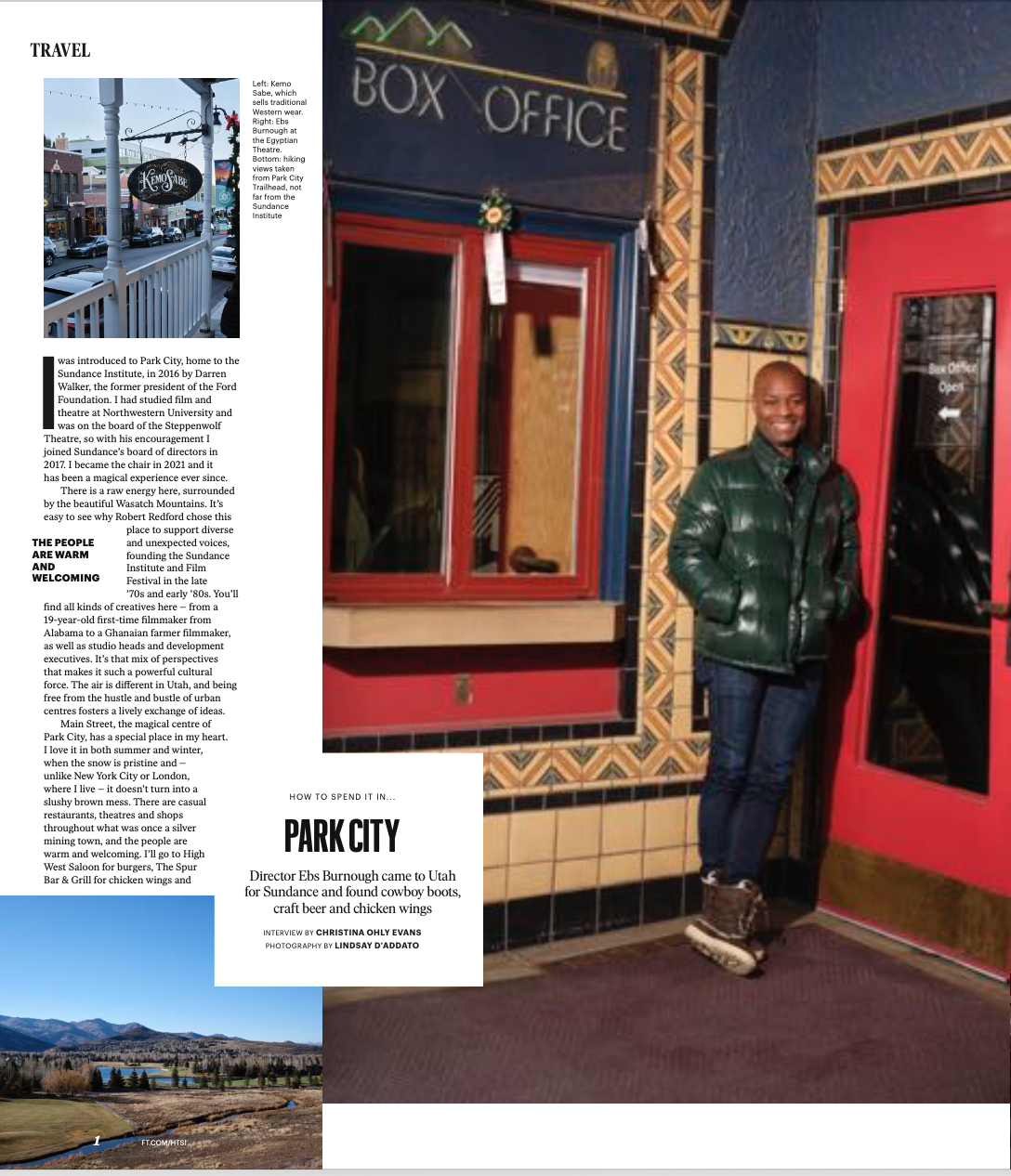
A Sundance insider guide to Park City, Utah
I was introduced to Park City, home to the Sundance Institute, in 2016 by Darren Walker, the former president of the Ford Foundation. I had studied film and theatre at Northwestern University and was on the board of the Steppenwolf Theatre, so with his encouragement I joined Sundance’s board of directors in 2017. I became the chair in 2021 and it has been a magical experience ever since.
Director Ebs Burnough came to Utah for the film festival and found a haven for coffee, craft beer and chicken wings
I was introduced to Park City, home to the Sundance Institute, in 2016 by Darren Walker, the former president of the Ford Foundation. I had studied film and theatre at Northwestern University and was on the board of the Steppenwolf Theatre, so with his encouragement I joined Sundance’s board of directors in 2017. I became the chair in 2021 and it has been a magical experience ever since.
There is a raw energy here, surrounded by the beautiful Wasatch Mountains. It’s easy to see why Robert Redford chose this place to support diverse and unexpected voices, founding the Sundance Institute and Film Festival in the late ’70s and early ’80s. You’ll find all kinds of creatives here – from a 19-year-old first-time filmmaker from Alabama to a Ghanaian farmer-director, as well as studio heads and development executives. It’s that mix of perspectives that makes it such a powerful cultural force. The air is different in Utah, and being free from the hustle and bustle of urban centres fosters a lively exchange of ideas.
Main Street, the centre of Park City, has a special place in my heart. I love it in both summer and winter, when the snow is pristine and – unlike New York City or London, where I live – it doesn’t turn into a slushy brown mess. There are casual restaurants, theatres and shops throughout what was once a silver mining town, and the people are warm and welcoming. I’ll go to High West Saloon for burgers, The Spur Bar & Grill for chicken wings and Tekila for Tex-Mex. I like to take meetings at the latter – possibly with a secret Margarita. Everything is relaxed and casual.
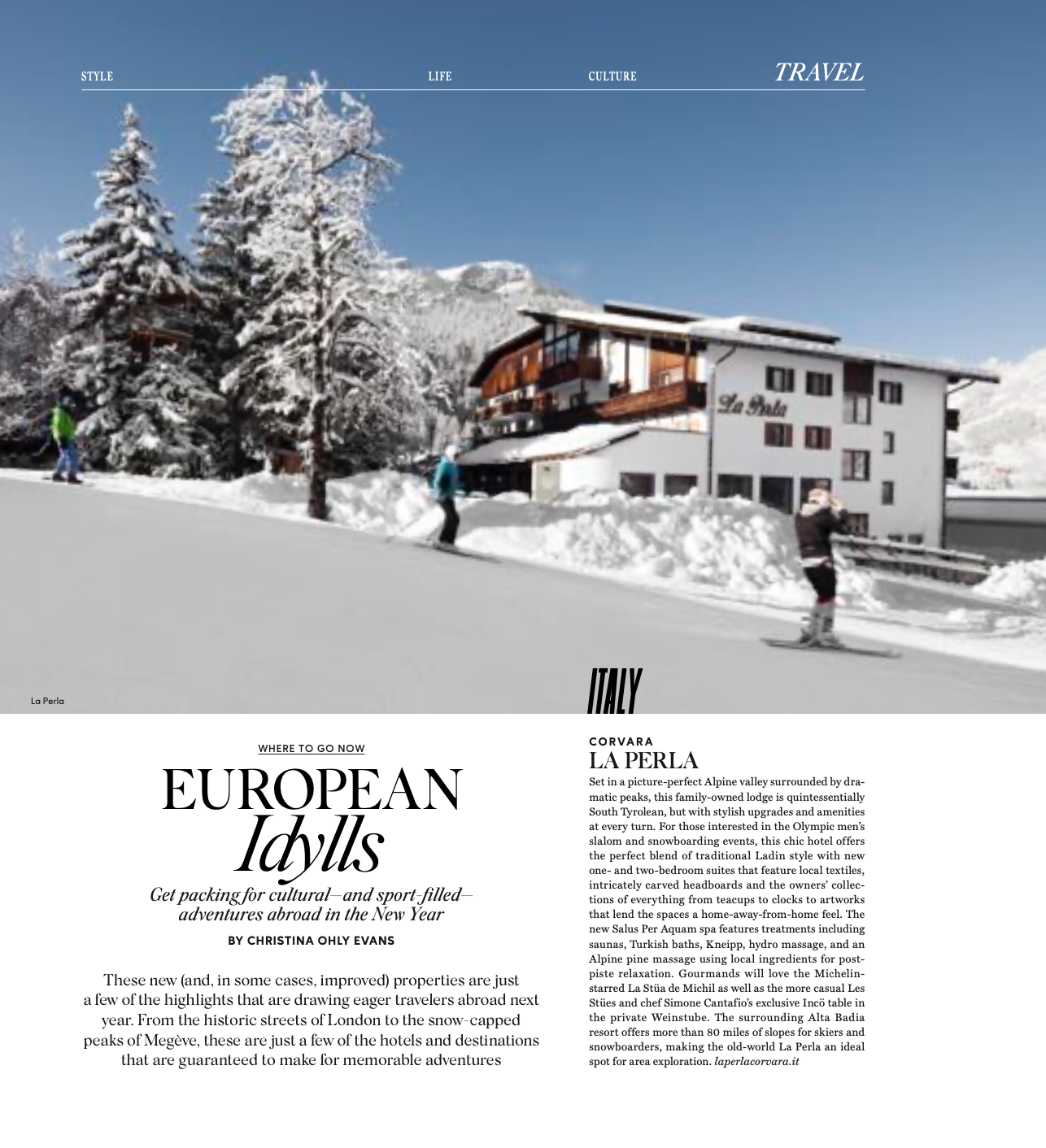
European Idylls
These new (and, in some cases, improved) properties are just
a few of the highlights that are drawing eager travelers abroad next year. From the historic streets of London to the snow-capped peaks of Megève, these are just a few of the hotels and destinations that are guaranteed to make for memorable adventures.
Get packing for cultural—and sport-filled— adventures abroad in the New Year
BY CHRISTINA OHLY EVANS
These new (and, in some cases, improved) properties are just a few of the highlights that are drawing eager travelers abroad next year. From the historic streets of London to the snow-capped peaks of Megève, these are just a few of the hotels and destinations that are guaranteed to make for memorable adventures.
CORVARA, LA PERLA
Set in a picture-perfect Alpine valley surrounded by dra- matic peaks, this family-owned lodge is quintessentially South Tyrolean, but with stylish upgrades and amenities at every turn. For those interested in the Olympic men’s slalom and snowboarding events, this chic hotel offers the perfect blend of traditional Ladin style with new one- and two-bedroom suites that feature local textiles, intricately carved headboards and the owners’ collec- tions of everything from teacups to clocks to artworks that lend the spaces a home-away-from-home feel. The new Salus Per Aquam spa features treatments including saunas, Turkish baths, Kneipp, hydro massage, and an Alpine pine massage using local ingredients for post- piste relaxation. Gourmands will love the Michelin- starred La Stüa de Michil as well as the more casual Les Stües and chef Simone Cantafio’s exclusive Incö table in the private Weinstube. The surrounding Alta Badia resort offers more than 80 miles of slopes for skiers and snowboarders, making the old-world La Perla an ideal spot for area exploration. laperlacorvara.it
CORTINA D’AMPEZZO ANCORA CORTINA
Almost 200 years after its founding, this beloved land- mark hotel is once again a hub for social and cultural life on the bustling Corso Italia in the heart of Cortina. Under the management of Egnazia Ospitalità Italiana (the team behind Borgo Egnazia in Puglia), the 35 rooms and suites by noted designer Vicky Charles, for- mer head of design for Soho House, are at once both authentically Alpine and quietly luxurious. The 17 suites—including the Ancora Suite, with a terrace— feature panoramic views over the quaint town and the Dolomites beyond. Just in time for the Olympic Games (women’s downhill skiing will be held here), the Ancora will debut a fine-dining restaurant and cocktail bar, as well as a state-of-the-art gym and the Brave Club, a gathering spot for creatives, athletes and curious trav- elers alike. ancoracortina.com
BRIXEN, FORESTIS DOLOMITES
Set against the stunning backdrop of the Dolomites—a UNESCO World Heritage site—and surrounded by dense forest, Forestis is a serene sanctuary where the silence of nature, locally inspired cuisine, sublime spa treatments and ski-in, ski-out access are all celebrated. The proper- ty’s 62 exquisite rooms and suites sit at 6,000 feet, adja- cent to the Puez-Geisler Nature Park and above the village of Brixen. The South Tyrolean retreat highlights the pillars of nature: clear water, pure air, bountiful sun and a mild climate. A combination of old and new archi- tectural styles meld three design-led towers with the original listed wooden structure to create a compound with unobstructed views. Interiors are hewn from local spruce according to architect Armin Sader’s designs. Natural materials—including wool from Trentino —are found throughout suites in the historic house as well as in tower suites where guests may sleep under starry skies. Penthouse suites feature floor-to-ceiling windows, while the recently opened Forestis Villa—complete with its own spa, wine cellar, fitness room and indoor-outdoor pool— can accommodate up to 10 people. The main spa is the star of the show with two light-filled stories offering everything from brine steam baths to Finnish saunas and a Tea Lounge with Forestis blends. Heavily influenced by Celtic tradition (the Celts were early settlers here), Wyda is a yoga practice centered around energy and inner cen- tering, while a range of treatments are tailored to guests’ wishes. Hiking through pristine snowfields, skiing 28 miles of runs at the Ploste ski area and cooking classes using the bounties of the forest are all on offer. Of special note is the new Yera (“harvest” in Rhaetian Celtic language)—a fine-dining restaurant set in a mountain cave. A deep red earth space envelops diners, all of whom sit around a central firepit while savoring such delicious ingredients as nettles, wild berries and spruce shoots in cell phone–free splendor. forestis.it