Dispatch from The Nordics
Growing up in Vermont, I was always drawn to Scandinavia—the climate, the colors, the can-do spirit of people habituated to serious weather. I was also steeped early in Danish and midcentury design by a family that traveled frequently to northern Europe. Other people’s grandparents went to Florida; mine went to Finland.
An August adventure of some kind has become a family tradition, and increasingly, I’m looking for cooler places (both aesthetically and weatherwise) with few tourists. In addition I like comfort, so when I was connected with Torunn Tronsvang, owner of Up Norway, I knew I could delegate the planning of our 8-day escape to her connected team.
by Christina Ohly Evans
Growing up in Vermont, I was always drawn to Scandinavia—the climate, the colors, the can-do spirit of people habituated to serious weather. I was also steeped early in Danish and midcentury design by a family that traveled frequently to northern Europe. Other people’s grandparents went to Florida; mine went to Finland.
An August adventure of some kind has become a family tradition, and increasingly, I’m looking for cooler places (both aesthetically and weatherwise) with few tourists. In addition I like comfort, so when I was connected with Torunn Tronsvang, owner of Up Norway, I knew I could delegate the planning of our 8-day escape to her connected team.
Largely due to flights, we wanted to start in Copenhagen and end in Oslo. After an introductory phone call where we detailed our preferences—outdoor activities but not too hardcore; luxurious-but-not-fancy hotels; art and culture, but not too many museums; “local color” in terms of neighborhoods, cafes, restaurants, shops and so forth—we were all on the same planning page. Torunn then set about executing the most meticulous, fun, slightly outside the box (in the best way) holiday for our group of four. I am used to handling all of my own travel arrangements, so it was hard and strange to let it go, but Torunn assured me that she knew exactly what we were looking for, our fitness levels, food allergies and so forth. The result was a unique road trip that is still so vivid—with all kinds of boats, museums, and memorable meals that will be tough to top this summer.
Gothenburg
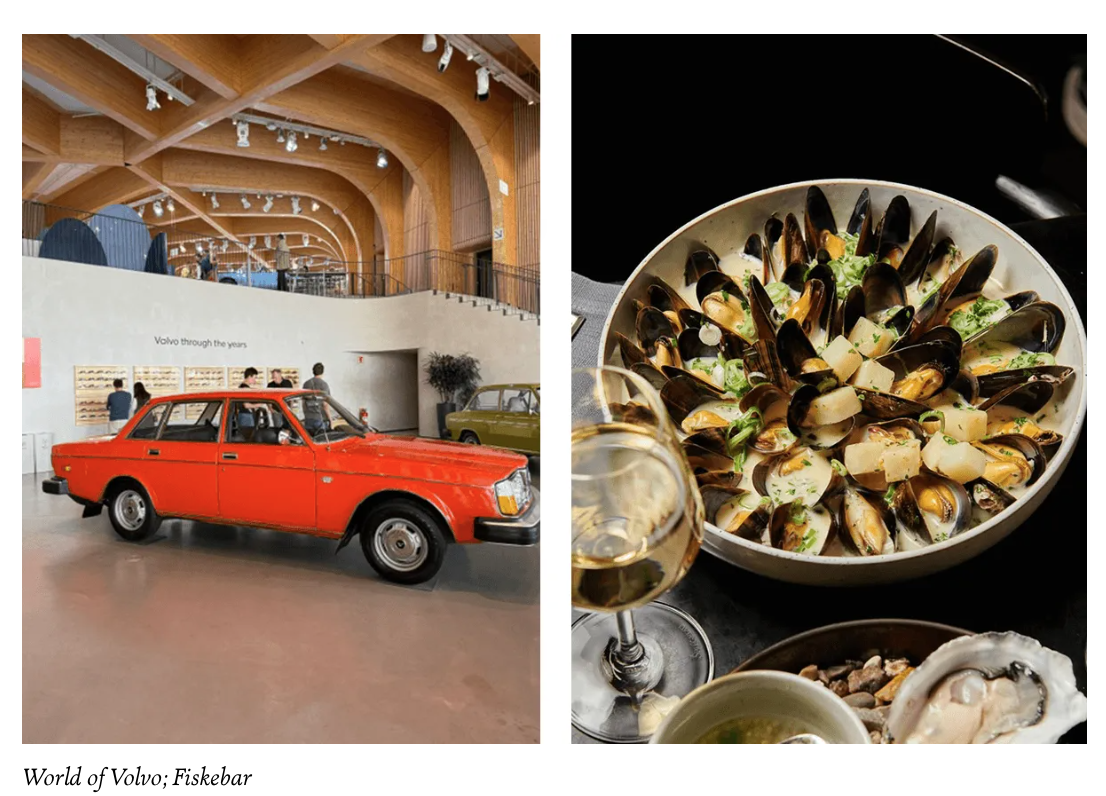
We spent a packed 24 hours in Copenhagen wandering Nyhavn and the King’s Garden, followed by an unforgettable meal outside at Fiskebar at 10 pm. Then it was time to head north. After swallowing the sticker shock of the rental car (beware one-way, cross-border, strict mileage limits and a 25% VAT), we made our first stop: Gothenburg, Sweden. We had visited Stockholm once years earlier, but knew very little about the country’s west coast and were quickly taken by this quieter, more manageable “second city.” Nature is everywhere, as are hipster coffee places and vintage clothing shops, so I highly recommend a day spent wandering. But we were really there so my traveling companions could hit the World of Volvo. I am no car enthusiast, but this new museum (opened last year) is an immersion in great Swedish design, from the earliest ambulances and safety vehicles to the iconic 740 series to state-of-the-art models available for purchase. Kids ages 5-12 will love Traffic School—an outdoor driving track where they learn the basics and earn a souvenir driver’s license. The building, by Danish architecture firm Henning Larsen, is an homage to the Swedish idea of Allemansrätten (the right to roam), with spaces made of sustainable wood that makes it feel like a light-filled forest. Pro tips: both the café and the gift shop are worthwhile stops before trying the driving game, Distractville, where reflexes and judgement are tested.
Pater Noster
We spent our first night at Pater Noster—a decommissioned lighthouse and keeper’s house that was built in 1868. I will never stop thinking about this place, and largely for the experience of getting there. We parked the car in the town of Marstrand, where we were met by the amiable Carl, who captained us over to Pater Noster. I knew we were in for an exciting journey, as the RIB boat was outfitted with all kinds of stirrups and straps. It was Captain Carl (straight out of Viking central casting) handing us each an inflatable suit that really got my attention: getting wet was inevitable, but I had no idea what we were in for (think “Deadliest Catch”). The wind and waves were howling, but 5 nautical miles and 30 minutes later, we arrived at this incredible rocky outcropping. I swore I wouldn’t get back on that terror ride for our return trip, and yet 24 short hours later I was a hearty, seafaring Swede myself.
A stay at Pater Noster is unlike anything I’ve experienced before or since. A cozy main house (there are 9 guest rooms), a few outbuildings including the communal dining room, a hot tub and sauna with sea views are the extent of this scraggly island that is the size of a soccer field. That said, every touch is magical: from the freshly baked scones to the Pater Noster wines and beer (made on the mainland), to the just-caught lobster, mussels and cod, a stay here is simple yet exquisite. The sounds of wind and crashing waves—not to mention the total isolation—make Pater Noster a rare reset, where you’ll come to know the small, attentive staff as well as the knowledgeable CEO/storyteller, Mirja Lilja Hagsjö, well into the night.
Kristiansand
After heading back to the mainland, we flew from Gothenburg to Kristiansand in southern Norway. Incidentally, the only other guests we met at Poster Noster were two women, Norwegian designers, who were impressed that we Americans were even going to southern Norway, as most people head straight for the fjords. They raved about its tiny coastal towns, and it was wonderful to find ourselves in this lesser-known countryside.
Just ten minutes from the Kristiansand Airport, we arrived at Boen Gård, a 16th century estate and manor that opened to the public in 2012. Once owned by King Christian II, it has hosted countless statesmen and was long a draw for Britons who came to fish salmon on the river below it. The furniture and art have been meticulously sourced to preserve traditions that began in 1520, and have since hosted kings and avid anglers, while guest rooms have a Scandi, clean-lined feel. Set in a beautiful park at the edge of the Tovdalselva River, Boen Gård is well known for its Michelin-starred cuisine—think tasting menus featuring herbs, honey, berries, and more grown on the estate. Everything else, including the meat and fish, comes from within a 90-mile radius and they are deeply committed to “New Nordic” sustainable everything—think peonies and geraniums sourced from the organic gardens; freshly caught salmon from the Tovdal river; a house-made flatbread of emmer flour, with smoked cod roe taramasalata and fresh dill; and not a single piece of plastic in sight.
The next day after breakfast in the bright dining room (designed that way to maximize natural light in the long, dark winters), decorated simply with local wildflowers, activities included fishing with the very personable Ryan (+4790915846), followed by a private tour of the Kunstilo museum in Kristiansand. A former 1930s grain silo, it now houses the world’s largest collection of Nordic modernism, and the building is the ultimate adaptive reuse project with soaring spaces and a cathedral-like feel.
Often called the “Summer City” because of its sunny maritime climate, Kristiansand is considered the cultural hub of southern Norway and there seemed to be art and music at every turn. Stroll along the Fiskebrygga (The Fish Quay) and on to the Fountain Park, the city beach and Posebyen, aka the “old town.” Kristiansand Cathedral is one of the largest in Norway and is a beautiful stop for lunch, before heading to Smag & Behag for dinner in an old school gymnasium. If you’ve had enough fish, Mother India is a colorful, family-run classic for butter chicken and excellent naan.
Coastal Lillesand
Our next stop was Lillesand, a tiny coastal village just 30 minutes from Boen Gård, which has a very Maine-esque feel. The main objective here was to do a guided tour of the archipelago by kayak with seasoned pro, Haakem Teland. A literal pro—he was on Norway’s national kayaking team and competed in the World Cup and European Championships—Teland is now the owner of Padlegleden, an outfitter dedicated to the stretch of coastline.
Once suited up, we headed off on a three-hour gentle paddle through islands and inlets and learned about everything from the white summer cabins belonging to affluent Osloveians that dot the sparse islands, to the crystal-clear water (thanks to a strong current and a rocky seabed), to Norwegian politics. (I especially loved learning about their consensus-based, stable model of government, and about the Norwegian Sovereign Wealth Fund, the largest in the world, that supports the country’s welfare state). Haakem is delightful, and I highly recommend seeing the area from the water while stopping on the sandy shores for refreshments and environmental highlights. After a thorough workout, we walked back to the harbor and ate lunch at Strandhaven—a charming restaurant with a patio, more water views and excellent pizza. Perfection on a warm summer afternoon.
Risør
Our next stop, an hour away, was the town of Risør, where our Norwegian friends from Pater Noster grew up going as children. It turns out this stretch of coastline is referred to as the “Norwegian Riviera” for its beautiful summer homes and fleets of sailboats that arrive in summer.
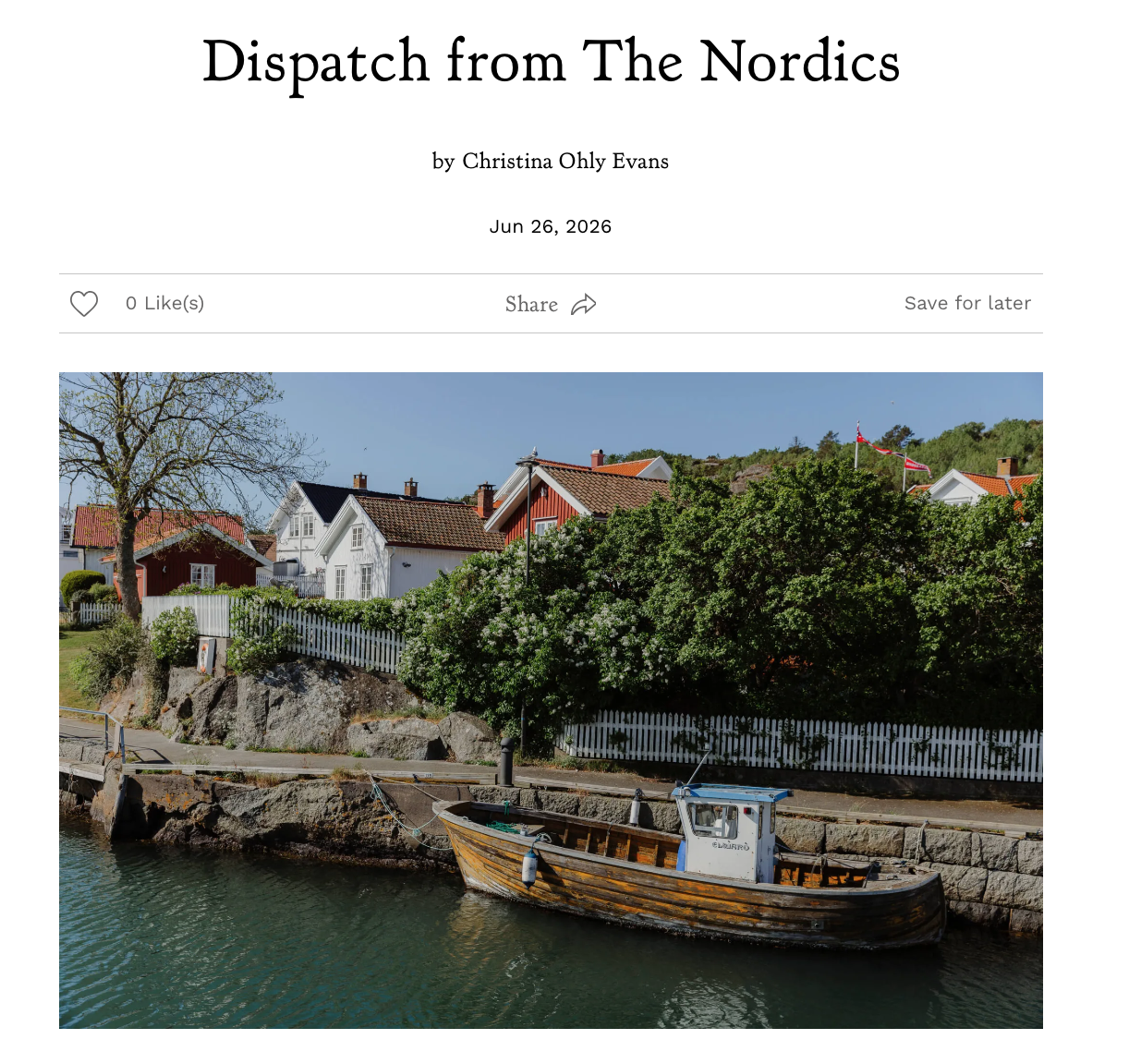
We stayed at Det Lille, which is actually a series of apartments plus one central hotel that are spread throughout the former fishing village. We were possibly the only tourists there—and certainly the only Americans—as Norwegian children head back to school in mid-August. Our base was the small mustard yellow hotel in the center of town, one with the tiniest rooms but the most expansive views of the harbor. The management are proud of their traditions and the head chef led us in a fish soup-making class (which I am sure I will never use again!), complete with Norwegian tunes. Risør is a lovely place, with a harbor filled with classic wooden skiffs and fishing vessels; I would highly recommend it for sailing enthusiasts and cold plungers alike, especially in shoulder season. With the wood-fired pizza spot humming with locals and the sun setting at 10 pm, it’s idyllic.
Before our return to Oslo, we spent the following day aboard the Risør 2, a beautifully restored rescue vessel that was built here in 1914. Like something out of a movie (think rigging, weathered sails, two non-English speaking deck hands), the ship plied the waters of a small fjord past tiny lighthouses and more summer homes accessible only by boat. Our final stop was Moen Trebåtverksted, a remote boatyard specializing in the construction and repair of traditional wooden boats. The enormous picnic lunch provided by the hotel—with sandwiches, smoked salmon, and fruit—made for a magical day spent on the water.
Oslo proved the perfect last stop. It’s a peaceful, outdoorsy city with excellent food and just the right amount of culture. We stayed at the Hotel Amerikalinjen, an iconic building designed in 1919, which previously served as the headquarters of the Norwegian America Line cruise company. The property has been reimagined to retain its maritime ethos, but with contemporary, design-led touches (their breakfast buffet remains one the best in recent memory). From this very central location, you’re next to the famous Oslo Opera House designed by acclaimed Norwegian architecture firm Snøhetta (a walk on this massive, marble-clad roof is a must), the Munch Museum, and best of all, the floating KOK saunas, where locals and tourists alike soak in the clean city views.
The highlight of our 24 hours in Oslo, however, was lunch at a tiny island restaurant called Lille Herbern. The two women—both Oslo residents—we’d met at Pater Noster invited us to join them at this “insider” favorite. A quick, minute-long ferry ride landed us at this truly local spot on a tiny island just off the shore at Bygdøy. A long lunch of oysters, Norwegian lobster, jerk chicken, and corn on the cob with chili and salt—with friends, in this gorgeous setting—was the perfect end to our Scandinavian journey.
Relaxing RETREATS
While travel can feel hectic—not to mention expensive—these days, adventures and relaxing escapes are in higher demand than ever. From design-led properties with a focus on wellness to sumptuous estates in remote winemaking regions, there are offerings for every age and interest. Whether you’re looking for an art-filled escape or an adrenaline-charged break, the time is now to book a summer holiday to remember.
From Mallorca to Mexico, a new crop of design-led hotels are their opening doors
BY CHRISTINA OHLY EVANS
While travel can feel hectic—not to mention expensive—these days, adventures and relaxing escapes are in higher demand than ever. From design-led properties with a focus on wellness to sumptuous estates in remote winemaking regions, there are offerings for every age and interest. Whether you’re looking for an art-filled escape or an adrenaline-charged break, the time is now to book a summer holiday to remember.
Amalfi Coasting;
LE SIRENUSE MARE
A beach club extraordinaire is the latest stylish addition to the Italian Riviera
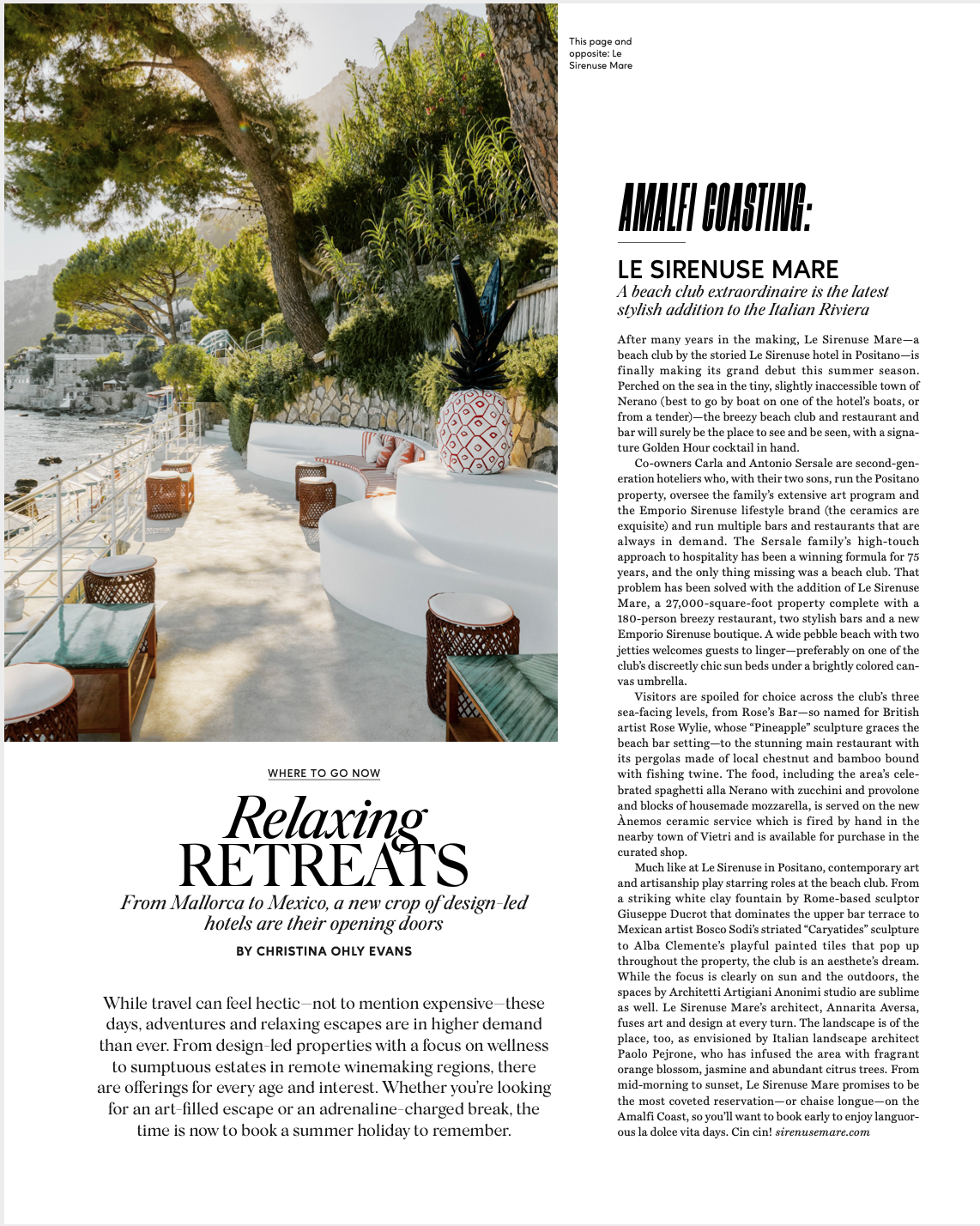
After many years in the making, Le Sirenuse Mare—a beach club by the storied Le Sirenuse hotel in Positano—is finally making its grand debut this summer season. Perched on the sea in the tiny, slightly inaccessible town of Nerano (best to go by boat on one of the hotel’s boats, or from a tender)—the breezy beach club and restaurant and bar will surely be the place to see and be seen, with a signa- ture Golden Hour cocktail in hand.
Co-owners Carla and Antonio Sersale are second-gen- eration hoteliers who, with their two sons, run the Positano property, oversee the family’s extensive art program and the Emporio Sirenuse lifestyle brand (the ceramics are exquisite) and run multiple bars and restaurants that are always in demand. The Sersale family’s high-touch approach to hospitality has been a winning formula for 75 years, and the only thing missing was a beach club. That problem has been solved with the addition of Le Sirenuse Mare, a 27,000-square-foot property complete with a 180-person breezy restaurant, two stylish bars and a new Emporio Sirenuse boutique. A wide pebble beach with two jetties welcomes guests to linger—preferably on one of the club’s discreetly chic sun beds under a brightly colored can- vas umbrella.
Visitors are spoiled for choice across the club’s three sea-facing levels, from Rose’s Bar—so named for British artist Rose Wylie, whose “Pineapple” sculpture graces the beach bar setting—to the stunning main restaurant with its pergolas made of local chestnut and bamboo bound with fishing twine. The food, including the area’s cele- brated spaghetti alla Nerano with zucchini and provolone and blocks of housemade mozzarella, is served on the new Ànemos ceramic service which is fired by hand in the nearby town of Vietri and is available for purchase in the curated shop.
Much like at Le Sirenuse in Positano, contemporary art and artisanship play starring roles at the beach club. From a striking white clay fountain by Rome-based sculptor Giuseppe Ducrot that dominates the upper bar terrace to Mexican artist Bosco Sodi’s striated “Caryatides” sculpture to Alba Clemente’s playful painted tiles that pop up throughout the property, the club is an aesthete’s dream. While the focus is clearly on sun and the outdoors, the spaces by Architetti Artigiani Anonimi studio are sublime as well. Le Sirenuse Mare’s architect, Annarita Aversa, fuses art and design at every turn. The landscape is of the place, too, as envisioned by Italian landscape architect Paolo Pejrone, who has infused the area with fragrant orange blossom, jasmine and abundant citrus trees. From mid-morning to sunset, Le Sirenuse Mare promises to be the most coveted reservation—or chaise longue—on the Amalfi Coast, so you’ll want to book early to enjoy languor- ous la dolce vita days. Cin cin! sirenusemare.com
ORIENT EXPRESS VENEZIA
Opened to coincide with this year’s Venice Biennale, Orient Express Venezia brings the storied brand to the Cannaregio dis- trict in an exquisitely restored palazzo originally designed by Filippo Calendario. Blending neo-gothic and baroque ele- ments, and with interiors by Aline Asmar d’Amman, the 47-room property evokes both grandeur and intimacy, with ele- gantly frescoed salons, a dramatic octago- nal staircase and an opulent ballroom all adding to the feeling of a (very) luxurious private home stay. Dining spans a fine- dining restaurant, a leafy courtyard café and the signature Wagon Bar that captures the romance of the golden age of travel. orient-express.com
THE LAKE COMO EDITION
Set within a restored 19th-century palazzo overlooking the lake, The Lake Como Edition has expanded its wellness offering with the debut of The Longevity Spa this season. Developed in part- nership with The Longevity Suite, the spa introduces a scientific approach to wellbeing, blending biohacking technologies with holistic treatments such as the Iki-Sabi Ritual and personalized skin therapies using locally sourced ingredients. Multiple sau- nas, steam rooms, a Technogym-equipped fitness space and outdoor experiences like sunrise yoga and guided hikes make this a wellness destination rooted in both the traditional setting and next-gen innovative therapies. editionhotels.com
CASA J.K. PLACE ROMA
From hotelier Ori Kafri comes an exten- sion of the wildly popular J.K. Place Roma: the 12-apartment Casa J.K. Place Roma, which is set to open this summer. Set in a 17th-century palazzo in Via dei Prefetti, the exclusive club will be perfect for extended stays as well as guests in search of truly bespoke services. A dedicated con- cierge, butler, all-day restaurant and state- of-the-art gym will all be available—all just steps from the Piazza di Spagna and the Piazza Navona. jkplaces.com
LA TIARA DI CERVO, SARDINIA
Set high above Porto Cervo, La Tiara di Cervo introduces a more private, residential- style approach to the bustling Costa Smeralda. Set within a protected park, the Mediterranean estate offers 26 grand suites (available in one-, two- and three-bed- room configurations) designed for seamless indoor-outdoor living—each with a connected concierge and a private chef. Blending residential living with the comforts of a luxury hotel (including two infinity pools and a fitness center), the property offers a quieter, more intimate alternative to the region’s traditional glamour—but with the same stunning azure views. latiaradicervo.it
LA GIARDINA GUEST HOUSE, PIEDMONT
Opened this spring, La Giardina Guest House in off-the-beaten-track Turin offers an intimate, art-driven retreat in a restored 12th-century convent in the hills of Piedmont. With just four unique suites (each with its own theme), the boutique property emphasizes thoughtful design, warm hospitality and a deep sense of narrative. At its heart is the work of Italo-Canadian artist Bruno Billio, whose interdisciplinary creations shape the hotel’s identity by blending bold sculpture, installations and layered design into an atmospheric experience that’s rooted in family and creativity. lagiardina.com
Guest House
ARA MARIS HOTEL & SPA, SORRENTO
Perched high above the Gulf of Naples, Ara Maris Hotel & Spa intro- duces a fresh vision of Mediterranean luxury in the heart of Sorrento. As the destination’s only fully design-led contemporary boutique hotel—and its only adults-focused property—the 49-room retreat offers a serene escape defined by sleek architectural lines, destination- driven gastronomy and an immersive wellness program rooted in the landscape. Now entering its third season, Ara Maris blends modern elegance with a strong sense of place, offering a quiet retreat on the otherwise bustling peninsula. aramarishotel.com
European Idylls
These new (and, in some cases, improved) properties are just
a few of the highlights that are drawing eager travelers abroad next year. From the historic streets of London to the snow-capped peaks of Megève, these are just a few of the hotels and destinations that are guaranteed to make for memorable adventures.
Get packing for cultural—and sport-filled— adventures abroad in the New Year
BY CHRISTINA OHLY EVANS
These new (and, in some cases, improved) properties are just a few of the highlights that are drawing eager travelers abroad next year. From the historic streets of London to the snow-capped peaks of Megève, these are just a few of the hotels and destinations that are guaranteed to make for memorable adventures.
CORVARA, LA PERLA
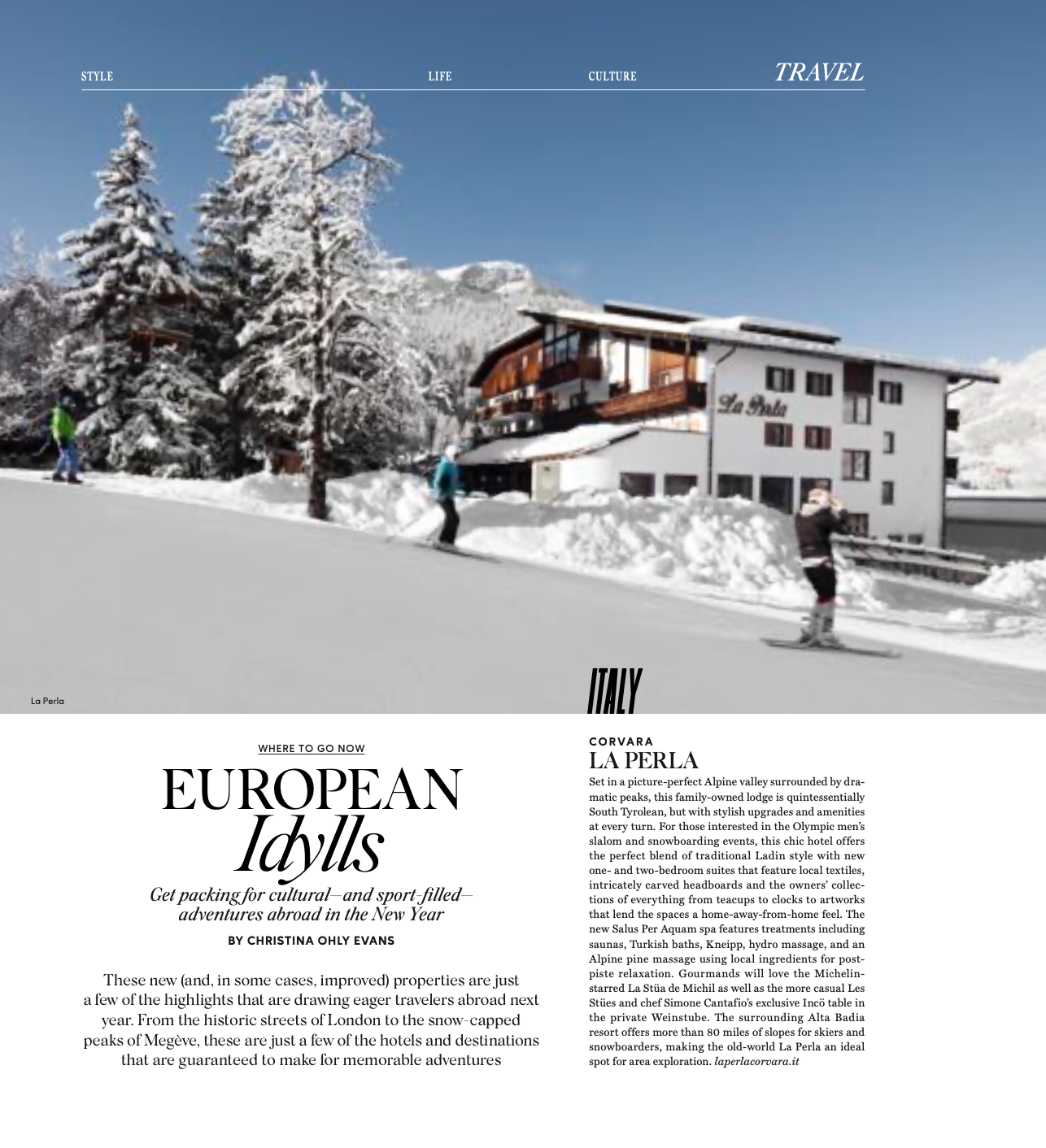
Set in a picture-perfect Alpine valley surrounded by dra- matic peaks, this family-owned lodge is quintessentially South Tyrolean, but with stylish upgrades and amenities at every turn. For those interested in the Olympic men’s slalom and snowboarding events, this chic hotel offers the perfect blend of traditional Ladin style with new one- and two-bedroom suites that feature local textiles, intricately carved headboards and the owners’ collec- tions of everything from teacups to clocks to artworks that lend the spaces a home-away-from-home feel. The new Salus Per Aquam spa features treatments including saunas, Turkish baths, Kneipp, hydro massage, and an Alpine pine massage using local ingredients for post- piste relaxation. Gourmands will love the Michelin- starred La Stüa de Michil as well as the more casual Les Stües and chef Simone Cantafio’s exclusive Incö table in the private Weinstube. The surrounding Alta Badia resort offers more than 80 miles of slopes for skiers and snowboarders, making the old-world La Perla an ideal spot for area exploration. laperlacorvara.it
CORTINA D’AMPEZZO ANCORA CORTINA
Almost 200 years after its founding, this beloved land- mark hotel is once again a hub for social and cultural life on the bustling Corso Italia in the heart of Cortina. Under the management of Egnazia Ospitalità Italiana (the team behind Borgo Egnazia in Puglia), the 35 rooms and suites by noted designer Vicky Charles, for- mer head of design for Soho House, are at once both authentically Alpine and quietly luxurious. The 17 suites—including the Ancora Suite, with a terrace— feature panoramic views over the quaint town and the Dolomites beyond. Just in time for the Olympic Games (women’s downhill skiing will be held here), the Ancora will debut a fine-dining restaurant and cocktail bar, as well as a state-of-the-art gym and the Brave Club, a gathering spot for creatives, athletes and curious trav- elers alike. ancoracortina.com
BRIXEN, FORESTIS DOLOMITES
Set against the stunning backdrop of the Dolomites—a UNESCO World Heritage site—and surrounded by dense forest, Forestis is a serene sanctuary where the silence of nature, locally inspired cuisine, sublime spa treatments and ski-in, ski-out access are all celebrated. The proper- ty’s 62 exquisite rooms and suites sit at 6,000 feet, adja- cent to the Puez-Geisler Nature Park and above the village of Brixen. The South Tyrolean retreat highlights the pillars of nature: clear water, pure air, bountiful sun and a mild climate. A combination of old and new archi- tectural styles meld three design-led towers with the original listed wooden structure to create a compound with unobstructed views. Interiors are hewn from local spruce according to architect Armin Sader’s designs. Natural materials—including wool from Trentino —are found throughout suites in the historic house as well as in tower suites where guests may sleep under starry skies. Penthouse suites feature floor-to-ceiling windows, while the recently opened Forestis Villa—complete with its own spa, wine cellar, fitness room and indoor-outdoor pool— can accommodate up to 10 people. The main spa is the star of the show with two light-filled stories offering everything from brine steam baths to Finnish saunas and a Tea Lounge with Forestis blends. Heavily influenced by Celtic tradition (the Celts were early settlers here), Wyda is a yoga practice centered around energy and inner cen- tering, while a range of treatments are tailored to guests’ wishes. Hiking through pristine snowfields, skiing 28 miles of runs at the Ploste ski area and cooking classes using the bounties of the forest are all on offer. Of special note is the new Yera (“harvest” in Rhaetian Celtic language)—a fine-dining restaurant set in a mountain cave. A deep red earth space envelops diners, all of whom sit around a central firepit while savoring such delicious ingredients as nettles, wild berries and spruce shoots in cell phone–free splendor. forestis.it
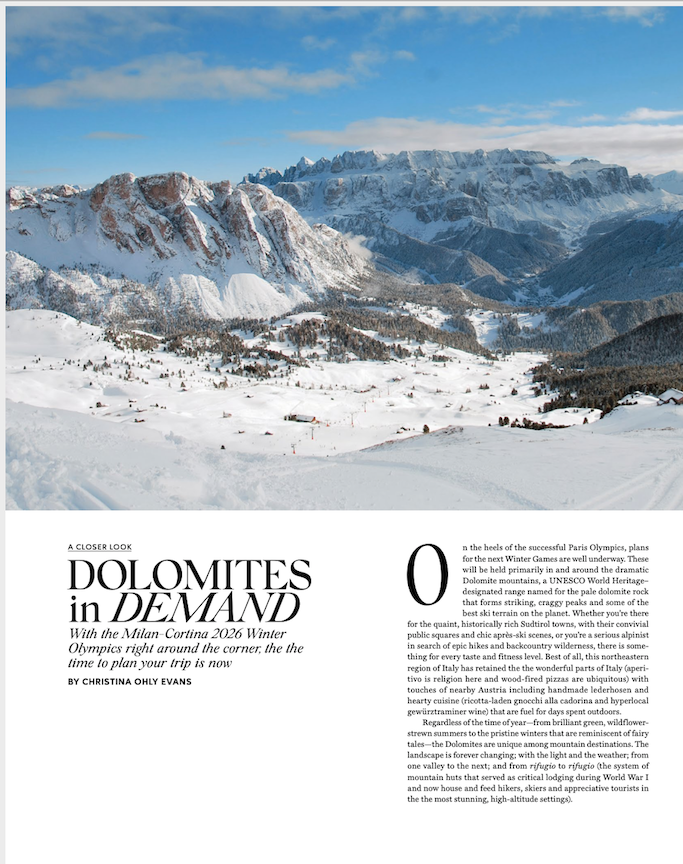
DOLOMITES in DEMAND
With the Milan-Cortina 2026 Winter Olympics right around the corner, the the time to plan your trip is now.
On the heels of the successful Paris Olympics, plans for the next Winter Games are well underway. These will be held primarily in and around the dramatic Dolomite mountains, a UNESCO World Heritage– designated range named for the pale dolomite rock that forms striking, craggy peaks and some of the best ski terrain on the planet.
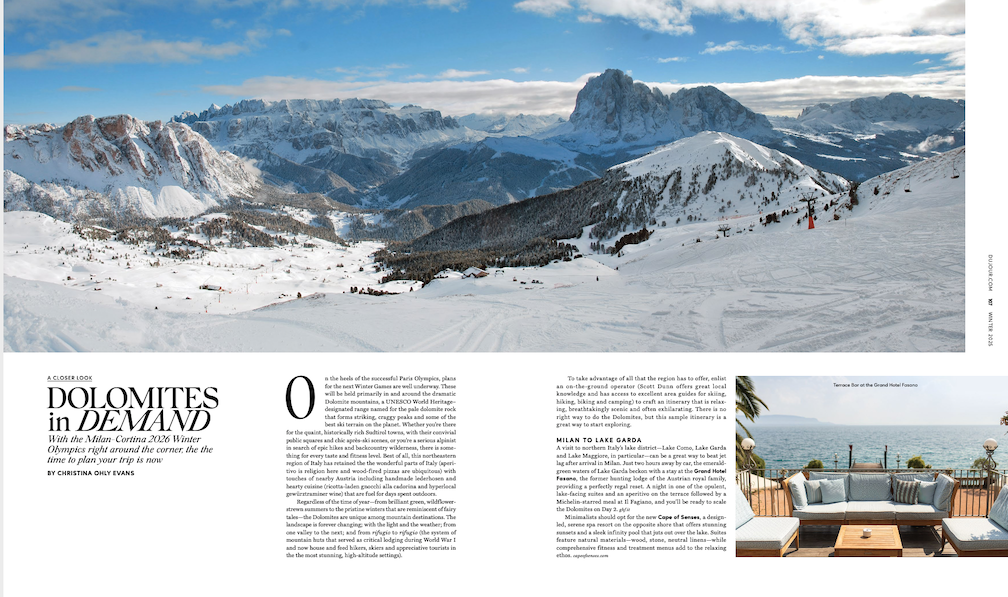
With the Milan-Cortina 2026 Winter Olympics right around the corner, the the time to plan your trip is now.
By Christina Ohly Evans
On the heels of the successful Paris Olympics, plans for the next Winter Games are well underway. These will be held primarily in and around the dramatic Dolomite mountains, a UNESCO World Heritage– designated range named for the pale dolomite rock that forms striking, craggy peaks and some of the best ski terrain on the planet. Whether you’re there for the quaint, historically rich Sudtirol towns, with their convivial public squares and chic après-ski scenes, or you’re a serious alpinist in search of epic hikes and backcountry wilderness, there is some- thing for every taste and fitness level. Best of all, this northeastern region of Italy has retained the the wonderful parts of Italy (aperi- tivo is religion here and wood-fired pizzas are ubiquitous) with touches of nearby Austria including handmade lederhosen and hearty cuisine (ricotta-laden gnocchi alla cadorina and hyperlocal gewürztraminer wine) that are fuel for days spent outdoors.
Regardless of the time of year—from brilliant green, wildflower- strewn summers to the pristine winters that are reminiscent of fairy tales—the Dolomites are unique among mountain destinations. The landscape is forever changing; with the light and the weather; from one valley to the next; and from rifugio to rifugio (the system of mountain huts that served as critical lodging during World War I and now house and feed hikers, skiers and appreciative tourists in the the most stunning, high-altitude settings).
To take advantage of all that the region has to offer, enlist an on-the-ground operator (Scott Dunn offers great local knowledge and has access to excellent area guides for skiing, hiking, biking and camping) to craft an itinerary that is relax- ing, breathtakingly scenic and often exhilarating. There is no right way to do the Dolomites, but this sample itinerary is a great way to start exploring.
MILAN TO LAKE GARDA
A visit to northern Italy’s lake district—Lake Como, Lake Garda and Lake Maggiore, in particular—can be a great way to beat jet lag after arrival in Milan. Just two hours away by car, the emerald- green waters of Lake Garda beckon with a stay at the Grand Hotel Fasano, the former hunting lodge of the Austrian royal family, providing a perfectly regal reset. A night in one of the opulent, lake-facing suites and an aperitivo on the terrace followed by a Michelin-starred meal at Il Fagiano, and you’ll be ready to scale the Dolomites on Day 2. ghf.it
Minimalists should opt for the new Cape of Senses, a design- led, serene spa resort on the opposite shore that offers stunning sunsets and a sleek infinity pool that juts out over the lake. Suites feature natural materials—wood, stone, neutral linens—while comprehensive fitness and treatment menus add to the relaxing ethos. capeofsenses.com
GATEWAY TO THE DOLOMITES
Surrounded by vineyards and fruit orchards, the small city of Bolzano is a relatively undiscovered gem. Here you’ll find medieval streets and arcades and the not-to-be-missed South Tyrol Museum of Archaeology, home to the remains of Ötzi, a man killed in the Alps about 5,300 years ago whose well-preserved body was discov- ered encased in ice in 1991 (be sure to book tickets in advance). Check in at the stunning Castel Hörtenberg, a 16th-century castle hidden behind gates on a tree-lined street that combines original elements, including imposing towers and lush gardens, with sleek Italian design. Original frescoes have been meticulously restored in the light-filled guest rooms and a soothing color palette of linen and beige recalls the style of Axel Vervoordt. Multiple dining spaces offer everything from a breakfast buffet to a South Tyrolean meal in a former wine cave. In summer, a sleek pool provides a respite from the heat, while the design-led spa specializes in sauna/ cold plunge combinations. castel-hoertenberg.com
ON TO ALTA BADIA
Start any ski adventure with a stay at the uber-charming Aman Rosa Alpina in the town of San Cassiano, with its onion-shaped belltower. Run by the third generation of the Pizzinini family and soon to be reopened with Aman Hotels & Resorts, this original hotel exudes traditional chalet warmth. The ski slopes of Alta Badia—some 80 miles of them—are within walking distance of the hotel and are equally popular in summer for hiking and climbing. Of special note here is the three Michelin-starred St. Hubertus, which is refined but never fussy. Helmed by chef Norbert Niederkofler, whose philosophy is “cook the mountain,” the restau- rant serves dishes infused with local ingredients in a serene, wel- coming space. The casual Wine Bar & Grill is the spot for pizzas and beer after a day on the slopes. aman.com
The Sky Pool Deluxe suite at Cape of Senses
VERY VAL GARDENA
From a luxurious base at the atmospheric Gardena Grödnerhof Hotel & Spa in the town of Ortisei, you can explore the alpine meadows of the magnificent Alpe di Siusi in summer, followed by lunch at the buzzing Sanon Hut, an authentic, on-mountain res- taurant where beef goulash and speck dumplings are the orders of the day (arrival by horse-drawn sleigh is another atmospheric option). Start any day here at the hotel’s enormous breakfast buffet full of fennel-infused breads, jams, cured meats, yogurt and eggs made to order, and either head for the mountains or explore nearby towns including Santa Cristina. The Grödnerhof offers a warm, familial atmosphere (larger suites with kitchens cater to groups)— no concierge request is too great, and bikes, dining reservations and extreme adventures can all be arranged. After days spent on- mountain, book in for restorative spa time: state-of-the-art ZeroBody Cryo therapies promise to soothe sore muscles, while massages incorporate aromatic Alpine herbs. Swimming, saunas and plunges and simply lounging in the chalet’s garden are equally beneficial. After all of this wellness, savor a gourmet extravaganza at the pine-paneled Anna Stuben, where cozy tables in rooms adorned with antlers and traditional Ladin stoves set the stage for multicourse Michelin-starred meals. gardena.it
CORVARA IS CALLING
Another great base is Corvara in Badia, where the Hotel La Perla offers a full-on chalet-style experience courtesy of the Costa fam- ily. Dirndl-clad staff—many of whom speak the Ladin language— serve Tyrolean cuisine in the charming Les Stües and La Stüa de Michil (half board is standard). In winter, you can ski straight from the hotel onto some of the most idyllic pistes in Europe, fol- lowed by a Turkish bath and sauna in the well-appointed spa. laperlacorvara.it
Alta Badia provides access to the ski runs around the Sella Massif, which makes it the perfect starting point for some of the most beautiful ski tours in the Alps, including the Sellaronda, the Great War Tour and the route to the Marmolada Glacier. The Sellaronda is perfect for intermediate skiers because of its wide breadth of lifts and terrain. The beauty here is that everything is connected: four Dolomite passes and five Ladin valleys (Val Gardena, Alta Badia, Val di Fassa, Cortina d’Ampezzo and Livinallongo) all meet. Staying in one of the slopeside rifugios in Val Gardena is a truly magical, old-world experience. In summer, opt for a hike on the Seceda plateau followed by lunch at Rifugio Firenze with views of the Sella Massif and the Puez-Geisler Nature Park. The free-roaming cows with their atmospheric bells add to the overall Tyrolean vibe.
A SKIING SAFARI
For anyone who really loves to ski—and doesn’t mind missing the après scene at the end of the day—a five-day ski safari offers the chance to ski from hut to hut, staying in family-run rifugios and quaint inns along the way. With 12 interconnected resorts to choose from and more than 745 miles of groomed trails (plus endless off-piste options), a knowledgeable guide and a Superski pass (the Ikon pass is also honored here), a safari is a wonderful way to experi- ence the mix of Italian, Austrian and Ladin cultures that meet in these mountains. There is something for every skill level; this isn’t heli-skiing, so even novice skiers can find suitable terrain, while guides can ensure that experts are challenged. dolomitemountains.com
Because these are luxury safaris, belongings are transferred from one place to the next each day. Trips typically end in Cortina d’Ampezzo, a chic town that played host to the Olympic Games once before, in 1956, as well as international competitions for skiing, snowboarding, curling and snow polo.
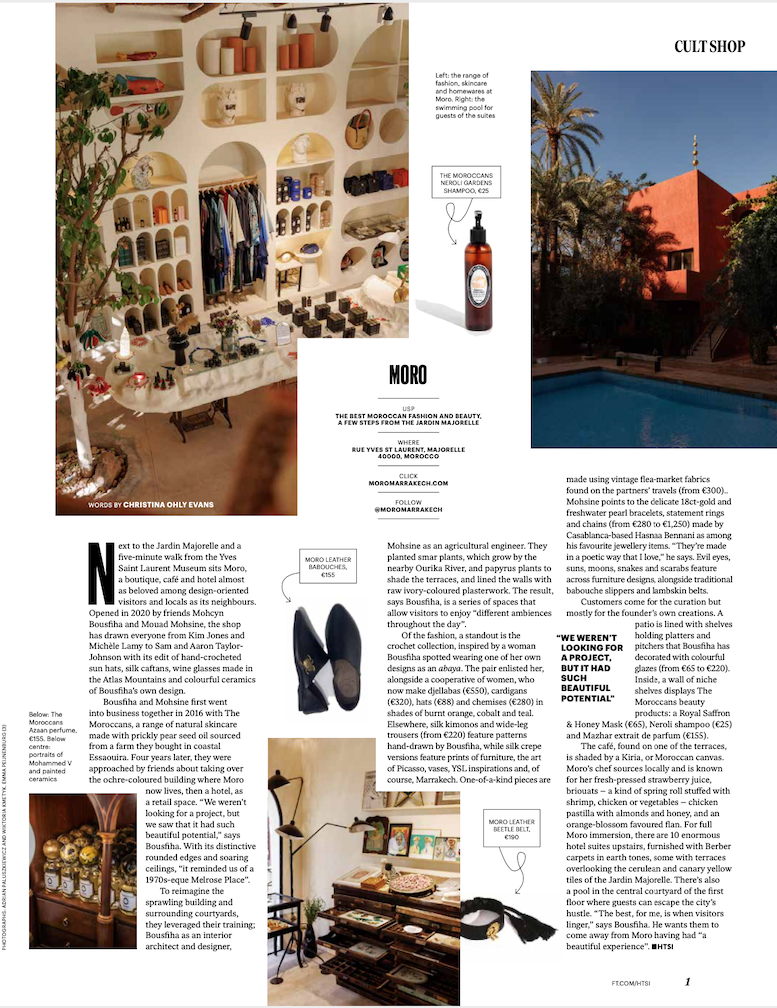
Moro, Morocco’s chicest boutique
Next to the Jardin Majorelle and a five-minute walk from the Yves Saint Laurent Museum sits Moro, a boutique, café and hotel almost as beloved among design-oriented visitors and locals as its neighbours. Opened in 2020 by friends Mohcyn Bousfiha and Mouad Mohsine, the shop has drawn everyone from fashion designers Kim Jones and Michèle Lamy to actor Aaron Taylor-Johnson with its edit of hand-crocheted sun hats, silk kaftans, wine glasses made in the Atlas Mountains and colourful ceramics of Bousfiha’s own design.
A Marrakech mecca, a few steps from the Jardin Majorelle
Next to the Jardin Majorelle and a five-minute walk from the Yves Saint Laurent Museum sits Moro, a boutique, café and hotel almost as beloved among design-oriented visitors and locals as its neighbours. Opened in 2020 by friends Mohcyn Bousfiha and Mouad Mohsine, the shop has drawn everyone from fashion designers Kim Jones and Michèle Lamy to actor Aaron Taylor-Johnson with its edit of hand-crocheted sun hats, silk kaftans, wine glasses made in the Atlas Mountains and colourful ceramics of Bousfiha’s own design.
Bousfiha and Mohsine first went into business together in 2016 with The Moroccans, a range of natural skincare made with prickly pear seed oil sourced from a farm they bought in coastal Essaouira. Four years later, they were approached by friends about taking over the ochre-coloured building where Moro now lives, then a hotel, as a retail space. “We weren’t looking for a project, but we saw that it had such beautiful potential,” says Bousfiha. With its distinctive rounded edges and soaring ceilings, “it reminded us of a 1970s-esque Melrose Place”.
To reimagine the sprawling building and surrounding courtyards, they leveraged their training; Bousfiha as an interior architect and designer, Mohsine as an agricultural engineer. They planted smar plants, which grow by the nearby Ourika river, and papyrus plants to shade the terraces, and lined the walls with raw ivory-coloured plasterwork. The result, says Bousfiha, is a series of spaces that allow visitors to enjoy “different ambiences throughout the day”.
Of the fashion, a standout is the crochet collection, inspired by a woman Bousfiha spotted wearing one of her own designs as an abaya. The pair enlisted her, alongside a cooperative of women, who make djellabas (€550), cardigans (€320), hats (€88) and chemises (€280) in shades of burnt orange, cobalt and teal. Elsewhere, silk kimonos and wide-leg trousers (from €220) feature patterns hand-drawn by Bousfiha, while silk crepe versions feature prints of furniture, the art of Picasso, vases, YSL inspirations and, of course, Marrakech. One-of-a-kind pieces are made using vintage flea-market fabrics found on the partners’ travels (from €300). Mohsine points to the delicate 18ct-gold and freshwater pearl bracelets, statement rings and chains (from €280 to €1,250) made by Casablanca-based Hasnaa Bennani as among his favourite jewellery items. “They’re made in a poetic way that I love,” he says. Evil eyes, suns, moons, snakes and scarabs feature across furniture designs, alongside traditional babouche slippers and lambskin belts.
Customers come for the curation but mostly for the founder’s own creations. A patio is lined with shelves holding platters and pitchers that Bousfiha has decorated with colourful glazes (from €65 to €220). Inside, a wall of niche shelves displays The Moroccans beauty products: a Royal Saffron & Honey Mask (€65), Neroli shampoo (€25) and Mazhar extrait de parfum (€155).
The café, found on one of the terraces, is shaded by a Kiria, or Moroccan canvas. Moro’s chef sources locally and is known for her fresh-pressed strawberry juice, briouats (a kind of spring roll stuffed with shrimp, chicken or vegetables), chicken pastilla with almonds and honey, and an orange-blossom favoured flan. For full Moro immersion, there are 10 enormous hotel suites upstairs, furnished with Berber carpets in earth tones, some with terraces overlooking the cerulean and canary yellow tiles of the Jardin Majorelle. There’s also a pool in the central courtyard of the first floor where guests can escape the city’s hustle. “The best, for me, is when visitors linger,” says Bousfiha. He wants them to come away from Moro having had “a beautiful experience”. Moro, Rue Yves St Laurent, Majorelle 40000, Morocco. moromarrakech.com

The great HTSI guide to luggage
Defining features These sleek brushed aluminium cases feature reinforced corners, three closures to keep contents secure, an ergonomic, four-height adjustable handle, speedy wheels and a quilted taffeta lining for extra luxe. Perfect for Chronic over-packers, and anyone who won’t mind inevitable scrapes and dings from the cargo hold. See also The North Face Base Camp Rolling Thunder bag (£360).
What bag to carry, wherever you’re going, whatever you’re doing
FOR THE LONG HAUL
Defining features These sleek brushed aluminium cases feature reinforced corners, three closures to keep contents secure, an ergonomic, four-height adjustable handle, speedy wheels and a quilted taffeta lining for extra luxe. Perfect for Chronic over-packers, and anyone who won’t mind inevitable scrapes and dings from the cargo hold. See also The North Face Base Camp Rolling Thunder bag (£360).
FOR WEEKEND GETAWAYS
Defining features Lightweight and durable, with a multi-wheel system that assures agility when running late. Perfect for Art-world heavyweights, C-suiters who don’t want to overthink it. See also The Vérité weekend bag by Métier (£3,850) in double-faced water-resistant linen has multiple pockets for SPF, books and a 16-inch laptop. See also the Bennett Winch Weekender (£975): waterproof cotton canvas, leather trim and brass finishes.
FOR THE BEACH
Defining features A soft structure as well as interior and exterior pockets make it ideal for organising drinks and towels. Each bag is made in a factory in the Philippines that’s committed to fair labour and environmentally sound practices. Perfect for Extroverts who enjoy a little virtue signalling. Bonus: the fabrics are del día – chosen from what’s available “of the day” – so every bag is one of a kind. See also Loewe Large Basket bag in palm leaf and calfskin (£495).
FOR BOATING
Defining features The ultimate dry bag for sailors and yachtspeople due to its airtight seams, a protective roll top and a removable shoulder strap. Perfect for Practical seafarers who care about protecting devices from salt air and prefer a streamlined aesthetic. See also LL Bean’s Boat and Tote (from £42) is a classic made of thick canvas, with a genius flat bottom that keeps everything upright – whether on deck or in the office.
FOR ALPINE ADVENTURES
Defining features A minimalist pack for summer hiking with an ultra-light frame, easy-access pockets, compression straps, trekking pole loops and a whistle. Perfect for Shorter treks – think rifugio to rifugio in the Dolomites as opposed to summiting Everest. See also Alpine Luddites, a one-man shop in Vermont with an 18-to-24-month waiting list, makes the ultimate colourful climbing packs and expedition luggage.
FOR THE FLEX
Defining features A rolling, old-school objet d’art, with bold colourways, hand-moulded corners and polished- chrome carbon-steel locks. Perfect for Anyone who appreciates fine craftsmanship. See also Berluti’s Formula 1005 Scritto rolling leather suitcase (£6,850) is Italian perfection, while the Louis Vuitton Horizon 55 suitcase (£3,300) by Marc Newson in Epi cowhide is the height of functional design.
FOR THE ECO CONSCIOUS
Defining features This carbon-neutral roller made of recycled materials is both fashionable and feelgood (the company offsets its emissions). The lining has multiple pockets and a laundry bag. Perfect for Hamptonites and the Hawaii-bound who favour the brand’s collabs with pro packers like Marie Kondo. See also Berlin-based Horizn Studios makes 97 per cent recycled hard shell luggage and accessories and offers a lifetime warranty (worth it for that alone).
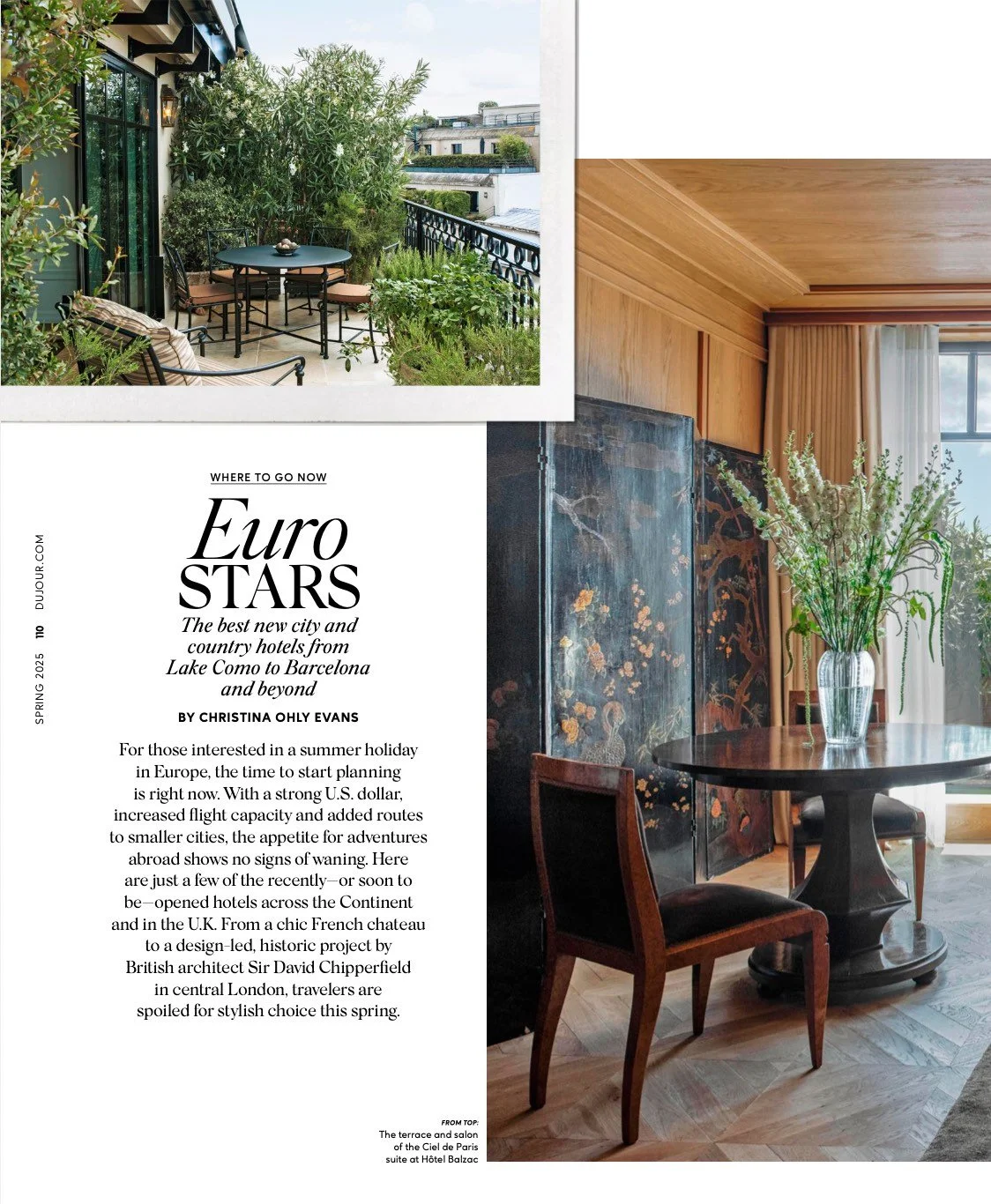
Euro STARS
For those interested in a summer holiday in Europe, the time to start planning is right now. With a strong U.S. dollar, increased flight capacity and added routes to smaller cities, the appetite for adventures abroad shows no signs of waning. Here are just a few of the recently—or soon to be—opened hotels across the Continent and in the U.K. From a chic French chateau to a design-led, historic project by British architect Sir David Chipperfield in central London, travelers are spoiled for stylish choice this spring.
BY CHRISTINA OHLY EVANS
For those interested in a summer holiday in Europe, the time to start planning is right now. With a strong U.S. dollar, increased flight capacity and added routes to smaller cities, the appetite for adventures abroad shows no signs of waning. Here are just a few of the recently—or soon to be—opened hotels across the Continent and in the U.K. From a chic French chateau to a design-led, historic project by British architect Sir David Chipperfield in central London, travelers are spoiled for stylish choice this spring.
FRANCE
HÔTEL BALZAC
Just off the Champs-Élysées in the 8th arrondissement, this 58-room hotel is a chic haven offering Eiffel Tower views and open-air terraces. With a recent re-do by Festen Architecture, the glass-roofed lobby lounge invites guests to linger, while the Japanese-inspired Spa Ikoi is a unique offering in the city’s well- ness space. Of special note is one of Paris’ chicest hotel bars (don’t miss the elevated take on a lobster roll) where travelers and locals alike meet for aperitifs. hotelbalzac.paris
CHÂTEAU DE FIAC
The lesser-known Occitania region in the South of France is now home to Château de Fiac, a 19th-century castle-cum-boutique hotel. Just 30 miles from Toulouse, the property’s 16 rooms and suites have been designed by Alexis Dupont and incorporate both historical and modern elements— with each enjoying expansive views of the surrounding lush gardens. A state-of-the- art Revivo spa (the first one for The Pavilions Hotels & Resorts brand in Europe) inspired by the original Balinese outpost is focused on the power of the ocean, from marine peels and spirulina- boosted facials to an Icelandic plunge pool, swimming pool and a hammam. Signature Retreats are also offered (a three-night minimum) to destress, detox and focus on nutrition and yoga technique. chateaudefiac.com
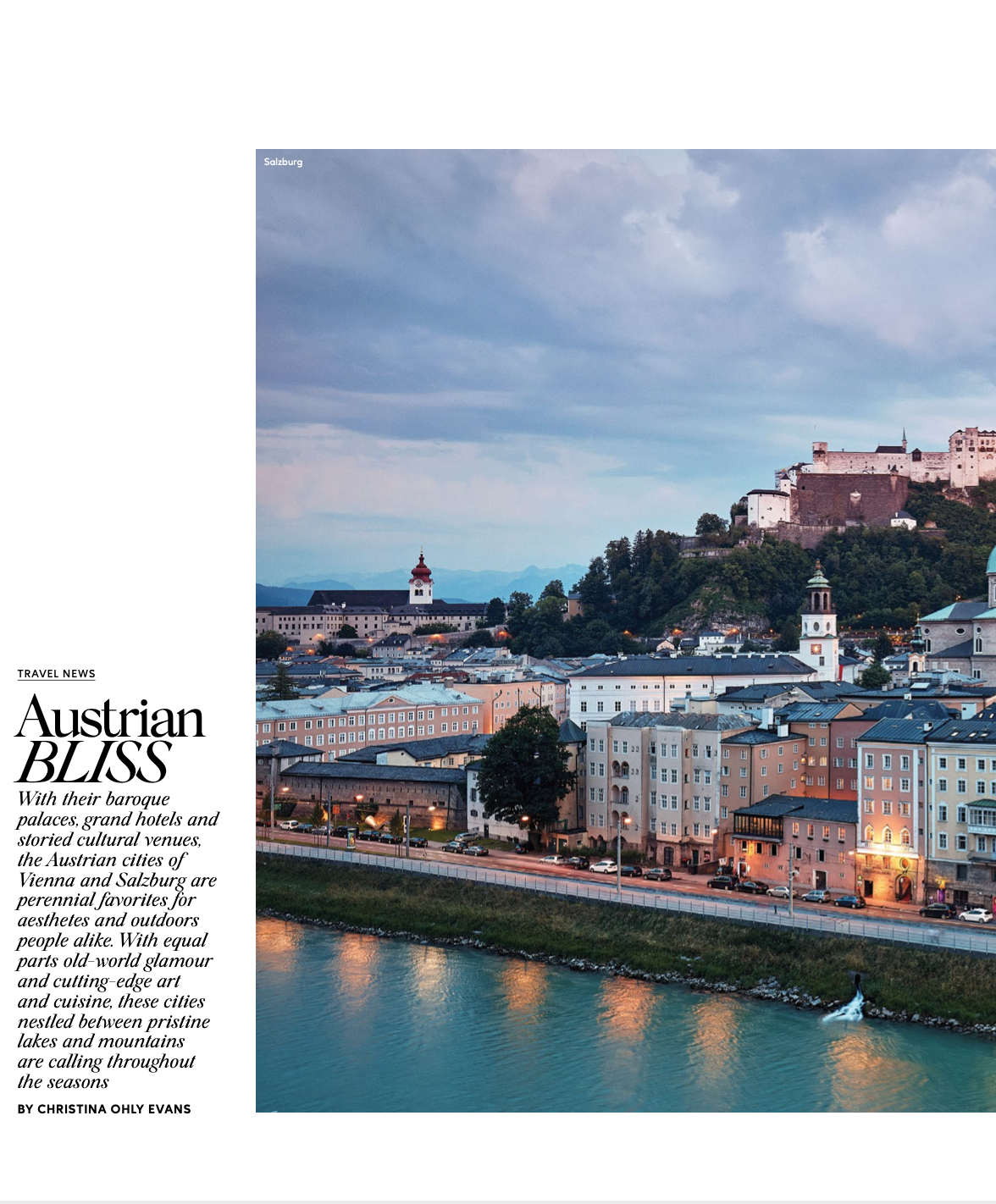
Austrian BLISS
With their baroque palaces, grand hotels and storied cultural venues, the Austrian cities of Vienna and Salzburg are perennial favorites for aesthetes and outdoors people alike. With equal parts old-world glamour and cutting-edge art and cuisine, these cities nestled between pristine lakes and mountains
are calling throughout the seasons.
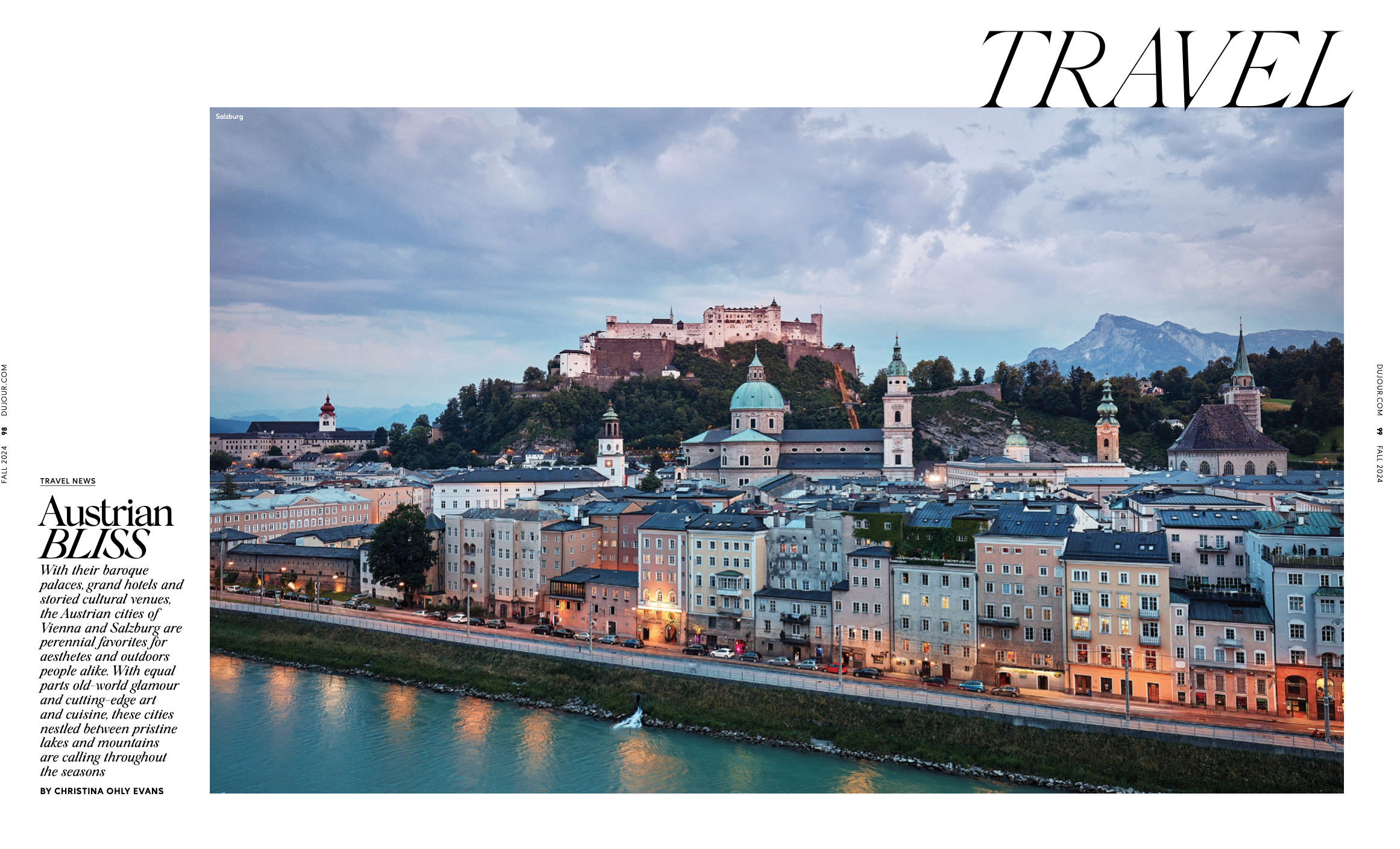
By Christina Ohly Evans
With their baroque palaces, grand hotels and storied cultural venues, the Austrian cities of Vienna and Salzburg are perennial favorites for aesthetes and outdoors people alike. With equal parts old-world glamour and cutting-edge art and cuisine, these cities nestled between pristine lakes and mountains
are calling throughout the seasons.
VIENNA
From St. Stephen’s Square to the iconic Schönbrunn Palace to the charming city trams and bustling cafés, the Austrian capital on
the Danube has stayed true to its elegant European roots but is also dynamic, with art galleries and design-led hotels vying for visitors’ attention. Ever a musical mecca— Beethoven, Brahms, Bruckner, Haydn,
Mahler, Mozart, Schoenberg, Schubert, Johann Strauss I and Johann Strauss II all called Vienna home—the arts continue to flourish here in all forms, at the world-renowned State Opera and at the Leopold Museum, with its collection of paintings by Egon Schiele and Gustav Klimt. But it is the chance to stroll the city’s endless lush gardens and savor a slice
of Sacher torte—a rich chocolate and apricot jam cake that is a Viennese hallmark—that makes a visit here feel like a step back in time. The pace is just a bit slower here, so linger over a decadent Wiener schnitzel with a glass of local grüner veltliner at one of the city’s Michelin-starred temples of gastronomy or opt for a simple street dog (or bratwurst). When it comes to exploring this magical, verdant city, there is no going wrong.
There is no shortage of sumptuous palace hotels here, so it’s the perfect place to make like a Habsburg and be enveloped in an expansive room brimming with gold and jewel-toned velvets. If it’s a more minimalist vibe you’re after, there are plenty of properties that fit that bill as well. In short, Vienna is a hotel town, and this is only a small handful of the very best.
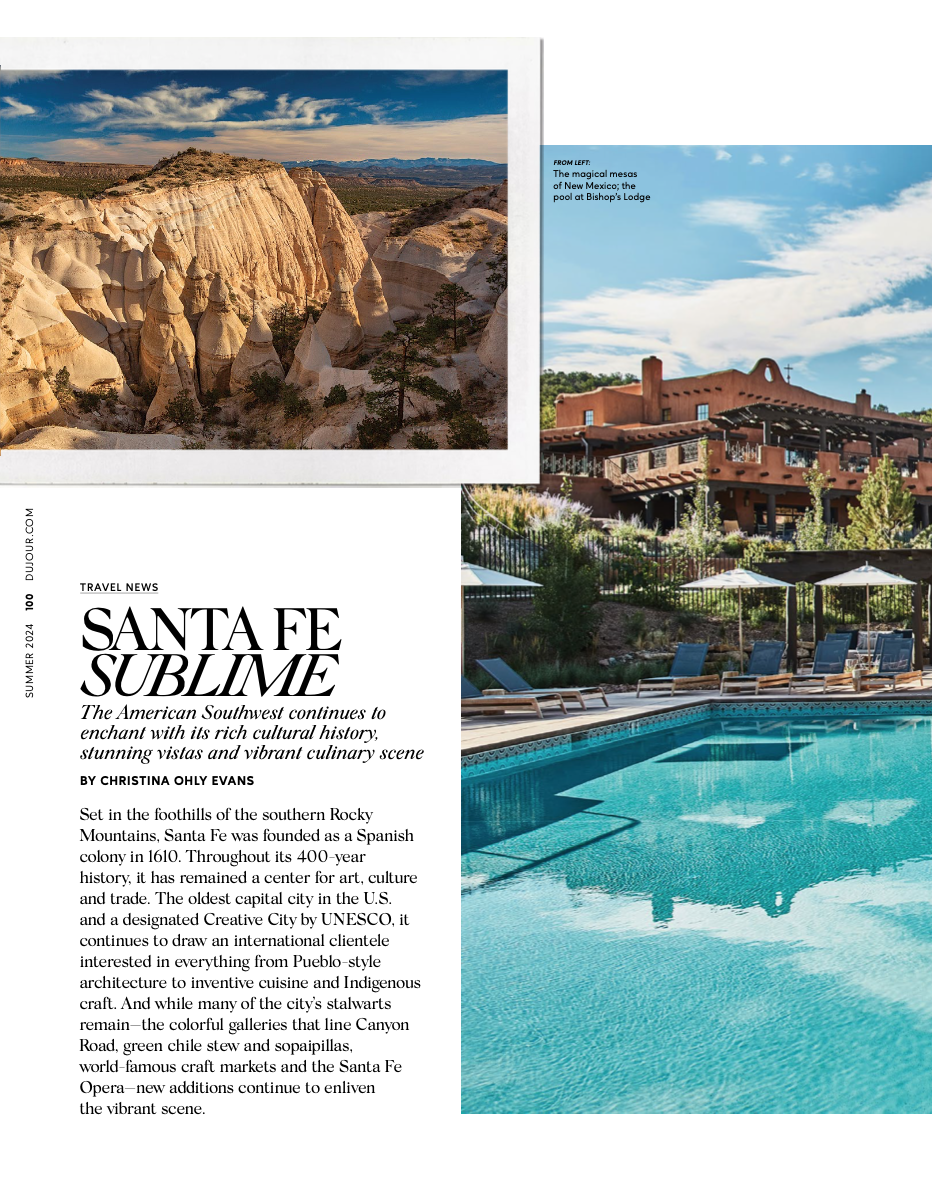
Santa Fe Sublime
Set in the foothills of the southern Rocky Mountains, Santa Fe was founded as a Spanish colony in 1610. Throughout its 400-year history, it has remained a center for art, culture and trade. The oldest capital city in the U.S. and a designated Creative City by UNESCO, it continues to draw an international clientele interested in everything from Pueblo-style architecture to inventive cuisine and Indigenous craft. And while many of the city’s stalwarts remain—the colorful galleries that line Canyon Road, green chile stew and sopaipillas, world-famous craft markets and the Santa Fe Opera—new additions continue to enliven the vibrant scene.
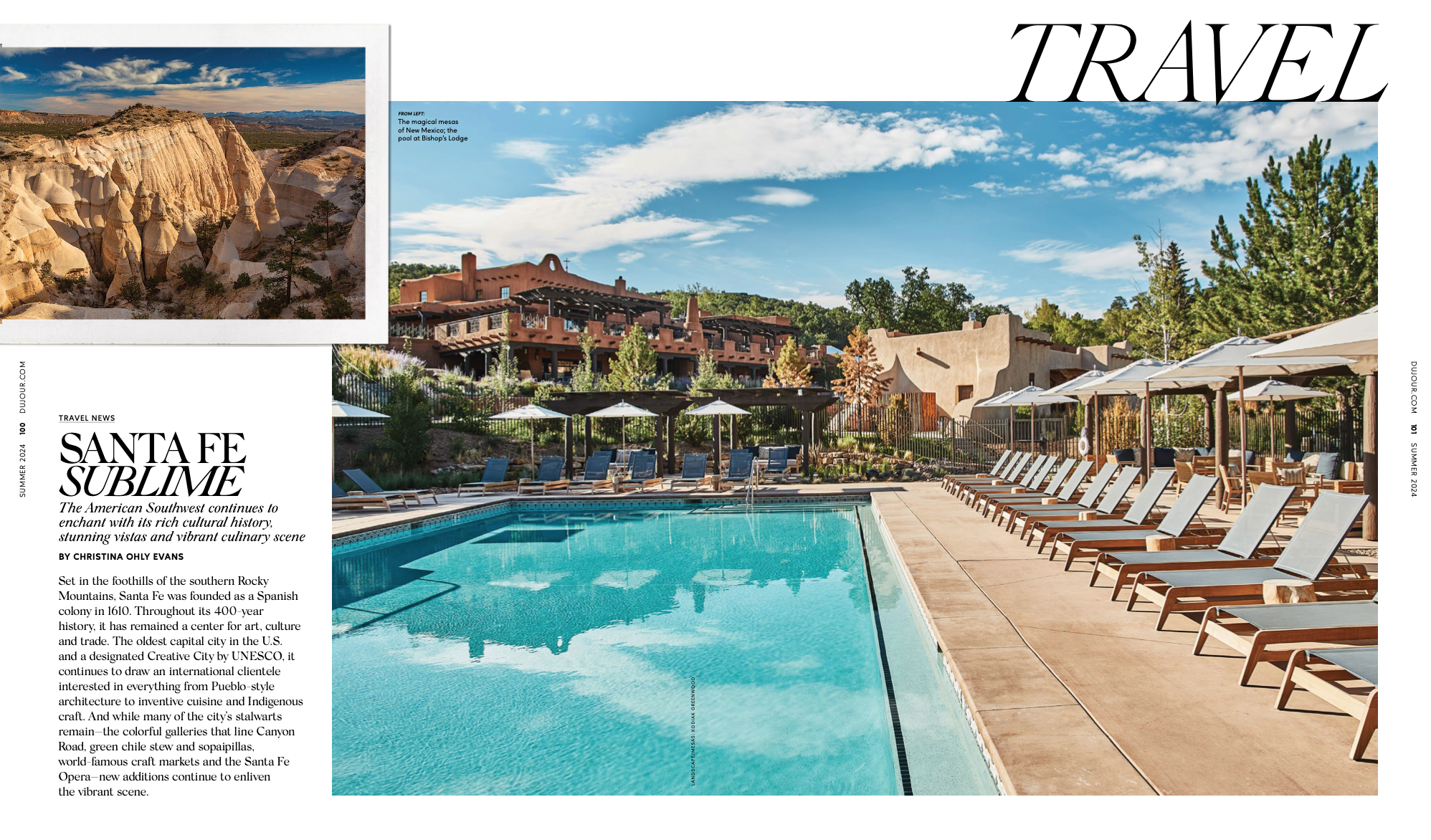
The American Southwest continues to enchant with its rich cultural history, stunning vistas and vibrant culinary scene.
By Christina Ohly Evans
Set in the foothills of the southern Rocky Mountains, Santa Fe was founded as a Spanish colony in 1610. Throughout its 400-year history, it has remained a center for art, culture and trade. The oldest capital city in the U.S. and a designated Creative City by UNESCO, it continues to draw an international clientele interested in everything from Pueblo-style architecture to inventive cuisine and Indigenous craft. And while many of the city’s stalwarts remain—the colorful galleries that line Canyon Road, green chile stew and sopaipillas, world-famous craft markets and the Santa Fe Opera—new additions continue to enliven
the vibrant scene.
HOTELS
From five-star properties to an authentic dude ranch, these hotels are perfect for stays with a sense of place
BISHOP’S LODGE, AUBERGE RESORTS COLLECTION
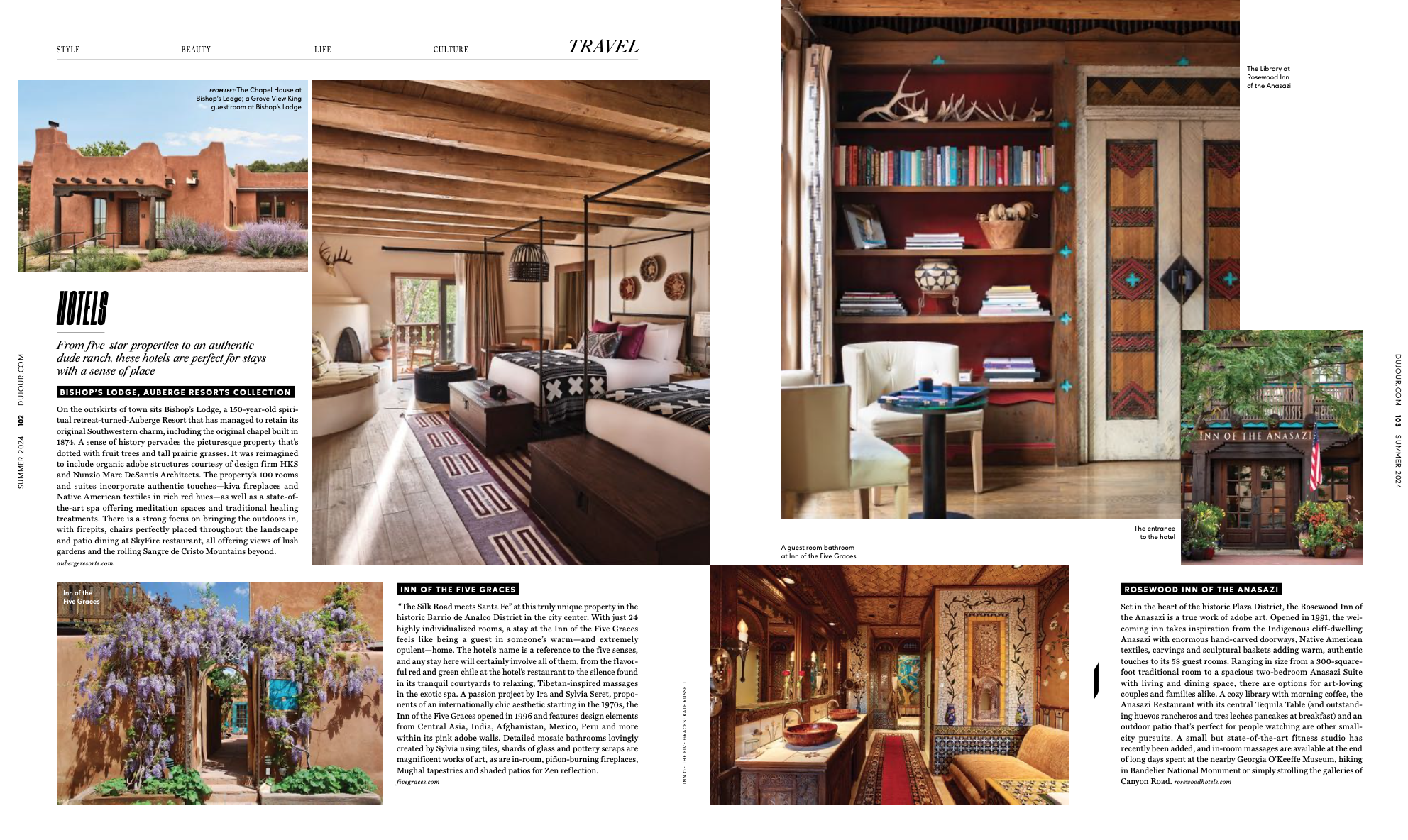
On the outskirts of town sits Bishop’s Lodge, a 150-year-old spiri- tual retreat-turned-Auberge Resort that has managed to retain its original Southwestern charm, including the original chapel built in 1874. A sense of history pervades the picturesque property that’s dotted with fruit trees and tall prairie grasses. It was reimagined to include organic adobe structures courtesy of design firm HKS and Nunzio Marc DeSantis Architects. The property’s 100 rooms and suites incorporate authentic touches—kiva fireplaces and Native American textiles in rich red hues—as well as a state-of- the-art spa offering meditation spaces and traditional healing treatments. There is a strong focus on bringing the outdoors in, with firepits, chairs perfectly placed throughout the landscape and patio dining at SkyFire restaurant, all offering views of lush gardens and the rolling Sangre de Cristo Mountains beyond.
INN OF THE FIVE GRACES
“The Silk Road meets Santa Fe” at this truly unique property in the historic Barrio de Analco District in the city center. With just 24 highly individualized rooms, a stay at the Inn of the Five Graces feels like being a guest in someone’s warm—and extremely opulent—home. The hotel’s name is a reference to the five senses, and any stay here will certainly involve all of them, from the flavor- ful red and green chile at the hotel’s restaurant to the silence found in its tranquil courtyards to relaxing, Tibetan-inspired massages in the exotic spa. A passion project by Ira and Sylvia Seret, propo- nents of an internationally chic aesthetic starting in the 1970s, the Inn of the Five Graces opened in 1996 and features design elements from Central Asia, India, Afghanistan, Mexico, Peru and more within its pink adobe walls. Detailed mosaic bathrooms lovingly created by Sylvia using tiles, shards of glass and pottery scraps are magnificent works of art, as are in-room, piñon-burning fireplaces, Mughal tapestries and shaded patios for Zen reflection. fivegraces.com
INN OF THE FIVE GRACES
“The Silk Road meets Santa Fe” at this truly unique property in the historic Barrio de Analco District in the city center. With just 24 highly individualized rooms, a stay at the Inn of the Five Graces feels like being a guest in someone’s warm—and extremely opulent—home. The hotel’s name is a reference to the five senses, and any stay here will certainly involve all of them, from the flavor- ful red and green chile at the hotel’s restaurant to the silence found in its tranquil courtyards to relaxing, Tibetan-inspired massages in the exotic spa. A passion project by Ira and Sylvia Seret, propo- nents of an internationally chic aesthetic starting in the 1970s, the Inn of the Five Graces opened in 1996 and features design elements from Central Asia, India, Afghanistan, Mexico, Peru and more within its pink adobe walls. Detailed mosaic bathrooms lovingly created by Sylvia using tiles, shards of glass and pottery scraps are magnificent works of art, as are in-room, piñon-burning fireplaces, Mughal tapestries and shaded patios for Zen reflection. fivegraces.com
ROSEWOOD INN OF THE ANASAZI
Set in the heart of the historic Plaza District, the Rosewood Inn of the Anasazi is a true work of adobe art. Opened in 1991, the wel- coming inn takes inspiration from the Indigenous cliff-dwelling Anasazi with enormous hand-carved doorways, Native American textiles, carvings and sculptural baskets adding warm, authentic touches to its 58 guest rooms. Ranging in size from a 300-square- foot traditional room to a spacious two-bedroom Anasazi Suite with living and dining space, there are options for art-loving couples and families alike. A cozy library with morning coffee, the Anasazi Restaurant with its central Tequila Table (and outstand- ing huevos rancheros and tres leches pancakes at breakfast) and an outdoor patio that’s perfect for people watching are other small- city pursuits. A small but state-of-the-art fitness studio has recently been added, and in-room massages are available at the end of long days spent at the nearby Georgia O’Keeffe Museum, hiking in Bandelier National Monument or simply strolling the galleries of Canyon Road. rosewoodhotels.com
FOUR SEASONS RESORT RANCHO ENCANTADO
A 57-acre former dude ranch that’s 10 miles from the center of Santa Fe, Four Seasons Resort Rancho Encantado offers a full immersion in nature with the Rio Grande River Valley and the Sangre de Cristo and Jemez mountains in full view. The property’s 65 spacious casi- tas have been refreshed and skew toward minimalist Southwestern chic; neutral cement floors, adobe fireplaces, soothing textiles, horsehair pottery by artist Linda Concho and local baskets all add to the serene atmosphere. A sleek, dark cement pool offers a welcome respite after long days spent hiking and biking, as does the spa—one where juniper sage smudging ceremonies meet nutrient- rich adobe clay treatments and end with chakra balancing massages. For authentic northern New Mexico cuisine with inven- tive twists, the restaurant, Terra, offers spice-infused dishes such as an aguachile rojo hamachi ceviche and a roasted poblano with calabacitas, quinoa pilaf, Mexican crema, yellow mole, crispy chicos and avocado. Be sure to save room for the legendary churros, served here with ancho reyes poblano cream. fourseasons.com
SPAS
Immerse yourself in the healing waters of New Mexico
OJO CALIENTE
It’s worth the hour drive out of town to soak in the healing waters of one of the country’s oldest health spas, Ojo Caliente. These hot springs feature nutrient-rich, healing minerals including lithia, iron and soda, each with properties that aid in digestion, promote relaxation and much more. In addition to eight communal tubs and private pools, there are hydrotherapy treatments and massages to suit every taste (or ailment). A Satva Botanicals massage incorpo- rates CBD oil to reduce stress, while the Rio Grande Hot Stone massage uses basalt rocks to eliminate stagnant energy from the body and mind. The tranquil Yoga Yurt is the place for small group classes—nidra, hatha and more—and group retreats are also an option. For those who prefer a total getaway, book in at the hotel with its homey Pueblo-style suites or in one of the North Cottages, the four-bedroom Adobe House or even an old-school Vintage Trailer for a true glamping experience. Dine on the patio at Artesian in summer, where hearty breakfasts—blue corn piñon pancakes and tacos stuffed with eggs, pinto beans and salsa—pro- vide fuel for days spent outdoors. ojosparesorts.com
The dining room at Geronimo
GERONIMO
Step inside Geronimo, a restaurant housed in a 250-year-old restored adobe building on Canyon Road, and you’ll feel trans- ported to the world of Georgia O’Keeffe. Whitewashed walls, beamed ceilings and intimate rooms lit by antler chandeliers and crackling kiva fireplaces all create a relaxed ambience. Among the many standouts are jumbo lump crab cakes with sweet corn puree, a vegetarian tasting menu with wine pairing and mains of Telicherry-rubbed elk tenderloin and New Mexico Four Corners grilled rack of lamb with fresh pea puree and parmesan yellow corn polenta. Be sure to book in for a cocktail on the Canyon Road patio to people-watch with an unmatched margarita in hand. geronimorestaurant.com
TOMASITA’S
At 50 years old, Tomasita’s is a Santa Fe institution serving straightforward New Mexican cuisine and some of the best mar- garitas in town. Enchiladas, chiles rellenos, chalupas topped with refried beans and cheese and pork tamales with red chile
are all favorites, as are classic SWIRL margaritas made with primo tequila. tomasitas.com
FALL into EUROPE
Record crowds—not to mention temperatures—made for a busy summer abroad, but the time to really enjoy cultural sights and new hotels is now. With many properties extending their seasons to attract off-peak visitors, fall is the ideal time to wander city streets and even hit the beach when the days are still sunny but cool.
Record crowds—not to mention temperatures—made for a busy summer abroad, but the time to really enjoy cultural sights and new hotels is now. With many properties extending their seasons to attract off-peak visitors, fall is the ideal time to wander city streets and even hit the beach when the days are still sunny but cool
BY CHRISTINA OHLY EVANS
Coastal Getaways
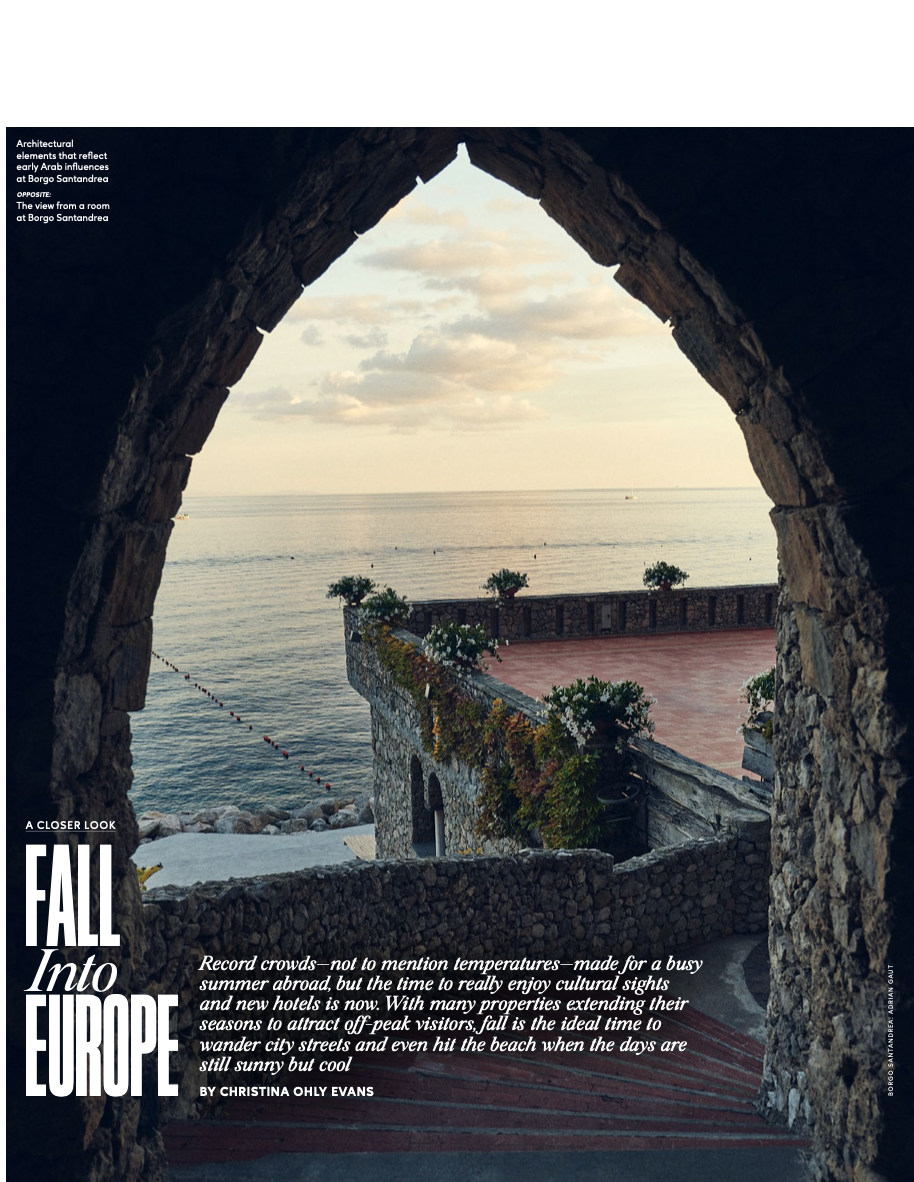
A 1960s design aesthetic meets pure Mediterranean chic at Borgo Santandrea, a cliffside perch overlooking the centuries-old fish- ing village of Conca dei Marini in the heart of the Amalfi Coast. From its breathtaking 30 rooms and 16 suites—each with an expansive sea view—guests are immersed in la dolce vita with scents of rosemary and jasmine wafting through the air. Furnishings are a mix of traditional and modern, with noted Italian makers such as Molteni&C in the mix. The just-opened Marinella Beach Club, with its own pebble beach and jetty, is the place to be by day or evening for an aperitivo before popping next door for coastal-inspired cuisine at the ever-stylish restaurant. borgosantandrea.it
Anantara Convento di Amalfi, a 13th-cen- tury Capuchin convent that’s built into the cliffside, is the latest jaw-dropping prop- erty from Anantara Hotels. Travel verti- cally from the outskirts of Amalfi to this truly unique perch—one with the coast’s most spectacular views—and check into one of the 52 minimalist rooms and suites where monks once slept. With its original cloister and chapel beautifully preserved and a passeggiata dei monaci—monk’s walk—bursting with bougainvillea, a stay here offers equal parts history lesson and pure pampering by way of service, an indoor-outdoor spa and attentive staff. The infinity pool with the sea below is a stun- ner, as are the pizzas made in an oven that was dropped in by helicopter to this moun- tainous idyll. anantara.com
Great in Greece
Founded in 1996, the Belvedere is a family-owned luxury boutique hotel in Mykonos offering sweeping views of Chora and the Aegean Sea. This elegant Mediterranean property offers a wide array of rooms, suites and private villas enriched with hilltop and waterfront views. The relaxing Pool Club, peaceful Six Senses Spa and bustling Belvedere Bar are just a few of the onsite offerings.
Recently, the Belvedere debuted 26 residential-style hilltop rooms and suites up the hill from the main complex that are easily accessible via shuttle service. These rooms blend an elegant Greek aesthetic with modern amenities, employing raw materials such as plaster, marble and wood.
The hotel’s Matsuhisa restaurant just celebrated its 20th anni- versary with the opening of an alfresco omakase bar. “Not only was it the first Matsuhisa in Europe, but also the first open-air Nobu Matsuhisa in the world,” says chef Nobu Matsuhisa. “I arrived in 2003 and quickly fell in love with the energetic atmo- sphere of the island. I love going to the beach, swimming daily, exploring the small villages and indulging in Greek food and culture.” belvederehotel.com
Nordic Nice
Oslo is having a cultural moment, and Sommerro is the place to stay—or try its newly opened sister property, Villa Inkognito, just next door. In the heart of the city’s West End, Sommerro has quickly become a hub with its seven bars and restaurants—includ- ing the rooftop Nordic-Japanese favorite TAK Oslo—drawing visi- tors and locals alike. Set in a historic building from the 1930s, each of the 231 rooms and luxury suites features sleek Norse accents, and the entire property is fueled by renewable energy and uses electric transport. Villa Inkognito is equally magical, but much more intimate in scale and approach. Housed in a former residence that was built in the 1870s, the reimagined villa boasts 11 suites, a private gym and dining spaces, as well as an intimate bar for use by house guests. Rooms feature an eclectic mix of antiques, original artwork and classic Scandinavian furnishings—all with art nou- veau and Japonisme touches. In addition to the feel of staying in a royal residence, Villa Inkognito guests also have full use of Sommerro’s endless amenities, including Vestkantbadet—the hotel’s 15,000-square-foot, state-of-the-art wellness center. sommerrohouse.com
Loire Living
Until recently, in order to play at the Les Bordes Golf Club in the Loire
Valley, France, a 1,400-acre estate amid a UNESCO World Heritage site,
Golf Club members and guests could only stay in one of 36 lakeside member cabins. Much of the appeal of this legendary location is its two world-renowned golf courses designed by Robert Von Hagge and Gil Hanse—and its proximity to Paris (about a 90-minute drive) and bucolic French villages like Tours, Blois and Orléans, not to mention the stunning Chateau de Chambord. Now, you can live there, too. The first and second phases of the Cour du Baron residences have launched, encompassing a total of 42 private homes ranging in size from 1,800-6,000 square feet. All but a few are already spoken for, and all should be ready for residents to move in early next year. It’s a European adventure to be sure, a bit like a Loire Valley version of Silo Ridge, the private gated community in Amenia, New York, but here, you can also practice your parlez-vous français. For guests not quite ready to make a commitment who want to dip their putters into Loire Valley life first, Les Bordes Estate also has a Six Senses Hotel and Residences opening in 2026. lesbordesestate.com
SWISS BLISS
While Switzerland might conjure images of piste rather than pools those in the know relish the calm summer season.
The bucolic hills of Switzerland will be alive this summer with the sound of music—courtesy of the country’s many music festivals and clanging cowbells—but they’ll also be blessedly quiet and free from the typical tourist throngs. While many will flock to summer staples such as the Amalfi Coast and the Côte d’Azur, those looking for a truly regenerative escape might opt for one of the 26 cantons that comprise Switzerland. There, pristine glacial lakes and Alpine adventures (not to mention a fine fondue) await. Direct flights from the U.S. to both Zurich and Geneva—and timely trains from either airport—make accessing the scenic mountain towns a breeze. A night in either city is a pleasure, one that makes the (often early-morning) return flight more manageable.
While Switzerland might conjure images of pistes rather than pools those in the know relish the calm summer season
BY CHRISTINA OHLY EVANS
The bucolic hills of Switzerland will be alive this summer with the sound of music—courtesy of the country’s many music festivals and clanging cowbells—but they’ll also be blessedly quiet and free from the typical tourist throngs. While many will flock to summer staples such as the Amalfi Coast and the Côte d’Azur, those looking for a truly regenerative escape might opt for one of the 26 cantons that comprise Switzerland. There, pristine glacial lakes and Alpine adventures (not to mention a fine fondue) await. Direct flights from the U.S. to both Zurich and Geneva—and timely trains from either airport—make accessing the scenic mountain towns a breeze. A night in either city is a pleasure, one that makes the (often early-morning) return flight more manageable.
Zurich
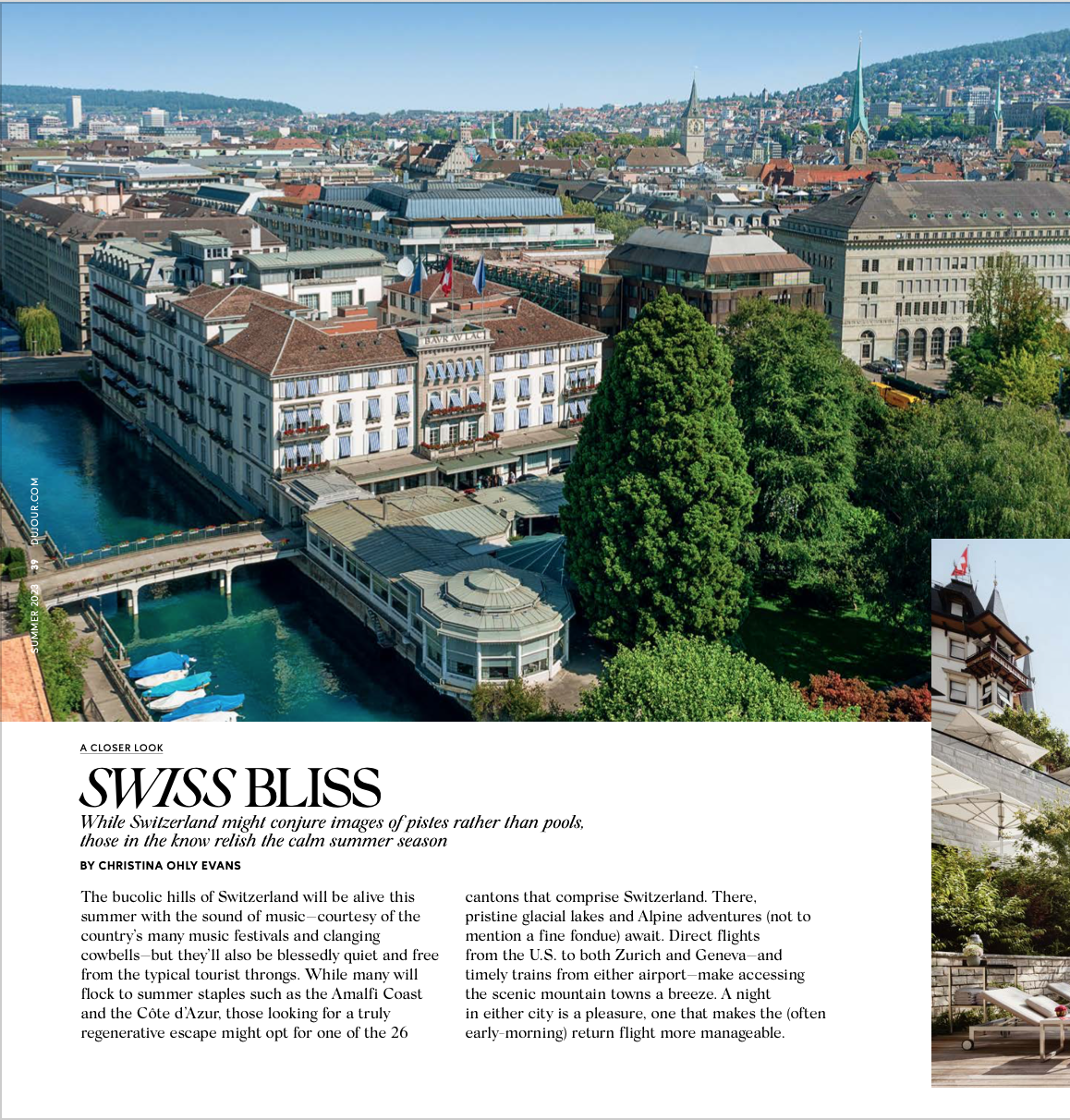
Zurich is full of churches, cobblestone streets and chocolate shops—all of which contrast brilliantly with contemporary art gal- leries and the latest in technology and transportation. Book in for a night at the iconic Baur au Lac (bauraulac.ch) for old-world elegance on the shores of Lake Zurich. Enjoy a sumptuous meal at the two- Michelin-starred Pavillon or savor a traditional wiener schnitzel in the more casual Martin Brudnizki–designed brasserie Baur’s. Just at the edge of the city sits The Dolder Grand (thedoldergrand.com), a castle-like hideaway with 175 rooms and suites as well as a 43,000-square-foot Foster + Partners–designed spa. Outdoor enthusiasts will love hiking and biking the trails around the lake or Käferberg and Greifensee—all with a gourmet picnic basket full of local cheeses and charcuterie in tow. Aesthetes will want to make time for the expansive Kunsthaus Zurich, which holds treasures from the 17th century as well as Alberto Giacometti sculptures and contemporary photography by Cindy Sherman
Cartier Design: A Living Legacy” Opens at Museo Jumex
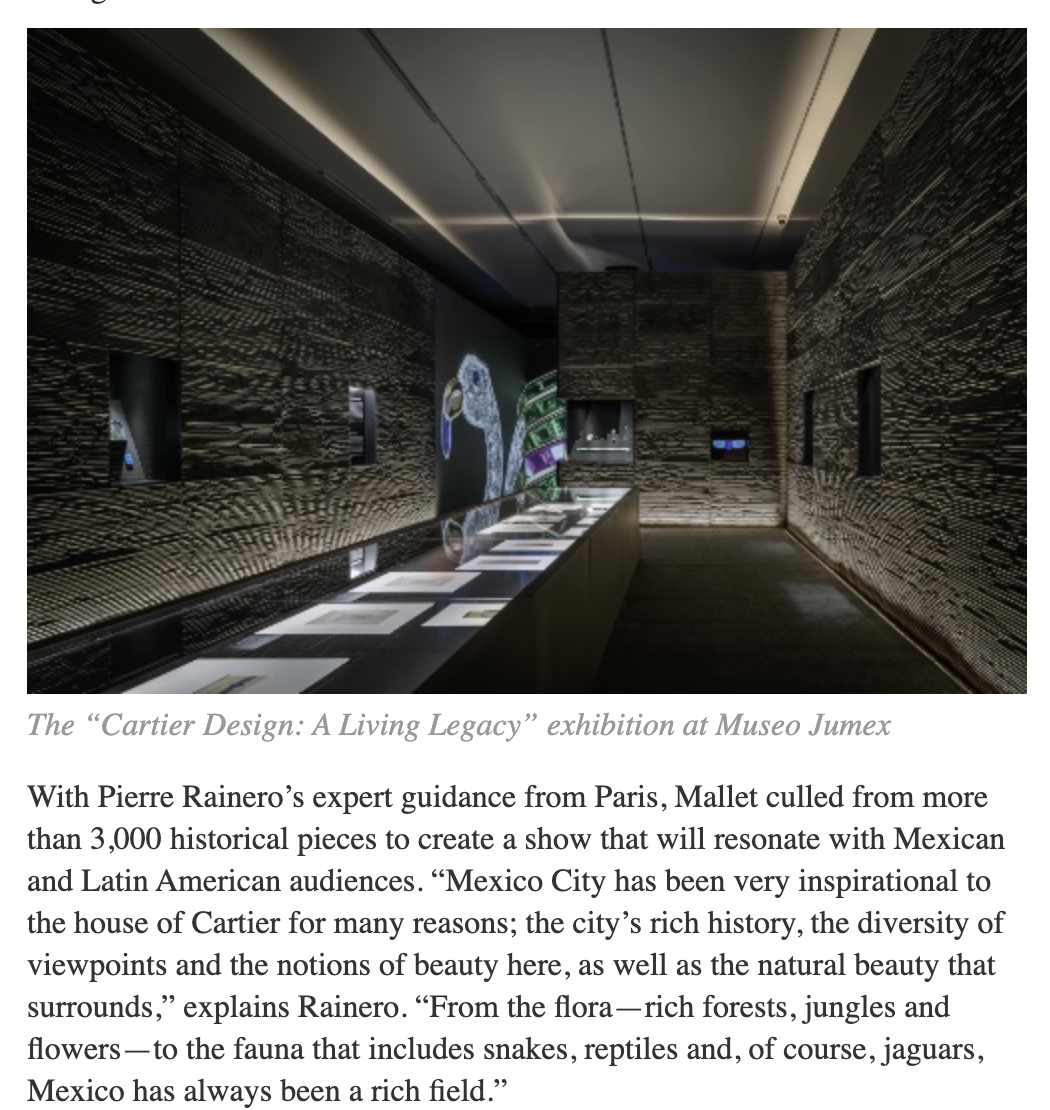
This month marks the opening of “Cartier Design: A Living Legacy,” a stunning retrospective of the maison’s most iconic creations that runs from March 15 through May 14 at Mexico City’s Museo Jumex. The strikingly spare David Chipperfield-designed museum is the perfect backdrop for the collection of 160 objects that were last exhibited at the Palacio de Bellas Artes in 1999 and offer unique insights into Cartier’s strong cultural ties to Mexico as well as its timeless savoir-faire.
A new exhibition featuring jewels from the archives of the French jewelry maison opens March 15 in Mexico City
This month marks the opening of “Cartier Design: A Living Legacy,” a stunning retrospective of the maison’s most iconic creations that runs from March 15 through May 14 at Mexico City’s Museo Jumex. The strikingly spare David Chipperfield-designed museum is the perfect backdrop for the collection of 160 objects that were last exhibited at the Palacio de Bellas Artes in 1999 and offer unique insights into Cartier’s strong cultural ties to Mexico as well as its timeless savoir-faire.
Arranged across five themes—The Early Days and the Birth of a Style, Universal Curiosity, Jeanne Toussaint’s Taste, Wearing Beauty and Measuring Time and Maria Félix and Icons of Elegance—the show has been meticulously edited by local design curator, Ana Elena Mallet, with the guidance of Cartier’s Pierre Rainero. Drawing on the Maison’s extensive archives, the pieces selected for this decades-in-the-making exhibition include dazzling jewels, timepieces, accessories and decorative objects that were once worn by the likes of Mexican diva and Cartier devotee, Maria Felix, and the Brazilian aviator, Alberto Santos-Dumont, the famed namesake of the original Santos wristwatch.
“I wanted to bring attention to Cartier jewels as design,” says Mallet of her curatorial process that highlights “pieces reflective of aesthetics, technology, innovation, craftsmanship and style” across two centuries. The selection of a such contemporary setting—the Museo Jumex that opened in 2013—made perfect sense to Mallet who is supportive of bringing “different types of objects and materials into a traditional museum space to expand the field of art and to blur the boundaries between artistic disciplines and also see them in dialogue.”
With Pierre Rainero’s expert guidance from Paris, Mallet culled from more than 3,000 historical pieces to create a show that will resonate with Mexican and Latin American audiences. “Mexico City has been very inspirational to the house of Cartier for many reasons; the city’s rich history, the diversity of viewpoints and the notions of beauty here, as well as the natural beauty that surrounds,” explains Rainero. “From the flora—rich forests, jungles and flowers—to the fauna that includes snakes, reptiles and, of course, jaguars, Mexico has always been a rich field.”
Noted Mexican architect Frida Escobedo has been tapped to create the scenography for the exhibition, calling on her design experience for cultural institutions such as the Serpentine Gallery and the Victoria & Albert Museum. With the stage beautifully set, emblematic pieces designed for Maria Félix—including a 178.2 carat snake necklace from 1968 and a crocodile necklace comprised of 1,023 brilliant-cut fancy intense yellow diamonds with ruby and emerald cabochon eyes—are among the collection standouts. As with so many innovative Cartier designs, these necklaces were made to be worn separately, as brooches, or used as decorative table ornaments.
Equally impressive are the selection of ornate turn of the century tiaras, a 1920s Tutti Frutti bracelet once owned by Mrs. Cole Porter, bold platinum and diamond bangles circa 1934, and a unique scarab belt buckle with touches of gold and blue Egyptian faience. The accompanying sketches in graphite and gouache are exquisite, too, and provide a rare look at the creative process throughout the decades. “The main angle of this exhibition is the journey of Cartier style,” explains Rainero, “so beyond the pleasure of seeing these beautiful pieces, the show will illustrate the different design evolutions from the beginning of the Maison up to present day.”
Spanish SPLENDOR
From the bustling plazas and trendy tapas bars of Madrid, to the bustling port city of Barcelona, to the architectural gem that is Seville, Spain is really having a moment. The combination of medieval towns, beautiful beaches, a vibrant art scene and endlessly creative cuisine make this country an appealing destination.
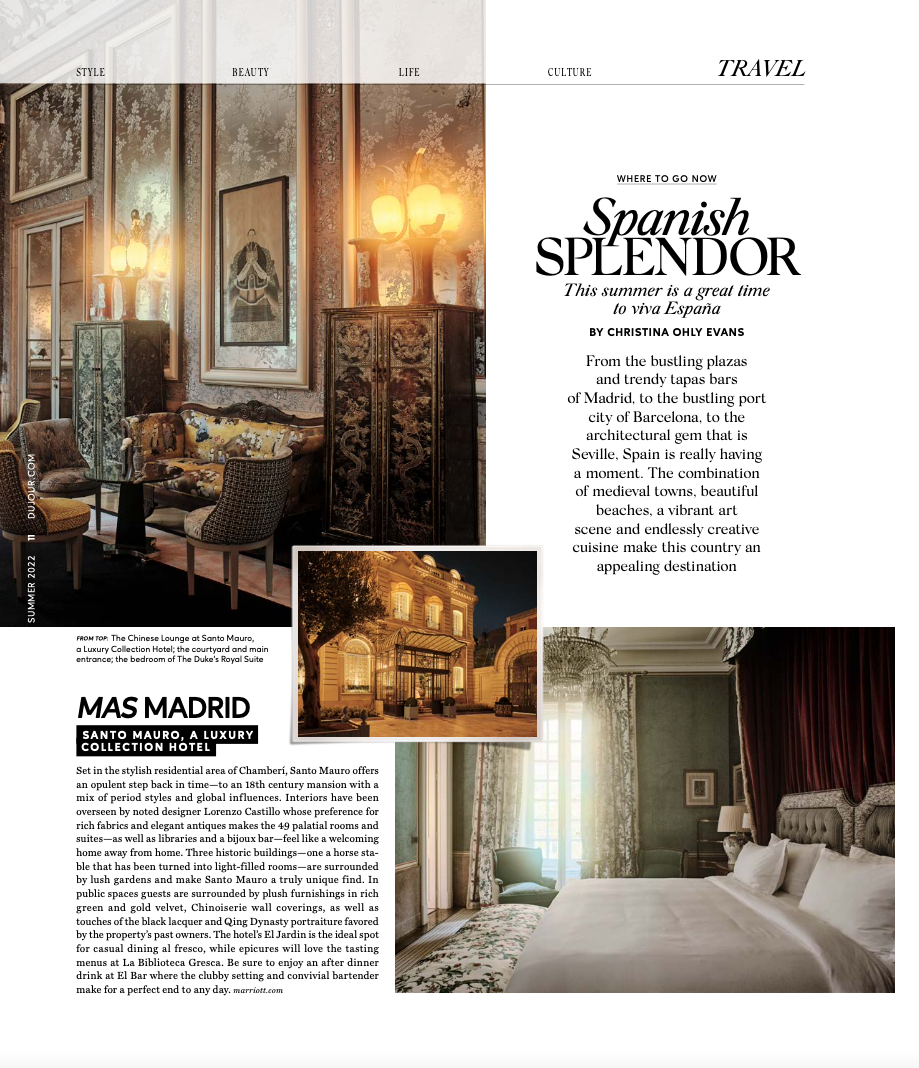
Set in the stylish residential area of Chamberí, Santo Mauro offers an opulent step back in time—to an 18th century mansion with a mix of period styles and global influences. Interiors have been overseen by noted designer Lorenzo Castillo whose preference for rich fabrics and elegant antiques makes the 49 palatial rooms and suites—as well as libraries and a bijoux bar—feel like a welcoming home away from home. Three historic buildings—one a horse sta- ble that has been turned into light-filled rooms—are surrounded by lush gardens and make Santo Mauro a truly unique find.
This summer is a great time to viva España
By Christina Ohly Evans


From the bustling plazas and trendy tapas bars of Madrid, to the bustling port city of Barcelona, to the architectural gem that is Seville, Spain is really having a moment. The combination of medieval towns, beautiful beaches, a vibrant art scene and endlessly creative cuisine make this country an appealing destination.
MAS MADRID SANTO MAURO, A LUXURY COLLECTION HOTEL
Set in the stylish residential area of Chamberí, Santo Mauro offers an opulent step back in time—to an 18th century mansion with a mix of period styles and global influences. Interiors have been overseen by noted designer Lorenzo Castillo whose preference for rich fabrics and elegant antiques makes the 49 palatial rooms and suites—as well as libraries and a bijoux bar—feel like a welcoming home away from home. Three historic buildings—one a horse sta- ble that has been turned into light-filled rooms—are surrounded by lush gardens and make Santo Mauro a truly unique find. In public spaces guests are surrounded by plush furnishings in rich green and gold velvet, Chinoiserie wall coverings, as well as touches of the black lacquer and Qing Dynasty portraiture favored by the property’s past owners. The hotel’s El Jardin is the ideal spot for casual dining al fresco, while epicures will love the tasting menus at La Biblioteca Gresca. Be sure to enjoy an after dinner drink at El Bar where the clubby setting and convivial bartender make for a perfect end to any day. marriott.com
MADRID EDTION
The winning combination of hotelier Ian Schrager and British architect, John Pawson, is in dazzling effect once again at this 200-room, 23-suite property that’s set on the historic Plaza de la Descalzas. A mix of the sleek lines, muted lighting and natural finishes that Pawson is known for contrast with an 18th-century Baroque portal that’s been restored by Spanish architect Pedro di Ribera, to create a daz- zling, yet authentic destination. Decorative touches range from bespoke sofas with dramatically back-lit shelves to Jean- Michel Frank armchairs to recycled bronze stools from Maison Intègre, as well a sculptural pool table by Emmanuel Levet Stenne sculpted from a single slab of white Bianco Neve marble.
One of the hotel’s main draws is Jerónimo, a Mexican-influenced restaurant by noted chef Enrique Olivera of Mexico City’s Pujol and Cosme in New York. Using the strong cultural ties between Spain and Mexico as well as local ingredients, guests can dine in a double-height, vibrant dining room or outside on the hotel’s verdant pri- vate terrace. The second gourmet offering is Oroya, helmed by Peruvian chef Diego Muñoz and where Pisco Sours and ceviches are the orders of the day. And last, but cer- tainly not least on a hot summer day, is the hotel’s sprawling rooftop pool—Madrid’s largest—surrounded by chic cabanas with views of the red-roofed city skyline beyond. editionhotels.com
MANDARIN ORIENTAL RITZ
The grand dame of Madrid, the Mandarin Oriental Ritz has just undergone the most extensive renovation in its 110 year history courtesy of architect Rafael de La-Hoz with interiors by French firm, Gilles & Boissier. The result is a timeless Belle Epoque gem that is in keeping with hotelier Cesar Ritz’s original aesthetic, all while incorporating modern leather, brushed brass and marble touches throughout. Centrally located within the Golden Triangle of Art—home to the Prado, Thyssen-Bornemisza and the Reina Sofia Museum of Modern Art— the Mandarin Oriental Ritz remains a bustling hub with its five restaurants and bars draw- ing a discerning international clientele throughout the day.
Under the guidance of multi-Michelin- starred chef, Quique Dacosta, Deessa offers fine dining with an avant-garde twist, while the Champagne Bar and Pictura Bar are the places for serious cocktails, live music and a buzzy vibe. The highlight, however, is the iconic El Jardin del Ritz—a chic oasis in the middle of the capital, complete with the perfect gin tonic (no “and”). After the vibrancy of the hotel’s public spaces, the 100 sumptuously- appointed guest rooms and 53 suites offer a bit of serenity with the terraced Turret Suites and the sprawling Presidential Suite with its hand-painted mural among the standouts. mandarinoriental.com
AND IN ANDALUSIA...
LA ZAMBRA, COSTA DEL SOL Originally opened in 1984 as the uber-chic luxurious Byblos, the Málaga hotel has counted The Rolling Stones and Diana, Princess of Wales among its glittery guests. After a refresh by father-son architectural duo Esteva i Esteva of Menorca’s Torralbenc fame, La Zambra opens this summer and promises a contemporary take on relaxed Andalusian style. The property’s 197 light-filled rooms and suites are swathed in neutral hues, while furniture hewn from light wood and stone add to the soothing ambience. Multiple swimming pools, a state of the art spa, a Turkish bath, sauna and a hammam are just a few of the luxurious amenities on offer, while golfers can take advantage of neighboring world class courses. Food and drink take center stage with an emphasis on Andulusian sea food and light, healthy cuisine by day and shifting to a more indulgent approach at sundown when the spit roast becomes the focal point. With its white-washed buildings, coastal setting, and killer sangria, La Zambra promises to bring back 1980s Mediterranean glamour. lazambrahotel.com
FLAVORFUL FINDS True gourmands and the casually hungry alike will find something to savor in Spain this summer
TASTING NOTES WITH DWANI LOPEZ
Serious foodies take note: Black Tomato, the U.K.-based travel insiders, specializes in planning trips focused around excellent, hard-to-find Spanish cuisine. Far beyond your standard sangria and tapas (though they’ll find you the best), you’ll be in the hands of three of Spain’s best chefs—Dani Lopez, Aitor Arregui, and Elena Arzak— who hold five Michelin stars between them—who have co-curated an itinerary that includes a private pintxos tour in Bilbao, a Michelin-starred meal at the impossible-to-book Azurmendi, followed by winery tours in Rioja. Demonstrations, access to private culinary clubs, and more Michelin stars await at Arzak in San Sebastian followed by cooking classes in Cantabria, all capped off by a seat at the Chef’s Table at Aito Arregui’s Elkano for delectable Basque bites. blacktomato.com
EL SILENCIO
Ibiza is heating up this summer with the residency of three Michelin star chef, Mauro Colagreco, at the iconic El Silencio, overlooking Cala Moli and the Balearic sea. Partnering with friend and fellow Argentine flame master, Federico Desseno, the pair will specialize in Mediterranean cuisine—just-caught seafood including shrimp aguachile finished with coriander and chile, Peruvian ceviche with fresh peach and lime and asado-inspired steak onions finished with chimichurri and rus- tic salad. Wood-fired pizzas that are per- fect for sharing over long, lazy lunches are paired with cocktails by French-Irish mix- ologist, Remy Savage, and a day spent here promises to be a gourmet (as well as people watching) delight. elsilencioibiza.com
JACQUELINE
The ultimate epicurean city, Barcelona, is about to get even better with the opening of Jacqueline—so named for Pablo Picasso’s second wife and muse, Jacqueline Roque. The three-story restaurant has been designed by Rockwell Group and is inspired by its namesakes’ colorful life—as well as her portraits including “Woman in a Turkish costume seated in a chair” and “Jacqueline with Flowers”. A grand vesti- bule swathed in blue velvet welcomes guests into the chic entry bar followed by a grand dining room complete with stunning metal palm trees which were the artist’s favorite. Upstairs features a bijoux cocktail bar while the lower level is home to a club that’s clad entirely in rich red. For Catalan cuisine complete with live music, join the waiting list now. jacquelinebarcelona.com ■

Summer ITALIAN STYLE
La dolce vita never gets old and this season promises to be one of the very best. Visit new hotspots in Capri, Verona and beyond.
After several years of travel disruptions, no place is more in demand this summer than the chic cities and dramatic coastlines of Italy. Adding to the general excitement are the opening of new properties from the shores of Lake Como to the cliffs of Capri—all luxurious hotels, restaurants and villas with a rich sense of history and the latest in luxury amenities—and each with its own particular brand of warm, Italian hospitality.
La dolce vita never gets old and this season promises to be one of the very best
By Christina Ohly Evans


After several years of travel disruptions, no place is more in demand this summer than the chic cities and dramatic coastlines of Italy. Adding to the general excitement are the opening of new properties from the shores of Lake Como to the cliffs of Capri—all luxurious hotels, restaurants and villas with a rich sense of history and the latest in luxury amenities—and each with its own particular brand of warm, Italian hospitality.
Passalacqua, Lake Como
Perhaps the most anticipated opening of summer (or the year, for that matter) is Passalacqua, a historic private villa that has been lovingly transformed into a 24-suite hotel on the edge of Lake Como, just above the picturesque village of Moltrasio. Once home to composer Vincenzo Bellini, and host to literary and political figures including Winston Churchill, Passalacqua is the passion project of Paolo, Antonella and stylish CEO Valentina DeSantis—a family with multigenerational ties to the lake whose sister property, the iconic Grand Hotel Tremezzo, has set the standard for understated elegance for decades.
With majestic terraced gardens dotted with centuries-old trees and fountains, the villa is an ideal destination for those seeking a quick, quiet respite from the bustling world beyond. Other painstakingly perfect details include a lush rose garden, a vegetable garden that supplies the hotel’s creative kitchens, an open-air gym and exquisitely restored glass houses—complete with flowering fruit trees. But it is the 24 suites—set within the original villa, the original stables and Casa del Lago—that are truly stunning. From a double-height suite where Bellini once played to the sumptuous marble-clad bathrooms (each single slab hand-chosen from the Breccia Pontificia in Verona—the same found in The Vatican) and vivid, frescoed ceilings, Passalacqua is a relaxing retreat like no other. For shimmering lake views, a game of tennis at the water’s edge or a sunset sail in one of the villa’s beautifully restored vintage boats, book in at Passalacqua and leave the world behind.
Vista Palazzo Verona
Set in a 19th century mansion in the heart of the city’s medieval Centro Storico, the five-star Vista Palazzo Verona is a special, family-owned gem offering 13 palatial suites and just 3 standard rooms that are anything but. Owned by the family-operated Lario Hotels—the group behind the stunning Vista Palazzo Lago di Como—the opulent property offers outsized amenities for such a bijoux hideaway: an indoor swimming pool—the only such hotel facility in Verona—as well as a spa, library, wine tasting room, and athletic facility are all part of the program. But it is the drinks and dining spaces that really differentiate it—from the penthouse level Sottovoce restaurant and bar to a rooftop terrace with 360-degree views of medieval rooftops and the rolling hills of Lake Garda in the distance.
Il San Corrado di Noto, Val di Noto
An ancient masseria once owned by Prince Nicolaci, Il San Corrado di Noto has undergone an extensive three-year renovation that has yielded 26 exquisite suites and eight pool villas—the perfect jumping-off points for exploration of Sicily’s surrounding UNESCO World Heritage sites. Streamlined yet spacious suites feature outdoor patios, while one- and two-bedroom pool villas offer flexible configurations for families and larger parties.
The property is a mix of Baroque charm and a minimalist aesthetic that pervades two enormous pools, a spa and a fitness room that’s kitted out with state-of-the-art equipment. For those interested in the beach, the hotel’s private club is accessible by a short shuttle ride, and two signature restaurants—Casa Pasta and Principe di Belludia—offer authentic Sicilian cuisine in relaxed settings at day’s end.
Hotel La Palma, Capri
The Amalfi Coast is always a good idea, but now more than ever with the addition of Hotel La Palma, the latest property in the Oetker Collection. Originally built in 1822 as the Locanda Pagano, the hotel was a gathering spot for artists and intellectuals—many of whom left drawings and poems on the walls in lieu of payment. In keeping with that spirit, interior designer Francis Sultana has conceived a 50-room-and-suite “home from home” complete with new frescoes by Rome-based Roberto Ruspoli. A soothing palette of neutral and sage hues sets the tone for commissioned artwork by Luisa Lambri, while bespoke furnishings and wall hung tapestries by Allegra Hicks add to the island glamour. No detail has been overlooked at this reimagined treasure, with handmade rattan furniture by Bonacina and custom bronze-lined bathroom fittings by Stella. Just steps from the buzzing Piazzetta, the rooftop restaurant Bianca promises to be the summer hotspot with stunning views of Capri Village and the endless sea—and with Campari cocktails to match.
Mandarin Oriental Milan
For a stay in this magnificent city there is no place more perfectly situated—or more welcoming—than the Mandarin Oriental, located just steps from the Duomo, the Galleria and the shops of Via della Spiga. Set across four 18th-century buildings and enhanced with modern M’O touches, the hotel has been welcoming tourists and locals alike for seven years—many of whom come for the outstanding aperitivo that’s on offer at the just-launched Mandarin Garden. For a bit of glamour and an authentic Milanese meal courtesy of Michelin-starred chef Antonio Guida, this is the place to be now.
Giacomo al Lago, Lake Como
This truly unique lakeside fish restaurant is the product of a partnership between the iconic Giacomo restaurant group and the design/hospitality talents of Valentina De Santis and the Grand Hotel Tremezzo. Come for the Giacomo Milano favorites—crudo of all kinds, housemade pastas—and stay for the sublime views, cocktail in hand.
Travel Tip: Black Tomato
This is shaping up to be a tough-to-book summer, so you might want to enlist the talents of Black Tomato for exceptional access to Italian experiences ranging from a behind-the-scenes look at the Lamborghini factory in Bologna, to making honey in Taormina, to mask-making in Venice and sculpting with a noted artist in Puglia. No request is too outlandish, and a dedicated travel expert will tailor-make Italian holidays—but you’ll need to book fast.

The world’s most wonderful private libraries
Founded in 1807, the Boston Athenæum holds half a million volumes ranging from the Nuremberg Chronicles to the personal library of George Washington and Paul Revere’s engraving The Bloody Massacre. Set just off Boston Common, its five galleried floors have drawn writers including Louisa May Alcott, Henry Wadsworth Longfellow, and Pulitzer Prize-winning David McCullough – some of whom wrote in the top-floor Silent Reading Room, overlooking the brood of red-tailed hawks gathered on the ledge outside.
Join the book club – from New York to Naples
The American Library, Paris

The American Library in Paris has a 100,000-book collection © Krystal Kenney Nestled on a quiet side street under the shadow of the Eiffel Tower, this was originally founded as part of an effort to get millions of donated books to American soldiers serving in the first world war, and has been a haven for expats ever since. Edith Wharton was among the library’s first trustees, while Ernest Hemingway and Gertrude Stein both contributed reviews to the library’s still existent newsletter, Ex Libris. Today, the not-for-profit institution draws English speakers and Parisians alike with its illustrious literary pedigree, enticing programme of author talks and events (past speakers include David Sedaris and Ottessa Moshfegh) and expansive collection of more than 100,000 books, each of which bears the library’s motto: “Atrum post bellum, ex libris lux” (“After the darkness of war, the light of books”). Sara Semic
Membership €12 a month, €9 for students; americanlibraryinparis.org
Bibliotheca Alexandrina, Egypt
The modern incarnation of the Bibliotheca Alexandrina © Bibliotheca Alexandrina What’s your favourite library in the world? Do you have a favourite library that we’ve missed? Let us know at htsifavourites@ft.com, and we’ll publish your nominations in a forthcoming story… The Library of Alexandria was, for the 1,000 years after it was established around 285BC, the most important library in the ancient world, believed to have housed between 40,000 to 400,000 scrolls (equivalent to about 100,000 books). In its long history, it was burned down multiple times – first in a civil war between Julius Caesar, Cleopatra and her brother Ptolemy XIII – but its final fate remains hotly contested to this day (one theory goes that the books were used as fuel for the city’s 4,000 bathhouses for six months). In 2002, 200m from the original site, a reincarnation of the Bibliotheca Alexandrina opened. Characters from 120 languages, both spoken and dead, are carved into the stone façade, while the circular structure was designed to symbolise the revolution of time. Its 11 floors house the world’s largest reading room (with space for 2,000 readers), around four million books, four museums and a planetarium. Baya Simons
From E£60 (about £2.50) a year for Egyptians, E£330 (about £13.80) for non-Egyptians; bibalex.org
Boston Athenæum, Boston
Founded in 1807, the Boston Athenæum holds half a million volumes ranging from the Nuremberg Chronicles to the personal library of George Washington and Paul Revere’s engraving The Bloody Massacre. Set just off Boston Common, its five galleried floors have drawn writers including Louisa May Alcott, Henry Wadsworth Longfellow, and Pulitzer Prize-winning David McCullough – some of whom wrote in the top-floor Silent Reading Room, overlooking the brood of red-tailed hawks gathered on the ledge outside. The Athenæum remains a cultural hub with a speaker series that has featured authors Susan Orlean, Nathaniel Philbrick and Charles Spencer, and continues to be a zen place to read, write and research. Christina Ohly Evans
$460 a year, bostonathenaeum.org
Bromley House, Nottingham

Housed in a pink 18th-century townhouse in the centre of Nottingham (described as “the best house in town” when it was built), this establishment has been in the business of book lending for more than 200 years. It opened in its first location on nearby Carlton Street in 1816 with 169 members (radically including nine women) and later upgraded to Bromley House, where a Newsroom and Billiard Room were installed, and rooms were let out to a chess club, a Ladies’ Bible Society, and a Literary and Scientific Society. Today, members have use of three floors connected by spiral staircases, high-ceilinged reading rooms, a children’s library featuring a mock “Narnia” wardrobe and some 50,000 books, as well as book clubs for all tastes (classic crime, vintage fiction, “spooky”), and an idyllic Georgian walled garden. It’s still as integral to city life as it was when it was created. Library director Melanie Duffill-Jeffs remembers how before the 2020 lockdown, they “gave members 48 hours’ notice to take as many books as they wanted to get them through. We had more members through the library in those two days than probably ever before in our history – some brought suitcases to pack with books. We issued more than 1,000 books, said goodbye to our members – there were some tears – and then shut the doors. The shelves had never looked so bare. They’re now full again, of course.” BS £132 a year; bromleyhouse.org
Circolo dei Lettori, Turin

The palazzo courtyard at Circolo dei Lettori, Turin Concealed within one of Turin’s many courtyards, the Circolo dei Lettori (Circle of Readers) is the seat of both dignified study and fun. To enter requires an approving nod from the bouncer, whereby you ascend a grand staircase to the palazzo. Once a seat of Napoleonic government, it later became a meeting point for the post-Risorgimento artist group founded by Count Camillo Cavour. The interior is rich with portraits and antique furniture, the sala filosofia dense with books. Long curtains are drawn around an old-fashioned salon where Turin’s literati – heirs to Italo Calvino and Primo Levi – come for talks, live readings and music performances. During the day the Circolo is a quiet haven for study, but when the 6pm church bells chime, the aperitivi start to flow. Camilla Bell-Davies
Membership €45 a year for under 30s, €90 for over 30s; circololettori.it
Forum Groningen, the Netherlands

Forum Groningen – “a pleasant ‘third space’ that isn’t home” © Stella Dekker Envisaged by Dutch architect Kamiel Klaasse as “a comfortable place for its residents to hang out without the obligation to consume”, Groningen’s Forum combines an exhibition space, cinema, museum, café and rooftop terrace as well as a library, which is spread across all 11 floors of the trapezoid building (so designed to reduce visual impact and make it look friendlier). As well as the requisite armchairs and table seating, a large section of one floor is made of rope netting, creating a kind of giant mattress where visitors can lie back with one of the 92,000 books, or a magazine from the news kiosk on the first floor. “We wanted to make a place where people like to be, like to spend time, that people use as a meeting place,” says managing director Dirk Nijdam. “A pleasant ‘third space’ that isn’t home.” BS
Membership €4.75 a month, forum.nl
Girolamini Library, Naples

Museums and libraries were often closed in the Naples of my childhood, for reasons that later became clear. The Girolamini library – a vaulted baroque hall, set in the wing of a monastery – was one of these. Every time we tried to visit, a lurking monk shunted us away, always with the words, “No no no, è in restauro” (“It’s under restoration”). Meanwhile, the director of the rare and sacred collection – the oldest in Naples – was quietly siphoning off the library’s contents and selling them on the black market, removing the seals from the books so they were impossible to trace. The library catalogue was destroyed too. It was the largest antiquarian plunder for decades. But remarkably, just 18 months after the looting was revealed, most of the stolen books had been tracked down with help from bibliophiles around the world. Centuries-old editions of Galileo treatises, Machiavellian texts and medieval music scores were recovered from private collections as distant as Japan. The place is currently undergoing restoration works before it will reopen. Certainly a library with more stories than just the ones that it shelves. CB-D
Some services open by appointment
Long overdue: the charity restoring Nairobi’s libraries By Baya Bimons Book Bunk was established in 2017 with the aim of restoring Nairobi’s libraries to their full architectural glory, and updating their collections to make them relevant for today’s residents. Many of the Kenyan capital’s libraries were established by 19th- and 20th-century colonisers and were open only to white citizens until the country gained independence in the 1960s. The collections reflect their founding fathers’ values – one journalist observed that you were more likely to find a guide to Shropshire in the McMillan Memorial Library in downtown Nairobi than a novel by a Kenyan writer. Through grants and donations, Book Bunk is working to buy new books, establish an arts programme and carry out much-needed restoration work. Donations can be made at bookbunk.org
Harold Acton library at the British Institute,
Florence Housed in the 16th-century Palazzo Lanfredini overlooking the Arno, this library is at the heart of the British Institute in Florence. Acton, a moneyed poet raised in Italy and educated at Oxford, set it up to promote English language learning in Italy. It now contains the memoirs of British writers captivated by Italian life, a large collection of travel writing as well as works of Italian literature and history. There is something of the London club in its armchairs, warm wood and folded newspapers. British Italophiles come to wade through Dante and grapple with irregular verbs before clocking off for an aperitivo in nearby piazza Santo Spirito. Local and visiting linguists and art historians come to study each other’s culture. Sometimes they succeed. Mostly they sit, with piles of books on their desks, gazing across the glowing river Arno. CB-D Membership €75 a year, €60 for students; britishinstitute.it
Het Predikheren, Mechelen, Belgium
The vaulted, oak-beamed ceilings and arched raw-brick corridors of Mechelen library in northern Belgium were originally built by the city’s religious community in 1650 to serve as a monastery and chapel, later adapted into a military hospital and barracks. The baroque building’s latest incarnation is as a library, fitted out in sumptuous custom woodwork, but maintaining many of the original 17th-century design features. What served as the monastery library – a high-ceilinged brick chamber – now houses novels, newspapers and audiobooks, while the attic, with its enormous wooden beams, is home to a children’s library. BS
From €10 a year for locals, €15 for non-residents; hetpredikheren.mechelen.be
JN Petit institute, Mumbai
The reading room of the JN Petit Institute is the crowning glory of this south Mumbai library. Light filters through the stained glass of the high, gothic windows. Pale pistachio walls showcase portraits of the Petit family, for whom the library was named in 1891, after it was founded in 1856. Propeller fans suspended from the lofty stuccoed ceiling keep a cool breeze flowing through the rows of tables and chairs. The 150,000 books span fiction and non-fiction, art, culture, history and religion, as well as rare titles such as an original copy of Persian poet Ferdowsi’s 11th-century work The Shahnama – one of the longest poems ever composed by a single writer. BS
Life membership Rs10,000 (about £100) with a Rs500 (about £5) admission fee; jnpetitinstitute.org
The London Library, London

Charles Dickens, John Stuart Mill and future prime minister Lord John Russell were among the first members of the St James’s library, the first lending library in London when it was founded in 1841. Its membership has maintained its lustre over the years, since hosting Virginia Woolf (whose father opened the Reading Room here), Joseph Conrad, Agatha Christie, EM Forster, Winston Churchill and Bram Stoker (“discovering the 27 books that Stoker used to research Dracula was certainly very special”, says library director Philip Marshall). Current regulars include Kazuo Ishiguro, William Boyd, Lady Antonia Fraser and Andrew Marr. “Our members publish around 800 books a year,” Marshall reveals. Literary stars aside, the institution is beloved for its collection of more than 1mn books dating from 1500 to the present day, many of which are rare leather-bound editions, and which readers can hang on to for as long as they please so long as there are no other requests. Its tardis-like interior also holds appeal. What at first glance appears to be a single slim townhouse on St James’s Square is actually seven, knocked into one reading and writing emporium. BS
£525 a year; londonlibrary.co.uk
The Morgan Library & Museum, New York


Mr Morgan’s Library at The Morgan Library in New York © Graham Haber. The Morgan Library & Museum Stepping off Madison Avenue in the bustling Murray Hill district of Manhattan and into The Morgan, you enter a serene campus reminiscent of an Italian piazza – one that melds the architectural styles of the original McKim, Mead & White library built in the early 1900s with the steel and glass of Pritzker Prize-winner Renzo Piano’s pavilion. Once the private collection of financier and collector Pierpont Morgan – “Mr Morgan’s Library” as it was known – holds a vast array of illuminated, literary and historical manuscripts, rare books, old master drawings and prints, and artefacts from 4000BC to the present – all for perusal throughout the library’s reading rooms, the Thaw Conservation Center, and in the Drawing Study Center.
The Morgan Library & Museum Collection highlights include Mozart’s handwritten Haffner Symphony, Henry David Thoreau’s journals, Milton’s Paradise Lost (the only known manuscript), Coptic papyri, a copy of the Declaration of Independence, Rembrandt prints, a 13th-century Crusader Bible… and the list goes on. With robust programming – concerts, talks with medieval art historians, poetry readings – as well as a vibrant café, The Morgan Library offers an Italianate urban escape to New Yorkers. COE
First-time members, $75 a year; themorgan.org
New York Society Library
Don’t be put off by the name: “society”, in this case, connoted community when the library was founded by civic-minded New Yorkers in 1754. Set on the leafy Upper East Side, the landmark institution counts Washington Irving, Herman Melville, Willa Cather and Tom Wolfe among its historic members, while modern-day writers flock to the quiet fifth-floor Hornblower Room and individual study rooms to work on the next Great American Novel. Rotating exhibitions are open to the public: Black Literature Matters, which highlights remarkable books by black writers from the 18th century to the present, is on view until 22 May. COE Membership $270 per year; nysoclib.org
The Portico library, Manchester

Manchester’s 19th-century Portico Library When it was founded in 1806, Manchester’s Portico was open only to men for its first 60 years. “I can see all the quarterlies three months after they are published. ’Till then they lie on the Portico table, for gentlemen to see,” wrote Elizabeth Gaskell in a letter to the publisher George Smith. “I think I will go in for Women’s Rights!” As one of the local women excluded from the library, Gaskell relied on her husband, who served as its longest-serving Chair, to bring home her reading materials. The library is now open to all, and runs a lively programme of talks and literary prizes from its Greek Revival building. It also houses a first edition of Gaskell’s fourth novel, North and South, in its collection of 25,000 books. BS
Membership £157 a year, £70 for students; theportico.org.uk
Senate house library, London
A librarian at Bloomsbury’s Senate House was understandably offended when I mused that I hadn’t studied in a dusty archive since leaving university. “On the contrary,” she insisted, “books at the Senate House Library are kept impeccably clean.” Plenty of dusting does indeed go on across its five reading rooms, home to one of the UK’s largest humanities collections, where books on social sciences, protest movements or Russian history are neatly ordered. The library was used as the Ministry of Information during the second world war, a period from which the classics section is yet to recover, with tomes stacked at jaunty angles threatening to tumble from their shelves. Its looming ivory tower, topped with a pyramidal structure known as a ziggurat, inspired the edifice of the Ministry Of Truth in Orwell’s 1984 and played the part of the City of Gotham State Courts in the Batman films. But the imposing exterior is deceptive: inside, light floods over faded, varnished bookshelves and across softly carpeted stairs. In the evening, seated in a warm, wood-panelled recess, the satisfying “pli-plunk” of a lamp’s pull chain signals the start of a working night. CB-D
Membership £210 a year, free for most students in London universities
Stuttgart city Library, Germany

Stuttgart City Library appears as a perfect white cube from the outside. Inside, five floors of reading rooms sit in concentric circles overlooking a ground floor fountain, connected by long flights of stairs. The design, completed a decade ago by Köln-based architecture firm Yi Architects, drew inspiration, variously, from the Pantheon, the 1785 Bibliothèque Nationale de France proposal, Noah’s ark, and Stanley Kubrick’s A Space Odyssey. Its creator was given a brief to focus on “centredness”, with the aim of providing a meditative space in Stuttgart’s busy city centre. Sofas scattered throughout the floors provide a place to settle down with the curation of bestsellers, fiction and non-fiction. When night falls, the 600 windows glow electric-blue, symbolic of the continued thrum of activity within the cuboid. BS
€20 for 12 months; stuttgart.de/stadtbibliothek
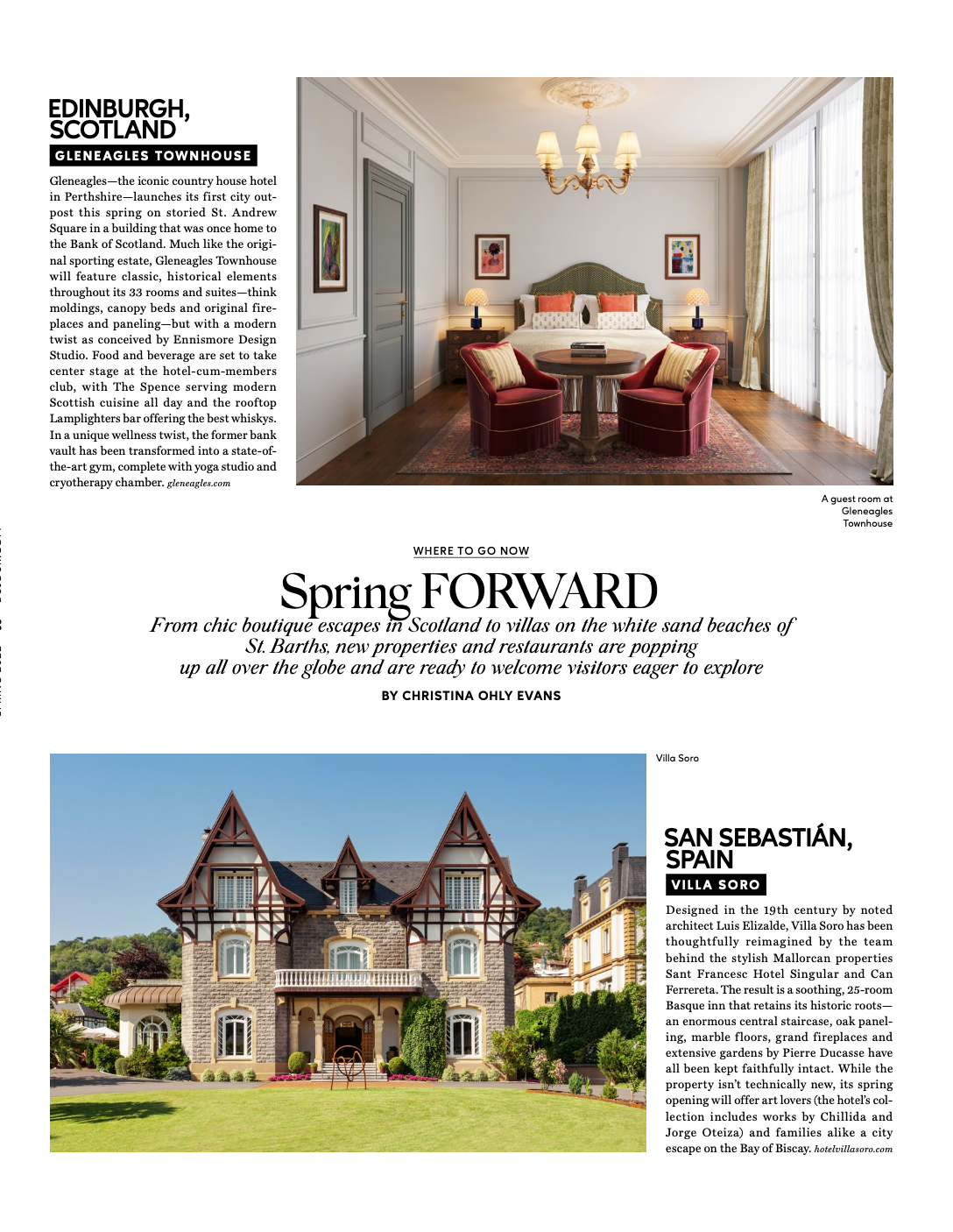
Spring FORWARD
From chic boutique escapes in Scotland to villas on the white sand beaches of St. Barths, new properties and restaurants are popping
up all over the globe and are ready to welcome visitors eager to explore
From chic boutique escapes in Scotland to villas on the white sand beaches of St. Barths, new properties and restaurants are popping up all over the globe and are ready to welcome visitors eager to explore
EDINBURGH, SCOTLAND
GLENEAGLES TOWNHOUSE
Gleneagles—the iconic country house hotel in Perthshire—launches its first city out- post this spring on storied St. Andrew Square in a building that was once home to the Bank of Scotland. Much like the origi- nal sporting estate, Gleneagles Townhouse will feature classic, historical elements throughout its 33 rooms and suites—think moldings, canopy beds and original fire- places and paneling—but with a modern twist as conceived by Ennismore Design Studio. Food and beverage are set to take center stage at the hotel-cum-members club, with The Spence serving modern Scottish cuisine all day and the rooftop Lamplighters bar offering the best whiskys. In a unique wellness twist, the former bank vault has been transformed into a state-of- the-art gym, complete with yoga studio and cryotherapy chamber. gleneagles.com
SAN SEBASTIÁN, SPAIN
VILLA SORO
Designed in the 19th century by noted architect Luis Elizalde, Villa Soro has been thoughtfully reimagined by the team behind the stylish Mallorcan properties Sant Francesc Hotel Singular and Can Ferrereta. The result is a soothing, 25-room Basque inn that retains its historic roots— an enormous central staircase, oak panel- ing, marble floors, grand fireplaces and extensive gardens by Pierre Ducasse have all been kept faithfully intact. While the property isn’t technically new, its spring opening will offer art lovers (the hotel’s col- lection includes works by Chillida and Jorge Oteiza) and families alike a city escape on the Bay of Biscay. hotelvillasoro.com
FIUGGI, ITALY
THE RANCH ITALY AT PALAZZO FIUGGI
Cult luxury fitness and wellness retreat The Ranch at Malibu is expanding its signature program to Palazzo Fiuggi, just an hour outside Rome. Set on a picturesque hilltop, the innovative retreat has a rich history of healing—Michelangelo sought its restor- ative waters—paired with a state-of-the-art medical facility. The Ranch Italy will capi- talize on the surrounding landscape and focus on intensive hiking, strength and core training, as well as yoga and massage. After spending the day in the Apennine Mountains, the 25 weekly guests (seven nights, eight days) will delight in nutrient- dense, plant-based meals courtesy of three Michelin-starred chef Heinz Beck, in part- nership with The Ranch’s executive chef. For a physical and mental refresh with Italian flair, book now. theranchmalibu.com
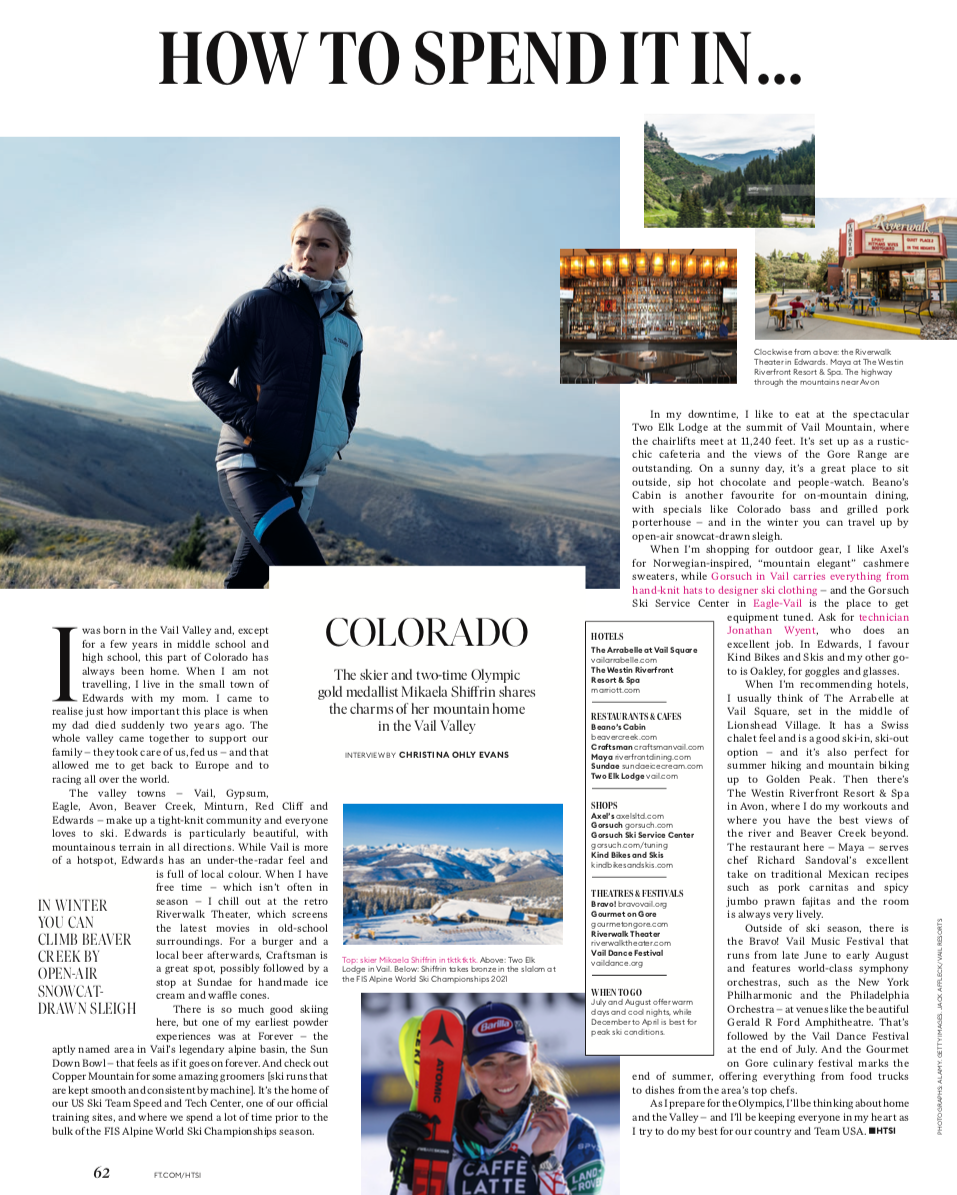
Mikaela Shiffrin’s guide to Colorado
Mikaela Shiffrin’s guide to Colorado
The skier and two-time Olympic gold medallist shares the charms of her mountain home in the Vail Valley
The skier and two-time Olympic gold medallist shares the charms of her mountain home in the Vail Valley
I was born in the Vail Valley and, except for a few years in middle school and high school, this part of Colorado has always been home. When I am not travelling, I live in the small town of Edwards with my mom. I came to realise just how important this place is when my dad died suddenly two years ago. The whole valley came together to support our family – they took care of us, fed us – and that allowed me to get back to Europe and to racing all over the world.
The valley towns – Vail, Gypsum, Eagle, Avon, Beaver Creek, Minturn, Red Cliff and Edwards – make up a tight-knit community and everyone loves to ski. Edwards is particularly beautiful, with mountainous terrain in all directions. While Vail is more of a hotspot, Edwards has an under-the-radar feel and is full of local colour. When I have free time – which isn’t often in season – I chill out at the retro Riverwalk Theater, which screens the latest movies in old-school surroundings. For a burger and a local beer afterwards, Craftsman is a great spot, possibly followed by a stop at Sundae for handmade ice cream and waffle cones.
There is so much good skiing here, but one of my earliest powder experiences was at Forever – the aptly named area in Vail’s legendary alpine basin, the Sun Down Bowl – that feels as if it goes on forever. And check out Copper Mountain for some amazing groomers [ski runs that are kept smooth and consistent by machine]. It’s the home of our US Ski Team Speed and Tech Center, one of our official training sites, and where we spend a lot of time prior to the bulk of the FIS Alpine World Ski Championships season. When I’m shopping for outdoor gear, I like Axel’s for Norwegian-inspired, “mountain elegant” cashmere sweaters, while Gorsuch in Vail carries everything from knit hats to designer ski clothing – and the Gorsuch Ski Service Center in Eagle-Vail is the place to get equipment tuned. Ask for technician Jonathan Weyant, who does an excellent job. In Edwards, I favour Kind Bikes and Skis and my other go-to is Oakley, for goggles and glasses.
When I’m recommending hotels, I usually think of The Arrabelle at Vail Square, set in the middle of Lionshead Village. It has a Swiss chalet feel and is a good ski-in, ski-out option – and it’s also perfect for summer hiking and mountain biking up to Golden Peak. Then there’s The Westin Riverfront Resort & Spa in Avon, where I do my workouts and where you have the best views of the river and Beaver Creek beyond. The restaurant here – Maya – serves chef Richard Sandoval’s excellent take on traditional Mexican recipes such as pork carnitas and spicy jumbo prawn fajitas and the room is always very lively.
Outside of ski season, there is the Bravo! Vail Music Festival that runs from late June to early August and features world-class symphony orchestras, such as the New York Philharmonic and the Philadelphia Orchestra – at venues like the beautiful Gerald R Ford Amphitheatre. That’s followed by the Vail Dance Festival at the end of July. And the Gourmet on Gore culinary festival marks the end of summer, offering everything from food trucks to dishes from the area’s top chefs.
As I prepare for the Olympics, I’ll be thinking about home and the Valley – and I’ll be keeping everyone in my heart as I try to do my best for our country and Team USA.
When to go: July and August offer warm days and cool nights, while December to April is best for peak ski conditions

On and Off Piste
Ski season is here, and with it comes everything from high-speed state of the art lifts to design led hotels and designer clothing collaborations. Here are just a few of this winter’s high altitude highlights.
The highly anticipated Montage Big Sky opens with 139 guest rooms, suites and residences all designed in a neutral palette using natural materials, in keeping with the rugged Rocky Mountain setting. Ski across 5,850 Big Sky acres followed by a satisfying meal at Cortina, where wood-fired Northern Italian fare is on offer, or hit Alpenglow—named after Big Sky Country’s stunning sunsets over the Spanish Peaks—for savory snacks and craft beers.
Ski season is here, and with it comes everything from high-speed state of the art lifts to design led hotels and designer clothing collaborations. Here are just a few of this winter’s high altitude highlights.
By Christina Ohly Evans


Dispatch from France
Dispatch from France
Paris is bursting with culinary excitement. From restaurants set within luxury hotels to more off the beaten path boites, there’s lots to explore in the French capital this season.
Paris is bursting with culinary excitement. From restaurants set within luxury hotels to more off the beaten path boites, there’s lots to explore in the French capital this season.
By Christina Ohly Evans


Best of Britain
London is the place to be this season, with a slew of new hotels, exhibitions, theater offerings and restaurants. Before you book, consider a few of the latest additions to the excellent lodging scene.
Set in the leafy green heart of Chelsea, the recently opened Beaverbrook Town House combines Georgian glamour with cosseting, luxe interiors (think lacquer, velvet, theatrical curtains and opulent carpets) by local designer Nicola Harding. The 15,000-square-foot heritage hotel occupies two imposing townhouses just across from bucolic Cadogan Gardens on Sloane Street that have been reimagined in the spirit of its namesake, Lord Beaverbrook—the former press baron and MP whose inner circle included the likes of Ian Fleming, Winston Churchill and Elizabeth Taylor. Guests at this home-away-from-home will be ensconced in vibrant, jewel-toned color, as well as art, photography and memorabilia from the Lord’s impressive private collection.
London is the place to be this season, with a slew of new hotels, exhibitions, theater offerings and restaurants. Before you book, consider a few of the latest additions to the excellent lodging scene.
By Christina Ohly Evans and Natasha Wolf


Beaverbrook Town House
Set in the leafy green heart of Chelsea, the recently opened Beaverbrook Town House combines Georgian glamour with cosseting, luxe interiors (think lacquer, velvet, theatrical curtains and opulent carpets) by local designer Nicola Harding. The 15,000-square-foot heritage hotel occupies two imposing townhouses just across from bucolic Cadogan Gardens on Sloane Street that have been reimagined in the spirit of its namesake, Lord Beaverbrook—the former press baron and MP whose inner circle included the likes of Ian Fleming, Winston Churchill and Elizabeth Taylor. Guests at this home-away-from-home will be ensconced in vibrant, jewel-toned color, as well as art, photography and memorabilia from the Lord’s impressive private collection. A cozy library, an exquisite private garden and an unexpected contemporary Japanese restaurant—the Fuji Grill and Omakase Sushi Bar—are among many highlights at this hidden SW3 gem. beaverbrooktownhouse.co.uk
The Cadogan, a Belmond Hotel
For understated luxury off the beaten path, this 54-room Chelsea hotel is impossible to beat. Upon arrival at The Cadogan, a Belmond Hotel, guests are welcomed into a light-filled townhouse setting and whisked to rooms that have been thoughtfully appointed in subtle cream hues—many with fireplaces and balconies overlooking the lush Cadogan Place Gardens across Sloane Street (guests have access to this coveted private garden with tennis courts). In addition to the highlights of British cuisine—from light bites in the chic bar and terrace to a luxurious afternoon tea—guests are in for a postprandial treat with the hotel’s Sleep Concierge, a new program designed to destress and maximize rest. From meditative recordings courtesy of sleep guru Malminder Gill (consultations available upon request) to pillow menus, weighted blankets and slumber-inducing scent, a stay here is the height of stylish relaxation. Other highlights include Elemental Herbology massages, a Royal Suite that was once Oscar Wilde’s favorite, after-hours access to the Chelsea Physic Garden and a stay at Belmond’s Oxfordshire property, Le Manoir aux Quat’Saisons, should the craving for chef Raymond Blanc’s Michelin-starred cuisine arise. belmond.com
Claridge’s
Long a refuge for royalty, statesmen and stars, Claridge’s is always innovating but never at the expense of the old-world, art deco charm that has earned it a loyal following. Among the many reasons to book in at Brook Street is L’Epicerie, an intimate dining space that seats 14 guests for interactive masterclasses and wine dinners led by longtime executive chef Martyn Nail. Also of note is the just-launched Painter’s Room—an homage to the 1930s space of the same name originally covered in murals by Mary Lea. Set between the magnificent Claridge’s Ballroom and the Talking Heads Gallery by artist in residence David Downton, The Painter’s Room offers a perfect escape from the bustle of Mayfair. So order that perfect martini and some assorted canapes and bask in the glow of a specially commissioned stained glass work by British artist Annie Morris before returning to busy city life. claridges.co.uk
Nomad
NoMad’s first European outpost, in a historic 19th-century building formerly known as Bow Street Magistrates’ Court and Police Station in Covent Garden, is the Sydell Group’s fourth NoMad hotel to date. The 91 rooms and suites were designed by interior design studio Roman and Williams. The hotel features spaces including the NoMad restaurant, Side Hustle, Library and the brand’s first-ever subterranean craft cocktail bar and lounge, Common Decency, which will debut later this year. thenomadhotel.com
The Londoner
All the world's a stage inside the walls of The Londoner, the newest addition to Leicester Square in the heart of the West End that opened in September. The 350-room hotel uses the theater as its muse, and interiors by Yabu Pushelberg offer glam moments at every turn, whether it's in the buzzy main lobby bar, gin-focused Joshua's Tavern, Whitcomb's restaurant, the Whisky Room speakeasy or the Japanese menu accompanied by sweeping city views at the rooftop venue, 8 at The Londoner. A massive excavation project resulted in extensive subterranean meeting and event spaces, as well as The Retreat, a full-service spa and pool located four stories below ground, making for the ultimate urban wellness experience. thelondoner.com
The Connaught
The 19th-century Mayfair gem known for its red brick façade, three Michelin-starred Hélène Darroze restaurant and a 3,000-plus-piece collection of world-class art is once again upping the hotel game in the capital. In addition to sumptuous rooms and suites with views of Mount Street and architect Tadao Ando’s tranquil water feature, the hotel has just opened The Connaught Patisserie—a bijoux space by Ab Rogers Design that’s a study in pink and white marble meant to echo the exquisite cakes on display. Another under-the-radar addition is The Red Room, a special space tucked just behind the iconic Connaught Bar. Designed by Bryan O’Sullivan, the clubby space is a study in cream and rose and holds one of the most significant collections of contemporary art—including two stunning Louise Bourgeois pieces—in the Maybourne Group. the-connaught.co.uk
Henry’s Townhouse
From the team behind Temple Guiting Manor in the Cotswolds comes Henry’s Townhouse, a new high-end, curious and charming exclusive-use property in Marylebone. The Upper Berkeley Street townhouse was once owned by Jane Austen’s brother Henry. Russell Sage Studio and Feix & Merlin Architects renovated the building, which boasts seven elegant and elaborately designed bedrooms, each with its own unique theme. “We are thrilled to see our project and years of hard work finally come to life as a beautiful and captivating small hotel,” says owner Steven Collins. “Henry’s Townhouse will have a sense of occasion and will be sophisticated yet fun, appealing to those looking for a lovely base to stay in the heart of the West End, as well as those wanting to hire the house exclusively for family and friends for a special occasion.” The property can be taken in its entirety as an exclusive home, making it ideal for families, groups of friends or work colleagues looking for luxury, privacy and a central location. henrystownhouse.co.uk
Mazi
Mazi, the upscale Greek restaurant in Notting Hill, is packed every evening thanks to a sweet outdoor patio area and a candlelit, whitewashed interior dining room. Expect a lively mix of young neighborhood folk who return regularly for favorites like tarama and tzatziki jars, sea bass tartare, honey roasted tomatoes and goat’s cheese, calamari, courgette cakes and black truffle chicken alongside refreshing Greek wines. mazi.co.uk
Ave Mario
Covent Garden hospitality giant Big Mamma Group is on track to make another hit restaurant with the new Ave Mario. The new 7,000-square-foot, 295-seat dining room (the group’s 16th restaurant in Europe) has a lot of color and personality (think red leather banquettes and geometric, monochromatic tiled walls). Restaurateurs Victor Lugger and Tigrane Seydoux are behind Big Mamma Group’s varied trattorias, and this one’s fluffy Neapolitan pizzas, housemade pastas, chopped salads and fresh burrata are clearly hitting the spot. bigmammagroup.com
The Farmyard at The Newt
Somerset favorite The Newt has recently launched The Farmyard, an equally stunning, rustic-chic 17-room boutique bolthole just down the road that makes for the ultimate weekend escape. An assortment of 18th-century converted buildings, including an old stable, a granary and cheese barn, a pool barn, and a new “grain store”—plus the gardens and spa at the original Georgian gem, Hadspen House—combine to make guests feel as if they are part of a stylish, understated house party. Complimentary drinks (including The Newt’s own cider) and freshly baked pastries are on offer throughout the day, as are complimentary bicycles and buggies for exploring the grounds. For a cozy winter break with Scandi touches, sumptuous rooms and indulgent spa treatments, book now. thenewtinsomerset.com
The Mitre
Once the overflow space for hard-partying guests of King Charles II at Hampton Court Palace next door, The Mitre has retained its festive English charm thanks to a thoughtful redesign by Nicola Harding. Just 30 minutes from central London, the Grade II-listed boutique hotel is set on the River Thames and features 36 uniquely appointed rooms, each with a mix of classic elements (hand-painted de Gournay wallpaper, antique furnishings, a well-stocked library complete with roaring fireplace) and contemporary touches (modern prints, a retro jukebox). The vibe here is relaxed yet stylish; waitstaff in the hotel’s riverside 1665 brasserie sport jeans and long aprons, while the Coppernose bar (Henry VIII’s nickname) offers all-day dining. mitrehamptoncourt.com
Looking Ahead
As if this weren’t enough, here are two promising properties opening in the years to come.
Set in the former U.S. embassy on Grosvenor Square, this landmark Mayfair building is being reimagined by architect David Chipperfield and interior architect Joseph Dirand. Designed by Eero Saarinen in 1960, the iconic building is set to feature 139 sumptuous yet sleek guestrooms and suites, as well as dining venues designed by Tristan Auer and a Yabu Pushelberg–designed Asaya integrative wellness space. For a touch of art deco glamour in the heart of central London, The Chancery Rosewood will be the place to be in 2024. rosewoodhotels.com
Overlooking Wellington Arch and Hyde Park Corner, the ambitious Peninsula London will feature 189 guest rooms designed by architect Peter Marino, whose latest hotel project, Cheval Blanc, continues to garner international buzz. With a focus on rich, artisanal finishes and fabrics, as well as several destination restaurants and retail outlets, The Peninsula London promises to be a spectacular addition to Belgravia when it opens in early 2023. peninsula.com