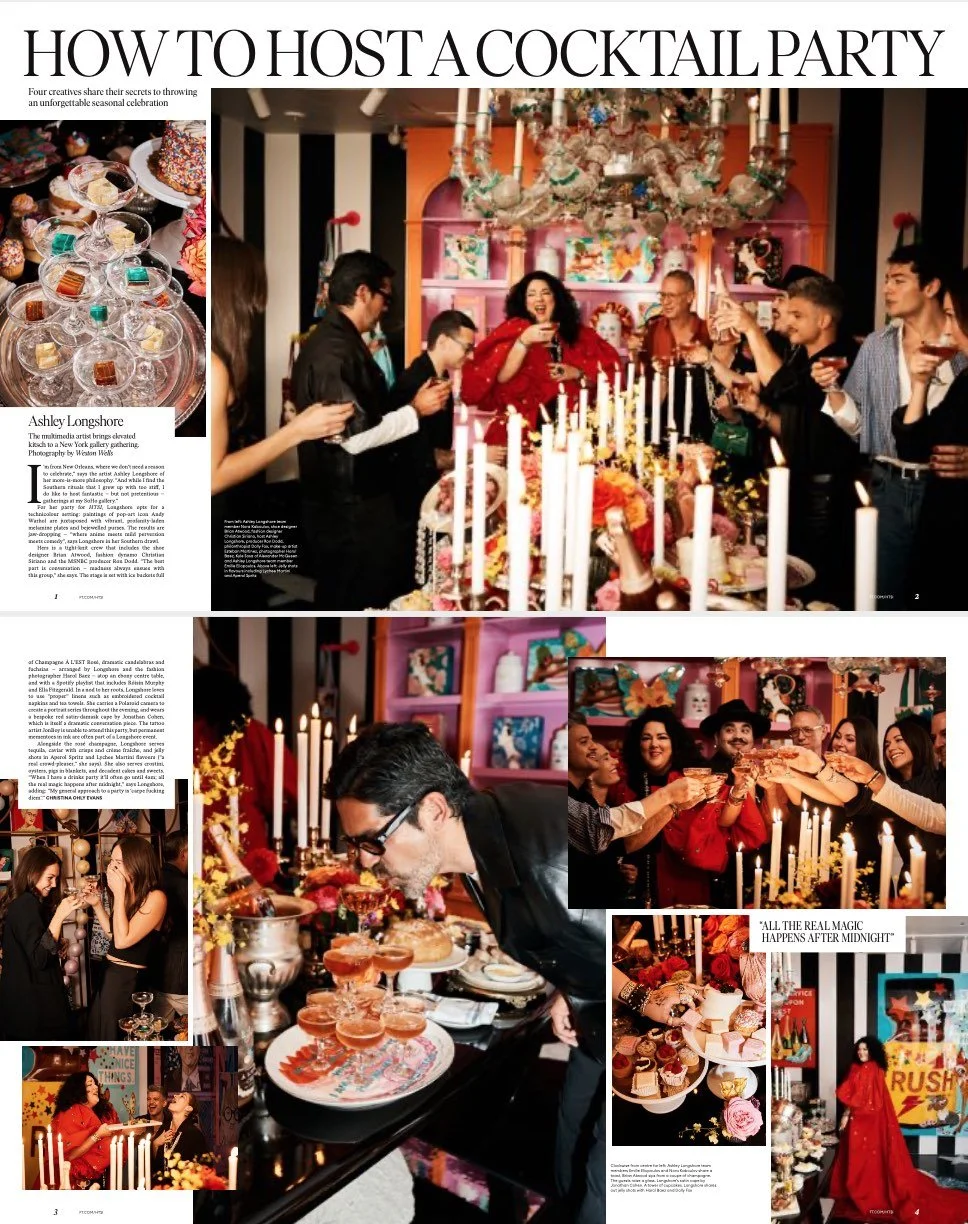
Ashley Longshore ‘All the real magic happens after midnight’
“I’m from New Orleans, where we don’t need a reason to celebrate,” says the artist Ashley Longshore of her more-is-more philosophy. “And while I find the Southern rituals that I grew up with too stiff, I do like to host fantastic – but not pretentious – gatherings at my SoHo gallery.”
The multimedia artist brings elevated kitsch to a New York gallery gathering
“I’m from New Orleans, where we don’t need a reason to celebrate,” says the artist Ashley Longshore of her more-is-more philosophy. “And while I find the Southern rituals that I grew up with too stiff, I do like to host fantastic – but not pretentious – gatherings at my SoHo gallery.”
For her party for HTSI, Longshore opts for a technicolour setting: paintings of pop-art icon Andy Warhol are juxtaposed with vibrant, profanity-laden melamine plates and bejewelled purses. The results are jaw-dropping – “where anime meets mild perversion meets comedy”, says Longshore in her Southern drawl.
Hers is a tight-knit crew that includes the shoe designer Brian Atwood, fashion dynamo Christian Siriano and the MSNBC producer Ron Dodd. “The best part is conversation – madness always ensues with this group,” she says. The stage is set with ice buckets full of Champagne À L’EST Rosé, dramatic candelabras and fuchsias – arranged by Longshore and the fashion photographer Harol Baez – atop an ebony centre table, and with a Spotify playlist that includes Róisín Murphy and Ella Fitzgerald.
In a nod to her roots, Longshore loves to use “proper” linens such as embroidered cocktail napkins and tea towels. She carries a Polaroid camera to create a portrait series throughout the evening, and wears a bespoke red satin-damask cape by Jonathan Cohen, which is itself a dramatic conversation piece. The tattoo artist JonBoy is unable to attend this party, but permanent mementoes in ink are often part of a Longshore event.
Alongside the rosé champagne, Longshore serves tequila, caviar with crisps and crème fraîche, and jelly shots in Aperol Spritz and Lychee Martini flavours (“a real crowd-pleaser,” she says). She also serves crostini, oysters, pigs in blankets, and decadent cakes and sweets. “When I have a drinks party it’ll often go until 4am; all the real magic happens after midnight,” says Longshore, adding: “My general approach to a party is ‘carpe fucking diem’.”
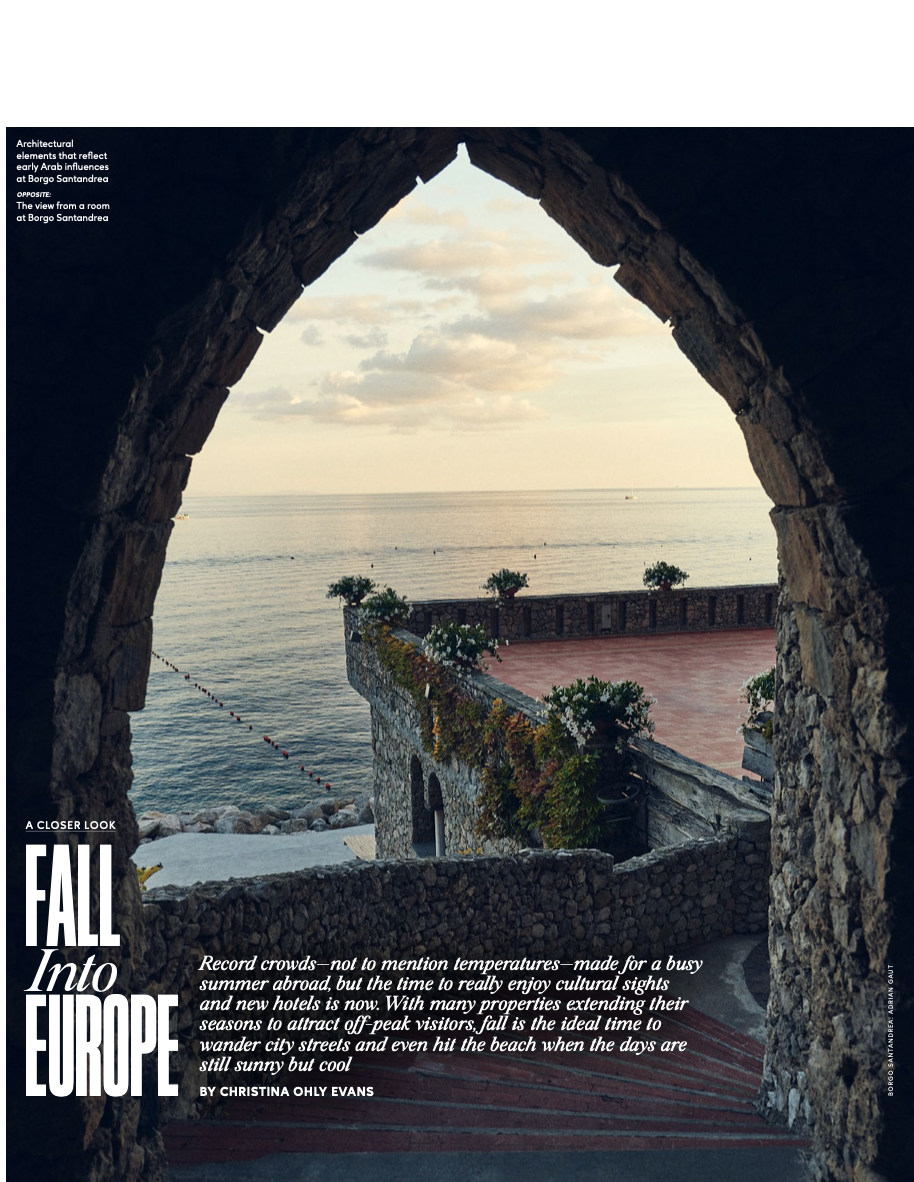
FALL into EUROPE
Record crowds—not to mention temperatures—made for a busy summer abroad, but the time to really enjoy cultural sights and new hotels is now. With many properties extending their seasons to attract off-peak visitors, fall is the ideal time to wander city streets and even hit the beach when the days are still sunny but cool.
Record crowds—not to mention temperatures—made for a busy summer abroad, but the time to really enjoy cultural sights and new hotels is now. With many properties extending their seasons to attract off-peak visitors, fall is the ideal time to wander city streets and even hit the beach when the days are still sunny but cool
BY CHRISTINA OHLY EVANS
Coastal Getaways
A 1960s design aesthetic meets pure Mediterranean chic at Borgo Santandrea, a cliffside perch overlooking the centuries-old fish- ing village of Conca dei Marini in the heart of the Amalfi Coast. From its breathtaking 30 rooms and 16 suites—each with an expansive sea view—guests are immersed in la dolce vita with scents of rosemary and jasmine wafting through the air. Furnishings are a mix of traditional and modern, with noted Italian makers such as Molteni&C in the mix. The just-opened Marinella Beach Club, with its own pebble beach and jetty, is the place to be by day or evening for an aperitivo before popping next door for coastal-inspired cuisine at the ever-stylish restaurant. borgosantandrea.it
Anantara Convento di Amalfi, a 13th-cen- tury Capuchin convent that’s built into the cliffside, is the latest jaw-dropping prop- erty from Anantara Hotels. Travel verti- cally from the outskirts of Amalfi to this truly unique perch—one with the coast’s most spectacular views—and check into one of the 52 minimalist rooms and suites where monks once slept. With its original cloister and chapel beautifully preserved and a passeggiata dei monaci—monk’s walk—bursting with bougainvillea, a stay here offers equal parts history lesson and pure pampering by way of service, an indoor-outdoor spa and attentive staff. The infinity pool with the sea below is a stun- ner, as are the pizzas made in an oven that was dropped in by helicopter to this moun- tainous idyll. anantara.com
Great in Greece
Founded in 1996, the Belvedere is a family-owned luxury boutique hotel in Mykonos offering sweeping views of Chora and the Aegean Sea. This elegant Mediterranean property offers a wide array of rooms, suites and private villas enriched with hilltop and waterfront views. The relaxing Pool Club, peaceful Six Senses Spa and bustling Belvedere Bar are just a few of the onsite offerings.
Recently, the Belvedere debuted 26 residential-style hilltop rooms and suites up the hill from the main complex that are easily accessible via shuttle service. These rooms blend an elegant Greek aesthetic with modern amenities, employing raw materials such as plaster, marble and wood.
The hotel’s Matsuhisa restaurant just celebrated its 20th anni- versary with the opening of an alfresco omakase bar. “Not only was it the first Matsuhisa in Europe, but also the first open-air Nobu Matsuhisa in the world,” says chef Nobu Matsuhisa. “I arrived in 2003 and quickly fell in love with the energetic atmo- sphere of the island. I love going to the beach, swimming daily, exploring the small villages and indulging in Greek food and culture.” belvederehotel.com
Nordic Nice
Oslo is having a cultural moment, and Sommerro is the place to stay—or try its newly opened sister property, Villa Inkognito, just next door. In the heart of the city’s West End, Sommerro has quickly become a hub with its seven bars and restaurants—includ- ing the rooftop Nordic-Japanese favorite TAK Oslo—drawing visi- tors and locals alike. Set in a historic building from the 1930s, each of the 231 rooms and luxury suites features sleek Norse accents, and the entire property is fueled by renewable energy and uses electric transport. Villa Inkognito is equally magical, but much more intimate in scale and approach. Housed in a former residence that was built in the 1870s, the reimagined villa boasts 11 suites, a private gym and dining spaces, as well as an intimate bar for use by house guests. Rooms feature an eclectic mix of antiques, original artwork and classic Scandinavian furnishings—all with art nou- veau and Japonisme touches. In addition to the feel of staying in a royal residence, Villa Inkognito guests also have full use of Sommerro’s endless amenities, including Vestkantbadet—the hotel’s 15,000-square-foot, state-of-the-art wellness center. sommerrohouse.com
Loire Living
Until recently, in order to play at the Les Bordes Golf Club in the Loire
Valley, France, a 1,400-acre estate amid a UNESCO World Heritage site,
Golf Club members and guests could only stay in one of 36 lakeside member cabins. Much of the appeal of this legendary location is its two world-renowned golf courses designed by Robert Von Hagge and Gil Hanse—and its proximity to Paris (about a 90-minute drive) and bucolic French villages like Tours, Blois and Orléans, not to mention the stunning Chateau de Chambord. Now, you can live there, too. The first and second phases of the Cour du Baron residences have launched, encompassing a total of 42 private homes ranging in size from 1,800-6,000 square feet. All but a few are already spoken for, and all should be ready for residents to move in early next year. It’s a European adventure to be sure, a bit like a Loire Valley version of Silo Ridge, the private gated community in Amenia, New York, but here, you can also practice your parlez-vous français. For guests not quite ready to make a commitment who want to dip their putters into Loire Valley life first, Les Bordes Estate also has a Six Senses Hotel and Residences opening in 2026. lesbordesestate.com
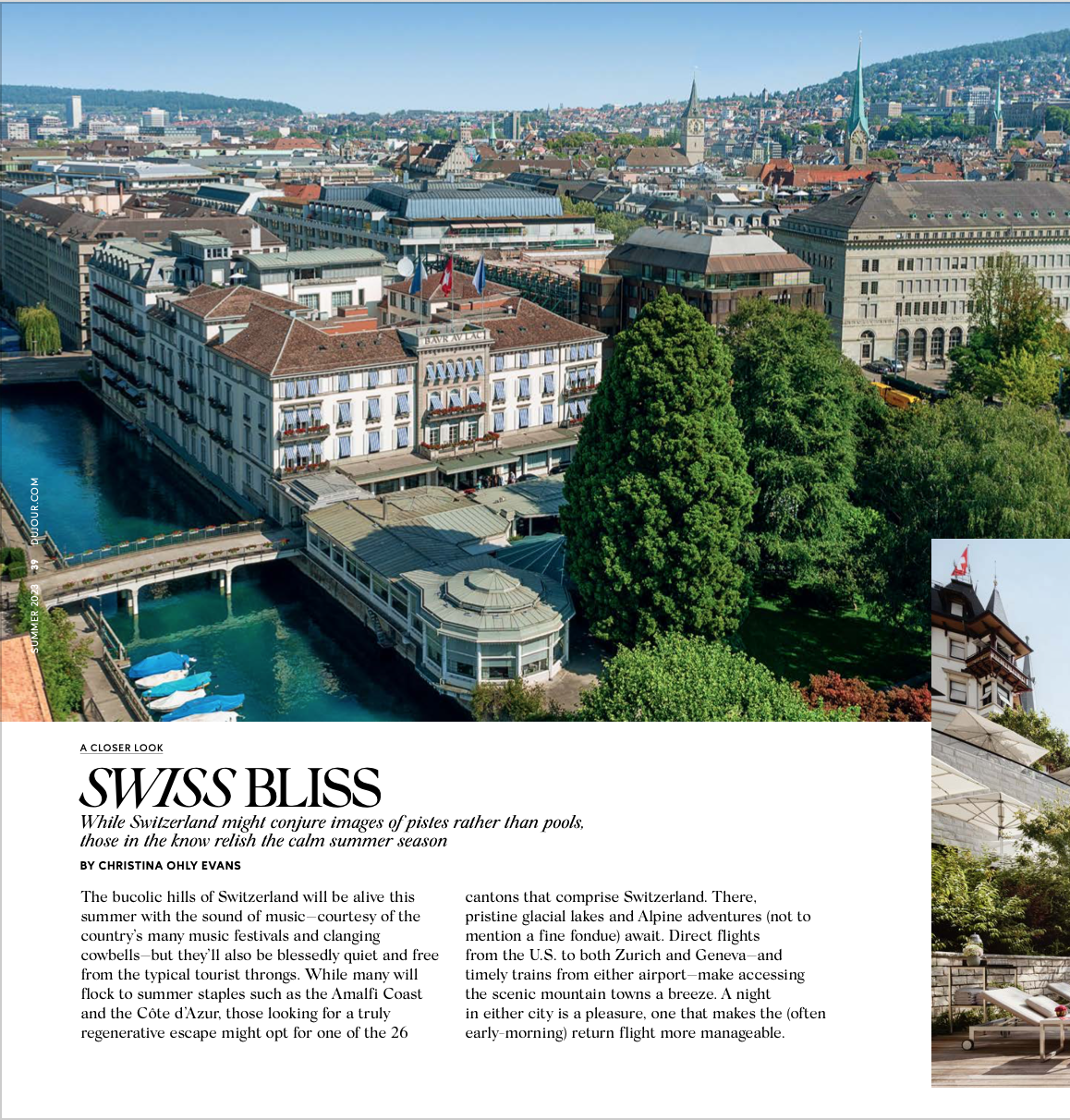
SWISS BLISS
While Switzerland might conjure images of piste rather than pools those in the know relish the calm summer season.
The bucolic hills of Switzerland will be alive this summer with the sound of music—courtesy of the country’s many music festivals and clanging cowbells—but they’ll also be blessedly quiet and free from the typical tourist throngs. While many will flock to summer staples such as the Amalfi Coast and the Côte d’Azur, those looking for a truly regenerative escape might opt for one of the 26 cantons that comprise Switzerland. There, pristine glacial lakes and Alpine adventures (not to mention a fine fondue) await. Direct flights from the U.S. to both Zurich and Geneva—and timely trains from either airport—make accessing the scenic mountain towns a breeze. A night in either city is a pleasure, one that makes the (often early-morning) return flight more manageable.
While Switzerland might conjure images of pistes rather than pools those in the know relish the calm summer season
BY CHRISTINA OHLY EVANS
The bucolic hills of Switzerland will be alive this summer with the sound of music—courtesy of the country’s many music festivals and clanging cowbells—but they’ll also be blessedly quiet and free from the typical tourist throngs. While many will flock to summer staples such as the Amalfi Coast and the Côte d’Azur, those looking for a truly regenerative escape might opt for one of the 26 cantons that comprise Switzerland. There, pristine glacial lakes and Alpine adventures (not to mention a fine fondue) await. Direct flights from the U.S. to both Zurich and Geneva—and timely trains from either airport—make accessing the scenic mountain towns a breeze. A night in either city is a pleasure, one that makes the (often early-morning) return flight more manageable.
Zurich
Zurich is full of churches, cobblestone streets and chocolate shops—all of which contrast brilliantly with contemporary art gal- leries and the latest in technology and transportation. Book in for a night at the iconic Baur au Lac (bauraulac.ch) for old-world elegance on the shores of Lake Zurich. Enjoy a sumptuous meal at the two- Michelin-starred Pavillon or savor a traditional wiener schnitzel in the more casual Martin Brudnizki–designed brasserie Baur’s. Just at the edge of the city sits The Dolder Grand (thedoldergrand.com), a castle-like hideaway with 175 rooms and suites as well as a 43,000-square-foot Foster + Partners–designed spa. Outdoor enthusiasts will love hiking and biking the trails around the lake or Käferberg and Greifensee—all with a gourmet picnic basket full of local cheeses and charcuterie in tow. Aesthetes will want to make time for the expansive Kunsthaus Zurich, which holds treasures from the 17th century as well as Alberto Giacometti sculptures and contemporary photography by Cindy Sherman
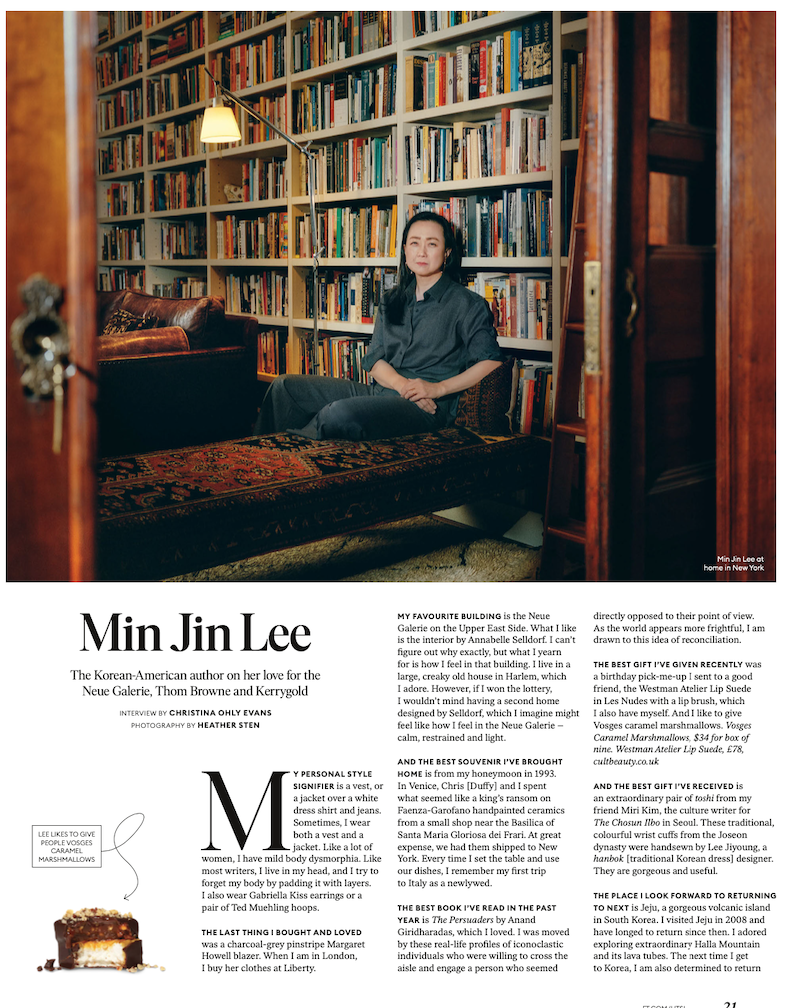
Author Min Jin Lee: ‘Dua Lipa and Beyoncé give me hope for the next generation’
The Korean-American author on her love for the Neue Galerie, Thom Browne and Kerrygold
My personal style signifier is a vest, or a jacket over a white dress shirt and jeans. Sometimes, I wear both a vest and a jacket. Like a lot of women, I have mild body dysmorphia. Like most writers, I live in my head, and I try to forget my body by padding it with layers. I also wear Gabriella Kiss earrings or a pair of Ted Muehling hoops.
The Korean-American author on her love for the Neue Galerie, Thom Browne and Kerrygold
My personal style signifier is a vest, or a jacket over a white dress shirt and jeans. Sometimes, I wear both a vest and a jacket. Like a lot of women, I have mild body dysmorphia. Like most writers, I live in my head, and I try to forget my body by padding it with layers. I also wear Gabriella Kiss earrings or a pair of Ted Muehling hoops.
The last thing I bought and loved was a charcoal-grey pinstripe Margaret Howell blazer. When I am in London, I buy her clothes at Liberty.
My favourite building is the Neue Galerie on the Upper East Side. What I like is the interior by Annabelle Selldorf. I can’t figure out why exactly, but what I yearn for is how I feel in that building. I live in a large, creaky old house in Harlem, which I adore. However, if I won the lottery, I wouldn’t mind having a second home designed by Selldorf, which I imagine might feel like how I feel in the Neue Galerie – calm, restrained and light.
And the best souvenir I’ve brought home is from my honeymoon in 1993. In Venice, Chris [Duffy] and I spent what seemed like a king’s ransom on Faenza-Garofano handpainted ceramics from a small shop near the Basilica of Santa Maria Gloriosa dei Frari. At great expense, we had them shipped to New York. Every time I set the table and use our dishes, I remember my first trip to Italy as a newlywed.
The best book I’ve read in the past year is The Persuaders by Anand Giridharadas, which I loved. I was moved by these real-life profiles of iconoclastic individuals who were willing to cross the aisle and engage a person who seemed directly opposed to their point of view. As the world appears more frightful, I am drawn to this idea of reconciliation. The best gift I’ve given recently was a birthday pick-me-up I sent to a good friend, the Westman Atelier Lip Suede in Les Nudes with a lip brush, which I also have myself. And I like to give Vosges caramel marshmallows. Vosges Caramel Marshmallows, $34 for box of nine. Westman Atelier Lip Suede, £78, cultbeauty.co.uk
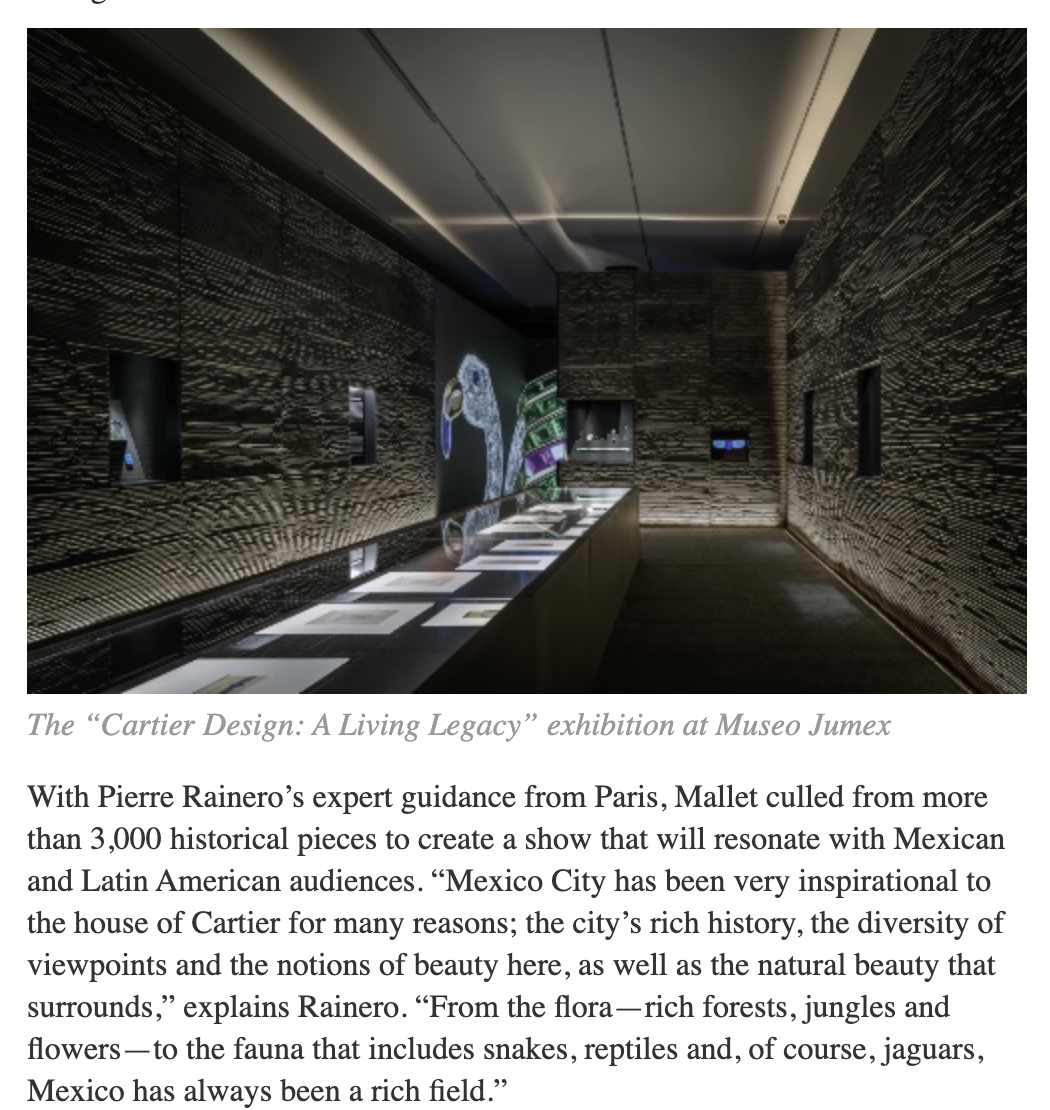
Cartier Design: A Living Legacy” Opens at Museo Jumex
This month marks the opening of “Cartier Design: A Living Legacy,” a stunning retrospective of the maison’s most iconic creations that runs from March 15 through May 14 at Mexico City’s Museo Jumex. The strikingly spare David Chipperfield-designed museum is the perfect backdrop for the collection of 160 objects that were last exhibited at the Palacio de Bellas Artes in 1999 and offer unique insights into Cartier’s strong cultural ties to Mexico as well as its timeless savoir-faire.
A new exhibition featuring jewels from the archives of the French jewelry maison opens March 15 in Mexico City
This month marks the opening of “Cartier Design: A Living Legacy,” a stunning retrospective of the maison’s most iconic creations that runs from March 15 through May 14 at Mexico City’s Museo Jumex. The strikingly spare David Chipperfield-designed museum is the perfect backdrop for the collection of 160 objects that were last exhibited at the Palacio de Bellas Artes in 1999 and offer unique insights into Cartier’s strong cultural ties to Mexico as well as its timeless savoir-faire.
Arranged across five themes—The Early Days and the Birth of a Style, Universal Curiosity, Jeanne Toussaint’s Taste, Wearing Beauty and Measuring Time and Maria Félix and Icons of Elegance—the show has been meticulously edited by local design curator, Ana Elena Mallet, with the guidance of Cartier’s Pierre Rainero. Drawing on the Maison’s extensive archives, the pieces selected for this decades-in-the-making exhibition include dazzling jewels, timepieces, accessories and decorative objects that were once worn by the likes of Mexican diva and Cartier devotee, Maria Felix, and the Brazilian aviator, Alberto Santos-Dumont, the famed namesake of the original Santos wristwatch.
“I wanted to bring attention to Cartier jewels as design,” says Mallet of her curatorial process that highlights “pieces reflective of aesthetics, technology, innovation, craftsmanship and style” across two centuries. The selection of a such contemporary setting—the Museo Jumex that opened in 2013—made perfect sense to Mallet who is supportive of bringing “different types of objects and materials into a traditional museum space to expand the field of art and to blur the boundaries between artistic disciplines and also see them in dialogue.”
With Pierre Rainero’s expert guidance from Paris, Mallet culled from more than 3,000 historical pieces to create a show that will resonate with Mexican and Latin American audiences. “Mexico City has been very inspirational to the house of Cartier for many reasons; the city’s rich history, the diversity of viewpoints and the notions of beauty here, as well as the natural beauty that surrounds,” explains Rainero. “From the flora—rich forests, jungles and flowers—to the fauna that includes snakes, reptiles and, of course, jaguars, Mexico has always been a rich field.”
Noted Mexican architect Frida Escobedo has been tapped to create the scenography for the exhibition, calling on her design experience for cultural institutions such as the Serpentine Gallery and the Victoria & Albert Museum. With the stage beautifully set, emblematic pieces designed for Maria Félix—including a 178.2 carat snake necklace from 1968 and a crocodile necklace comprised of 1,023 brilliant-cut fancy intense yellow diamonds with ruby and emerald cabochon eyes—are among the collection standouts. As with so many innovative Cartier designs, these necklaces were made to be worn separately, as brooches, or used as decorative table ornaments.
Equally impressive are the selection of ornate turn of the century tiaras, a 1920s Tutti Frutti bracelet once owned by Mrs. Cole Porter, bold platinum and diamond bangles circa 1934, and a unique scarab belt buckle with touches of gold and blue Egyptian faience. The accompanying sketches in graphite and gouache are exquisite, too, and provide a rare look at the creative process throughout the decades. “The main angle of this exhibition is the journey of Cartier style,” explains Rainero, “so beyond the pleasure of seeing these beautiful pieces, the show will illustrate the different design evolutions from the beginning of the Maison up to present day.”
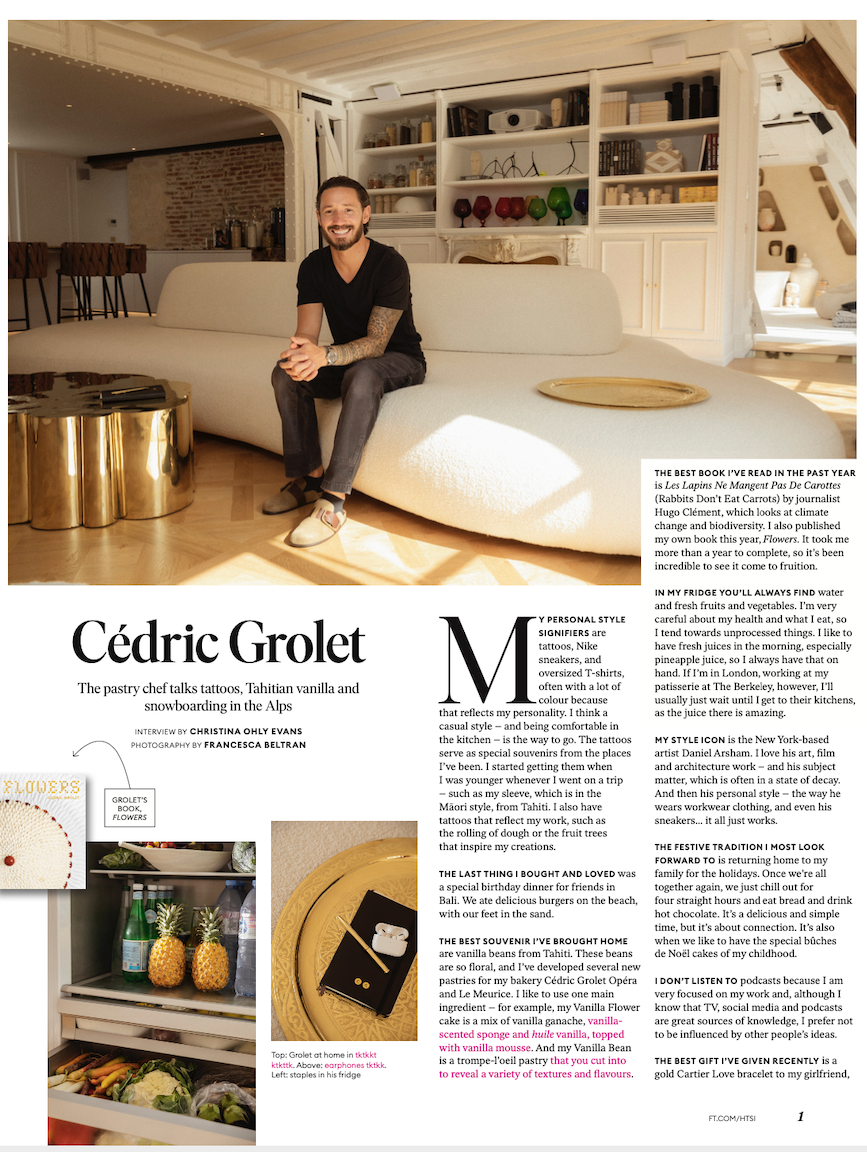
Master pâtissier Cedric Grolet talks taste
The pastry chef Cedric Grolet loves his tattoos, snowboarding in the Alps and Tahitian vanilla
My personal style signifiers are tattoos, Nike sneakers, and oversized T-shirts, often with a lot of colour because that reflects my personality. I think a casual style – and being comfortable in the kitchen – is the way to go. The tattoos serve as special souvenirs from the places I’ve been. I started getting them when I was younger whenever I went on a trip – such as my sleeve, which is in the Māori style, from Tahiti. I also have tattoos that reflect my work, such as the rolling of dough or the fruit trees that inspire my creations.
The last thing I bought and loved was a special birthday dinner for friends in Bali. We ate delicious burgers on the beach with our feet in the sand. The best souvenir I’ve brought home are vanilla beans from Tahiti. These beans are so floral, and I’ve developed several new pastries for my bakery Cédric Grolet Opéra and Le Meurice. I like to use one main ingredient – for example, my Vanilla Flower cake is a mix of vanilla ganache, vanilla almond biscuit, vanilla milk jam and vanilla cream. And my Vanilla Bean is a trompe-l’oeil pastry that you cut into to reveal a variety of textures.
The best book I’ve read in the past year is Les Lapins Ne Mangent Pas De Carottes (Rabbits Don’t Eat Carrots) by journalist Hugo Clément, which looks at climate change and biodiversity. I also published my own book this year, Flowers. It took me more than a year to complete, so it’s been incredible to see it come to fruition. In my fridge you’ll always find water and fresh fruits and vegetables. I’m very careful about my health and what I eat, so I tend towards unprocessed things. I like to have fresh juices in the morning, especially pineapple juice, so I always have that on hand. If I’m in London, working at my patisserie at The Berkeley, however, I’ll usually just wait until I get to their kitchens, as the juice there is amazing.
My style icon is the New York-based artist Daniel Arsham. I love his art, film and architecture work – and his subject matter, which is often in a state of decay. And then his personal style – the way he wears workwear clothing, and even his sneakers… it all just works. The festive tradition I most look forward to is returning home to my family for the holidays. Once we’re all together again, we just chill out for four straight hours and eat bread and drink hot chocolate. It’s a delicious and simple time, but it’s about connection. It’s also when we like to have the special bûches de Noël cakes of my childhood.
I don’t listen to podcasts because I am very focused on my work and, although I know that TV, social media and podcasts are great sources of knowledge, I prefer not to be influenced by other people’s ideas.
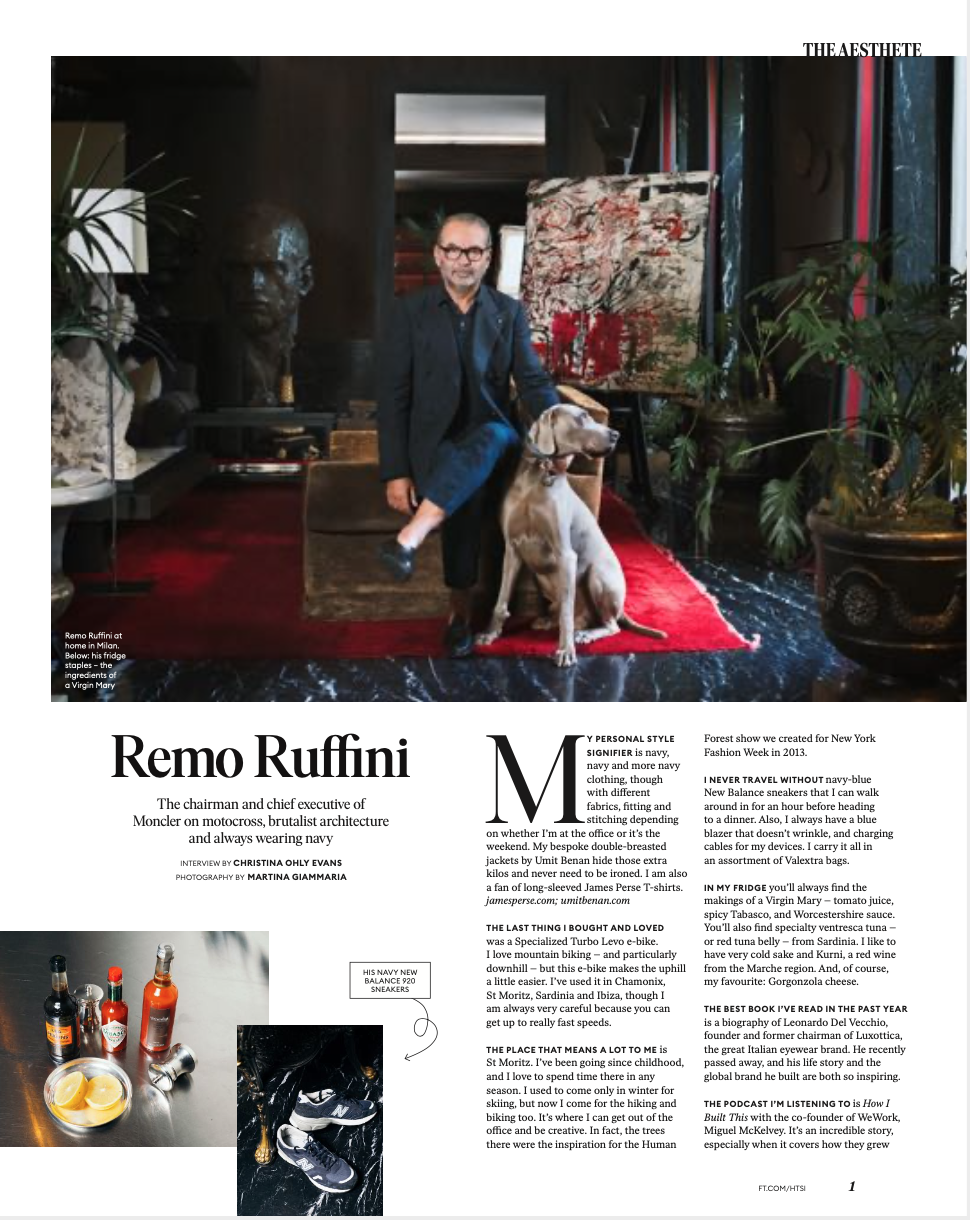
Moncler chief Remo Ruffini talks taste
The chairman and chief executive of Moncler on motocross, brutalist architecture and always wearing navy.
My personal style signifier is navy, navy and more navy clothing, though with different fabrics, fitting and stitching depending on whether I’m at the office or it’s the weekend. My bespoke double-breasted jackets by Umit Benan hide those extra kilos and never need to be ironed. I am also a fan of long-sleeved James Perse T-shirts.
The chairman and chief executive loves motocross, Bloody Marys and his monochromatic wardrobe
My personal style signifier is navy, navy and more navy clothing, though with different fabrics, fitting and stitching depending on whether I’m at the office or it’s the weekend. My bespoke double-breasted jackets by Umit Benan hide those extra kilos and never need to be ironed. I am also a fan of long-sleeved James Perse T-shirts. The last thing I bought and loved was a Specialized Turbo Levo e-bike. I love mountain biking – and particularly downhill – but this e-bike makes the uphill a little easier. I’ve used it in Chamonix, St Moritz, Sardinia and Ibiza, though I am always very careful because you can get up to really fast speeds.
The place that means a lot to me is St Moritz. I’ve been going since childhood, and I love to spend time there in any season. I used to come only in winter for skiing, but now I come for the hiking and biking too. It’s where I can get out of the office and be creative. In fact, the trees there were the inspiration for the Human Forest show we created for New York Fashion Week in 2013. I never travel without navy-blue New Balance sneakers that I can walk around in for an hour before heading to a dinner. Also, I always have a blue blazer that doesn’t wrinkle, and charging cables for my devices. I carry it all in an assortment of Valextra bags.
In my fridge you’ll always find the makings of a Virgin Mary – tomato juice, spicy Tabasco, and Worcestershire sauce. You’ll also find specialty ventresca tuna – or red tuna belly – from Sardinia. I like to have very cold sake and Kurni, a red wine from the Marche region. And, of course, my favourite: Gorgonzola cheese.
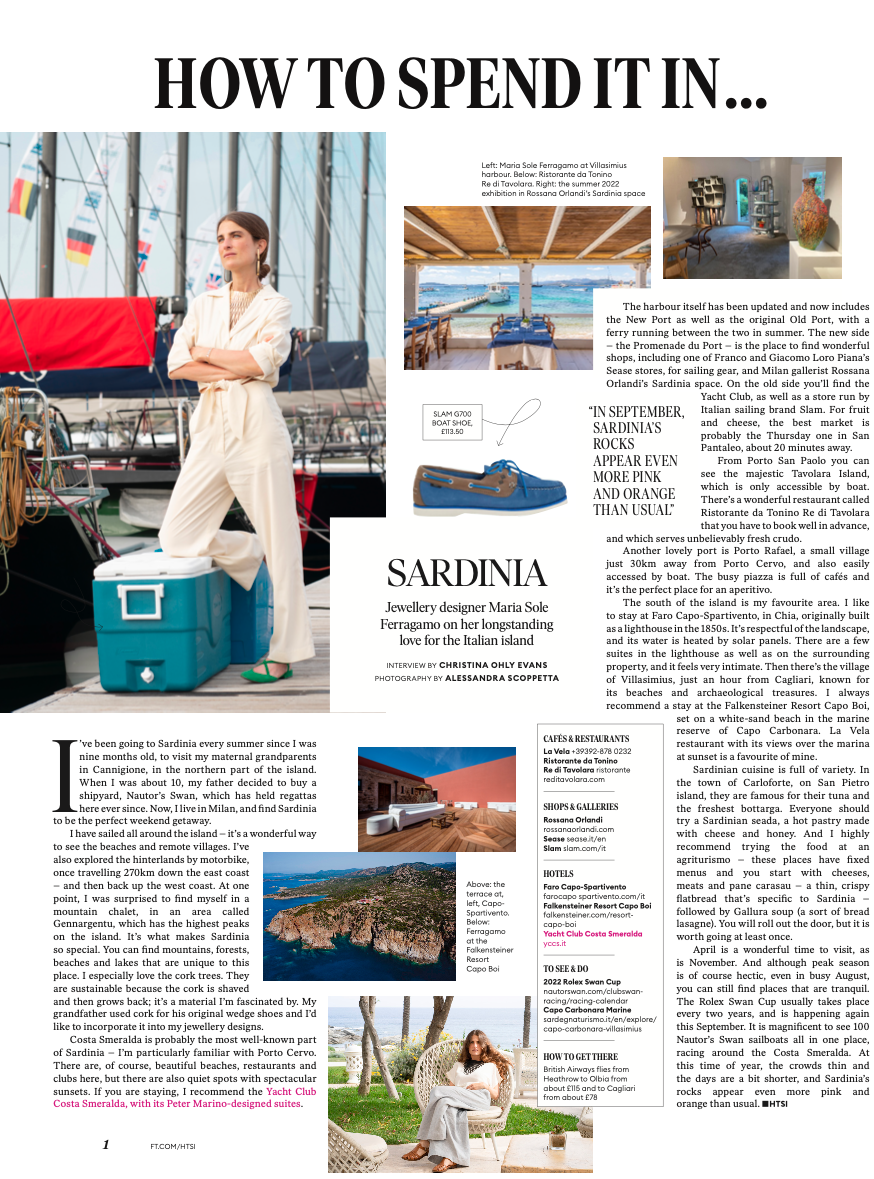
Maria Sole Ferragamo’s secret guide to Sardinia
Maria Sole Ferragamo’s secret guide to Sardinia
The jewellery designer recommends her favourite places to eat, shop and stay
The jewellery designer recommends her favourite places to eat, shop and stay
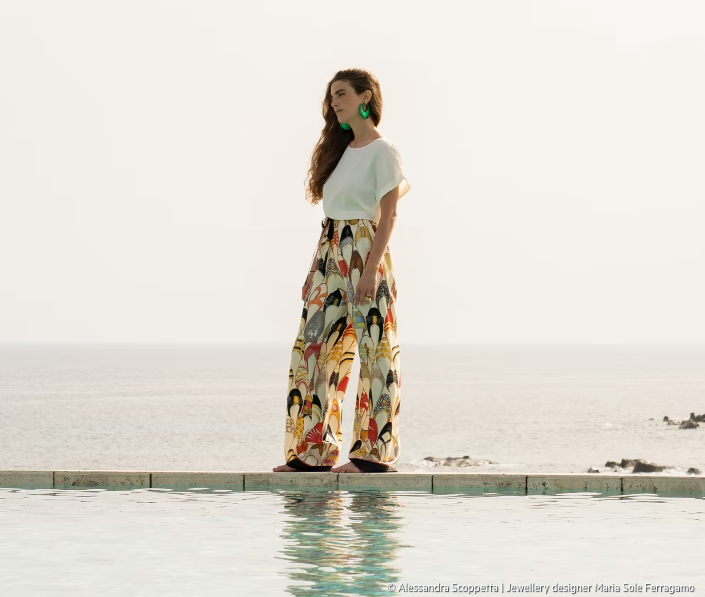
I’ve been going to Sardinia every summer since I was nine months old to visit my maternal grandparents in Cannigione in the northern part of the island. When I was about 10, my father decided to buy a shipyard, Nautor’s Swan, which has held regattas here ever since. Now I live in Milan and find Sardinia to be the perfect weekend getaway.
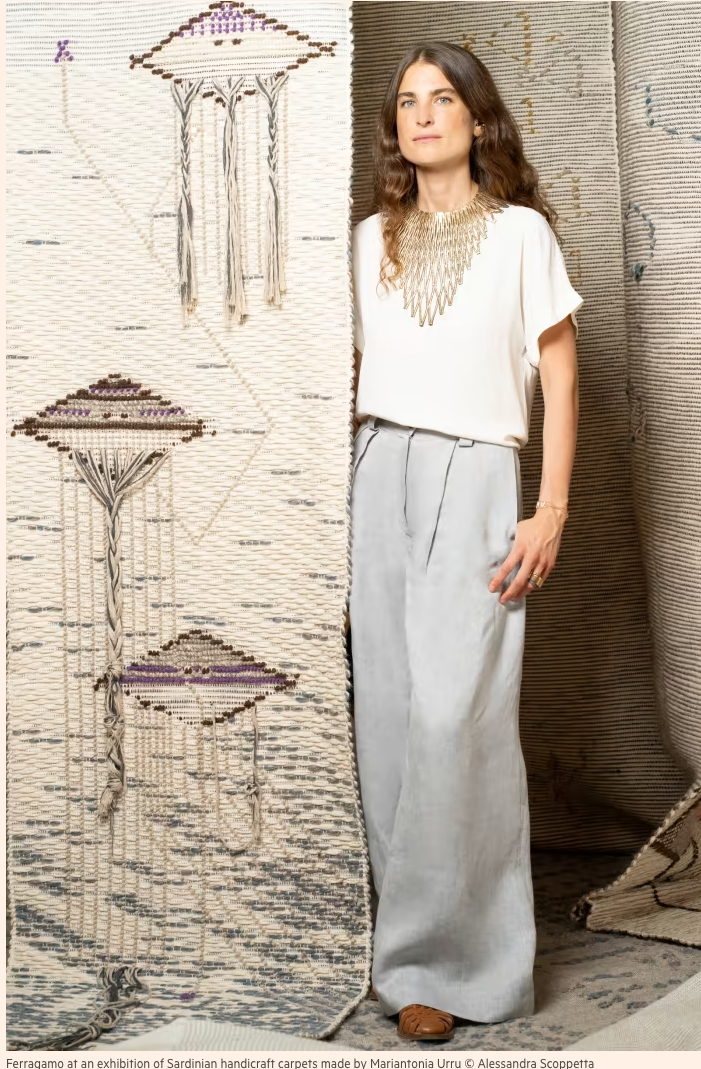
I have sailed all around the island – it’s a wonderful way to see the beaches and remote villages. I’ve also explored the hinterlands by motorbike, once travelling 270km down the east coast – and then back up the west coast. At one point, I was surprised to find myself in a mountain chalet in an area called Gennargentu, which has the highest peaks on the island. It’s what makes Sardinia so special. You can find mountains, forests, beaches and lakes that are unique to this place. I especially love the cork trees. They are sustainable because the cork is shaved and then grows back; it’s a material I’m fascinated by. My grandfather used cork for his original wedge shoes and I’d like to incorporate it into my jewellery designs.

Costa Smeralda is probably the most well-known part of Sardinia – I’m particularly familiar with Porto Cervo. There are, of course, beautiful beaches, restaurants and clubs here, but there are also quiet spots with spectacular sunsets. In September, Sardinia’s rocks appear even more pink and orange than usual. The harbour itself has been updated and now includes the New Port as well as the original Old Port, with a ferry running between the two in summer. The new side – the Promenade du Port – is the place to find wonderful shops including one of Franco and Giacomo Loro Piana’s Sease stores, for sailing gear, and Milan gallerist Rossana Orlandi’s Sardinia space. On the old side you’ll find the Yacht Club as well as a store run by Italian sailing brand Slam. For fruit and cheese the best market is probably the Thursday one in San Pantaleo, about 20 minutes away.


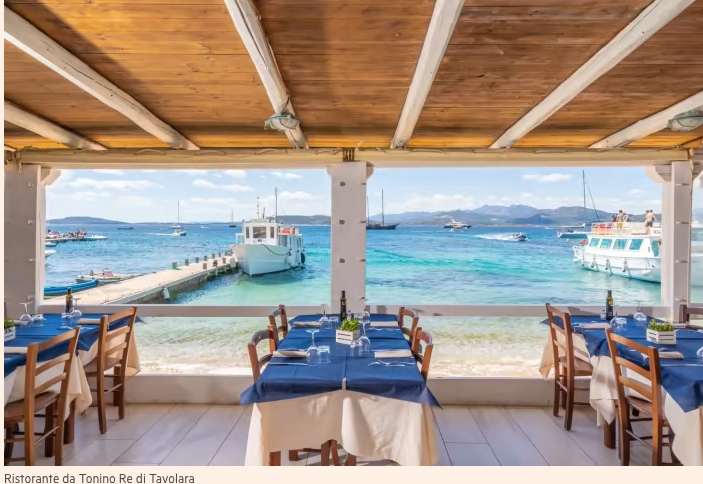
From Porto San Paolo you can see the majestic Tavolara Island, which is only accessible by boat. There’s a wonderful restaurant called Ristorante da Tonino Re di Tavolara that you have to book well in advance, and which serves unbelievably fresh crudo. Another lovely port is Porto Rafael, a small village just 30km away from Porto Cervo, and also easily accessed by boat. The busy piazza is full of cafés and it’s the perfect place for an aperitivo.
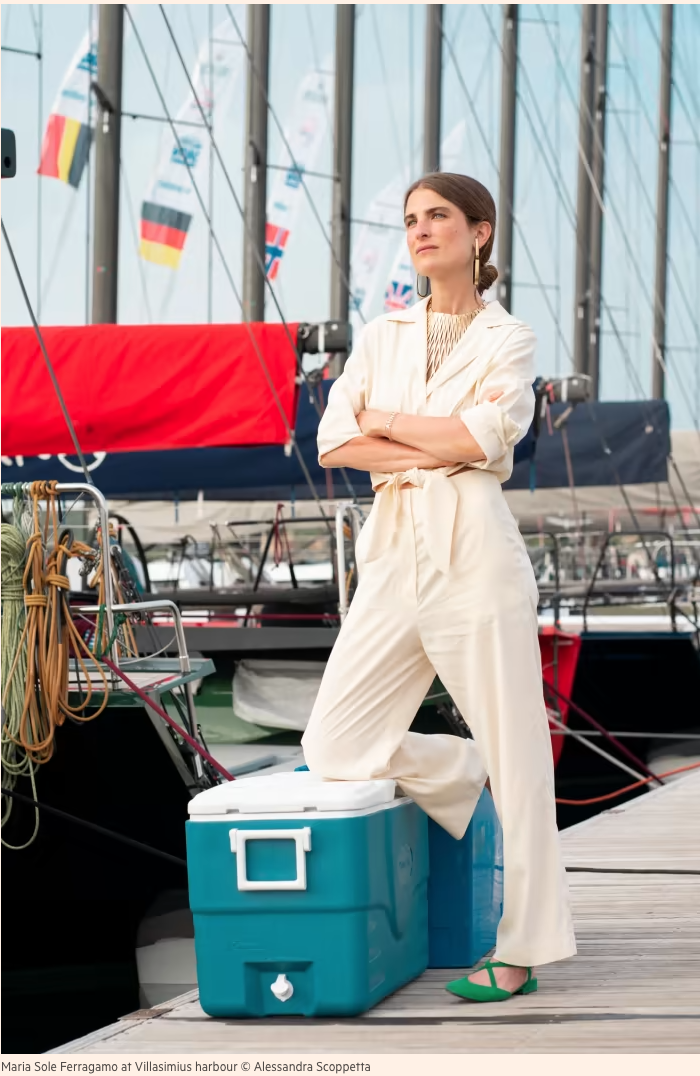
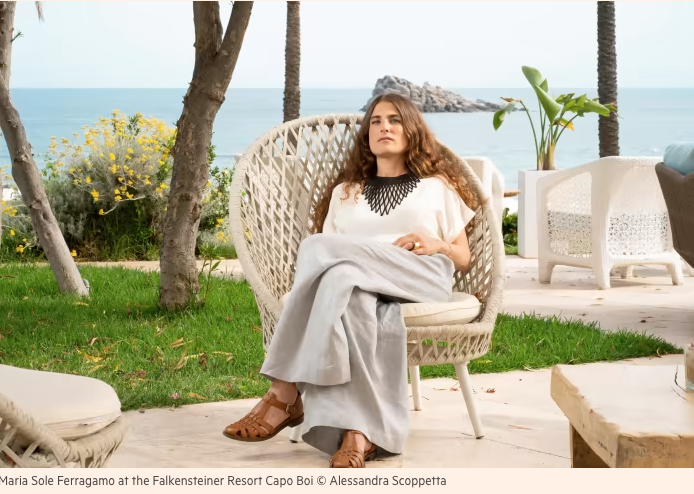
The south of the island is my favourite area. I like to stay at Faro Capo-Spartivento, in Chia, originally built as a lighthouse in the 1850s. It’s respectful of the landscape, and its water is heated by solar panels. There are a few suites in the lighthouse as well as on the surrounding property, and it feels very intimate. Then there’s the village of Villasimius, just an hour from Cagliari, known for its beaches and archaeological treasures. I always recommend a stay at the Falkensteiner Resort Capo Boi, set on a white-sand beach in the marine reserve of Capo Carbonara. La Vela restaurant with its views over the marina at sunset is a favourite of mine.

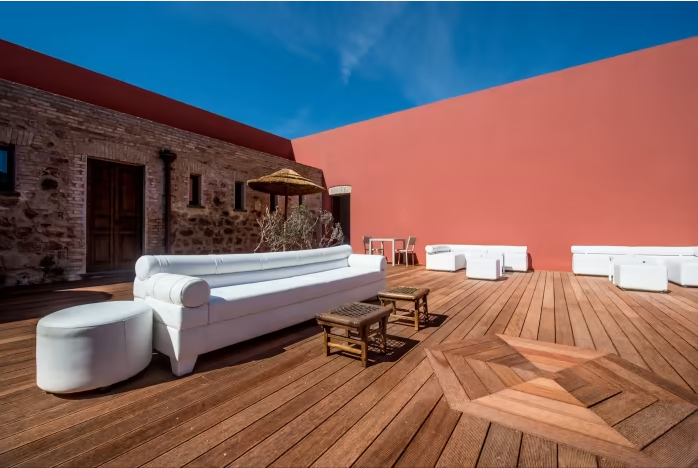
The terrace at Capo Spartivento
Sardinian cuisine is full of variety. In the town of Carloforte, on San Pietro island, they are famous for their tuna and the freshest bottarga. Everyone should try a Sardinian seada, a hot pastry made with cheese and honey. And I highly recommend trying the food at an agriturismo – these places have fixed menus and you start with cheeses, meats and pane carasau – a thin, crispy flatbread that’s specific to Sardinia – followed by Gallura soup (a sort of bread lasagne). You will roll out the door, but it is worth going at least once.
April is a wonderful time to visit, as is November. And although peak season is of course hectic, even in busy August, you can still find places that are tranquil. The Rolex Swan Cup usually takes place every two years, and is happening again this September. It is magnificent to see 100 Nautor’s Swan sailboats all in one place, racing around the Costa Smeralda. At this time of year, the crowds thin and the days are a bit shorter, and Sardinia’s rocks appear even more pink and orange than usual.
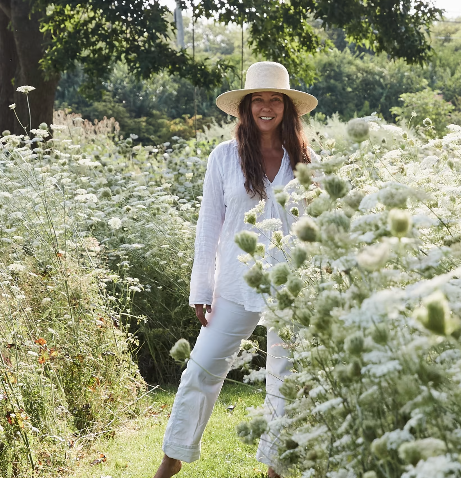
Designer Robin Standefer’s insider guide to Montauk
Designer Robin Standefer’s insider guide to Montauk
The co-founder of design studio Roman and Williams on why it’s worth travelling to the tip of Long Island
The co-founder of design studio Roman and Williams on why it’s worth travelling to the tip of Long Island
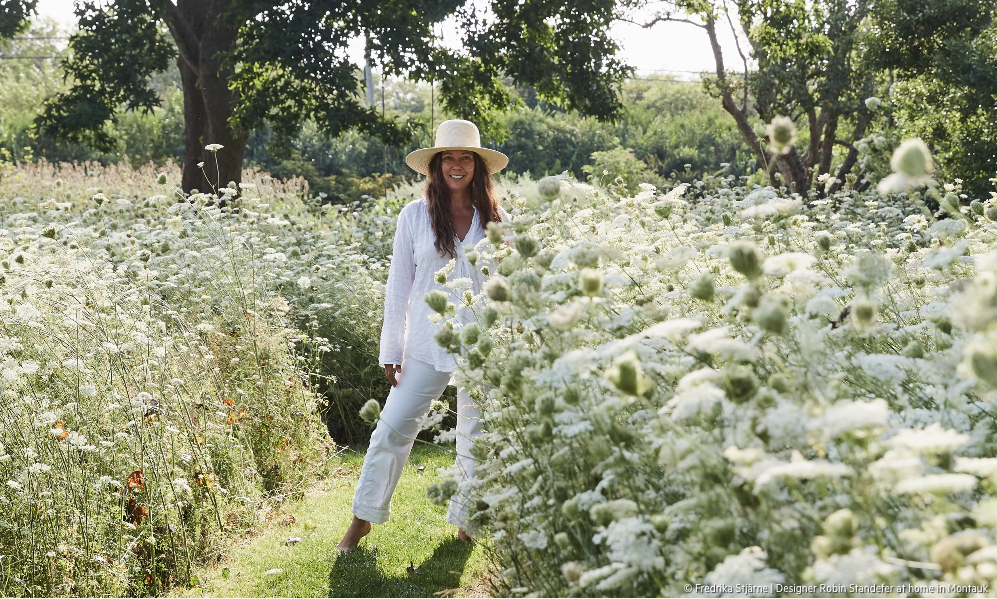
Montauk has always been a place for artists and thinkers: Edward Albee, Stanford White, Andy Warhol and Mick Jagger all spent time here, each drawn to the dramatic landscape of “The End”, as the eastern tip of Long Island is known. I first came here as a teen, and when my husband and business partner Stephen [Alesch] and I needed a retreat from the city, it seemed like the perfect place. We have now called the area home for over 20 years and we love everything about it: the ocean, the farms, the fishing boats and the history. This is our spiritual home – the place that centres us – and it’s where we’ve developed ideas for everything from the British Galleries at The Met to homes for Gwyneth Paltrow and hotels for André Balazs. It’s also the place that has inspired our lighting and furniture lines and even our menus at the restaurant at our New York store RW Guild, because the produce and seafood here are so phenomenal.
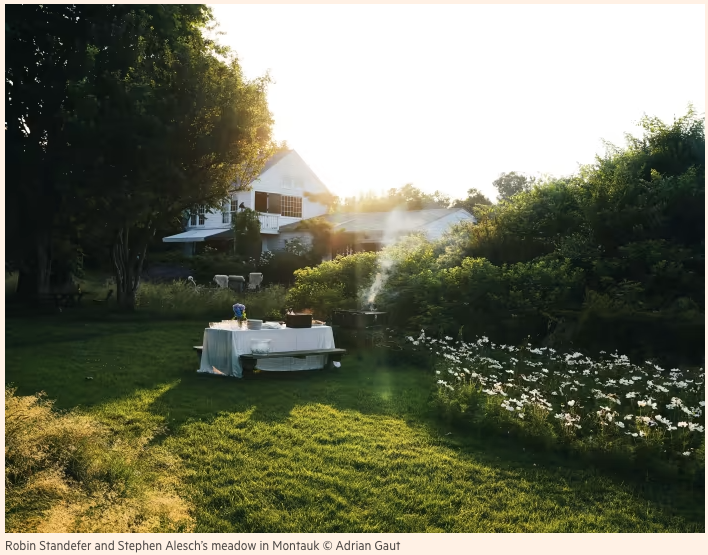
Montauk offers two entirely different experiences just a few miles apart. There is the calm Long Island Sound on one side, where Sunset Beach and Gin Beach offer gentle swimming and walks, and the noisy Atlantic Ocean on the other, with its dramatic cliffs and surf breaks. People love to talk about the traffic getting to the Hamptons and beyond, so at peak times the train is a great option, as is the Hampton Jitney [a motorcoach company]. I love watching the landscape fade from dense to wild as you leave Amagansett behind and enter Montauk. There are no manicured lawns out

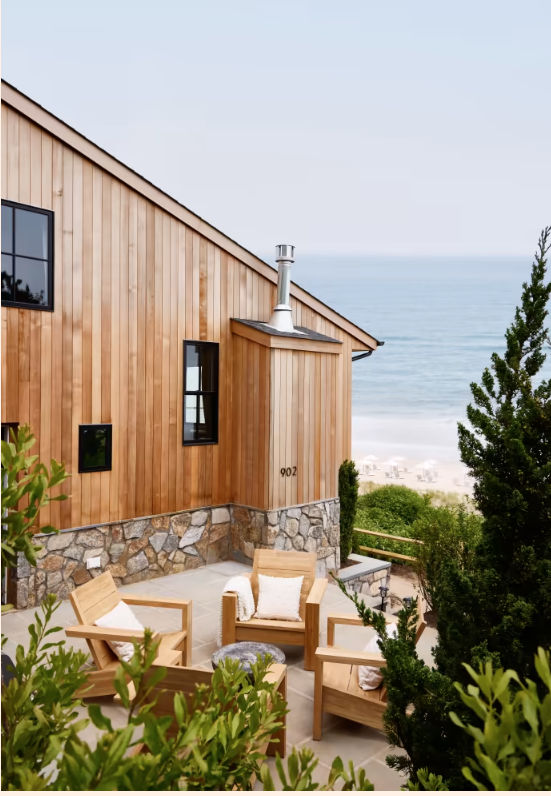
There are plenty of places to stay, from the hip and sexy Crow’s Nest by Sean McPherson of The Bowery Hotel, to the minimalist Marram hotel, which sits right on the beach and has yoga and biking. And Gurney’s is an old school institution that has the excellent Seawater Spa, and feels like a total escape. I like to get a morning coffee at Left Hand. For fish, Gosman’s Gourmet Fish Market is my go-to, and I’ll get up at 6am to buy tuna that’s just come off the boat. There’s also the seafood market Multi Aquaculture Systems, aka the Fish Farm. The place is scattered with buoys and nets and you can pick up incredible takeaway – they’ve got it all, especially local colour.
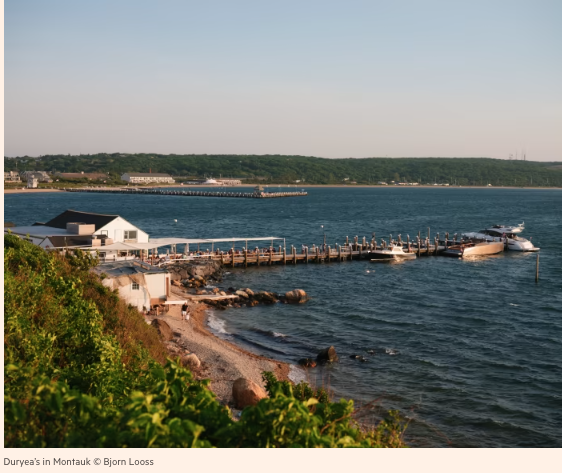

There is much less of a party scene out here than in the Hamptons. Duryea’s Lobster Deck – a seafood restaurant on the dock overlooking Fort Pond Bay – has a south of France vibe, and is perfect for a glass of rosé at sunset. Alimentari Beach on Montauk Highway has great coffee and pizzas that you can eat outside in the little plaza. To live like a local you need to surf and, if you’re lucky, you’ll get to surf with the harbour seals. Stop at Air + Speed Surf Shop to rent a board – they give lessons, too – or just to buy a cool T-shirt.
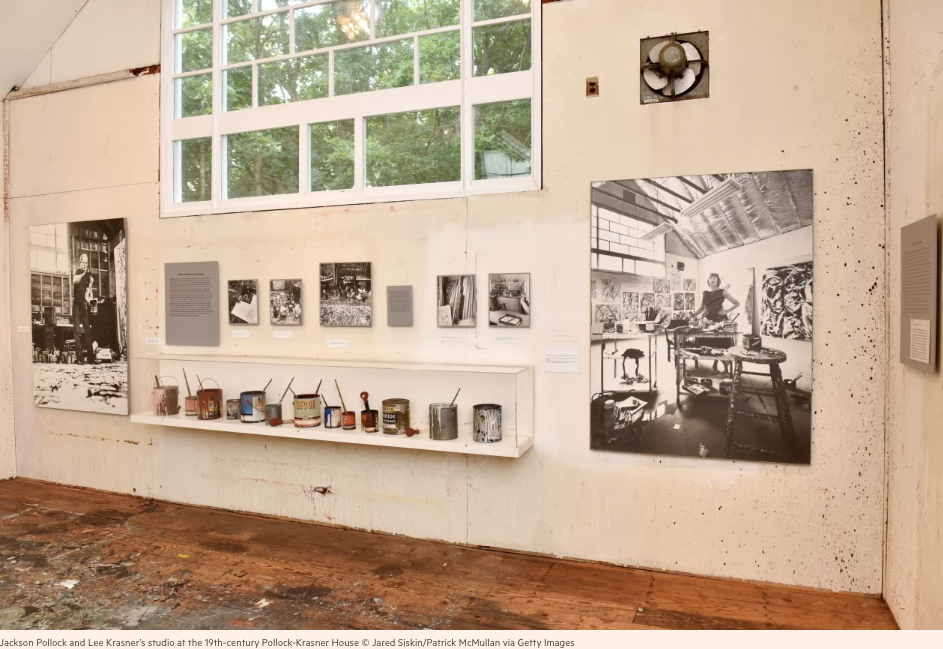
There are also great bike tracks and walks around the coast – much of it is state parks, like Shadmoor Park – as well as ferry rides to Block Island for whale watching. For the best views of the coast, visit the Montauk Point Lighthouse – the oldest in New York state. The 19th-century Pollock-Krasner House – once the home and studio of artists Jackson Pollock and Lee Krasner – is wonderful, too. The farmhouse is just as they left it in 1984, right down to the drips from Pollock’s paintings on the floors. A bit further on, in Water Mill, is the Parrish Art Museum. It was designed by Herzog and de Meuron and you can see works by artists such as Sol Lewitt and April Gornik, who have ties to the area.

The summer is high season, of course, and while places like Ditch Plains can be crowded, you can be blissfully alone and left just to collect rocks in spots like Camp Hero State Park – even in August. Autumn is spectacular. You can still surf and hike, the air is crisp and cool, and there is fantastic apple-picking. We always host a harvest dinner in late October. Winter feels very Scandinavian – there is lots of fog, and sometimes it snows. Our Reed candlesticks were inspired by the dried stems you see in Montauk in this bleak but beautiful season. Montauk is so environmentally protected that I don’t worry too much about it all changing, or the wild beauty of the gardens or the shape of the coastline deteriorating. I do, however, want it to remain a place for explorers, and I also want to see it stay balanced, because that’s what makes Montauk so cool.

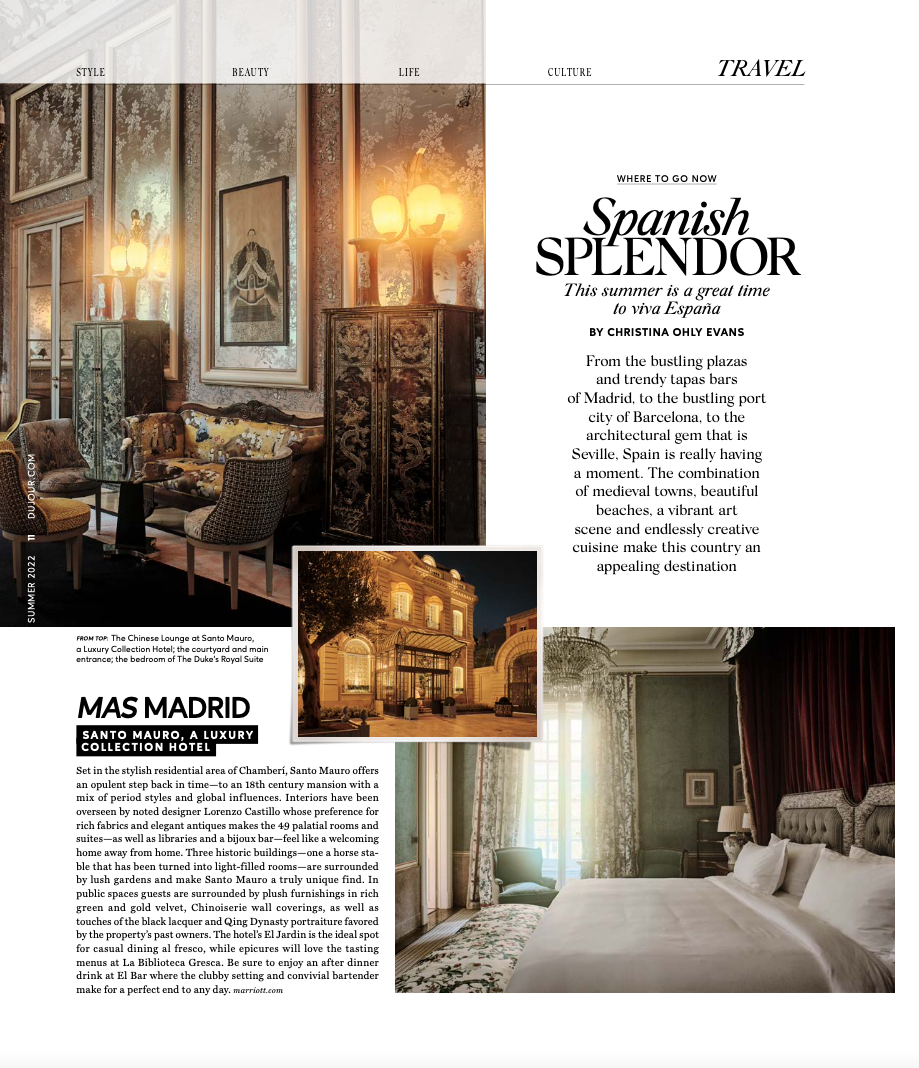
Spanish SPLENDOR
From the bustling plazas and trendy tapas bars of Madrid, to the bustling port city of Barcelona, to the architectural gem that is Seville, Spain is really having a moment. The combination of medieval towns, beautiful beaches, a vibrant art scene and endlessly creative cuisine make this country an appealing destination.
Set in the stylish residential area of Chamberí, Santo Mauro offers an opulent step back in time—to an 18th century mansion with a mix of period styles and global influences. Interiors have been overseen by noted designer Lorenzo Castillo whose preference for rich fabrics and elegant antiques makes the 49 palatial rooms and suites—as well as libraries and a bijoux bar—feel like a welcoming home away from home. Three historic buildings—one a horse sta- ble that has been turned into light-filled rooms—are surrounded by lush gardens and make Santo Mauro a truly unique find.
This summer is a great time to viva España
By Christina Ohly Evans


From the bustling plazas and trendy tapas bars of Madrid, to the bustling port city of Barcelona, to the architectural gem that is Seville, Spain is really having a moment. The combination of medieval towns, beautiful beaches, a vibrant art scene and endlessly creative cuisine make this country an appealing destination.
MAS MADRID SANTO MAURO, A LUXURY COLLECTION HOTEL
Set in the stylish residential area of Chamberí, Santo Mauro offers an opulent step back in time—to an 18th century mansion with a mix of period styles and global influences. Interiors have been overseen by noted designer Lorenzo Castillo whose preference for rich fabrics and elegant antiques makes the 49 palatial rooms and suites—as well as libraries and a bijoux bar—feel like a welcoming home away from home. Three historic buildings—one a horse sta- ble that has been turned into light-filled rooms—are surrounded by lush gardens and make Santo Mauro a truly unique find. In public spaces guests are surrounded by plush furnishings in rich green and gold velvet, Chinoiserie wall coverings, as well as touches of the black lacquer and Qing Dynasty portraiture favored by the property’s past owners. The hotel’s El Jardin is the ideal spot for casual dining al fresco, while epicures will love the tasting menus at La Biblioteca Gresca. Be sure to enjoy an after dinner drink at El Bar where the clubby setting and convivial bartender make for a perfect end to any day. marriott.com
MADRID EDTION
The winning combination of hotelier Ian Schrager and British architect, John Pawson, is in dazzling effect once again at this 200-room, 23-suite property that’s set on the historic Plaza de la Descalzas. A mix of the sleek lines, muted lighting and natural finishes that Pawson is known for contrast with an 18th-century Baroque portal that’s been restored by Spanish architect Pedro di Ribera, to create a daz- zling, yet authentic destination. Decorative touches range from bespoke sofas with dramatically back-lit shelves to Jean- Michel Frank armchairs to recycled bronze stools from Maison Intègre, as well a sculptural pool table by Emmanuel Levet Stenne sculpted from a single slab of white Bianco Neve marble.
One of the hotel’s main draws is Jerónimo, a Mexican-influenced restaurant by noted chef Enrique Olivera of Mexico City’s Pujol and Cosme in New York. Using the strong cultural ties between Spain and Mexico as well as local ingredients, guests can dine in a double-height, vibrant dining room or outside on the hotel’s verdant pri- vate terrace. The second gourmet offering is Oroya, helmed by Peruvian chef Diego Muñoz and where Pisco Sours and ceviches are the orders of the day. And last, but cer- tainly not least on a hot summer day, is the hotel’s sprawling rooftop pool—Madrid’s largest—surrounded by chic cabanas with views of the red-roofed city skyline beyond. editionhotels.com
MANDARIN ORIENTAL RITZ
The grand dame of Madrid, the Mandarin Oriental Ritz has just undergone the most extensive renovation in its 110 year history courtesy of architect Rafael de La-Hoz with interiors by French firm, Gilles & Boissier. The result is a timeless Belle Epoque gem that is in keeping with hotelier Cesar Ritz’s original aesthetic, all while incorporating modern leather, brushed brass and marble touches throughout. Centrally located within the Golden Triangle of Art—home to the Prado, Thyssen-Bornemisza and the Reina Sofia Museum of Modern Art— the Mandarin Oriental Ritz remains a bustling hub with its five restaurants and bars draw- ing a discerning international clientele throughout the day.
Under the guidance of multi-Michelin- starred chef, Quique Dacosta, Deessa offers fine dining with an avant-garde twist, while the Champagne Bar and Pictura Bar are the places for serious cocktails, live music and a buzzy vibe. The highlight, however, is the iconic El Jardin del Ritz—a chic oasis in the middle of the capital, complete with the perfect gin tonic (no “and”). After the vibrancy of the hotel’s public spaces, the 100 sumptuously- appointed guest rooms and 53 suites offer a bit of serenity with the terraced Turret Suites and the sprawling Presidential Suite with its hand-painted mural among the standouts. mandarinoriental.com
AND IN ANDALUSIA...
LA ZAMBRA, COSTA DEL SOL Originally opened in 1984 as the uber-chic luxurious Byblos, the Málaga hotel has counted The Rolling Stones and Diana, Princess of Wales among its glittery guests. After a refresh by father-son architectural duo Esteva i Esteva of Menorca’s Torralbenc fame, La Zambra opens this summer and promises a contemporary take on relaxed Andalusian style. The property’s 197 light-filled rooms and suites are swathed in neutral hues, while furniture hewn from light wood and stone add to the soothing ambience. Multiple swimming pools, a state of the art spa, a Turkish bath, sauna and a hammam are just a few of the luxurious amenities on offer, while golfers can take advantage of neighboring world class courses. Food and drink take center stage with an emphasis on Andulusian sea food and light, healthy cuisine by day and shifting to a more indulgent approach at sundown when the spit roast becomes the focal point. With its white-washed buildings, coastal setting, and killer sangria, La Zambra promises to bring back 1980s Mediterranean glamour. lazambrahotel.com
FLAVORFUL FINDS True gourmands and the casually hungry alike will find something to savor in Spain this summer
TASTING NOTES WITH DWANI LOPEZ
Serious foodies take note: Black Tomato, the U.K.-based travel insiders, specializes in planning trips focused around excellent, hard-to-find Spanish cuisine. Far beyond your standard sangria and tapas (though they’ll find you the best), you’ll be in the hands of three of Spain’s best chefs—Dani Lopez, Aitor Arregui, and Elena Arzak— who hold five Michelin stars between them—who have co-curated an itinerary that includes a private pintxos tour in Bilbao, a Michelin-starred meal at the impossible-to-book Azurmendi, followed by winery tours in Rioja. Demonstrations, access to private culinary clubs, and more Michelin stars await at Arzak in San Sebastian followed by cooking classes in Cantabria, all capped off by a seat at the Chef’s Table at Aito Arregui’s Elkano for delectable Basque bites. blacktomato.com
EL SILENCIO
Ibiza is heating up this summer with the residency of three Michelin star chef, Mauro Colagreco, at the iconic El Silencio, overlooking Cala Moli and the Balearic sea. Partnering with friend and fellow Argentine flame master, Federico Desseno, the pair will specialize in Mediterranean cuisine—just-caught seafood including shrimp aguachile finished with coriander and chile, Peruvian ceviche with fresh peach and lime and asado-inspired steak onions finished with chimichurri and rus- tic salad. Wood-fired pizzas that are per- fect for sharing over long, lazy lunches are paired with cocktails by French-Irish mix- ologist, Remy Savage, and a day spent here promises to be a gourmet (as well as people watching) delight. elsilencioibiza.com
JACQUELINE
The ultimate epicurean city, Barcelona, is about to get even better with the opening of Jacqueline—so named for Pablo Picasso’s second wife and muse, Jacqueline Roque. The three-story restaurant has been designed by Rockwell Group and is inspired by its namesakes’ colorful life—as well as her portraits including “Woman in a Turkish costume seated in a chair” and “Jacqueline with Flowers”. A grand vesti- bule swathed in blue velvet welcomes guests into the chic entry bar followed by a grand dining room complete with stunning metal palm trees which were the artist’s favorite. Upstairs features a bijoux cocktail bar while the lower level is home to a club that’s clad entirely in rich red. For Catalan cuisine complete with live music, join the waiting list now. jacquelinebarcelona.com ■

Summer ITALIAN STYLE
La dolce vita never gets old and this season promises to be one of the very best. Visit new hotspots in Capri, Verona and beyond.
After several years of travel disruptions, no place is more in demand this summer than the chic cities and dramatic coastlines of Italy. Adding to the general excitement are the opening of new properties from the shores of Lake Como to the cliffs of Capri—all luxurious hotels, restaurants and villas with a rich sense of history and the latest in luxury amenities—and each with its own particular brand of warm, Italian hospitality.
La dolce vita never gets old and this season promises to be one of the very best
By Christina Ohly Evans


After several years of travel disruptions, no place is more in demand this summer than the chic cities and dramatic coastlines of Italy. Adding to the general excitement are the opening of new properties from the shores of Lake Como to the cliffs of Capri—all luxurious hotels, restaurants and villas with a rich sense of history and the latest in luxury amenities—and each with its own particular brand of warm, Italian hospitality.
Passalacqua, Lake Como
Perhaps the most anticipated opening of summer (or the year, for that matter) is Passalacqua, a historic private villa that has been lovingly transformed into a 24-suite hotel on the edge of Lake Como, just above the picturesque village of Moltrasio. Once home to composer Vincenzo Bellini, and host to literary and political figures including Winston Churchill, Passalacqua is the passion project of Paolo, Antonella and stylish CEO Valentina DeSantis—a family with multigenerational ties to the lake whose sister property, the iconic Grand Hotel Tremezzo, has set the standard for understated elegance for decades.
With majestic terraced gardens dotted with centuries-old trees and fountains, the villa is an ideal destination for those seeking a quick, quiet respite from the bustling world beyond. Other painstakingly perfect details include a lush rose garden, a vegetable garden that supplies the hotel’s creative kitchens, an open-air gym and exquisitely restored glass houses—complete with flowering fruit trees. But it is the 24 suites—set within the original villa, the original stables and Casa del Lago—that are truly stunning. From a double-height suite where Bellini once played to the sumptuous marble-clad bathrooms (each single slab hand-chosen from the Breccia Pontificia in Verona—the same found in The Vatican) and vivid, frescoed ceilings, Passalacqua is a relaxing retreat like no other. For shimmering lake views, a game of tennis at the water’s edge or a sunset sail in one of the villa’s beautifully restored vintage boats, book in at Passalacqua and leave the world behind.
Vista Palazzo Verona
Set in a 19th century mansion in the heart of the city’s medieval Centro Storico, the five-star Vista Palazzo Verona is a special, family-owned gem offering 13 palatial suites and just 3 standard rooms that are anything but. Owned by the family-operated Lario Hotels—the group behind the stunning Vista Palazzo Lago di Como—the opulent property offers outsized amenities for such a bijoux hideaway: an indoor swimming pool—the only such hotel facility in Verona—as well as a spa, library, wine tasting room, and athletic facility are all part of the program. But it is the drinks and dining spaces that really differentiate it—from the penthouse level Sottovoce restaurant and bar to a rooftop terrace with 360-degree views of medieval rooftops and the rolling hills of Lake Garda in the distance.
Il San Corrado di Noto, Val di Noto
An ancient masseria once owned by Prince Nicolaci, Il San Corrado di Noto has undergone an extensive three-year renovation that has yielded 26 exquisite suites and eight pool villas—the perfect jumping-off points for exploration of Sicily’s surrounding UNESCO World Heritage sites. Streamlined yet spacious suites feature outdoor patios, while one- and two-bedroom pool villas offer flexible configurations for families and larger parties.
The property is a mix of Baroque charm and a minimalist aesthetic that pervades two enormous pools, a spa and a fitness room that’s kitted out with state-of-the-art equipment. For those interested in the beach, the hotel’s private club is accessible by a short shuttle ride, and two signature restaurants—Casa Pasta and Principe di Belludia—offer authentic Sicilian cuisine in relaxed settings at day’s end.
Hotel La Palma, Capri
The Amalfi Coast is always a good idea, but now more than ever with the addition of Hotel La Palma, the latest property in the Oetker Collection. Originally built in 1822 as the Locanda Pagano, the hotel was a gathering spot for artists and intellectuals—many of whom left drawings and poems on the walls in lieu of payment. In keeping with that spirit, interior designer Francis Sultana has conceived a 50-room-and-suite “home from home” complete with new frescoes by Rome-based Roberto Ruspoli. A soothing palette of neutral and sage hues sets the tone for commissioned artwork by Luisa Lambri, while bespoke furnishings and wall hung tapestries by Allegra Hicks add to the island glamour. No detail has been overlooked at this reimagined treasure, with handmade rattan furniture by Bonacina and custom bronze-lined bathroom fittings by Stella. Just steps from the buzzing Piazzetta, the rooftop restaurant Bianca promises to be the summer hotspot with stunning views of Capri Village and the endless sea—and with Campari cocktails to match.
Mandarin Oriental Milan
For a stay in this magnificent city there is no place more perfectly situated—or more welcoming—than the Mandarin Oriental, located just steps from the Duomo, the Galleria and the shops of Via della Spiga. Set across four 18th-century buildings and enhanced with modern M’O touches, the hotel has been welcoming tourists and locals alike for seven years—many of whom come for the outstanding aperitivo that’s on offer at the just-launched Mandarin Garden. For a bit of glamour and an authentic Milanese meal courtesy of Michelin-starred chef Antonio Guida, this is the place to be now.
Giacomo al Lago, Lake Como
This truly unique lakeside fish restaurant is the product of a partnership between the iconic Giacomo restaurant group and the design/hospitality talents of Valentina De Santis and the Grand Hotel Tremezzo. Come for the Giacomo Milano favorites—crudo of all kinds, housemade pastas—and stay for the sublime views, cocktail in hand.
Travel Tip: Black Tomato
This is shaping up to be a tough-to-book summer, so you might want to enlist the talents of Black Tomato for exceptional access to Italian experiences ranging from a behind-the-scenes look at the Lamborghini factory in Bologna, to making honey in Taormina, to mask-making in Venice and sculpting with a noted artist in Puglia. No request is too outlandish, and a dedicated travel expert will tailor-make Italian holidays—but you’ll need to book fast.

Joe Gebbia - The Airbnb co-founder on his favourite things
The Airbnb co-founder on his favourite things
Joe Gebbia loves Space Hippies, sound baths, cereal packets and will go anywhere for Christo
Joe Gebbia loves Space Hippies, sound baths, cereal packets and will go anywhere for Christo
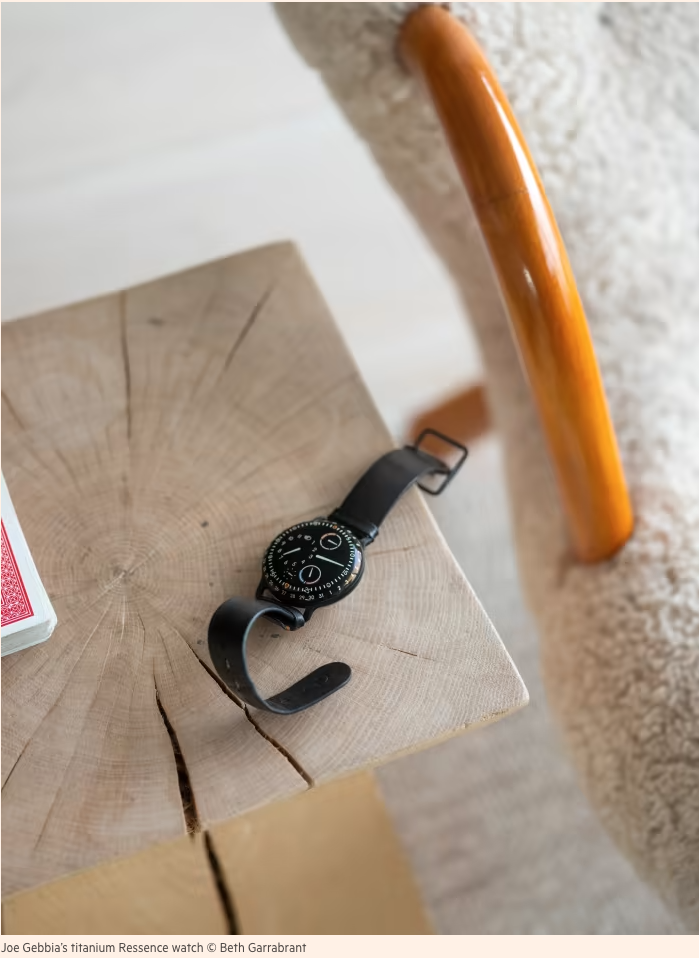
My personal style signifier is a pair of Nike Space Hippies – a modern marvel of sneaker design. They’re made of recycled materials – plastic bottles, T-shirts and post-industrial scraps from the factory – and I like that they’re environmentally low-impact, incredibly comfortable and distinctive. I have them in high-top and low-top versions, in grey and orange. Along with my titanium Ressence watch, they are my everyday staples.
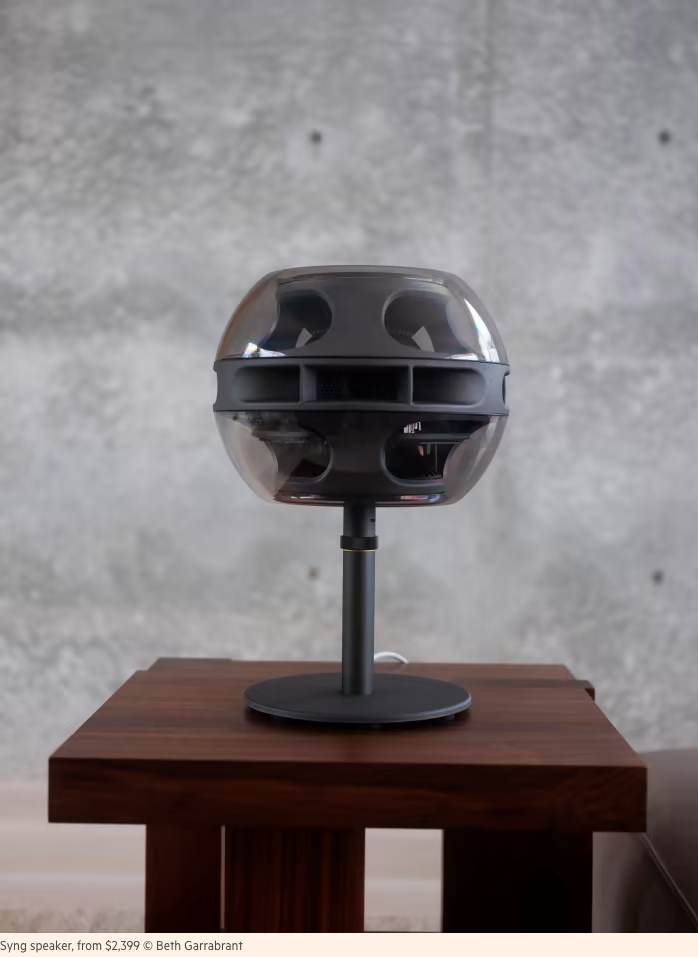
The last thing I bought and loved was a set of Syng triphonic speakers. I love reaching the end of the day, when I can blast out some music. They are spread equidistantly through the room in order to create a sound bath – the sound quality is a revelation.
I’ve recently rediscovered my love of live sports. Since moving to Austin, I’ve become a partner in the San Antonio Spurs, and getting to go to basketball games again – sitting courtside, feeling that energy, watching people convene – has been wonderful.
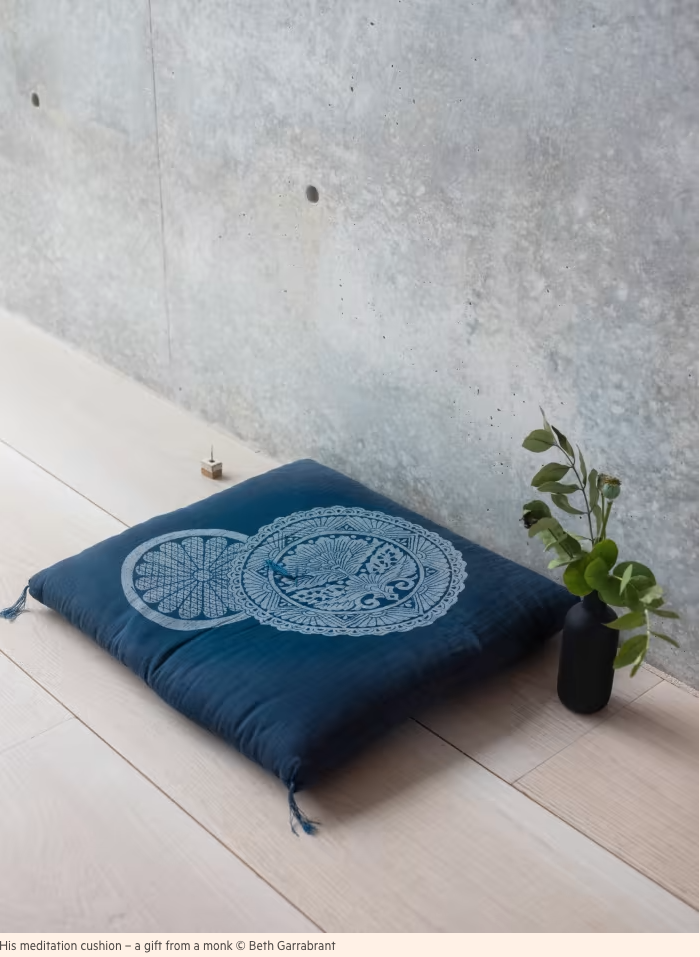
The best souvenir I’ve brought home is a meditation cushion from a Buddhist monk in Oita, Japan. He’s an Airbnb host and he gave it to me when I stayed in his temple. I got to live the life of a monk on that trip – meditating at 5am, cooking meals in his kitchen, tagging along to the village where he performed rituals in people’s homes. I still use it often. My style icon is Haider Ackermann. His designs look like no one else’s, and his work is a reflection of him – informally formal.
The best gift I’ve given recently was cereal boxes, which I designed for our early investors and each member of our executive team, to commemorate our IPO. Each one had that person’s likeness on it. I made 40 or so boxes, so it was a time-intensive project. It was a homage to our Obama O’s breakfast cereal of 2008, which we sold to keep Airbnb afloat at that time. The last music I downloaded was the album Battle Lines by the Canadian electronic duo Bob Moses. It’s a mix of wistful lyrics, pop beats and synths.

The objects I would never part with are my sketchbooks. I have them custom-made in three sizes and with weighty paper so that the ink doesn’t bleed through the pages. I sketch first concepts – for example, for Neighborhood, a furniture line I did with Bernhardt – and I also draw people, so that I have a written and visual record of meetings.
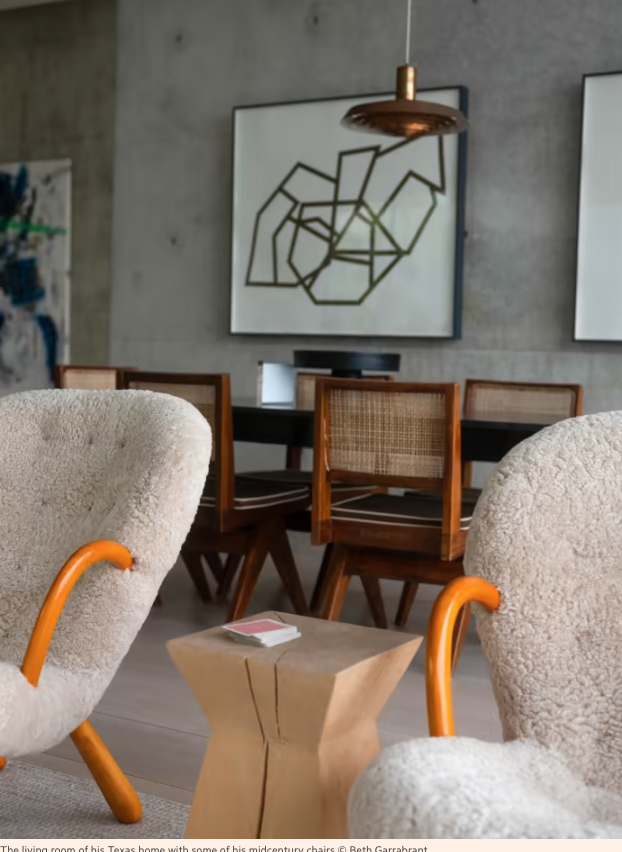
I have a collection of midcentury modern chairs. Many of the pieces are by Charles and Ray Eames and also by the Dutch designer Gerrit Rietveld, who broke the mould of what furniture was supposed to look like. I have Rietveld’s Red and Blue chair, and also his Zig Zag and Crate chairs. And I have an Eames daybed-like one that they made for the director Billy Wilder, who used it for napping on movie sets.
In my fridge you’ll always find maple syrup and butter for making pancakes at the weekend. I have a wide variety of syrups – all the grades, all the light and dark versions – and like to make pancakes for whoever is staying with us. I also have Hello Pure dog food for my puppy, Belo.
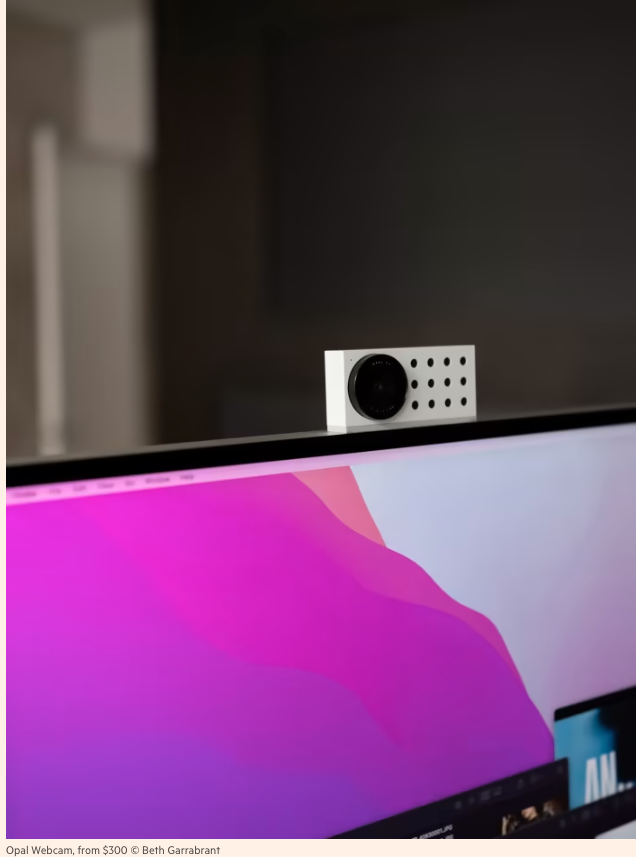
The thing I couldn’t do without is my Opal webcam. It’s beautiful and of the highest quality – they have somehow packaged DSLR-level quality into a camera that fits in your pocket.
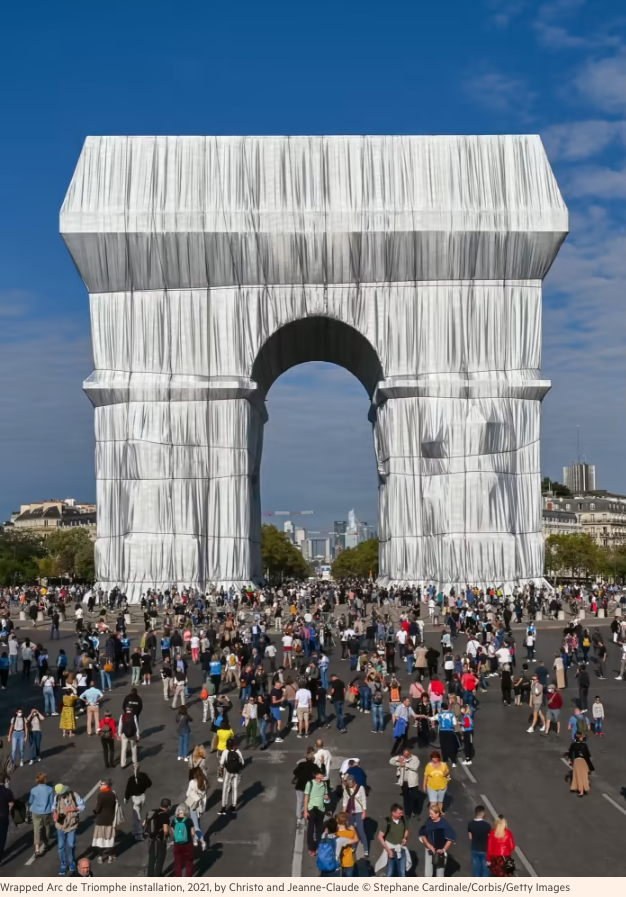
An indulgence I would never forgo is travelling to see a Christo and Jeanne-Claude installation anywhere in the world. I was recently in Paris for the Arc de Triomphe installation, and at Lake Iseo for The Floating Piers before that, and in New York to see The Gates in Central Park in 2005. I find it the most profound public art. There is one more left to go – The Mastaba in Abu Dhabi – which will be bigger than the Great Pyramid, and you can bet I will be there.
The carry-on essentials I’m never without include my Porter-Yoshida & Co briefcase, a black nylon model with plenty of compartments. It also holds some important things such as my Manta Sleep eye mask, which has an adjustable Velcro strap so that no light slips in and is as soft as butter. I’m also never without my 16in MacBook Pro – it’s got a big screen and is super-fast – and my Leica M10, so I can bring back some memories.
The last item of clothing I added to my wardrobe was a Dolce & Gabbana three-piece suit in polka-dot silk jacquard that’s killer. I wore it for this year’s Met Gala.
The one artist whose work I would collect if I could is Willem de Kooning. I’m reading his biography now and he had an incredible life; he grew up impoverished, made his way to America, helped to define the abstract expressionist art movement and lived the dream. I would like any painting from his Woman series.


My favourite building is the Rothko Chapel in Houston, Texas. It’s an octagon that contains 14 of Mark Rothko’s monumental murals.
My wellbeing gurus are a physician – Peter Attia – who helps me figure out what I should be eating and is focused on longevity. I also love a good myofascial massage where they dig really deep into your muscles and find all of the problem spots and work them out. And I’ve been searching for a new jujitsu trainer.
My favourite website is – sticking close to home – airbnb.org, the non-profit side of our business. We partner with people to house refugees and displaced citizens in times of crisis. Right now, Ukraine is a huge focus and we’ve promised to host 100,000 people. The plug here – for anyone reading this – is if you have an extra room, please sign up. We are focused on rooms in Europe – Poland, Slovakia, Hungary, Germany, Denmark, Sweden – but anyone can help. As far as apps go, I use the Oura app to track my sleep. I average six and a half hours per night, and no matter what I do, I can’t seem to change it.

In another life, I would have been a film director. I am starting to explore filmmaking by producing a documentary about the IOC Refugee Olympic team that participated in last year’s Tokyo games. This all-refugee team comprised 29 athletes, originating from 11 countries, and residing in 13 host nations. Their resilience is inspiring.
My favourite room in my house is my gym. I start my day here and it sets the tone; working out is my form of meditation and I am rarely distracted when I am doing it. It used to be a garage, so I just added a skylight and I open the door wide for natural light. It’s equipped with the basics: a bench, cables, free weights, kettlebells, a leg press and an elliptical machine. My goal is three hours of cardio a week at a target heart rate of 125bpm, plus four days of strength training.
The place that means a lot to me is the Eames Ranch in Petaluma, California. Spread over 27 rolling acres in Sonoma County, it’s surrounded by farmland with sheep and a llama. The original house and barn were designed by architect William Turnbull, so it’s an iconic place – and it’s now the site of a non-profit I helped start called the Eames Institute of Infinite Curiosity. It contains many of the original Charles and Ray Eames sketches, prototypes, films, books and textiles.

The best bit of advice I ever received was via CNN, when I was in high school. I was watching an interview with Warren Buffett on investing and I was expecting a stock pick, but instead he said to “invest in yourself”. As a kid, I’d never previously considered this concept, but it’s an important one.
The trip that I’m looking forward to next is to the village of Mezzojuso, in Sicily. My ancestors came from this small, hillside village in the country and I visited once before, as a surprise holiday for my whole family. I worked with the mayor and council members to find the old ledgers and birth certificates and we traced our family back to the 1700s. I organised a party for the village, and we were granted honorary citizenship – it was an exceptional moment, and my dad was in tears, being in the place where his grandfather had emigrated from in 1900.

The best book I’ve read in the past year is The Truth: An Uncomfortable Book About Relationships by Neil Strauss. It’s a book of relationship advice and it’s insightful, funny and chock-full of observations on commitment, love and family. We did a talk together at South By Southwest and he recommended it to me. It’s a truly hilarious book.
The podcast I’m listening to is Hidden Brain by NPR. It’s all about psychology and helping us to understand why we do what we do. My favourite episode is one about the placebo effect; it’s fascinating on the power of the mind.
And the best gift I’ve received is a speech that was given by my co-founder and friend, Brian Chesky, for my 40th birthday. Somehow, he managed to capture 22 years of our friendship in a funny, heartfelt, deeply touching toast – in front of 180 people, no less – that I’ll never forget. The speech now hangs framed on the wall of my office. Brian is as talented a writer as he is a businessman.


The world’s most wonderful private libraries
Founded in 1807, the Boston Athenæum holds half a million volumes ranging from the Nuremberg Chronicles to the personal library of George Washington and Paul Revere’s engraving The Bloody Massacre. Set just off Boston Common, its five galleried floors have drawn writers including Louisa May Alcott, Henry Wadsworth Longfellow, and Pulitzer Prize-winning David McCullough – some of whom wrote in the top-floor Silent Reading Room, overlooking the brood of red-tailed hawks gathered on the ledge outside.
Join the book club – from New York to Naples
The American Library, Paris

The American Library in Paris has a 100,000-book collection © Krystal Kenney Nestled on a quiet side street under the shadow of the Eiffel Tower, this was originally founded as part of an effort to get millions of donated books to American soldiers serving in the first world war, and has been a haven for expats ever since. Edith Wharton was among the library’s first trustees, while Ernest Hemingway and Gertrude Stein both contributed reviews to the library’s still existent newsletter, Ex Libris. Today, the not-for-profit institution draws English speakers and Parisians alike with its illustrious literary pedigree, enticing programme of author talks and events (past speakers include David Sedaris and Ottessa Moshfegh) and expansive collection of more than 100,000 books, each of which bears the library’s motto: “Atrum post bellum, ex libris lux” (“After the darkness of war, the light of books”). Sara Semic
Membership €12 a month, €9 for students; americanlibraryinparis.org
Bibliotheca Alexandrina, Egypt
The modern incarnation of the Bibliotheca Alexandrina © Bibliotheca Alexandrina What’s your favourite library in the world? Do you have a favourite library that we’ve missed? Let us know at htsifavourites@ft.com, and we’ll publish your nominations in a forthcoming story… The Library of Alexandria was, for the 1,000 years after it was established around 285BC, the most important library in the ancient world, believed to have housed between 40,000 to 400,000 scrolls (equivalent to about 100,000 books). In its long history, it was burned down multiple times – first in a civil war between Julius Caesar, Cleopatra and her brother Ptolemy XIII – but its final fate remains hotly contested to this day (one theory goes that the books were used as fuel for the city’s 4,000 bathhouses for six months). In 2002, 200m from the original site, a reincarnation of the Bibliotheca Alexandrina opened. Characters from 120 languages, both spoken and dead, are carved into the stone façade, while the circular structure was designed to symbolise the revolution of time. Its 11 floors house the world’s largest reading room (with space for 2,000 readers), around four million books, four museums and a planetarium. Baya Simons
From E£60 (about £2.50) a year for Egyptians, E£330 (about £13.80) for non-Egyptians; bibalex.org
Boston Athenæum, Boston
Founded in 1807, the Boston Athenæum holds half a million volumes ranging from the Nuremberg Chronicles to the personal library of George Washington and Paul Revere’s engraving The Bloody Massacre. Set just off Boston Common, its five galleried floors have drawn writers including Louisa May Alcott, Henry Wadsworth Longfellow, and Pulitzer Prize-winning David McCullough – some of whom wrote in the top-floor Silent Reading Room, overlooking the brood of red-tailed hawks gathered on the ledge outside. The Athenæum remains a cultural hub with a speaker series that has featured authors Susan Orlean, Nathaniel Philbrick and Charles Spencer, and continues to be a zen place to read, write and research. Christina Ohly Evans
$460 a year, bostonathenaeum.org
Bromley House, Nottingham

Housed in a pink 18th-century townhouse in the centre of Nottingham (described as “the best house in town” when it was built), this establishment has been in the business of book lending for more than 200 years. It opened in its first location on nearby Carlton Street in 1816 with 169 members (radically including nine women) and later upgraded to Bromley House, where a Newsroom and Billiard Room were installed, and rooms were let out to a chess club, a Ladies’ Bible Society, and a Literary and Scientific Society. Today, members have use of three floors connected by spiral staircases, high-ceilinged reading rooms, a children’s library featuring a mock “Narnia” wardrobe and some 50,000 books, as well as book clubs for all tastes (classic crime, vintage fiction, “spooky”), and an idyllic Georgian walled garden. It’s still as integral to city life as it was when it was created. Library director Melanie Duffill-Jeffs remembers how before the 2020 lockdown, they “gave members 48 hours’ notice to take as many books as they wanted to get them through. We had more members through the library in those two days than probably ever before in our history – some brought suitcases to pack with books. We issued more than 1,000 books, said goodbye to our members – there were some tears – and then shut the doors. The shelves had never looked so bare. They’re now full again, of course.” BS £132 a year; bromleyhouse.org
Circolo dei Lettori, Turin

The palazzo courtyard at Circolo dei Lettori, Turin Concealed within one of Turin’s many courtyards, the Circolo dei Lettori (Circle of Readers) is the seat of both dignified study and fun. To enter requires an approving nod from the bouncer, whereby you ascend a grand staircase to the palazzo. Once a seat of Napoleonic government, it later became a meeting point for the post-Risorgimento artist group founded by Count Camillo Cavour. The interior is rich with portraits and antique furniture, the sala filosofia dense with books. Long curtains are drawn around an old-fashioned salon where Turin’s literati – heirs to Italo Calvino and Primo Levi – come for talks, live readings and music performances. During the day the Circolo is a quiet haven for study, but when the 6pm church bells chime, the aperitivi start to flow. Camilla Bell-Davies
Membership €45 a year for under 30s, €90 for over 30s; circololettori.it
Forum Groningen, the Netherlands

Forum Groningen – “a pleasant ‘third space’ that isn’t home” © Stella Dekker Envisaged by Dutch architect Kamiel Klaasse as “a comfortable place for its residents to hang out without the obligation to consume”, Groningen’s Forum combines an exhibition space, cinema, museum, café and rooftop terrace as well as a library, which is spread across all 11 floors of the trapezoid building (so designed to reduce visual impact and make it look friendlier). As well as the requisite armchairs and table seating, a large section of one floor is made of rope netting, creating a kind of giant mattress where visitors can lie back with one of the 92,000 books, or a magazine from the news kiosk on the first floor. “We wanted to make a place where people like to be, like to spend time, that people use as a meeting place,” says managing director Dirk Nijdam. “A pleasant ‘third space’ that isn’t home.” BS
Membership €4.75 a month, forum.nl
Girolamini Library, Naples

Museums and libraries were often closed in the Naples of my childhood, for reasons that later became clear. The Girolamini library – a vaulted baroque hall, set in the wing of a monastery – was one of these. Every time we tried to visit, a lurking monk shunted us away, always with the words, “No no no, è in restauro” (“It’s under restoration”). Meanwhile, the director of the rare and sacred collection – the oldest in Naples – was quietly siphoning off the library’s contents and selling them on the black market, removing the seals from the books so they were impossible to trace. The library catalogue was destroyed too. It was the largest antiquarian plunder for decades. But remarkably, just 18 months after the looting was revealed, most of the stolen books had been tracked down with help from bibliophiles around the world. Centuries-old editions of Galileo treatises, Machiavellian texts and medieval music scores were recovered from private collections as distant as Japan. The place is currently undergoing restoration works before it will reopen. Certainly a library with more stories than just the ones that it shelves. CB-D
Some services open by appointment
Long overdue: the charity restoring Nairobi’s libraries By Baya Bimons Book Bunk was established in 2017 with the aim of restoring Nairobi’s libraries to their full architectural glory, and updating their collections to make them relevant for today’s residents. Many of the Kenyan capital’s libraries were established by 19th- and 20th-century colonisers and were open only to white citizens until the country gained independence in the 1960s. The collections reflect their founding fathers’ values – one journalist observed that you were more likely to find a guide to Shropshire in the McMillan Memorial Library in downtown Nairobi than a novel by a Kenyan writer. Through grants and donations, Book Bunk is working to buy new books, establish an arts programme and carry out much-needed restoration work. Donations can be made at bookbunk.org
Harold Acton library at the British Institute,
Florence Housed in the 16th-century Palazzo Lanfredini overlooking the Arno, this library is at the heart of the British Institute in Florence. Acton, a moneyed poet raised in Italy and educated at Oxford, set it up to promote English language learning in Italy. It now contains the memoirs of British writers captivated by Italian life, a large collection of travel writing as well as works of Italian literature and history. There is something of the London club in its armchairs, warm wood and folded newspapers. British Italophiles come to wade through Dante and grapple with irregular verbs before clocking off for an aperitivo in nearby piazza Santo Spirito. Local and visiting linguists and art historians come to study each other’s culture. Sometimes they succeed. Mostly they sit, with piles of books on their desks, gazing across the glowing river Arno. CB-D Membership €75 a year, €60 for students; britishinstitute.it
Het Predikheren, Mechelen, Belgium
The vaulted, oak-beamed ceilings and arched raw-brick corridors of Mechelen library in northern Belgium were originally built by the city’s religious community in 1650 to serve as a monastery and chapel, later adapted into a military hospital and barracks. The baroque building’s latest incarnation is as a library, fitted out in sumptuous custom woodwork, but maintaining many of the original 17th-century design features. What served as the monastery library – a high-ceilinged brick chamber – now houses novels, newspapers and audiobooks, while the attic, with its enormous wooden beams, is home to a children’s library. BS
From €10 a year for locals, €15 for non-residents; hetpredikheren.mechelen.be
JN Petit institute, Mumbai
The reading room of the JN Petit Institute is the crowning glory of this south Mumbai library. Light filters through the stained glass of the high, gothic windows. Pale pistachio walls showcase portraits of the Petit family, for whom the library was named in 1891, after it was founded in 1856. Propeller fans suspended from the lofty stuccoed ceiling keep a cool breeze flowing through the rows of tables and chairs. The 150,000 books span fiction and non-fiction, art, culture, history and religion, as well as rare titles such as an original copy of Persian poet Ferdowsi’s 11th-century work The Shahnama – one of the longest poems ever composed by a single writer. BS
Life membership Rs10,000 (about £100) with a Rs500 (about £5) admission fee; jnpetitinstitute.org
The London Library, London

Charles Dickens, John Stuart Mill and future prime minister Lord John Russell were among the first members of the St James’s library, the first lending library in London when it was founded in 1841. Its membership has maintained its lustre over the years, since hosting Virginia Woolf (whose father opened the Reading Room here), Joseph Conrad, Agatha Christie, EM Forster, Winston Churchill and Bram Stoker (“discovering the 27 books that Stoker used to research Dracula was certainly very special”, says library director Philip Marshall). Current regulars include Kazuo Ishiguro, William Boyd, Lady Antonia Fraser and Andrew Marr. “Our members publish around 800 books a year,” Marshall reveals. Literary stars aside, the institution is beloved for its collection of more than 1mn books dating from 1500 to the present day, many of which are rare leather-bound editions, and which readers can hang on to for as long as they please so long as there are no other requests. Its tardis-like interior also holds appeal. What at first glance appears to be a single slim townhouse on St James’s Square is actually seven, knocked into one reading and writing emporium. BS
£525 a year; londonlibrary.co.uk
The Morgan Library & Museum, New York


Mr Morgan’s Library at The Morgan Library in New York © Graham Haber. The Morgan Library & Museum Stepping off Madison Avenue in the bustling Murray Hill district of Manhattan and into The Morgan, you enter a serene campus reminiscent of an Italian piazza – one that melds the architectural styles of the original McKim, Mead & White library built in the early 1900s with the steel and glass of Pritzker Prize-winner Renzo Piano’s pavilion. Once the private collection of financier and collector Pierpont Morgan – “Mr Morgan’s Library” as it was known – holds a vast array of illuminated, literary and historical manuscripts, rare books, old master drawings and prints, and artefacts from 4000BC to the present – all for perusal throughout the library’s reading rooms, the Thaw Conservation Center, and in the Drawing Study Center.
The Morgan Library & Museum Collection highlights include Mozart’s handwritten Haffner Symphony, Henry David Thoreau’s journals, Milton’s Paradise Lost (the only known manuscript), Coptic papyri, a copy of the Declaration of Independence, Rembrandt prints, a 13th-century Crusader Bible… and the list goes on. With robust programming – concerts, talks with medieval art historians, poetry readings – as well as a vibrant café, The Morgan Library offers an Italianate urban escape to New Yorkers. COE
First-time members, $75 a year; themorgan.org
New York Society Library
Don’t be put off by the name: “society”, in this case, connoted community when the library was founded by civic-minded New Yorkers in 1754. Set on the leafy Upper East Side, the landmark institution counts Washington Irving, Herman Melville, Willa Cather and Tom Wolfe among its historic members, while modern-day writers flock to the quiet fifth-floor Hornblower Room and individual study rooms to work on the next Great American Novel. Rotating exhibitions are open to the public: Black Literature Matters, which highlights remarkable books by black writers from the 18th century to the present, is on view until 22 May. COE Membership $270 per year; nysoclib.org
The Portico library, Manchester

Manchester’s 19th-century Portico Library When it was founded in 1806, Manchester’s Portico was open only to men for its first 60 years. “I can see all the quarterlies three months after they are published. ’Till then they lie on the Portico table, for gentlemen to see,” wrote Elizabeth Gaskell in a letter to the publisher George Smith. “I think I will go in for Women’s Rights!” As one of the local women excluded from the library, Gaskell relied on her husband, who served as its longest-serving Chair, to bring home her reading materials. The library is now open to all, and runs a lively programme of talks and literary prizes from its Greek Revival building. It also houses a first edition of Gaskell’s fourth novel, North and South, in its collection of 25,000 books. BS
Membership £157 a year, £70 for students; theportico.org.uk
Senate house library, London
A librarian at Bloomsbury’s Senate House was understandably offended when I mused that I hadn’t studied in a dusty archive since leaving university. “On the contrary,” she insisted, “books at the Senate House Library are kept impeccably clean.” Plenty of dusting does indeed go on across its five reading rooms, home to one of the UK’s largest humanities collections, where books on social sciences, protest movements or Russian history are neatly ordered. The library was used as the Ministry of Information during the second world war, a period from which the classics section is yet to recover, with tomes stacked at jaunty angles threatening to tumble from their shelves. Its looming ivory tower, topped with a pyramidal structure known as a ziggurat, inspired the edifice of the Ministry Of Truth in Orwell’s 1984 and played the part of the City of Gotham State Courts in the Batman films. But the imposing exterior is deceptive: inside, light floods over faded, varnished bookshelves and across softly carpeted stairs. In the evening, seated in a warm, wood-panelled recess, the satisfying “pli-plunk” of a lamp’s pull chain signals the start of a working night. CB-D
Membership £210 a year, free for most students in London universities
Stuttgart city Library, Germany

Stuttgart City Library appears as a perfect white cube from the outside. Inside, five floors of reading rooms sit in concentric circles overlooking a ground floor fountain, connected by long flights of stairs. The design, completed a decade ago by Köln-based architecture firm Yi Architects, drew inspiration, variously, from the Pantheon, the 1785 Bibliothèque Nationale de France proposal, Noah’s ark, and Stanley Kubrick’s A Space Odyssey. Its creator was given a brief to focus on “centredness”, with the aim of providing a meditative space in Stuttgart’s busy city centre. Sofas scattered throughout the floors provide a place to settle down with the curation of bestsellers, fiction and non-fiction. When night falls, the 600 windows glow electric-blue, symbolic of the continued thrum of activity within the cuboid. BS
€20 for 12 months; stuttgart.de/stadtbibliothek

Kengo Kuma: ‘I am not attached to objects at all’
Kengo Kuma: ‘I am not attached to objects at all’
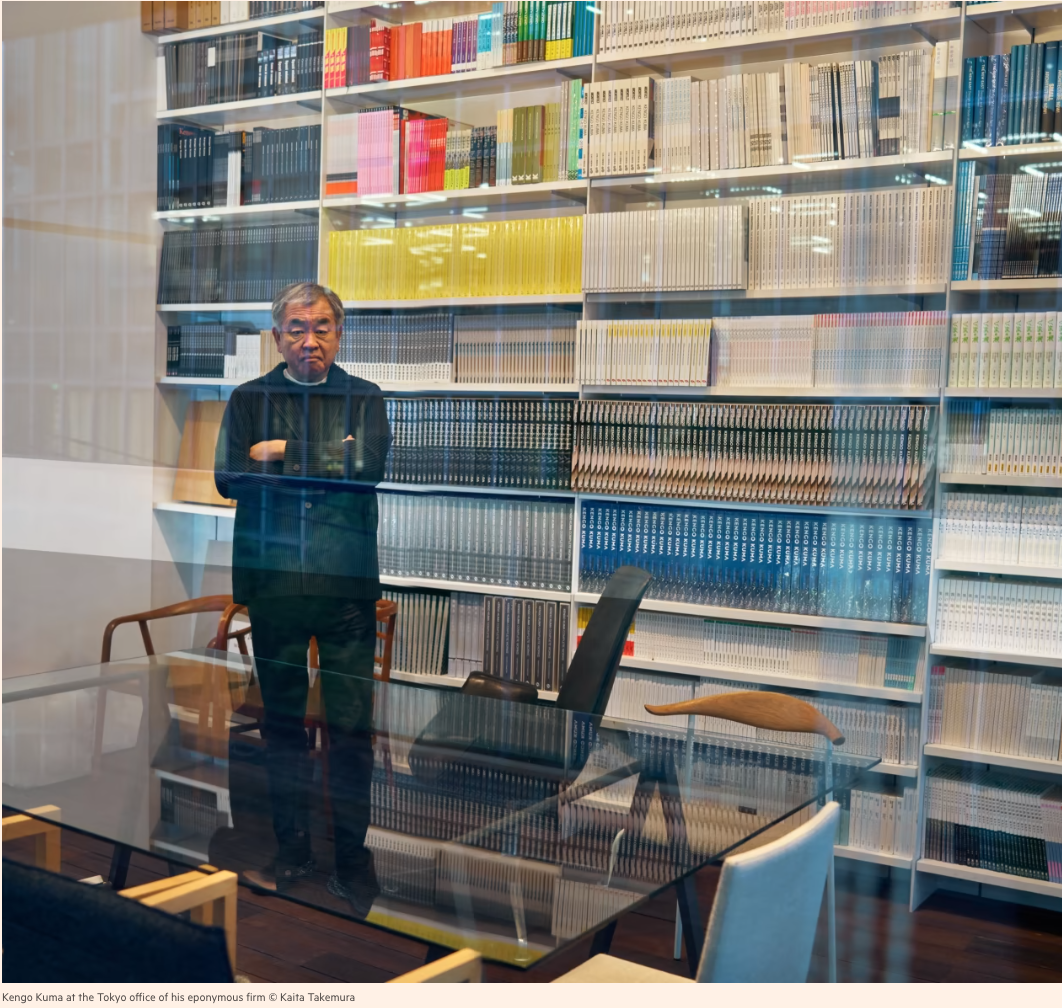
But the Tokyo-based architect still loves tenuguis and his cat T-shirt
But the Tokyo-based architect still loves tenuguis and his cat T-shirt
My personal style signifiers are minimalist, comfortable clothing – black jackets, sometimes by Issey Miyake, and always T-shirts. My clothes are like my own designs: spare and simple.
The last thing I bought and loved was a Danish chair for my furniture collection. The design is human and intimate. I have Mies van der Rohe and Hans Wegner chairs; architects often like uniformity but I like to experiment with different styles.

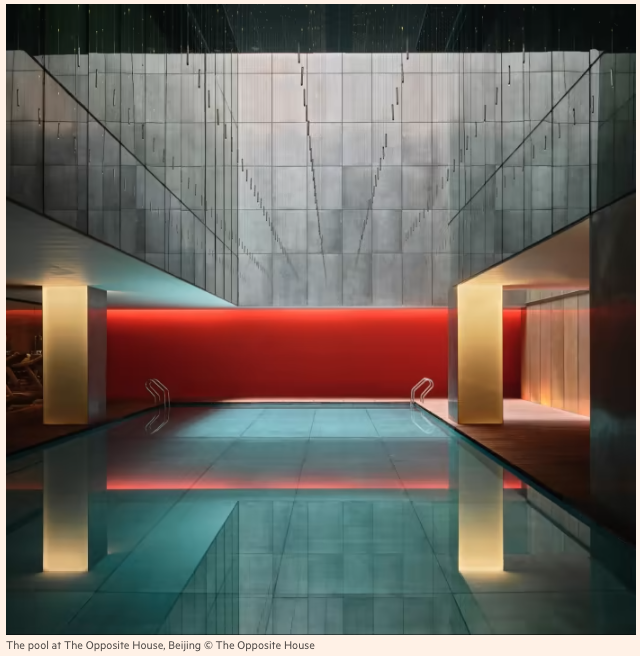
The place that means a lot to me is The Opposite House in Beijing – although I am slightly biased as it’s my own design. It’s a hotel, but the use of natural materials such as wood and stone makes it comfortable and warm. It is an oasis. Everything is minimal – a stainless-steel pool, wooden water basins – so it feels serene and uncluttered.

The design that has most inspired my work is a set of black ceramic tiles that were given to me in China. These influenced my design for the China Academy of Art in Hangzhou, specifically the grey roof. I love the beauty of Chinese ceramics, and materials that are of a place.
The best book I’ve read in the past year is First Person Singular by my good friend Haruki Murakami. His novels have a sort of tunnel structure and I apply this same design philosophy to my buildings. We inspire each other.


My style icons are farmers. I like workwear and the simplicity of this local vernacular. My grandfather taught me how to grow vegetables and was a mentor to me. Another icon is Sen no Rikyu – a 16th-century Japanese tea master who raised the ritual to an art form.
The best gift I’ve given recently was a sketch, to a client, made on tenugui “kerchief” – a gift towel used to wrap presents. I like to sketch on tenuguis. They are applied with a special dyeing process and have a rough texture, but are nonetheless elegant.

And the best gift I’ve received is a huge load of vegetables from the mayor of the city of Sakai-shi in the Osaka prefecture. I am designing some small buildings for the community there, and as a thank you he gave me all kinds of fresh produce – aubergines, cucumbers, ginger – which were all irregularly shaped, not shiny like supermarket produce. They were a different kind of delicious.
The last music I downloaded was by Ryuichi Sakamoto, who worked on The Last Emperor. We are longtime friends and I have been influenced by his music. It remains very contemporary.
In my fridge you’ll always find Japanese sake, especially old sake from the Masuizumi label. They make two-year-old and five-year-old sakes that are full of unique flavour. You’ll also find genmai brown rice which has a rich, nutty flavour. My style icons are farmers. I like workwear and the simplicity of this local vernacular
The works of art that changed everything for me were Japanese gardens. These are, to me, more spectacular than any painting. Muso Kokushi was a 14th-century designer who has influenced my own work so much – his use of moss and stone was wild and stunningly beautiful. He is considered a “national Zen teacher”.
I’ve recently rediscovered funazushi, a type of fermented sushi that was popular before there was refrigeration. Some can’t eat it because of the smell, but I particularly like the crucian carp variety. You won’t find this in Tokyo, but rather in seaside prefectures such as Toyama-ken and Fukui-ken.

The one artist whose work I would collect if I could isn’t so much an artist as an art form: Chinese and Japanese calligraphy. These scrolls are impressive; I love the contrast of rice paper and ink.
The grooming staple I’m never without is Hatomugi rice soap. I have tried many other kinds but this is the best. It is made with seeds and is very cleansing.
An indulgence I would never forgo is… Nothing. My tastes are simple.
An object I would never part with is… Nothing. I am not attached to objects at all.

My favourite room in my house is my terrace in Tokyo. I love outdoor spaces and I have a collection here of all kinds of plants. Every morning small birds come to feed and it’s a serene setting. In another life, I would have been a veterinarian. I adore animals, particularly cats.
The best bit of advice I’ve ever received was from a university professor who said: “Don’t refuse anything, accept it all.” He encouraged me to be open to all new things – places, people, foods. We travelled to the Sahara together and it was so eye-opening. A university professor told me: “Don’t refuse anything, accept it all”
The best souvenir I’ve brought home is an inexpensive, classic Chinese shelf that I purchased in a nondescript shop in Beijing. It’s now in my living room and holds all of my souvenirs. I travel the world – we have projects in more than 30 countries – and so my taste in souvenirs is eclectic.
I have a collection of rice papers from all over Asia. I have many different textures, all in different shades of white, and each relates to a specific place. I use them for making pictures with pen and ink.
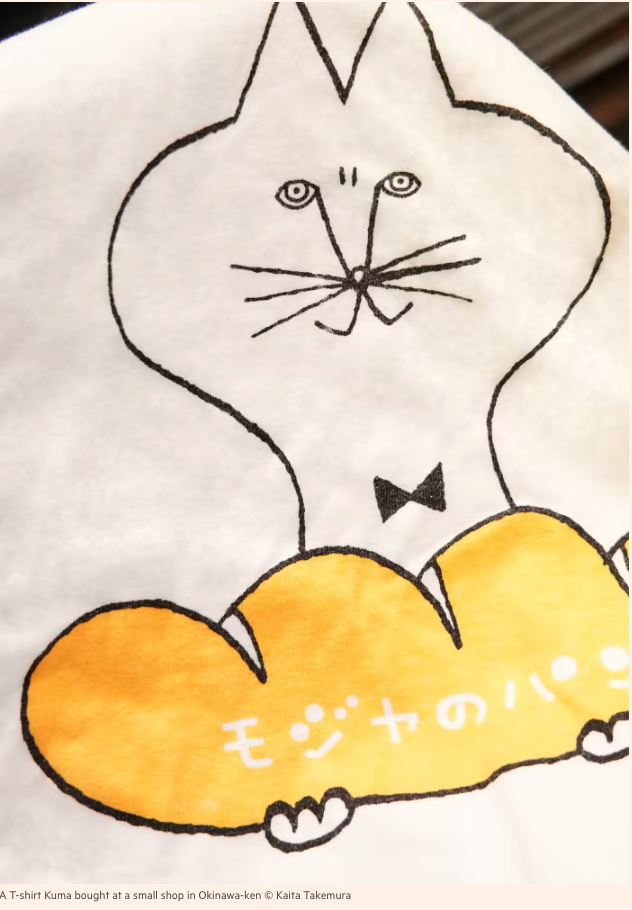
The last item of clothing I added to my wardrobe was a T-shirt with an image of a cat that I got in a small shop in Okinawa-ken. I love cats and quirky things that aren’t mass-produced, and this T-shirt is fun and comfortable.
The things I couldn’t do without are pencils. I sketch whenever an idea strikes so I carry pencils with me everywhere, in all of my pockets. I don’t much care what brand, just so long as I have a piece of paper and a pencil on hand…
The buildings that changed everything for me are by Frank Lloyd Wright. He came to Japan and found the essence of our culture in a way that we couldn’t. This translated to his buildings, in particular Fallingwater, the Pennsylvanian house that he designed in the 1930s. It has literally made me weep.

Lauren Ridloff, the first deaf Marvel superhero, talks personal taste
Lauren Ridloff, the first deaf Marvel superhero, talks personal taste
The actress loves her Makkari figurines, the late Anthony Bourdain – and her kettlebells
The actress loves her Makkari figurines, the late Anthony Bourdain – and her kettlebells
My personal style signifier is my hair, usually worn natural and loose, though I have braids right now. My hair is the first thing that people notice about me and I’m proud of my curls. I also like the ’70s look and tend to wear high-waisted, wide-legged Jesse Kamm pants. I’m a fan of supporting small, women-owned businesses. jessekamm.world
The last thing I bought and loved was a complete set of TRX kettlebells. My personal trainer, Anne Reuss, does strengthening work with me using these weights. They make me feel athletic, strong and graceful. Anne Reuss, hearanneout.com

I have a collection of Makkari figurines. Makkari is the superhero I played in Marvel’s Eternals and being deaf is one of her powers. I’m just so proud of this character. My collection has a Funko Pop version, one that I got from a McDonald’s Happy Meal, a Hasbro one with moveable arms and legs, and a Lego figurine. If I am feeling blocked or upset, a run is always the answer
The place that means a lot to me is a small beach cottage in the Hamptons that has been in my husband’s family for years. It sits on a quiet bay where we go clamming, and my two boys love this place more than anywhere on earth.
The best book I’ve read in the past year is Kitchen Confidential by the late Anthony Bourdain. I loved his CNN series, Parts Unknown, and his writing is so raw and funny. Just as important was a book called Being Heumann: An Unrepentant Memoir of a Disability Rights Activist by Judith Heumann. It’s the fascinating story of Heumann’s fight for basic human rights such as an education and the right to work.

The best gift I’ve given recently is packing cubes for my husband. My publicist clued me into them and they make travelling so much easier. Now he can separate his garments – workout clothes, tops, sweaters – and put the cubes straight into a hotel drawer instead of unpacking.
My favourite apps include Cardzilla and Philips Hue. Cardzilla is a simple texting app that allows me to converse with people who don’t sign. It’s so easy to use with my castmates or in restaurants. I also love the Hue lighting app that allows you to change colours throughout the house – from room to room and by floor. My family is deaf, so we sometimes communicate with each other through the different bright colours we choose, and my kids love it.

In my fridge you’ll always find fresh herbs. They transform any dish and I like to add mint, coriander and basil to make herby soups and salads, dressing and smoothies.
The thing I couldn’t do without is my purple Moleskine journal. It has graph paper that allows me to make notes and to-do lists, and to log exercise in a very specific way. I carry it with me wherever I go with brightly coloured, fine-point Le Pen pens in orange, red and green that fit perfectly on the side. uchida.com
An indulgence I would never forgo is running. Whether I am feeling blocked or upset, a run is always the answer. Running gives me time to troubleshoot and to get in a zone. I often run past Domino Park, along the East River to Greenpoint, or over the Williamsburg Bridge and back across the Brooklyn Bridge. It allows me to feel fit and able and, mostly importantly, relaxed, so it’s a real priority for me. I’m currently shooting in Atlanta and I find that a run through Piedmont Park is a form of meditation.

An object I would never part with is an heirloom charm bracelet given to me by my mom and which once belonged to my grandmother. It has many different gold charms on it – when I was a teacher, my students could always hear me coming.
The last item of clothing I added to my wardrobe was a big, warm-blue turtleneck sweater by the sustainable Spanish brand Babaà. It has exaggerated long sleeves and is very Brooklyn-Mom chic. babaa.es
The grooming staple I’m never without is a Tangle Teezer detangling hairbrush. It fits in the palm of the hand, so it’s very manageable. I use it on my boys too.
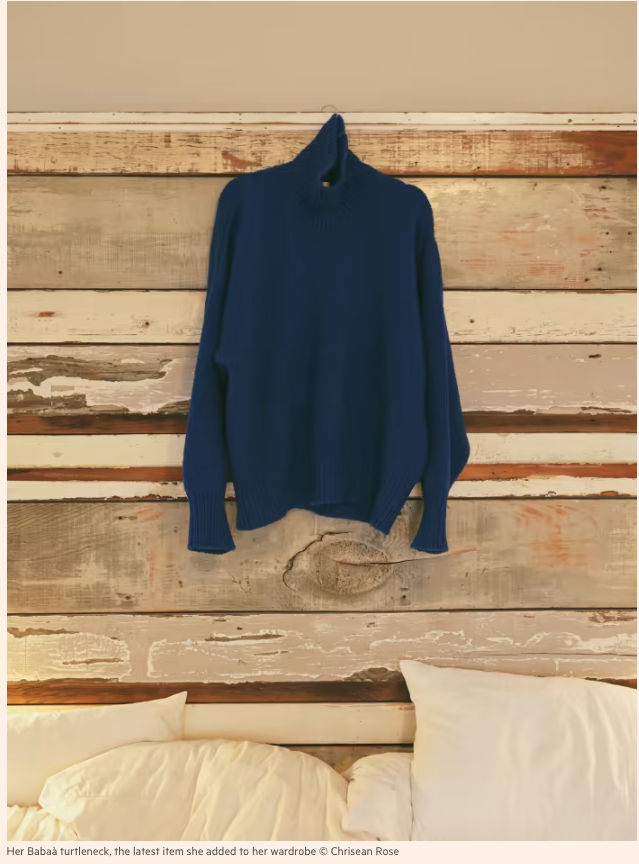

The best bit of advice I ever received was from the Tony Award-winning director Kenny Leon. He said to “always come from a place of love” – meaning have the best intentions and all will work out right.
The best souvenir I’ve brought home is a teak stool that my husband and I bought on our honeymoon in Thailand. It’s a simple, portable stool that has grown with us and is now used by our boys in the kitchen. It’s a reminder of our beautiful trip to the Golden Triangle 16 years ago.
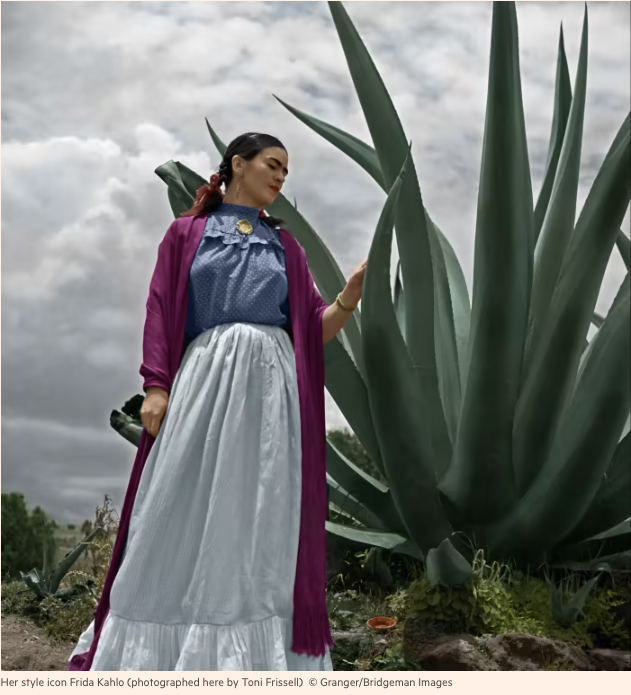
My style icon is Frida Kahlo. She embraced her disabilities – and her back brace and prosthetic leg – and made them statements by wearing bold, colourful skirts and big jewellery. And, of course, there were her big brows. She had a uniform and I relate to that too.
The best gift I’ve received is a Le Creuset teapot from my mother-in-law. This glazed stoneware pot has been a gateway to many more Le Creuset Dutch ovens and pans – in Caribbean blue, orange and cherry red. I love the bold pops of colour in my otherwise all-white kitchen.
The one artist whose work I would collect if I could is difficult to choose. I’d really like to collect the work of several artists to create a symphony: a calming Alice Neel painting for my bedroom; a Frida Kahlo portrait for the living room; and a Jean-Michel Basquiat painting in the dining room. Together they would really spark conversation.

My favourite room in my house is the kitchen in our brownstone in Williamsburg. It has great light and is the central hub for our family. We bought the house in 2009 during the financial collapse, and it was the best decision we ever made. Luckily, we had a great architect who reimagined this space from a closed galley to an open, sun-filled kitchen with enormous windows that open onto the back garden.
My favourite building is La Casa Azul in Mexico City. This was Frida Kahlo’s childhood home and the place where she learned to paint and spent much of the rest of her life. With its beautiful bright blue exterior, and a central courtyard and pond, it’s a magical place. museofridakahlo.org.mx
My beauty and grooming gurus are my close group of friends who advise me on everything from style to fitness to food. In addition, I rely on LA-based hairstylist Vernon François. He specialises in curly hair, and while I love my curls, I don’t like dealing with frizz. Vernon has taught me to fully embrace it. vernonfrancois.com
In another life, I would have been a ballet dancer. My older sister was a professional dancer and is a choreographer in Chicago – I would have loved to continue in the dance world.

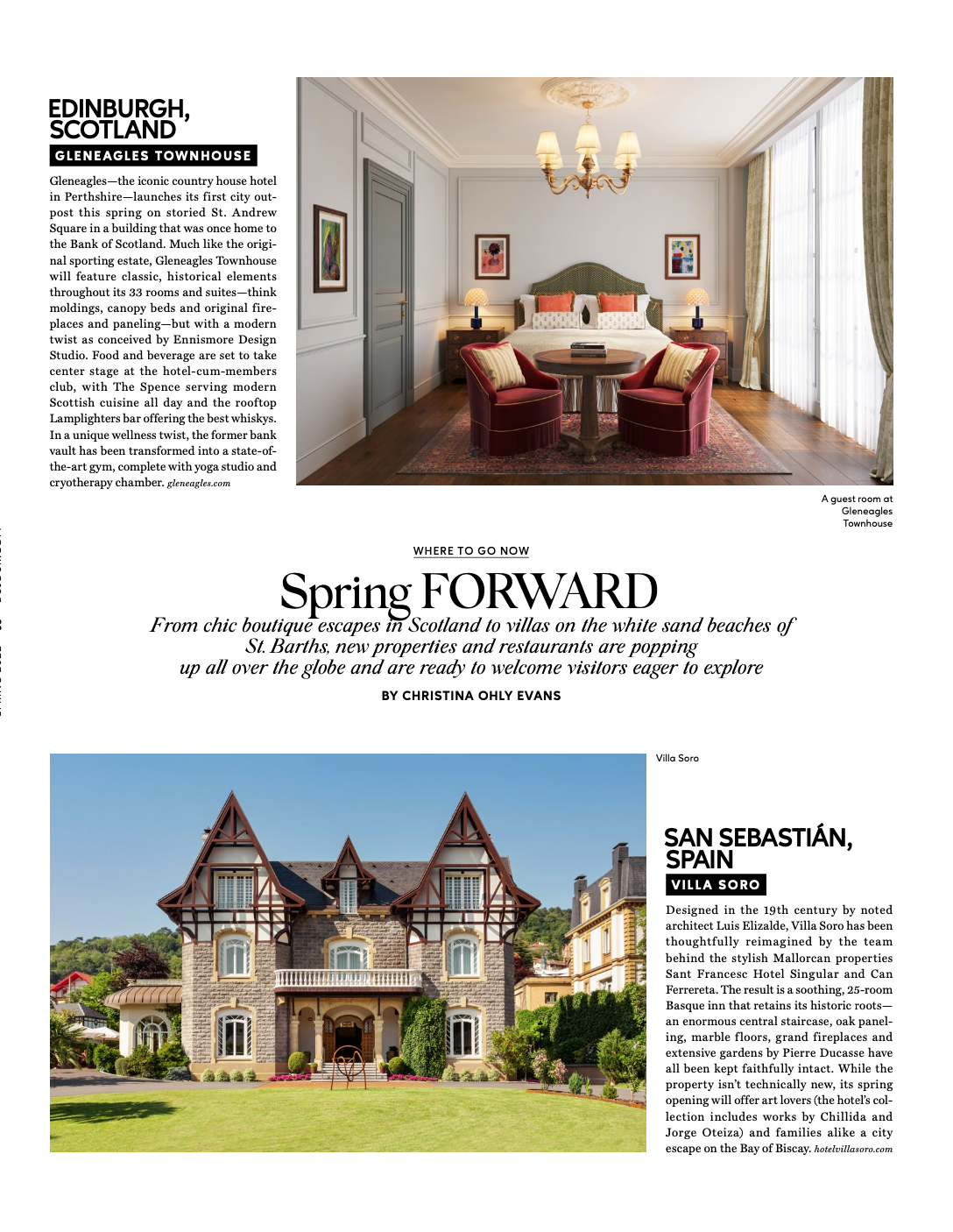
Spring FORWARD
From chic boutique escapes in Scotland to villas on the white sand beaches of St. Barths, new properties and restaurants are popping
up all over the globe and are ready to welcome visitors eager to explore
From chic boutique escapes in Scotland to villas on the white sand beaches of St. Barths, new properties and restaurants are popping up all over the globe and are ready to welcome visitors eager to explore
EDINBURGH, SCOTLAND
GLENEAGLES TOWNHOUSE
Gleneagles—the iconic country house hotel in Perthshire—launches its first city out- post this spring on storied St. Andrew Square in a building that was once home to the Bank of Scotland. Much like the origi- nal sporting estate, Gleneagles Townhouse will feature classic, historical elements throughout its 33 rooms and suites—think moldings, canopy beds and original fire- places and paneling—but with a modern twist as conceived by Ennismore Design Studio. Food and beverage are set to take center stage at the hotel-cum-members club, with The Spence serving modern Scottish cuisine all day and the rooftop Lamplighters bar offering the best whiskys. In a unique wellness twist, the former bank vault has been transformed into a state-of- the-art gym, complete with yoga studio and cryotherapy chamber. gleneagles.com
SAN SEBASTIÁN, SPAIN
VILLA SORO
Designed in the 19th century by noted architect Luis Elizalde, Villa Soro has been thoughtfully reimagined by the team behind the stylish Mallorcan properties Sant Francesc Hotel Singular and Can Ferrereta. The result is a soothing, 25-room Basque inn that retains its historic roots— an enormous central staircase, oak panel- ing, marble floors, grand fireplaces and extensive gardens by Pierre Ducasse have all been kept faithfully intact. While the property isn’t technically new, its spring opening will offer art lovers (the hotel’s col- lection includes works by Chillida and Jorge Oteiza) and families alike a city escape on the Bay of Biscay. hotelvillasoro.com
FIUGGI, ITALY
THE RANCH ITALY AT PALAZZO FIUGGI
Cult luxury fitness and wellness retreat The Ranch at Malibu is expanding its signature program to Palazzo Fiuggi, just an hour outside Rome. Set on a picturesque hilltop, the innovative retreat has a rich history of healing—Michelangelo sought its restor- ative waters—paired with a state-of-the-art medical facility. The Ranch Italy will capi- talize on the surrounding landscape and focus on intensive hiking, strength and core training, as well as yoga and massage. After spending the day in the Apennine Mountains, the 25 weekly guests (seven nights, eight days) will delight in nutrient- dense, plant-based meals courtesy of three Michelin-starred chef Heinz Beck, in part- nership with The Ranch’s executive chef. For a physical and mental refresh with Italian flair, book now. theranchmalibu.com

Actor Matthew Broderick’s guide to Broadway
The New York native has lived in a six-block radius his whole life – and that’s just the way he likes it
The New York native has lived in a six-block radius his whole life – and that’s just the way he likes it
I was born in Manhattan, and first lived on Ninth Street at Fifth Avenue before moving a few blocks to Washington Square North. My wife [Sarah Jessica Parker] and I shared our first apartment in Soho, but we now live back in Greenwich Village where I started, so I basically haven’t gotten out of a six-block radius my whole life. I love it here: the buildings are low so you can see the sky and it’s a short walk to the Hudson River, which is now an extremely pleasant place to walk. Although the area has gentrified, it retains a sense of weirdness and quirk, and I like that I still see elderly people hauling their groceries from small local shops. The area has kept its history, the brownstones and tree-lined streets are the same, my friends are still here, and my kids go to the same school that I did.
Much of my life is centred on Broadway. The ripple effect of it closing for 18 months was huge: from the trucks that drive the lights to the make-up artists, to the scenery people being out of work, and on and on. Midtown still feels quiet but it’s coming back. I just saw my first play in two years, The Lehman Trilogy, which I loved; it felt incredible to be back watching a live performance with an enthusiastic audience.
With Plaza Suite set to run, I am thinking more about the theatre and Times Square in general. I’m looking forward to so many plays – Six, The Music Man and Caroline, Or Change, like everyone else – but also to the routine of rehearsals, and to just standing around eating a Sweetgreen salad with our stage manager and lighting crew. I’m also excited about returning to old favourites including The Algonquin Hotel, which is such a part of the old theatre world and, not to be obvious, but post-show drinks at Bar Centrale, or a more substantial meal at the famous Joe Allen. I like the Glass House Tavern for a casual burger and a drink after a show, or Café Un Deux Trois, which is an institution. José is the maître d’ there and I love him – the French food is excellent too.
When people come to New York I tend to recommend boutique hotels or the old classics that have a real sense of place and history. The Mercer in Soho is great for meeting for drinks, while The Jane is a landmark West Village spot with small rooms but excellent river views. For old-fashioned glamour, it’s The Carlyle uptown: quintessential New York of a certain time and it’s right near Central Park. A drink and live music at Bemelmans Bar here is a must.
Nearer home, I am a big fan of Three Lives bookstore in the West Village, because I always need books, and J Mueser is a great men’s clothing store that carries funkier independent labels. You’ll find suits and sport coats here in unusual colours and with a little edge, either off the rack or bespoke. The salespeople are endlessly helpful and always tell you what’s coming next. Then just down the street is Casa Magazines – New York’s ultimate newsstand – and also Village Cigars on Sheridan Square, an iconic store that everyone should see once. For a bite afterwards I highly recommend Mary’s Fish Camp for classic New England seafood but a bit more refined. It’s local and cosy and the perfect place for a lobster roll.
I am really looking forward to being with a live audience again and to working with this group of actors – one of whom, my wife, I get to see every day – and our director, John Benjamin Hickey. Part of theatre lore is its “show must go on” mentality. It’s about being adaptable, and we’ve had to be. The theatre is about togetherness and we all appreciate how important that is now. I hope we can “build back better”, as President Biden says, and that theatre becomes more affordable, inclusive and accessible. If, out of this time, we can improve on theatre for all then I think that’s a silver lining. Plaza Suite is showing at the Hudson Theatre Broadway until 12 June; plazasuitebroadway.com
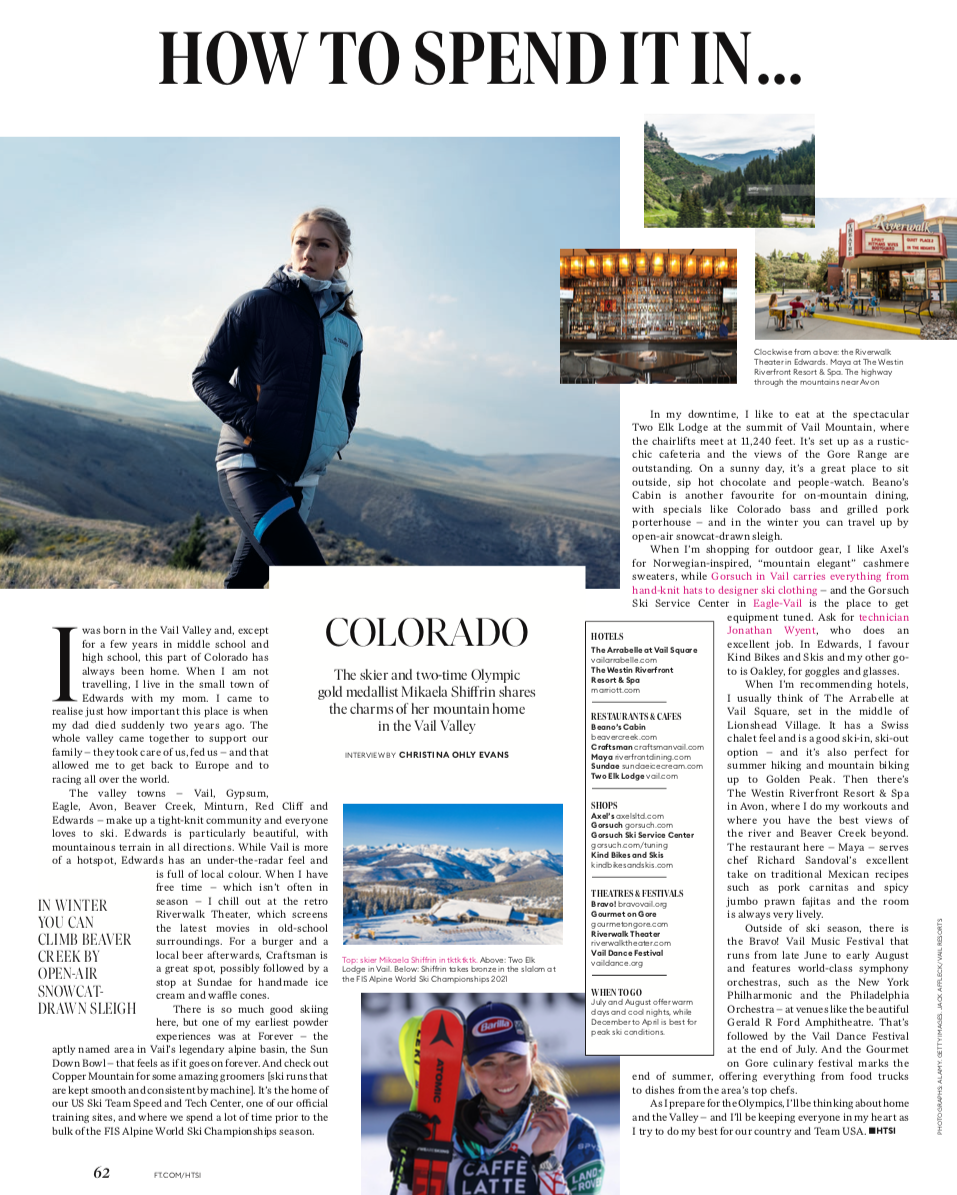
Mikaela Shiffrin’s guide to Colorado
Mikaela Shiffrin’s guide to Colorado
The skier and two-time Olympic gold medallist shares the charms of her mountain home in the Vail Valley
The skier and two-time Olympic gold medallist shares the charms of her mountain home in the Vail Valley
I was born in the Vail Valley and, except for a few years in middle school and high school, this part of Colorado has always been home. When I am not travelling, I live in the small town of Edwards with my mom. I came to realise just how important this place is when my dad died suddenly two years ago. The whole valley came together to support our family – they took care of us, fed us – and that allowed me to get back to Europe and to racing all over the world.
The valley towns – Vail, Gypsum, Eagle, Avon, Beaver Creek, Minturn, Red Cliff and Edwards – make up a tight-knit community and everyone loves to ski. Edwards is particularly beautiful, with mountainous terrain in all directions. While Vail is more of a hotspot, Edwards has an under-the-radar feel and is full of local colour. When I have free time – which isn’t often in season – I chill out at the retro Riverwalk Theater, which screens the latest movies in old-school surroundings. For a burger and a local beer afterwards, Craftsman is a great spot, possibly followed by a stop at Sundae for handmade ice cream and waffle cones.
There is so much good skiing here, but one of my earliest powder experiences was at Forever – the aptly named area in Vail’s legendary alpine basin, the Sun Down Bowl – that feels as if it goes on forever. And check out Copper Mountain for some amazing groomers [ski runs that are kept smooth and consistent by machine]. It’s the home of our US Ski Team Speed and Tech Center, one of our official training sites, and where we spend a lot of time prior to the bulk of the FIS Alpine World Ski Championships season. When I’m shopping for outdoor gear, I like Axel’s for Norwegian-inspired, “mountain elegant” cashmere sweaters, while Gorsuch in Vail carries everything from knit hats to designer ski clothing – and the Gorsuch Ski Service Center in Eagle-Vail is the place to get equipment tuned. Ask for technician Jonathan Weyant, who does an excellent job. In Edwards, I favour Kind Bikes and Skis and my other go-to is Oakley, for goggles and glasses.
When I’m recommending hotels, I usually think of The Arrabelle at Vail Square, set in the middle of Lionshead Village. It has a Swiss chalet feel and is a good ski-in, ski-out option – and it’s also perfect for summer hiking and mountain biking up to Golden Peak. Then there’s The Westin Riverfront Resort & Spa in Avon, where I do my workouts and where you have the best views of the river and Beaver Creek beyond. The restaurant here – Maya – serves chef Richard Sandoval’s excellent take on traditional Mexican recipes such as pork carnitas and spicy jumbo prawn fajitas and the room is always very lively.
Outside of ski season, there is the Bravo! Vail Music Festival that runs from late June to early August and features world-class symphony orchestras, such as the New York Philharmonic and the Philadelphia Orchestra – at venues like the beautiful Gerald R Ford Amphitheatre. That’s followed by the Vail Dance Festival at the end of July. And the Gourmet on Gore culinary festival marks the end of summer, offering everything from food trucks to dishes from the area’s top chefs.
As I prepare for the Olympics, I’ll be thinking about home and the Valley – and I’ll be keeping everyone in my heart as I try to do my best for our country and Team USA.
When to go: July and August offer warm days and cool nights, while December to April is best for peak ski conditions

On and Off Piste
Ski season is here, and with it comes everything from high-speed state of the art lifts to design led hotels and designer clothing collaborations. Here are just a few of this winter’s high altitude highlights.
The highly anticipated Montage Big Sky opens with 139 guest rooms, suites and residences all designed in a neutral palette using natural materials, in keeping with the rugged Rocky Mountain setting. Ski across 5,850 Big Sky acres followed by a satisfying meal at Cortina, where wood-fired Northern Italian fare is on offer, or hit Alpenglow—named after Big Sky Country’s stunning sunsets over the Spanish Peaks—for savory snacks and craft beers.
Ski season is here, and with it comes everything from high-speed state of the art lifts to design led hotels and designer clothing collaborations. Here are just a few of this winter’s high altitude highlights.
By Christina Ohly Evans


Dispatch from France
Dispatch from France
Paris is bursting with culinary excitement. From restaurants set within luxury hotels to more off the beaten path boites, there’s lots to explore in the French capital this season.
Paris is bursting with culinary excitement. From restaurants set within luxury hotels to more off the beaten path boites, there’s lots to explore in the French capital this season.
By Christina Ohly Evans


