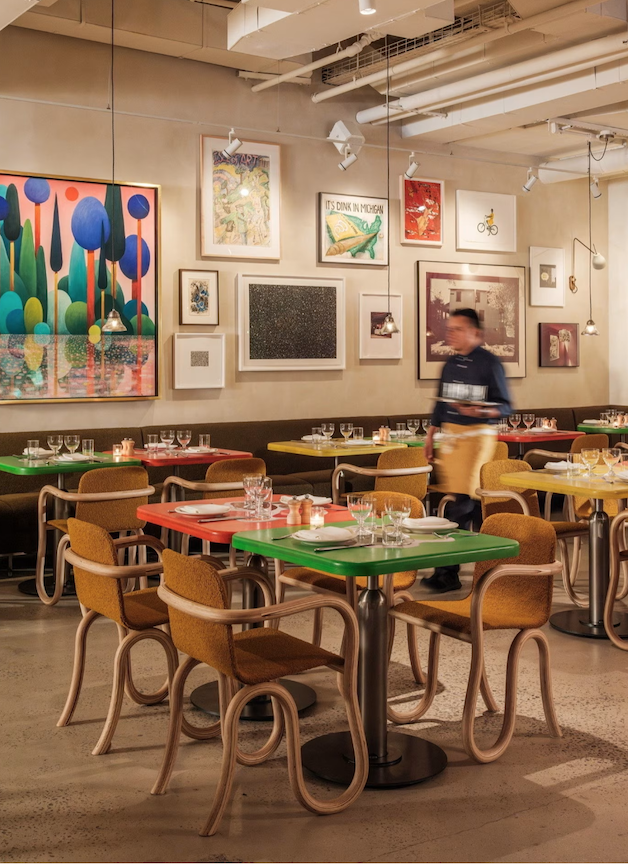
New York’s hottest new restaurants
The tables to book now, from a haute fried-chicken joint to an ultra-cool art destination, classic French cuisine revived and more.
Remember the spate of Covid-19 restaurant closures? Well, those days are long gone, and New York’s top tables are more plentiful — and more difficult to book — than ever before. From new neighbourhood gems in Brooklyn to a reimagined French dining institution on the Upper East Side (and virtually everything in between), the city’s diverse culinary energy is palpable. And while the statistics aren’t favourable for new restaurants (approximately one in three will close in the first year after opening), these establishments are sure to be longer-term winners.
The tables to book now, from a haute fried-chicken joint to an ultra-cool art destination, classic French cuisine revived and more
Remember the spate of Covid-19 restaurant closures? Well, those days are long gone, and New York’s top tables are more plentiful — and more difficult to book — than ever before. From new neighbourhood gems in Brooklyn to a reimagined French dining institution on the Upper East Side (and virtually everything in between), the city’s diverse culinary energy is palpable. And while the statistics aren’t favourable for new restaurants (approximately one in three will close in the first year after opening), these establishments are sure to be longer-term winners.
Coqodaq 12 East 22nd Street, New York, NY 10010
Old-school fine French cuisine has been given a new life by chefs Riad Nasr and Lee Hanson of Frenchette and Le Rock fame. Bringing the winning mix that they started at Balthazar back in the 1990s (perfect steak frites and île flottante), the original institution that was opened in 1937 has been left largely intact with its low-ceilinged, cherry red banquettes-and-checkered tablecloth swagger. The menu — heavy on organ meats, duck and escargots — isn’t for the faint of heart (or the health-obsessed), but it is for those who crave a sense of occasion, a perfectly executed pâté en croute with natural wine pairings and a vibrant atmosphere that is finally bringing the downtown crowd to the Upper East Side. Three-course prix-fixe menu, $125. lvdnyc.com
The ultimate haute fried-chicken restaurant from award-winning restaurateur Simon Kim and the team behind Michelin-starred Cote Korean Steakhouse, Coqodaq has been a runaway success since opening in January thanks to its vibrant scene, sustainability focus and perfectly crispy soy-sauce, garlic-glaze chicken. Vegetables are celebrated here too, with chilled pickled sides adding zesty flavour and crunchy texture. The opulent Flatiron District location, designed, by the Rockwell Group has Korean-American as well as Art Nouveau design touches, with deep-green leather banquettes, walnut finishes and bronze fixtures all enticing hungry guests to linger in 8,000 sq ft of luxury. Mains, $28–$38. coqodaq.com;
SEA West 30th Street, New York, NY 10001
Chef Jungsik Yim — of the eponymous Korean fine-dining restaurant Jungsik, in Tribeca — has turned his talents to SEA, a modern, casual south-east Asian restaurant near Koreatown that is inspired by many different regions, countries, techniques and ingredients. The 80-seat, low-lit space by Kimoy Studios features wooden banquettes and an intimate bar area for walk-ins and is the ideal backdrop for chefs Yim and Jun Hee Park’s inventive, delicious takes on traditional dishes such as crispy pork, informed by Singaporean and Vietnamese preparations of fried pork belly. Other savoury highlights include dry tom-yum noodles (a Korean/Thai mash-up), delicate Vietnamese prawn rolls made with spring-roll papers imported from Ho Chi Minh City and crab fried rice, which fuses crab omelette with Indonesian nasi goreng. The cocktail list is impressive too, with signature the Dirty “Cha Yen” (Thai iced tea meets a strong Old-Fashioned) and the Baby Banana Martini served well into the night. Mains, $34–$54. ny-sea.com
BORGO 124 East 27th Street, New York, NY 10016
From chef Andrew Tarlow (Marlow & Sons, Achilles Heel, Diner), who is widely credited with putting “New Brooklyn” on the foodie map, comes Borgo, a trattoria in NoMad with a welcoming great hearth at its centre. The menu includes vegetable-driven starters and contorni, antipasti (Sicilian garlic dip with Italian almonds), house-made pasta (ancient-grain spaghetti with Calabrian anchovies and chiles) and meat (fennel pollen-infused pork ribs), fish and seafood roasted in the wood-burning oven. The wine list is extensive and, much like those found at his other restaurants, highlights low-intervention wines from Europe’s most sustainable and noted producers. Tableside martinis and a cocktail cart stocked with an assortment of amari add to the festive vibe. This kind of epicurean brilliance takes a village and Borgo has enlisted its own: Jordan Frosolone will head the kitchen; Tarlow’s eldest son, Elijah (formerly of his family’s restaurants Diner and Roman’s), will serve as sous-chef; and Kate Huling — Tarlow’s wife and business partner in Marlow Goods and Shop Collective — has designed the uniforms. Mains, $30–$60. borgonyc.com;
CAFE MADAO 791 Washington Avenue, Brooklyn, NY 11238
Prospect Heights has a new player in Cafe Mado, an all-day dining establishment that starts with freshly baked goods from its sibling establishment, Laurel Bakery, in Brooklyn Heights, and transitions into tartines and small plates for lunch. Housed in the former Michelin-starred Oxalis space, it is exactly what the neighbourhood needs: a hub for fresh French-, Italian- and Californian-inflected cuisine served in a bright and bustling space. Light and inventive salads including pea shoots with sugar snaps, and bamboo and littleneck clams pair perfectly with mains such as pici with pesto Genovese and Smoke In Chimneys trout garnished with sungold tomatoes. Crispy baguettes and butter, sides of harissa, craft cocktails and a decadent chocolate sponge with vanilla and raspberry pudding all make for a perfectly casual night. Mains, $25–$32. cafemadonyc.com
CAFE ZAFFRI
16 East 16th Street, New York, NY 10003
From the acclaimed team behind New York hotspots Raf’s and The Musket Room comes Cafe Zaffri, a restaurant fusing Mediterranean and Levant-style cuisines. Situated on the ground floor of The Twenty Two New York hotel (a new sibling property to The Twenty Two London) in Union Square, it will be helmed by executive chef Mary Attea, who brings her Lebanese heritage to the kitchen through such dishes as shakshuka, labneh, meze and more. Set in a former women’s home built by heiress Margaret Louisa Vanderbilt in 1891, Cafe Zaffri — aka “Zaf’s” — promises farm-fresh cuisine (much of it from neighbouring Union Square Green Market) in an old-world setting by London-based Child Studio and local design firm Post Company. Luxurious velvets, custom rattan furniture and marble elements, as well as a stunning garden atrium all add to the theatrical scene — one where a “skewer service” with Lebanese rice, lamb tartare and spaghetti with crab and saffron are all served in jolly family style. Mains, $28–$65. thetwentytwo.com/newyork
MANUELA 130 Prince Street, New York, NY 10012
From hospitality group Artfarm (which is also behind The Audley Public House and Mount St Restaurant in London and The Fife Arms in Braemar) comes the art-centric Manuela in historic SoHo. The first east-coast project for the group, so named for gallerist and partner Manuela Wirth, this seasonally driven restaurant is a celebration of Tri-State and New England producers. Half the menu is dedicated to plant-focused dishes such as turnips with royal corona beans and grilled brassicas served alongside spiced monkfish skewers with lovage and guindilla peppers. The open kitchen with its wood-fired oven adds to the overall energy in the see-and-be-seen room. Given the restaurant’s ties to Hauser & Wirth, art takes centre stage with specially commissioned artworks by Mika Rottenberg (whose bar is a playful construction of discarded plastic and invasive vines), Rashid Johnson (a bespoke seven-metre dining table that seats 24), Mary Heilmann (colourful tabletops), as well as Lorna Simpson, Pat Steir and Uman (murals), among others. The work of artists who have lived in or been inspired by Soho decorates the vibrant walls, with Louise Bourgeois’ “Spider” paired with pieces by George Condo, Nicolas Party and Cindy Sherman. Designed by Russell Sage Studios (The Fife Arms, Fish Shop Ballater), the buzzing space is full of eco-friendly materials that are vintage, recycled or unused scraps. The result is a perfectly lit, convivial setting that is sure to be downtown’s top table this season. Mains, $25–$127. manuela-nyc.com;
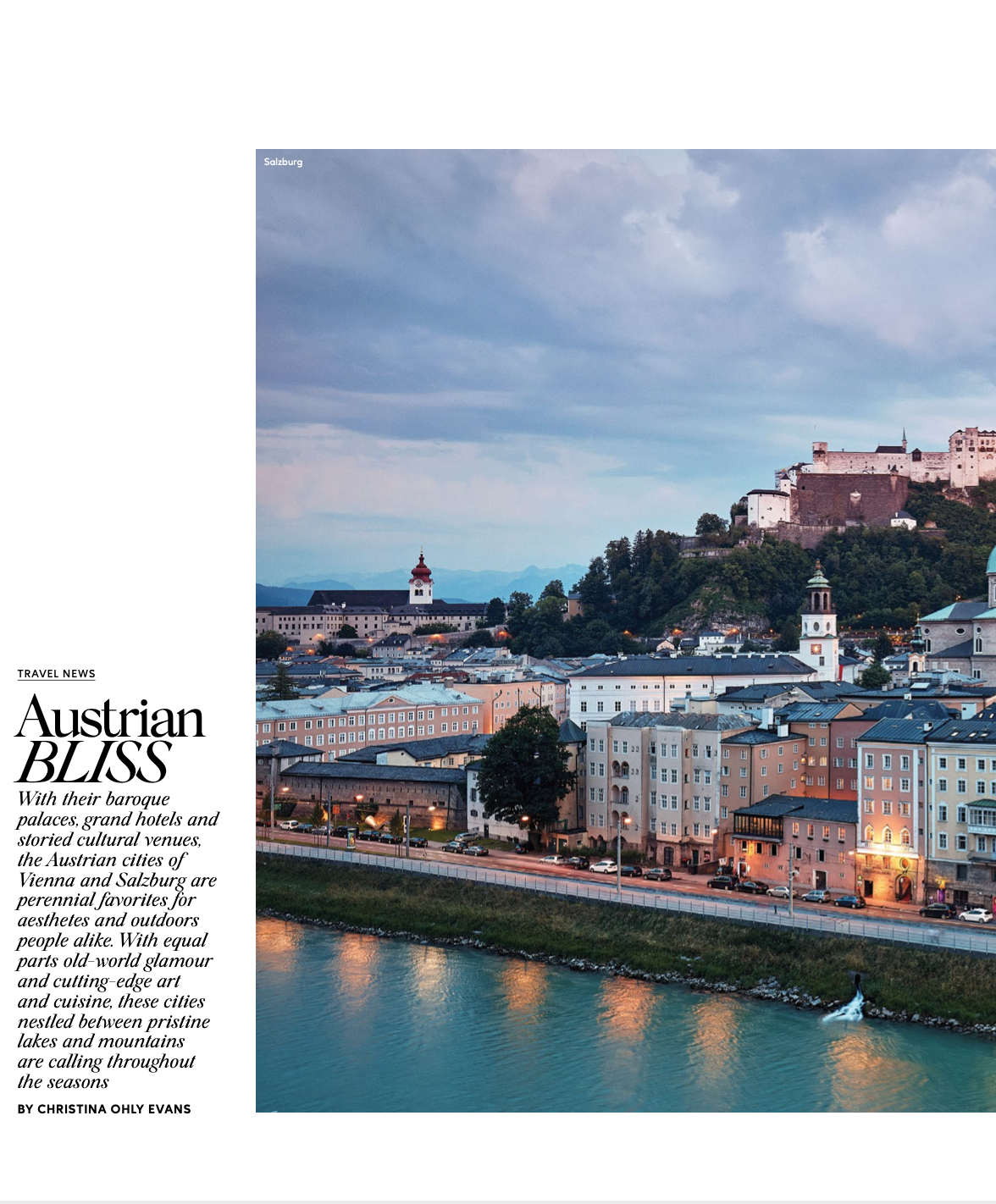
Austrian BLISS
With their baroque palaces, grand hotels and storied cultural venues, the Austrian cities of Vienna and Salzburg are perennial favorites for aesthetes and outdoors people alike. With equal parts old-world glamour and cutting-edge art and cuisine, these cities nestled between pristine lakes and mountains
are calling throughout the seasons.
By Christina Ohly Evans
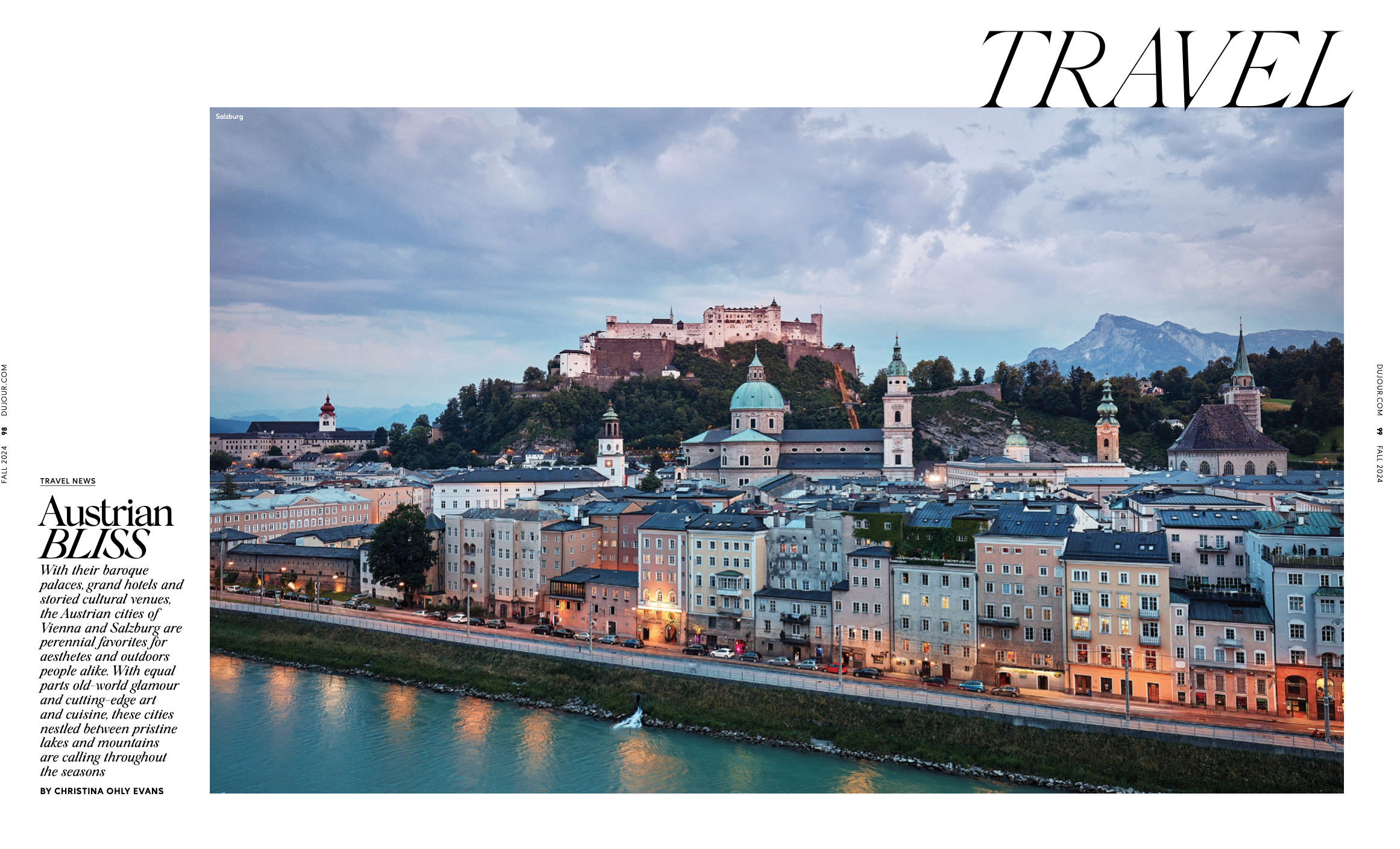
With their baroque palaces, grand hotels and storied cultural venues, the Austrian cities of Vienna and Salzburg are perennial favorites for aesthetes and outdoors people alike. With equal parts old-world glamour and cutting-edge art and cuisine, these cities nestled between pristine lakes and mountains
are calling throughout the seasons.
VIENNA
From St. Stephen’s Square to the iconic Schönbrunn Palace to the charming city trams and bustling cafés, the Austrian capital on
the Danube has stayed true to its elegant European roots but is also dynamic, with art galleries and design-led hotels vying for visitors’ attention. Ever a musical mecca— Beethoven, Brahms, Bruckner, Haydn,
Mahler, Mozart, Schoenberg, Schubert, Johann Strauss I and Johann Strauss II all called Vienna home—the arts continue to flourish here in all forms, at the world-renowned State Opera and at the Leopold Museum, with its collection of paintings by Egon Schiele and Gustav Klimt. But it is the chance to stroll the city’s endless lush gardens and savor a slice
of Sacher torte—a rich chocolate and apricot jam cake that is a Viennese hallmark—that makes a visit here feel like a step back in time. The pace is just a bit slower here, so linger over a decadent Wiener schnitzel with a glass of local grüner veltliner at one of the city’s Michelin-starred temples of gastronomy or opt for a simple street dog (or bratwurst). When it comes to exploring this magical, verdant city, there is no going wrong.
There is no shortage of sumptuous palace hotels here, so it’s the perfect place to make like a Habsburg and be enveloped in an expansive room brimming with gold and jewel-toned velvets. If it’s a more minimalist vibe you’re after, there are plenty of properties that fit that bill as well. In short, Vienna is a hotel town, and this is only a small handful of the very best.
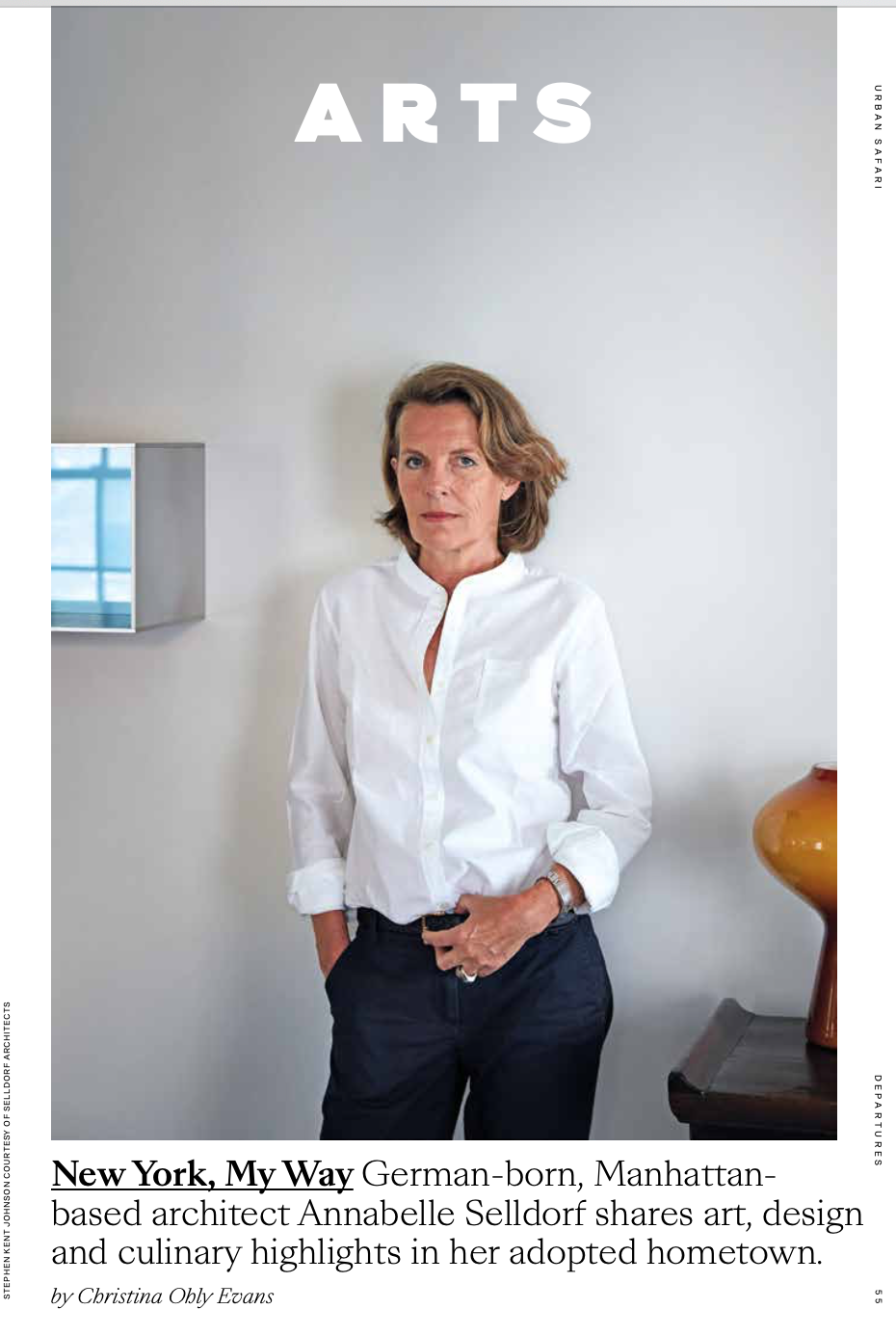
Annabelle Selldorf, New York, My Way
German-born, Manhattan-based architect Annabelle Selldorf shares art, design and culinary highlights in her adopted hometown.
It was an initial visit to New York City at the age of 18 that sealed the deal for a young Annabelle Selldorf. Taken by the “electrifying atmosphere that felt like a massive infusion of oxygen”, the future university student packed her bags in her native Cologne and headed for Brooklyn’s Pratt Institute to study architecture. That was the 1980s and she has called the city – uptown, downtown, SoHo, NoHo – home ever since. “It’s very different from other major European cities such as Paris and London,” explains Selldorf of the city that sometimes gets an abrasive rap. “There’s an openness and a jovial embrace that New Yorkers provide that is like nowhere else.”
German-born, Manhattan-based architect Annabelle Selldorf shares art, design and culinary highlights in her adopted hometown
It was an initial visit to New York City at the age of 18 that sealed the deal for a young Annabelle Selldorf. Taken by the “electrifying atmosphere that felt like a massive infusion of oxygen”, the future university student packed her bags in her native Cologne and headed for Brooklyn’s Pratt Institute to study architecture. That was the 1980s and she has called the city – uptown, downtown, SoHo, NoHo – home ever since. “It’s very different from other major European cities such as Paris and London,” explains Selldorf of the city that sometimes gets an abrasive rap. “There’s an openness and a jovial embrace that New Yorkers provide that is like nowhere else.”
Fuelled by the vibrant gallery scene of the day, Selldorf initially gravitated toward SoHo and Tribeca – “places full of artists and culture”, she says of the cast-iron buildings, endless exhibitions and vibrant parties that drew an eclectic mix of characters. And while she moved around the city – from the Upper West Side to a loft in SoHo to a former undertaker’s flat – it was always driven by the community and surrounding street life. “Being close to a park or nature didn’t matter to me at all; I was a total urbanite,” she says of her early cosmopolitan existence.
Fast-forward 40 years, and Selldorf is still enthralled by the city’s history, energy and boundless creativity – all of which guide her work as one of the art world’s pre-eminent architects. Her eponymous firm (Selldorf Architects, which she founded in 1988) has long been focused on bringing people to art in all its forms. From galleries and exhibition spaces for David Zwirner, Gagosian and Hauser & Wirth, to Maja Hoffmann’s sprawling cultural centre, LUMA Arles, to cultural institutions including the Neue Galerie New York and the Museum of Contemporary Art San Diego, she is sought after for her exquisite restraint – a pared-down design aesthetic that is at once elegant, sensitive to the surroundings and, above all, highly functional.
Upcoming high-profile museum projects – including the expansion of New York’s storied Frick Collection and the forthcoming redesign of the British National Gallery’s Sainsbury Wing, as well as the revitalisation of the Smithsonian American Art Museum – are all keeping her busy, but strolling the city streets continues to awe and inspire her. In the following pages, Selldorf offers a glimpse into her New York.
Perfect Weekends
Weekends in New York are all about walking; from the quiet West Village to the East Village and Tompkins Square Park and up to NoHo, the area north of Houston Street. This landmarked area is full of loft buildings built during the late-19th and early-20th centuries. They’re made of cast iron and brick and are so stout – and they’re juxtaposed against contemporary residential structures by Herzog & de Meuron and our own 10 Bond Street. I think this building anchors the neighbourhood a bit. The streets are wide here, and the buildings are low so you can see the sky, and the restaurants are great, too.
The Art March
I always make a list of galleries in Chelsea that I want to visit, with a mix of new and young artists and more established names as well. From Chelsea, I might head to The Whitney, or go uptown to visit the Met [Metropolitan Museum of Art], Neue Galerie and Guggenheim. This provides a structure to my day, a checklist of culture. In terms of music and theatre, Lincoln Center – and the concerts at David Geffen Hall in particular – have so much to offer. The arts programming at the Park Avenue Armory is another highlight.
Great Heights
New York is a city of skyscrapers that are in dialogue with each other. From the iconic Empire State Building to the late-1920s Art Deco Chrysler Building, to the newer 432 Park Avenue by the late Rafael Viñoly, which makes a striking figure because of its proportions, they all add to the unique mix. I do think with all the buildings popping up everywhere, more regulation might be helpful. We’re working on our first skyscraper project, One Domino Square, which is twin residential towers in Williamsburg, Brooklyn. It’s influenced by the entire city – the nearby Williamsburg Bridge, the sky, the weather. The project features a ceramic façade that’s slightly iridescent and reflects the beautiful light from white to sky blue depending on the season and time of day.
Culinary Gems
My tastes are simple – I like food that is like the buildings that I design. I’ve been a longtime regular at [Japanese restaurant] Omen Azen [Thompson Street] in SoHo where I like both the setting and the cuisine. It’s all about the balance. I love King [King Street] for the same reasons – the atmosphere and the food. It’s like the River Café in London, which makes sense because two of the women owners/chefs trained there. Via Carota [Grove Street] and I Sodi [Bleecker Street] are other favourites; everything is so freshly cooked and so simple.
Green Spaces
People crave parks and public spaces – particularly in New York City. The Hudson River Park, which runs along the Hudson River downtown, is particularly important, as is Washington Square Park near my home; it’s always crowded. Madison Square Park is a little forbidding because the green zones are fenced in, but it’s a nice counterbalance to the urban surroundings. I am a huge fan of both Union Square Park and the Union Square Greenmarket. I buy everything here – my greens, fruit, farm-fresh eggs, milk. New Yorkers love not only the produce and the variety, but the sense of community. I love to observe vendors and locals interacting and experiencing the seasons.
The Cultural Horizon
I’m incredibly excited about The Frick, which has been seven years in the making. The galleries and spaces are finished and are being acclimatised to welcome the art back over the next few months. We designed the entire thing and added 27,000 square feet to the original 1914 building by Thomas Hastings and later, by John Russell Pope. The original garden by Russell Page is now a focal point, as is a beautifully proportioned reception hall, and we restored the art and research library on East 70th Street. In addition, we replaced skylights, changed entry sequences, education spaces, an auditorium and added a light-filled cafe. The way the museum welcomes people is much different and much more inclusive now. As an architect, you must always articulate how a building contributes and why it matters. You need to listen to why people want continuity, but you also need to understand how life and society change. I hope this building transitions seamlessly between the old Beaux-Arts architecture and the new – in terms of spaces and materials – and that everyone feels welcome. If we can change that threshold of anxiety for people who aren’t in the habit of going to museums just a little bit, then I think that’s culturally significant.
Santa Fe Sublime
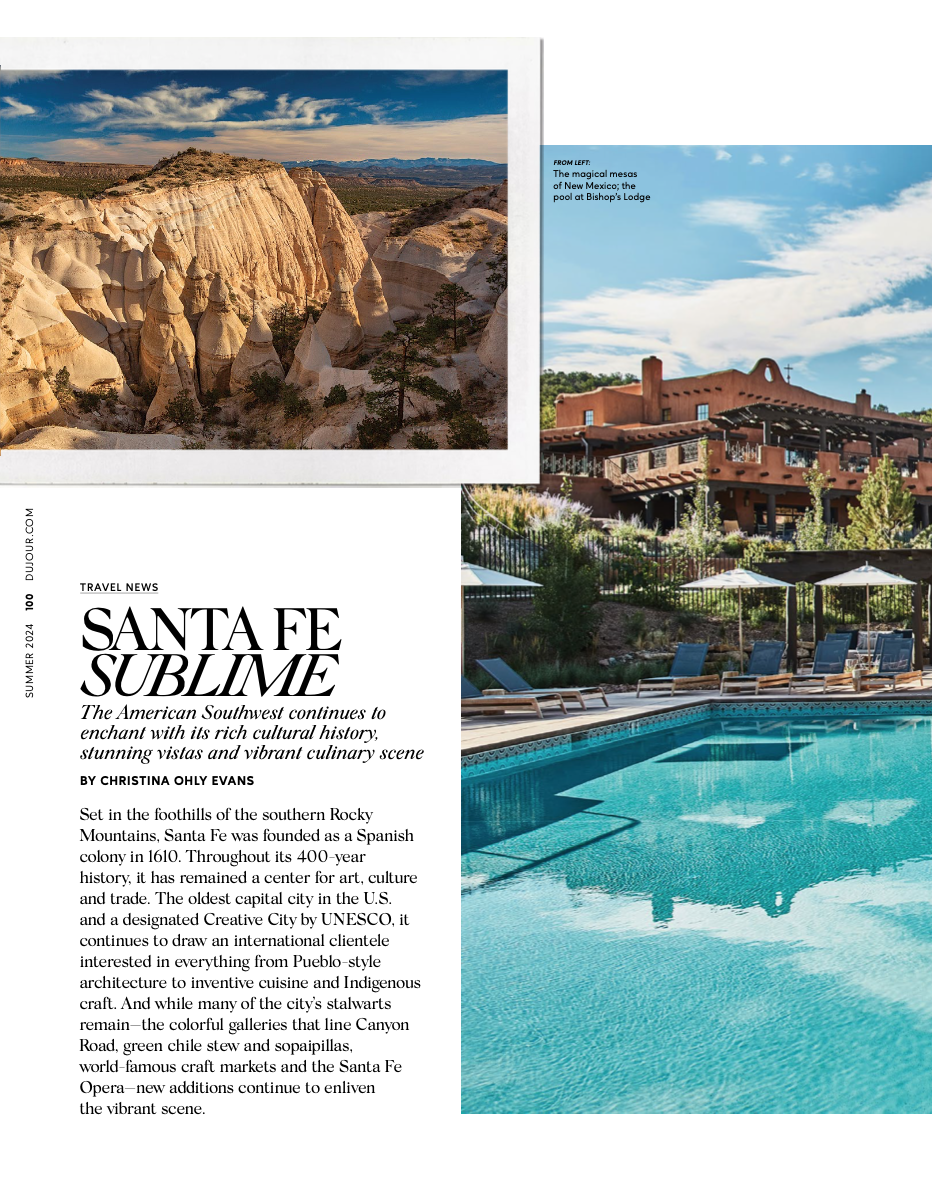
Set in the foothills of the southern Rocky Mountains, Santa Fe was founded as a Spanish colony in 1610. Throughout its 400-year history, it has remained a center for art, culture and trade. The oldest capital city in the U.S. and a designated Creative City by UNESCO, it continues to draw an international clientele interested in everything from Pueblo-style architecture to inventive cuisine and Indigenous craft. And while many of the city’s stalwarts remain—the colorful galleries that line Canyon Road, green chile stew and sopaipillas, world-famous craft markets and the Santa Fe Opera—new additions continue to enliven the vibrant scene.
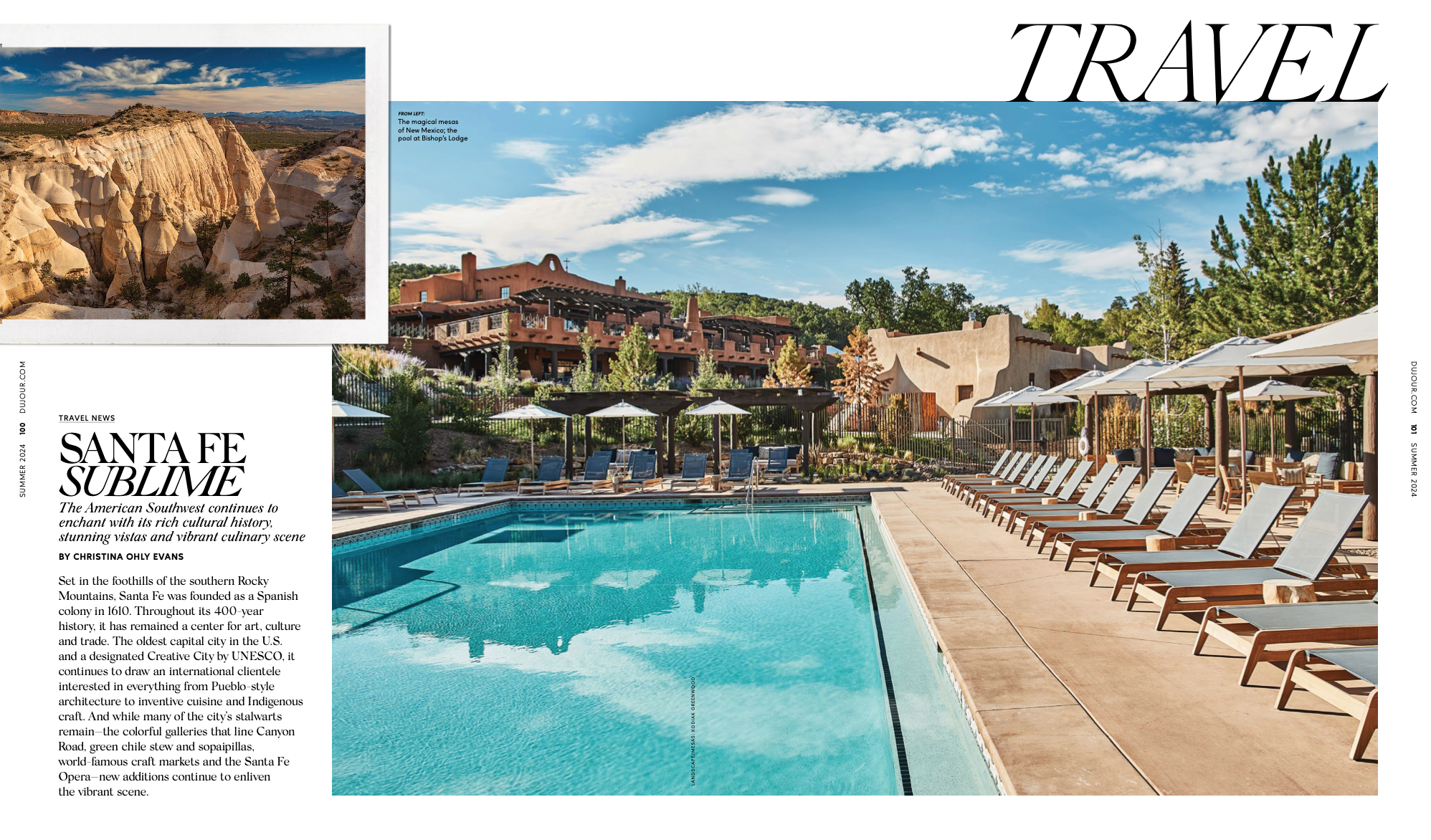
The American Southwest continues to enchant with its rich cultural history, stunning vistas and vibrant culinary scene.
By Christina Ohly Evans
Set in the foothills of the southern Rocky Mountains, Santa Fe was founded as a Spanish colony in 1610. Throughout its 400-year history, it has remained a center for art, culture and trade. The oldest capital city in the U.S. and a designated Creative City by UNESCO, it continues to draw an international clientele interested in everything from Pueblo-style architecture to inventive cuisine and Indigenous craft. And while many of the city’s stalwarts remain—the colorful galleries that line Canyon Road, green chile stew and sopaipillas, world-famous craft markets and the Santa Fe Opera—new additions continue to enliven
the vibrant scene.
HOTELS
From five-star properties to an authentic dude ranch, these hotels are perfect for stays with a sense of place
BISHOP’S LODGE, AUBERGE RESORTS COLLECTION
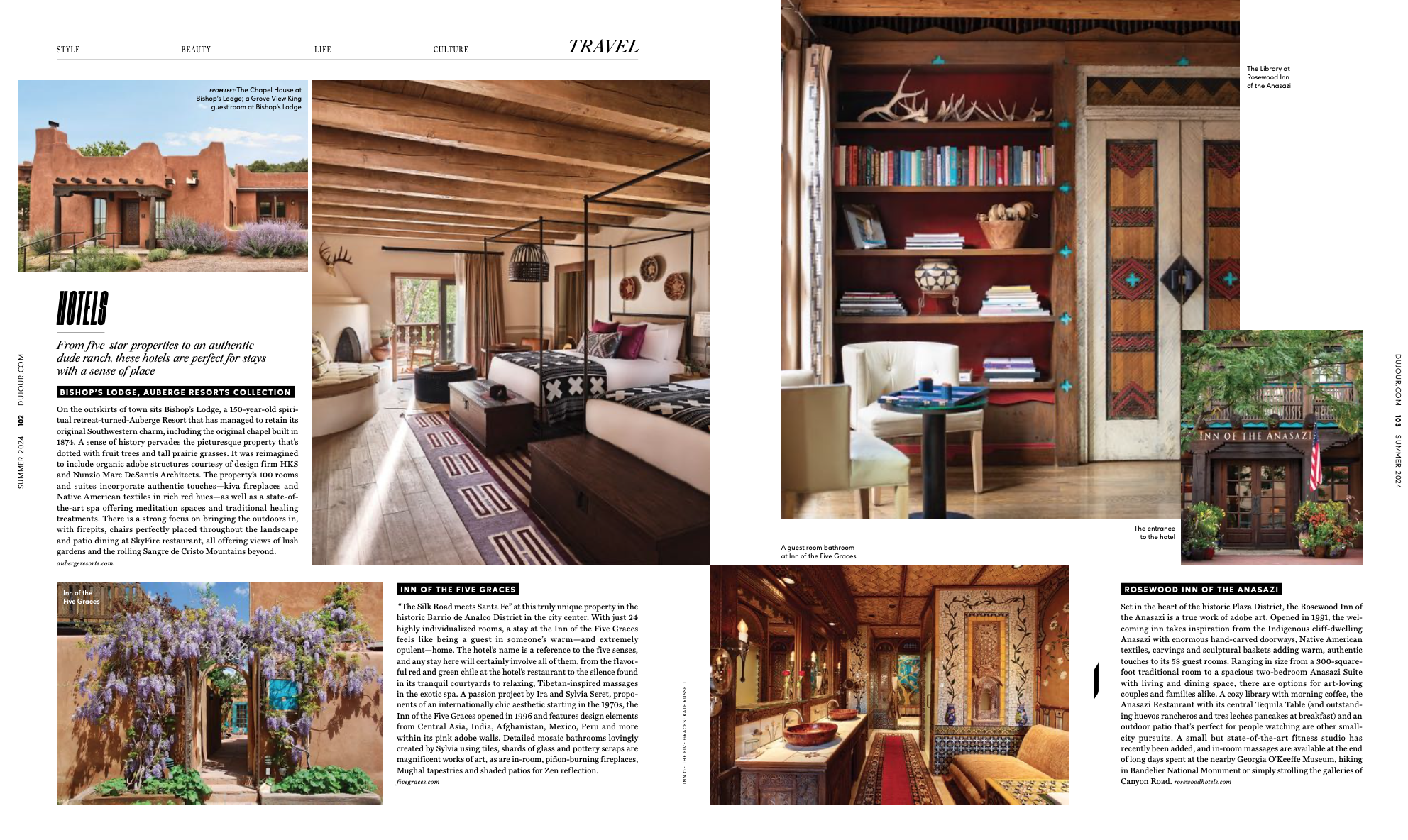
On the outskirts of town sits Bishop’s Lodge, a 150-year-old spiri- tual retreat-turned-Auberge Resort that has managed to retain its original Southwestern charm, including the original chapel built in 1874. A sense of history pervades the picturesque property that’s dotted with fruit trees and tall prairie grasses. It was reimagined to include organic adobe structures courtesy of design firm HKS and Nunzio Marc DeSantis Architects. The property’s 100 rooms and suites incorporate authentic touches—kiva fireplaces and Native American textiles in rich red hues—as well as a state-of- the-art spa offering meditation spaces and traditional healing treatments. There is a strong focus on bringing the outdoors in, with firepits, chairs perfectly placed throughout the landscape and patio dining at SkyFire restaurant, all offering views of lush gardens and the rolling Sangre de Cristo Mountains beyond.
INN OF THE FIVE GRACES
“The Silk Road meets Santa Fe” at this truly unique property in the historic Barrio de Analco District in the city center. With just 24 highly individualized rooms, a stay at the Inn of the Five Graces feels like being a guest in someone’s warm—and extremely opulent—home. The hotel’s name is a reference to the five senses, and any stay here will certainly involve all of them, from the flavor- ful red and green chile at the hotel’s restaurant to the silence found in its tranquil courtyards to relaxing, Tibetan-inspired massages in the exotic spa. A passion project by Ira and Sylvia Seret, propo- nents of an internationally chic aesthetic starting in the 1970s, the Inn of the Five Graces opened in 1996 and features design elements from Central Asia, India, Afghanistan, Mexico, Peru and more within its pink adobe walls. Detailed mosaic bathrooms lovingly created by Sylvia using tiles, shards of glass and pottery scraps are magnificent works of art, as are in-room, piñon-burning fireplaces, Mughal tapestries and shaded patios for Zen reflection. fivegraces.com
INN OF THE FIVE GRACES
“The Silk Road meets Santa Fe” at this truly unique property in the historic Barrio de Analco District in the city center. With just 24 highly individualized rooms, a stay at the Inn of the Five Graces feels like being a guest in someone’s warm—and extremely opulent—home. The hotel’s name is a reference to the five senses, and any stay here will certainly involve all of them, from the flavor- ful red and green chile at the hotel’s restaurant to the silence found in its tranquil courtyards to relaxing, Tibetan-inspired massages in the exotic spa. A passion project by Ira and Sylvia Seret, propo- nents of an internationally chic aesthetic starting in the 1970s, the Inn of the Five Graces opened in 1996 and features design elements from Central Asia, India, Afghanistan, Mexico, Peru and more within its pink adobe walls. Detailed mosaic bathrooms lovingly created by Sylvia using tiles, shards of glass and pottery scraps are magnificent works of art, as are in-room, piñon-burning fireplaces, Mughal tapestries and shaded patios for Zen reflection. fivegraces.com
ROSEWOOD INN OF THE ANASAZI
Set in the heart of the historic Plaza District, the Rosewood Inn of the Anasazi is a true work of adobe art. Opened in 1991, the wel- coming inn takes inspiration from the Indigenous cliff-dwelling Anasazi with enormous hand-carved doorways, Native American textiles, carvings and sculptural baskets adding warm, authentic touches to its 58 guest rooms. Ranging in size from a 300-square- foot traditional room to a spacious two-bedroom Anasazi Suite with living and dining space, there are options for art-loving couples and families alike. A cozy library with morning coffee, the Anasazi Restaurant with its central Tequila Table (and outstand- ing huevos rancheros and tres leches pancakes at breakfast) and an outdoor patio that’s perfect for people watching are other small- city pursuits. A small but state-of-the-art fitness studio has recently been added, and in-room massages are available at the end of long days spent at the nearby Georgia O’Keeffe Museum, hiking in Bandelier National Monument or simply strolling the galleries of Canyon Road. rosewoodhotels.com
FOUR SEASONS RESORT RANCHO ENCANTADO
A 57-acre former dude ranch that’s 10 miles from the center of Santa Fe, Four Seasons Resort Rancho Encantado offers a full immersion in nature with the Rio Grande River Valley and the Sangre de Cristo and Jemez mountains in full view. The property’s 65 spacious casi- tas have been refreshed and skew toward minimalist Southwestern chic; neutral cement floors, adobe fireplaces, soothing textiles, horsehair pottery by artist Linda Concho and local baskets all add to the serene atmosphere. A sleek, dark cement pool offers a welcome respite after long days spent hiking and biking, as does the spa—one where juniper sage smudging ceremonies meet nutrient- rich adobe clay treatments and end with chakra balancing massages. For authentic northern New Mexico cuisine with inven- tive twists, the restaurant, Terra, offers spice-infused dishes such as an aguachile rojo hamachi ceviche and a roasted poblano with calabacitas, quinoa pilaf, Mexican crema, yellow mole, crispy chicos and avocado. Be sure to save room for the legendary churros, served here with ancho reyes poblano cream. fourseasons.com
SPAS
Immerse yourself in the healing waters of New Mexico
OJO CALIENTE
It’s worth the hour drive out of town to soak in the healing waters of one of the country’s oldest health spas, Ojo Caliente. These hot springs feature nutrient-rich, healing minerals including lithia, iron and soda, each with properties that aid in digestion, promote relaxation and much more. In addition to eight communal tubs and private pools, there are hydrotherapy treatments and massages to suit every taste (or ailment). A Satva Botanicals massage incorpo- rates CBD oil to reduce stress, while the Rio Grande Hot Stone massage uses basalt rocks to eliminate stagnant energy from the body and mind. The tranquil Yoga Yurt is the place for small group classes—nidra, hatha and more—and group retreats are also an option. For those who prefer a total getaway, book in at the hotel with its homey Pueblo-style suites or in one of the North Cottages, the four-bedroom Adobe House or even an old-school Vintage Trailer for a true glamping experience. Dine on the patio at Artesian in summer, where hearty breakfasts—blue corn piñon pancakes and tacos stuffed with eggs, pinto beans and salsa—pro- vide fuel for days spent outdoors. ojosparesorts.com
The dining room at Geronimo
GERONIMO
Step inside Geronimo, a restaurant housed in a 250-year-old restored adobe building on Canyon Road, and you’ll feel trans- ported to the world of Georgia O’Keeffe. Whitewashed walls, beamed ceilings and intimate rooms lit by antler chandeliers and crackling kiva fireplaces all create a relaxed ambience. Among the many standouts are jumbo lump crab cakes with sweet corn puree, a vegetarian tasting menu with wine pairing and mains of Telicherry-rubbed elk tenderloin and New Mexico Four Corners grilled rack of lamb with fresh pea puree and parmesan yellow corn polenta. Be sure to book in for a cocktail on the Canyon Road patio to people-watch with an unmatched margarita in hand. geronimorestaurant.com
TOMASITA’S
At 50 years old, Tomasita’s is a Santa Fe institution serving straightforward New Mexican cuisine and some of the best mar- garitas in town. Enchiladas, chiles rellenos, chalupas topped with refried beans and cheese and pork tamales with red chile
are all favorites, as are classic SWIRL margaritas made with primo tequila. tomasitas.com