Annabelle Selldorf, New York, My Way
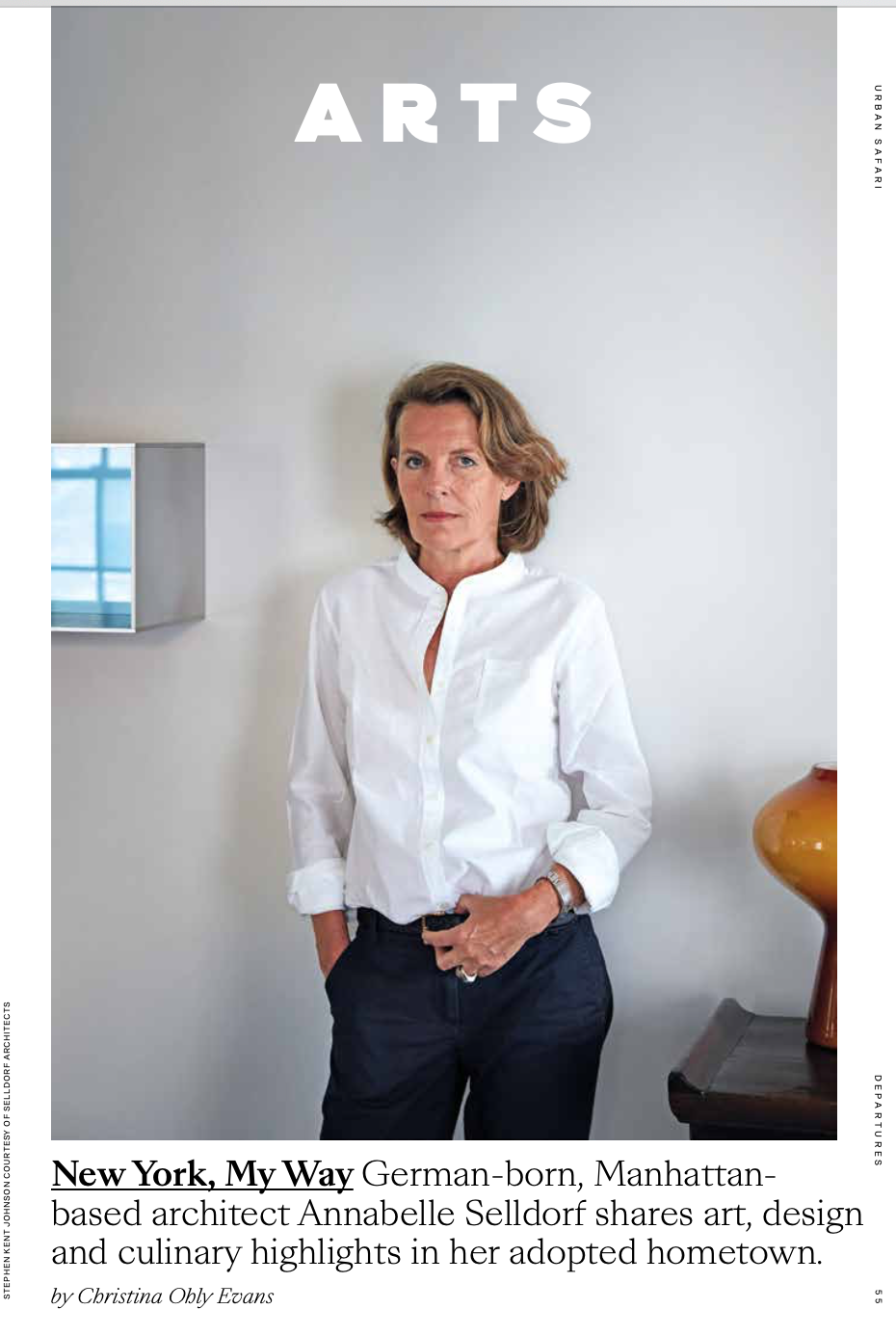
German-born, Manhattan-based architect Annabelle Selldorf shares art, design and culinary highlights in her adopted hometown
It was an initial visit to New York City at the age of 18 that sealed the deal for a young Annabelle Selldorf. Taken by the “electrifying atmosphere that felt like a massive infusion of oxygen”, the future university student packed her bags in her native Cologne and headed for Brooklyn’s Pratt Institute to study architecture. That was the 1980s and she has called the city – uptown, downtown, SoHo, NoHo – home ever since. “It’s very different from other major European cities such as Paris and London,” explains Selldorf of the city that sometimes gets an abrasive rap. “There’s an openness and a jovial embrace that New Yorkers provide that is like nowhere else.”
Fuelled by the vibrant gallery scene of the day, Selldorf initially gravitated toward SoHo and Tribeca – “places full of artists and culture”, she says of the cast-iron buildings, endless exhibitions and vibrant parties that drew an eclectic mix of characters. And while she moved around the city – from the Upper West Side to a loft in SoHo to a former undertaker’s flat – it was always driven by the community and surrounding street life. “Being close to a park or nature didn’t matter to me at all; I was a total urbanite,” she says of her early cosmopolitan existence.
Fast-forward 40 years, and Selldorf is still enthralled by the city’s history, energy and boundless creativity – all of which guide her work as one of the art world’s pre-eminent architects. Her eponymous firm (Selldorf Architects, which she founded in 1988) has long been focused on bringing people to art in all its forms. From galleries and exhibition spaces for David Zwirner, Gagosian and Hauser & Wirth, to Maja Hoffmann’s sprawling cultural centre, LUMA Arles, to cultural institutions including the Neue Galerie New York and the Museum of Contemporary Art San Diego, she is sought after for her exquisite restraint – a pared-down design aesthetic that is at once elegant, sensitive to the surroundings and, above all, highly functional.
Upcoming high-profile museum projects – including the expansion of New York’s storied Frick Collection and the forthcoming redesign of the British National Gallery’s Sainsbury Wing, as well as the revitalisation of the Smithsonian American Art Museum – are all keeping her busy, but strolling the city streets continues to awe and inspire her. In the following pages, Selldorf offers a glimpse into her New York.
Perfect Weekends
Weekends in New York are all about walking; from the quiet West Village to the East Village and Tompkins Square Park and up to NoHo, the area north of Houston Street. This landmarked area is full of loft buildings built during the late-19th and early-20th centuries. They’re made of cast iron and brick and are so stout – and they’re juxtaposed against contemporary residential structures by Herzog & de Meuron and our own 10 Bond Street. I think this building anchors the neighbourhood a bit. The streets are wide here, and the buildings are low so you can see the sky, and the restaurants are great, too.
The Art March
I always make a list of galleries in Chelsea that I want to visit, with a mix of new and young artists and more established names as well. From Chelsea, I might head to The Whitney, or go uptown to visit the Met [Metropolitan Museum of Art], Neue Galerie and Guggenheim. This provides a structure to my day, a checklist of culture. In terms of music and theatre, Lincoln Center – and the concerts at David Geffen Hall in particular – have so much to offer. The arts programming at the Park Avenue Armory is another highlight.
Great Heights
New York is a city of skyscrapers that are in dialogue with each other. From the iconic Empire State Building to the late-1920s Art Deco Chrysler Building, to the newer 432 Park Avenue by the late Rafael Viñoly, which makes a striking figure because of its proportions, they all add to the unique mix. I do think with all the buildings popping up everywhere, more regulation might be helpful. We’re working on our first skyscraper project, One Domino Square, which is twin residential towers in Williamsburg, Brooklyn. It’s influenced by the entire city – the nearby Williamsburg Bridge, the sky, the weather. The project features a ceramic façade that’s slightly iridescent and reflects the beautiful light from white to sky blue depending on the season and time of day.
Culinary Gems
My tastes are simple – I like food that is like the buildings that I design. I’ve been a longtime regular at [Japanese restaurant] Omen Azen [Thompson Street] in SoHo where I like both the setting and the cuisine. It’s all about the balance. I love King [King Street] for the same reasons – the atmosphere and the food. It’s like the River Café in London, which makes sense because two of the women owners/chefs trained there. Via Carota [Grove Street] and I Sodi [Bleecker Street] are other favourites; everything is so freshly cooked and so simple.
Green Spaces
People crave parks and public spaces – particularly in New York City. The Hudson River Park, which runs along the Hudson River downtown, is particularly important, as is Washington Square Park near my home; it’s always crowded. Madison Square Park is a little forbidding because the green zones are fenced in, but it’s a nice counterbalance to the urban surroundings. I am a huge fan of both Union Square Park and the Union Square Greenmarket. I buy everything here – my greens, fruit, farm-fresh eggs, milk. New Yorkers love not only the produce and the variety, but the sense of community. I love to observe vendors and locals interacting and experiencing the seasons.
The Cultural Horizon
I’m incredibly excited about The Frick, which has been seven years in the making. The galleries and spaces are finished and are being acclimatised to welcome the art back over the next few months. We designed the entire thing and added 27,000 square feet to the original 1914 building by Thomas Hastings and later, by John Russell Pope. The original garden by Russell Page is now a focal point, as is a beautifully proportioned reception hall, and we restored the art and research library on East 70th Street. In addition, we replaced skylights, changed entry sequences, education spaces, an auditorium and added a light-filled cafe. The way the museum welcomes people is much different and much more inclusive now. As an architect, you must always articulate how a building contributes and why it matters. You need to listen to why people want continuity, but you also need to understand how life and society change. I hope this building transitions seamlessly between the old Beaux-Arts architecture and the new – in terms of spaces and materials – and that everyone feels welcome. If we can change that threshold of anxiety for people who aren’t in the habit of going to museums just a little bit, then I think that’s culturally significant.