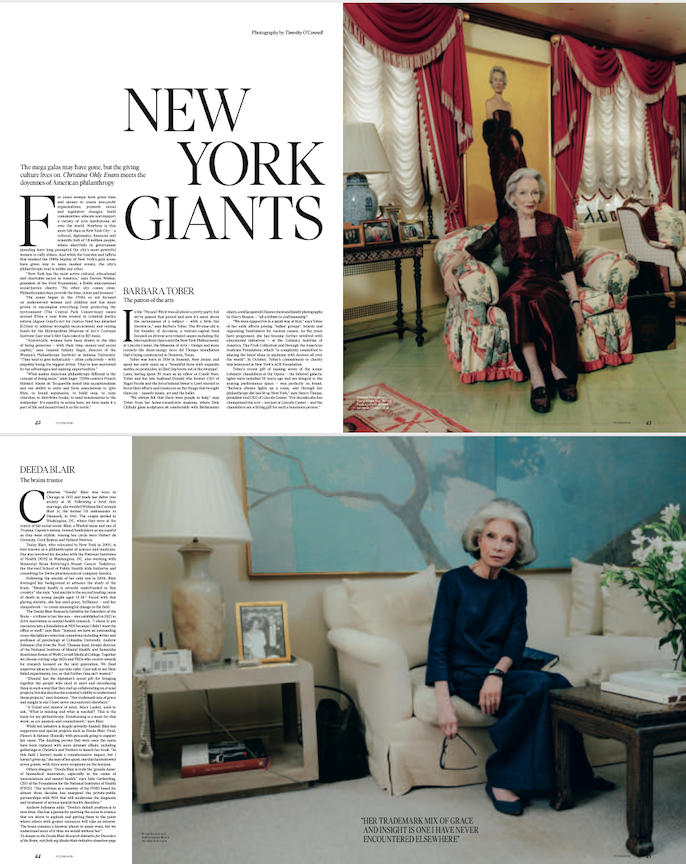
The queens of NYC philanthropy
For years women have given time and money to create non-profit organisations, promote social and legislative changes, build communities, educate and support a variety of arts institutions all over the world. Nowhere is this more felt than in New York City – a cultural, diplomatic, financial and scientific hub of 7.8 million people, where shortfalls in government spending have long prompted the city’s most powerful women to rally others. And while the tuxedos and taffeta that marked the 1980s heyday of New York’s gala scene have given way to more modest events, the city’s philanthropic zeal is unlike any other.
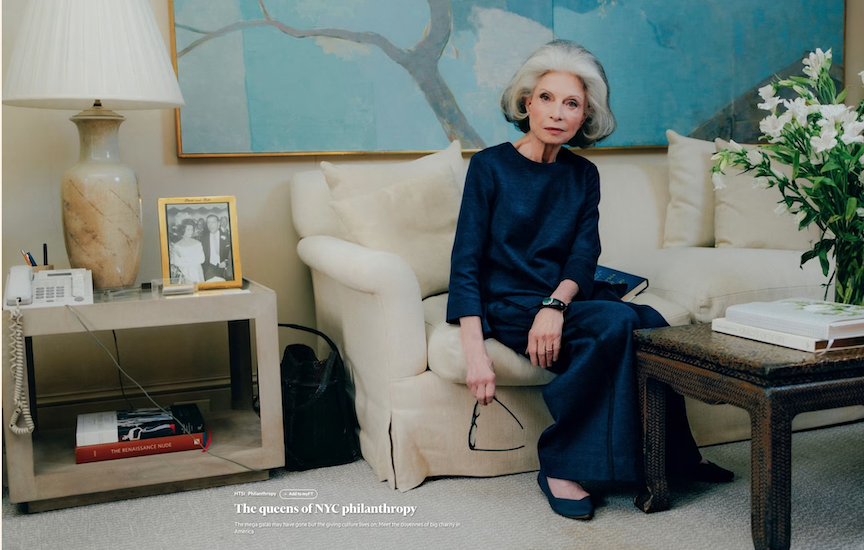
Deeda Blair
The mega galas may have gone but the giving culture lives on. Meet the doyennes of big charity in America
For years women have given time and money to create non-profit organisations, promote social and legislative changes, build communities, educate and support a variety of arts institutions all over the world. Nowhere is this more felt than in New York City – a cultural, diplomatic, financial and scientific hub of 7.8 million people, where shortfalls in government spending have long prompted the city’s most powerful women to rally others. And while the tuxedos and taffeta that marked the 1980s heyday of New York’s gala scene have given way to more modest events, the city’s philanthropic zeal is unlike any other. “New York has the most active cultural, educational and charitable sector in America,” says Darren Walker, president of the Ford Foundation, a $16bn international social-justice charity. “No other city comes close. Philanthropists here provide the time, talent and treasure.” The scene began in the 1700s as aid focused on underserved women and children and has since grown to encompass everything from protecting the environment (The Central Park Conservancy raises around $7mn a year from events) to criminal justice reform (Agnes Gund’s Art for Justice fund has awarded $125mn to address wrongful incarceration) and raising funds for the Metropolitan Museum of Art’s Costume Institute (last year’s Met Gala raked in $17.4mn).
“Historically, women have been drawn to the idea of being generous – with their time, money and social capital,” says Jeannie Infante Sager, director of the Women’s Philanthropy Institute at Indiana University. “They tend to give holistically – often collectively – with empathy being the biggest driver. They’re less motivated by tax advantages and naming opportunities.” “What makes American philanthropy different is the concept of doing more,” adds Sager. “[19th-century French thinker] Alexis de Tocqueville noted this exceptionalism and our ability to unite and form associations to ‘give fêtes, to found seminaries, to build inns, to raise churches, to distribute books, to send missionaries to the Antipodes’. It’s equality in action here; we have made it a part of life and incentivised it as the norm.”
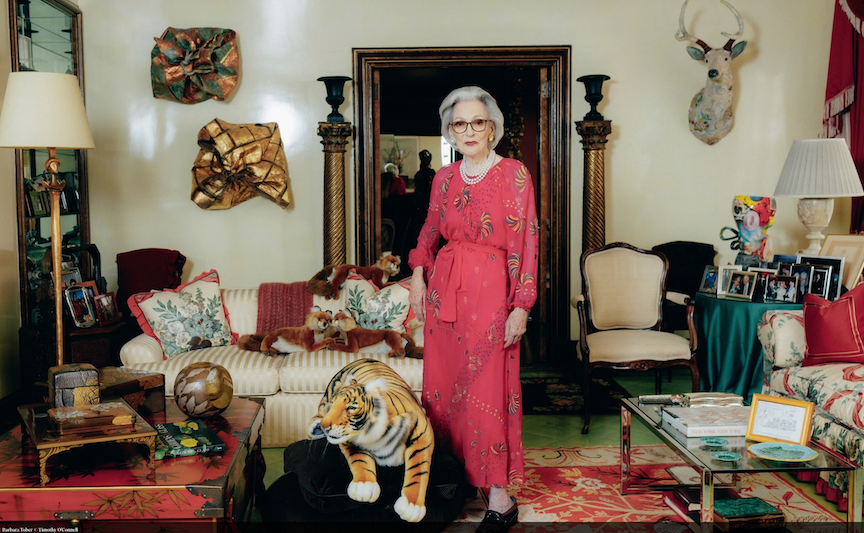
Barbara Tober
BARBARA TOBER
“In the ’70s and ’80s it was all about a pretty party, but we’ve passed that period and now it’s more about the seriousness of a subject – with a little fun thrown in,” says Barbara Tober. The 89-year-old is the founder of Acronym, a venture-capital fund focused on diverse arts-related causes including the Metropolitan Opera and the New York Philharmonic at Lincoln Center, the Museum of Arts + Design and more recently the clean-energy Arco del Tiempo installation that’s being constructed in Houston, Texas. Tober was born in 1934 in Summit, New Jersey, and spent her early years on a “beautiful farm with exquisite moths, no pesticides, in [her] hip boots out in the swamps”. Later, having spent 30 years as an editor at Condé Nast, Tober and her late husband Donald (the former CEO of Sugar Foods and the force behind Sweet’n Low) started to focus their efforts and resources on the things that brought them joy – namely music, art and the ballet. “We always felt that there were people to help,” says Tober from her home-turned-arts museum, where Dale Chihuly glass sculptures sit comfortably with Biedermeier chairs, a red lacquered Chinese chest and family photographs by Harry Benson – “all a tribute to craftsmanship”.
“We were supportive in a small way at first,” says Tober of her early efforts joining “ladies’ groups”, boards and organising fundraisers for various causes. As the years have progressed, she has become further involved with educational initiatives – at the Culinary Institute of America, The Frick Collection and through the American Austrian Foundation, which “is completely committed to sharing the latest ideas in medicine with doctors all over the world”. In October, Tober’s commitment to charity was honoured at New York’s ACE Foundation.
Tober’s recent gift of naming seven of the iconic Lobmeyr chandeliers at the Opera – the beloved galactic lights were installed 50 years ago and are integral to the soaring performance space – was perfectly on brand. “Barbara always lights up a room, and through her philanthropy she has lit up New York,” says Henry Timms, president and CEO of Lincoln Center. “For decades she has championed the arts – not just at Lincoln Center – and the chandeliers are a fitting gift for such a luminous person.”
DEEDA BLAIR
Catherine “Deeda” Blair was born in Chicago in 1931 and made her debut into society at 18. Following a brief first marriage, she wedded William McCormick Blair Jr, the former US ambassador to Denmark, in 1961. The couple settled in Washington, DC, where they were at the centre of the social scene. Blair, a Warhol muse and one of Truman Capote’s swans, hosted fundraisers as successful as they were stylish. Among her circle were Hubert de Givenchy, Cecil Beaton and Helmut Newton. Today Blair, who relocated to New York in 2005, is best known as a philanthropist of science and medicine. She was involved for decades with the National Institutes of Health (NIH) in Washington, DC, also working with the Breast Cancer Taskforce at the National Cancer Institute of the NIH, the Harvard School of Public Health Aids Initiative and consulting for Swiss pharmaceutical company Sandoz. Following the suicide of her only son in 2004, Blair leveraged her background to advance the study of the brain. “Mental health is severely underfunded in this country,” she says, “and suicide is the second leading cause of death in young people aged 15-34.” Faced with this glaring statistic, she has used grace, brilliance – and her chequebook – to create meaningful change in the field.
The Deeda Blair Research Initiative for Disorders of the Brain – a tribute to her late son – was established in 2021 to drive innovation in mental-health research. “I chose to put resources into the Foundation for the National Institutes of Health [FNIH] because I didn’t want the office or staff,” says Blair. “Instead, we have an outstanding cross-disciplinary selection committee including writer and professor of psychology at Columbia University, Andrew Solomon (Far from the Tree); Thomas Insel, former director of the National Institute of Mental Health; and Samantha Boardman Rosen of Weill Cornell Medical College. Together we choose cutting-edge MDs and PhDs who receive awards for research focused on the next generation. We fund unproven ideas so they can take risks. I just ask to see their failed experiments, too, so that further time isn’t wasted.”
“[Deeda] has the diplomat’s social gift for bringing together the people who need to meet and introducing them in such a way that they end up collaborating on crucial projects; but she also has the scientist’s ability to understand those projects,” says Solomon. “Her trademark mix of grace and insight is one I have never encountered elsewhere.”
“A friend and mentor of mine, Mary Lasker, used to ask, ‘What is missing and what is needed?’ This is the basis for my philanthropy. Fundraising is a must for this work, as are passion and commitment,” says Blair. While her initiative is largely privately funded, Blair has supporters and special projects such as Deeda Blair: Food, Flowers & Fantasy (Rizzoli), with proceeds going to support her cause. The dazzling parties that were once the norm have been replaced with more intimate affairs, including gatherings at Christie’s and Verdura to launch her book. “In this field I haven’t made a transformative impact, but I haven’t given up,” she says of her quest, one that has bestowed seven grants, with three more recipients on the horizon.
Others disagree. “Deeda Blair is truly the ‘grande dame’ of biomedical innovation, especially in the realm of neurosciences and mental health,” says Julie Gerberding, CEO of the FNIH. “Her activism as a member of the FNIH board for almost three decades has energised the private-public partnerships with NIH that will modernise the diagnosis and treatment of serious mental-health disorders.” Andrew Solomon adds: “Deeda’s default position is to save lives. She has a genius for spotting the areas in science that are about to explode and getting them to the point where others with greater resources will take an interest. The brain remains a faraway planet in many ways, but we understand more of it than we would without her.” To donate to the Deeda Blair Research Initiative for Disorders of the Brain, visit fnih.org/deeda-blair-initiative-donation-page
SUSAN FALES-HILL
The lady of the dance
Italian-born Susan Fales-Hill is an author, television writer and producer (she is currently a consulting writer/producer of Max’s And Just Like That...). She’s also an International Best Dressed List Hall of Famer and an ardent advocate for the arts and education. Fales-Hill’s passions are many, including St Paul’s School in New Hampshire,
Harvard College and the American Ballet Theatre (ABT), in particular its diversity effort ABT Rise. “There’s nothing like the communal, ephemeral experience of dance,” says Fales-Hill. “I grew up going to the ballet, so it’s in my heart and blood.” Understanding that “ballet has traditionally not been by or for people of colour”, she has been on a “crusade for the inclusion of marginalised people – dancers, teachers and choreographers – so that the ballet is accessible to a wider audience”. Every year she brings 10-20 African-American women to the ballet – this year to Christopher Wheeldon’s Like Water for Chocolate. “It’s important for the dancers to see diversity, too,” she says.
As co-chair of ABT’s trustees emeriti, Fales-Hill is involved with decision-making around fundraising and expenditures, and has previously worked on the glamorous Spring and Fall Galas. Events like these raise approximately seven per cent of ABT’s annual budget, and are among the organisation’s most important – not to mention some of the city’s most festive.
Her efforts are paying off. “Susan is a master networker, organiser and connector – this is her superpower,” says Darren Walker, president of the Ford Foundation. “She uses her boundless energy to benefit the cultural landscape of New York City, particularly at American Ballet Theatre, where she’s had a material impact on the diversity of the organisation. She mentors dancers and is a compelling proselytiser for the cause.”
Together with other New Yorkers – socialites Muffie Potter Aston and Blaine Trump, and film producer Sarah Arison among them – Fales-Hill is committed to adding “kids of colour to the school, as well as dancers of colour to the corps and as principals”, she says.
“IT’S IMPORTANT FOR THE DANCERS TO SEE DIVERSITY, TOO”
MARIFÉ HERNÁNDEZ
The grande dame of music
Long a staple of the New York charity circuit, Marifé Hernández has worked for the arts, voter rights, New York Presbyterian Hospital and countless other civic organisations for more than 40 years.
A Puerto Rican-born only child, she was raised in Argentina and France, with summers spent in Salzburg and Vienna, where she was steeped in classical music. Hernández has always been impressed by “the exceptional level of doing in the United States”, a trait she attributes to the fact that everyone is a transplant in one way or another. “In other countries – South America, Asia – families care for families, but here we take care of one another. It’s just ingrained in the American psyche,” she says. This is especially heightened in New York, which serves as a hub for finance, immigration,entrepreneurship, the United Nations and more.
After years as a television producer and on-air personality for WPIX in New York, as well as in marketing and, later, politics (she was the chief of protocol at the State Department during the Carter administration, where she entertained Margaret Thatcher and Pierre Trudeau), Hernández has devoted her life to giving back to the city she loves. A particular passion project is the Vienna Philharmonic. The orchestra performs at Carnegie Hall every year and has an academy for young musicians in Austria that she has helped to support financially, as well as through gilded parties andconcerts on both sides of the Atlantic. “She is the face of the Vienna Philharmonic Society in America,” explains Daniel Froschauer, the orchestra’s chairman and first violinist. “It’s more than just money – it’s a personal relationship with the orchestra, our musicians and our academists. She’s widening our audience, bringing groups and significant individuals to hear our concerts both in New York and in Europe. She’s explained to us the stratagem for enlarging our presence abroad including hosting press lunches for us at Carnegie Hall. Her commitment to the Vienna Philharmonic is rivalled only by her enthusiasm for music and arts. Marifé is ensuring a future for the unique sound of the Vienna Philharmonic.”
“I believe in the importance of art for children,” says Hernández. When music education was cut in the 1970s, she started to fill the void through work with the Opera Lafayette and the National Symphony Orchestra, among other institutions. “I learned early on – at Wellesley College – about the power of committees and women’s ability to raise money,” she says. She applies her well- honed skills to a fundraiser she hosts annually at a private club on Manhattan’s Upper East Side that benefits the Vienna Philharmonic Society. “We can only fit 150 people, but that makes it a smaller, more intimate party,” she says of the black-tie affair. “It’s not lavish, but personal. When it comes to lavish: been there, done that.”
ELIZABETH KURPIS
As the founder of her eponymous fashion-focused legal practice – Kurpis Legal – Elizabeth Kurpis is accustomed to balancing clients including Loeffler Randall, Tenoverten nails and influencer Stephanie Hill (aka The Style Bungalow). But it’s her work on behalf of The Frick Collection and Memorial Sloan Kettering Cancer Center (MSK) that is closest to her heart. “I’ve been involved with the Young Fellows Ball at The Frick over the years – curating guest lists, working with fashion and spirits sponsors – and it’s one of the few black-tie galas left,” says the 41-year-old lawyer and mother of two from her home in Saddle River, New Jersey. “I miss being in gowns; everything has got more and more casual,” adds Kurpis, who is dressed in a vintage Gucci skirt, cashmere turtleneck and over-the-knee Manolo Blahnik boots. In addition to the Young Fellows Ball being a glittery affair, the annual party provides “essential support for the Frick’s Art Reference Library and education department, which serves students from New York City public schools as well as digital audiences around the world”, explains Rowan Moody, head of individual giving at The Frick Collection. The museum raised more than $30mn during its 2022 fiscal year alone, and recently announced it has received $235mn in private donations for its renovation.
Other causes are more personal. “My mother was treated for leukaemia [at MSK] and received best-in-class care,” she says of her work on behalf of the hospital. “They handled everything so graciously.” She joined the Associates Committee shortly after her mother’s death and has remained involved with everything from the Winter Luncheon held at the iconic Rainbow Room at the top of Rockefeller Center to the Fall Party at The Plaza (“that one is cocktail attire”, she says). In between these, she works on Halloween parties and paediatric proms, physician talks and the annual family-friendly favourite, the Bunny Hop, a children’s day party that benefits cancer research and patient care programs at MSK Kids.
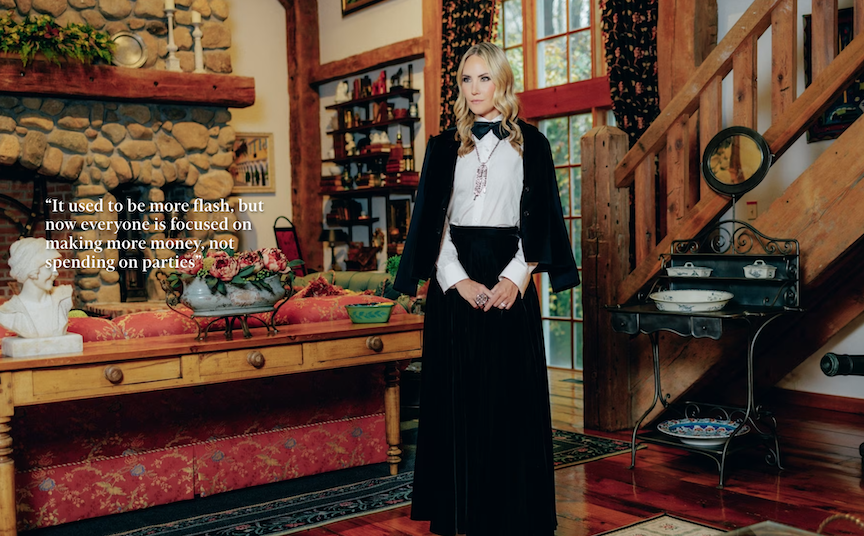
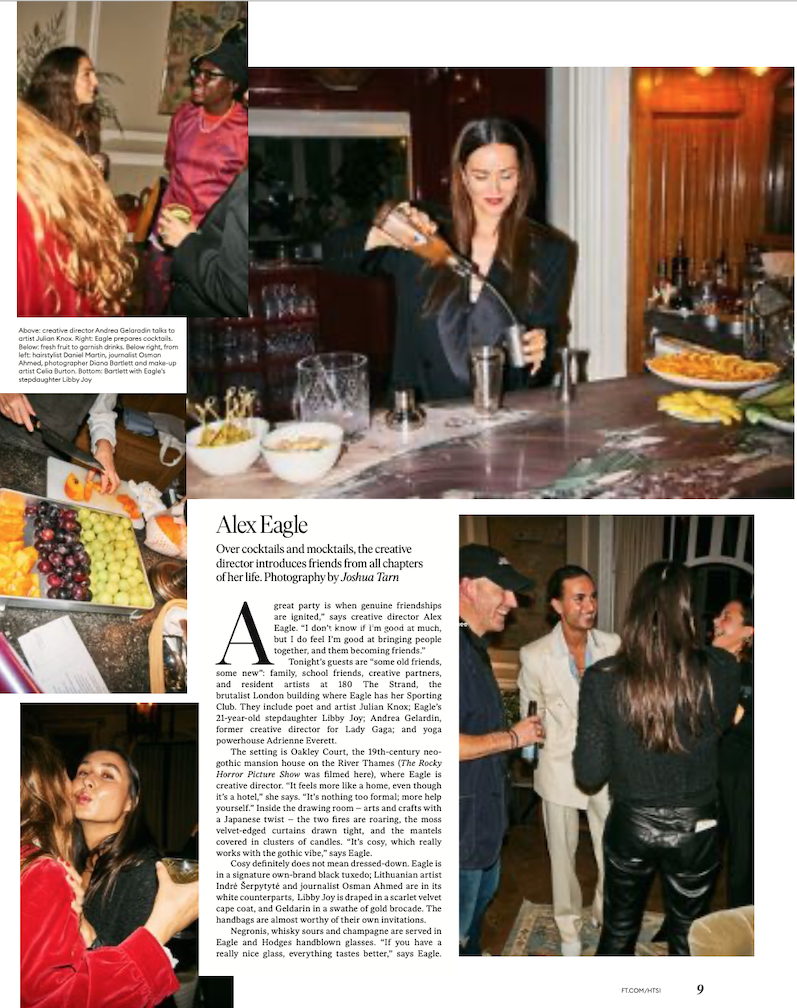
Alex Eagle: ‘It’s cosy, which really works with the gothic vibe’
“A great party is when genuine friendships are ignited,” says creative director Alex Eagle. “I don’t know if I’m good at much, but I do feel I’m good at bringing people together, and them becoming friends.”
The creative director opens the stately Oakley Court to a wide circle of friends
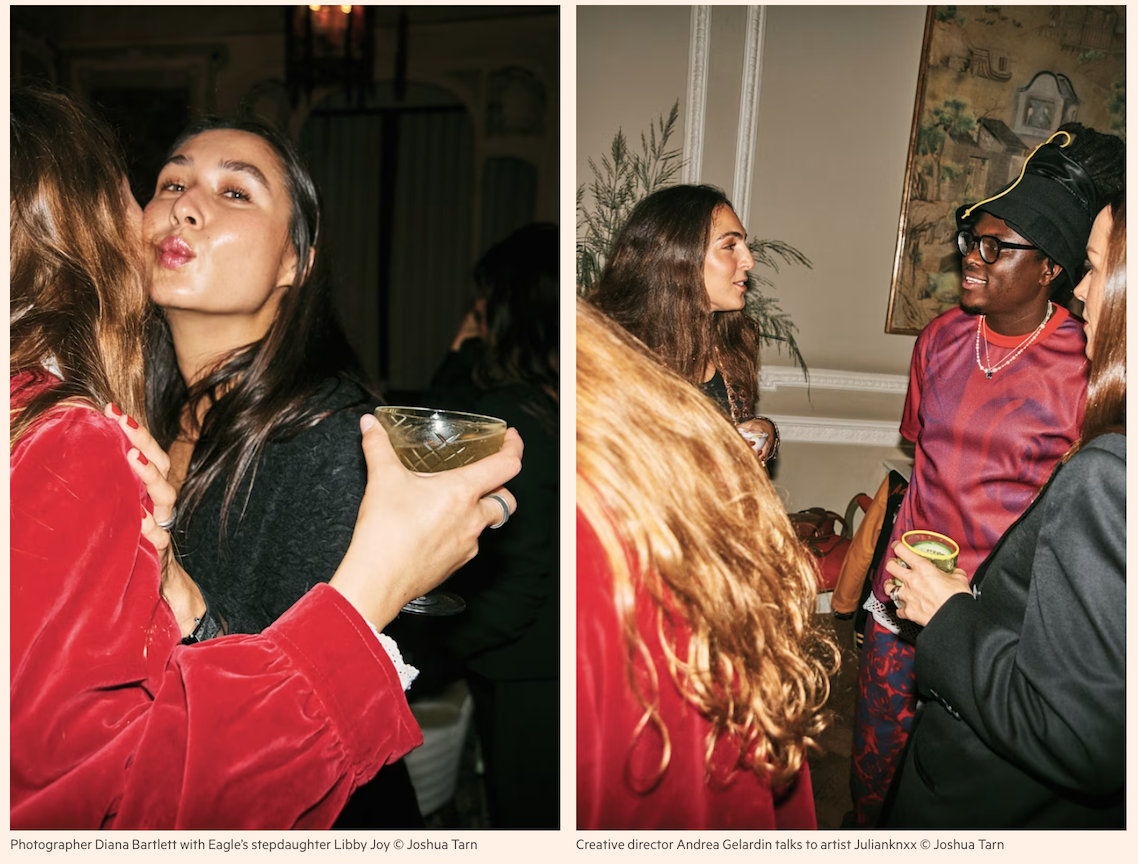
“A great party is when genuine friendships are ignited,” says creative director Alex Eagle. “I don’t know if I’m good at much, but I do feel I’m good at bringing people together, and them becoming friends.”
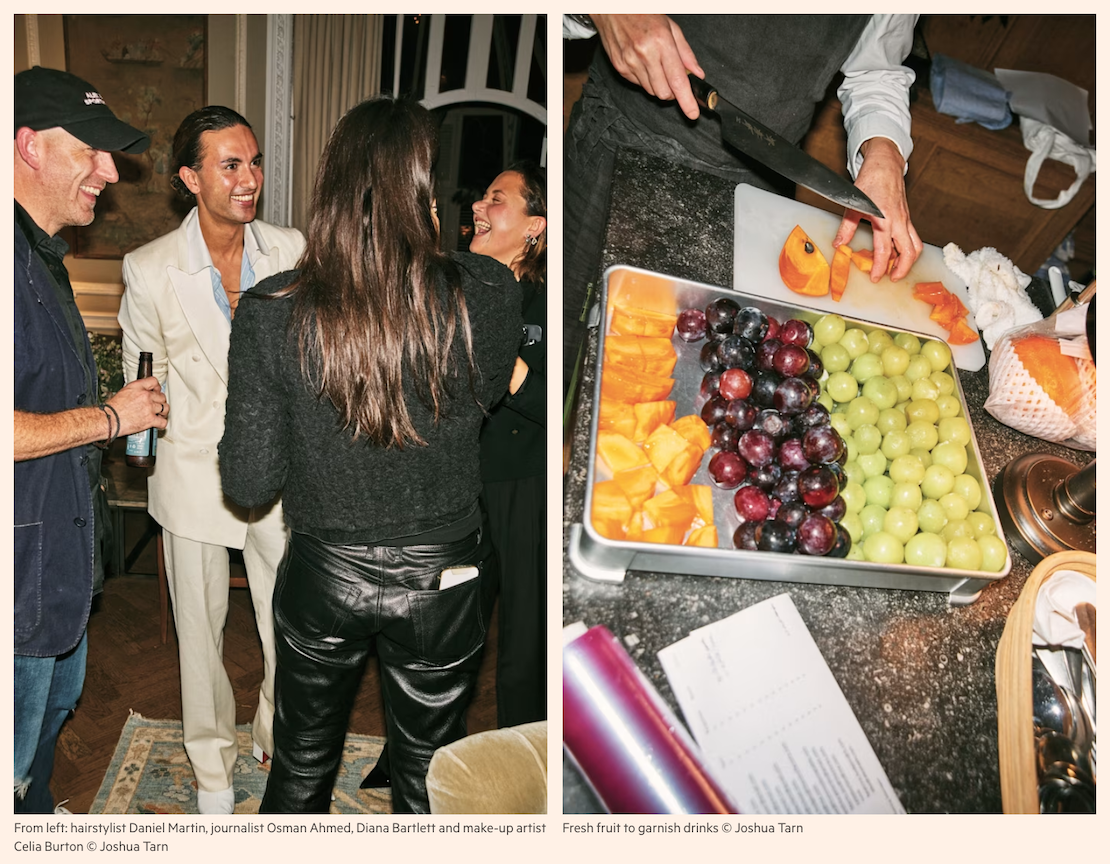
Tonight’s guests are “some old friends, some new”: family, school friends, creative partners, and resident artists at 180 The Strand, the brutalist London building where Eagle has her Sporting Club. They include poet and artist Julianknxx; Eagle’s 21-year‑old stepdaughter Libby Joy; Andrea Gelardin, former creative director for Lady Gaga; and yoga powerhouse Adrienne Everett.
The setting is Oakley Court, the 19th-century neo-gothic mansion house on the River Thames (The Rocky Horror Picture Show was filmed here), where Eagle is creative director. “It feels more like a home, even though it’s a hotel,” she says. “It’s nothing too formal; more help yourself.” Inside the drawing room – arts and crafts with a Japanese twist – the two fires are roaring, the moss velvet-edged curtains drawn tight, and the mantels covered in clusters of candles. “It’s cosy, which really works with the gothic vibe,” says Eagle.
Cosy definitely does not mean dressed-down. Eagle is in a signature own-brand black tuxedo; Lithuanian artist Indrė Šerpytytė and journalist Osman Ahmed are in its white counterparts, Libby Joy is draped in a scarlet velvet cape coat and Geldarin is in a swathe of gold brocade. The handbags are almost worthy of their own invitations.
Negronis, whisky sours and champagne are served in Eagle and Hodges handblown glasses. “If you have a really nice glass, everything tastes better,” says Eagle. And “nothing too matchy-matchy,” she scoffs. “And lots of different kinds of glasses – I don’t necessarily use a wine glass for wine or a Martini glass for a Martini.” Eagle herself is sipping a (non-alcoholic) Tanqueray Zero and tonic with a sprig of rosemary from the kitchen garden. “Enough bloody elderflower and fizzy water! Now lots of people don’t drink, it’s important to have really good mocktails.” Non-alcoholic Palomas, with fresh grapefruit and soda, are also a “delicious” substitute.
Canapés decorate low tables around the room; small in number but substantial in size. “I’d rather have a plate of less, but where each one is generous. That feels really sumptuous and luxurious,” says Eagle. Tonight’s snacks are jewel-like Japanese bites from Oakley Court’s chef Akira: slivers of salmon and tuna tied with edible ribbons. Each could be one course from the omakase menu he leads in the dining room.
In the corner is a stack of records. “We never have music piped out of the speaker,” says Eagle, “My husband owns the old EMI vinyl pressing plant; he’s mad about vinyl, it’s always records playing. Vinyl makes a big difference; people always interact, choosing records.” It’s one more way for new friendships to begin.
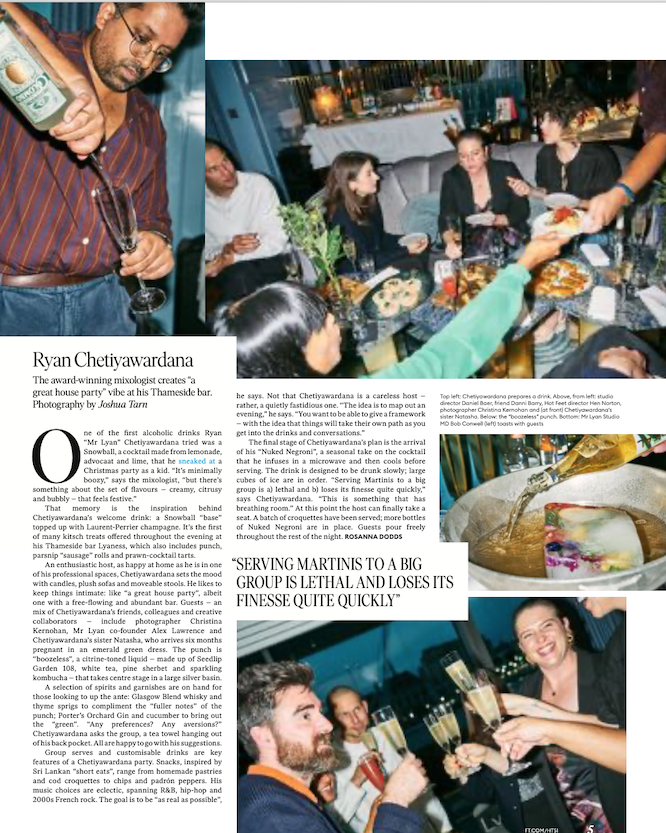
Ryan Chetiyawardana creates a ‘house party’ mood at his Thameside bar
One of the first alcoholic drinks Ryan “Mr Lyan” Chetiyawardana tried was a Snowball, a cocktail made from lemonade, advocaat and lime, that he sneaked at a Christmas party as a kid. “It’s minimally boozy,” says the mixologist, “but there’s something about the set of flavours – creamy, citrusy and bubbly – that feels festive.”
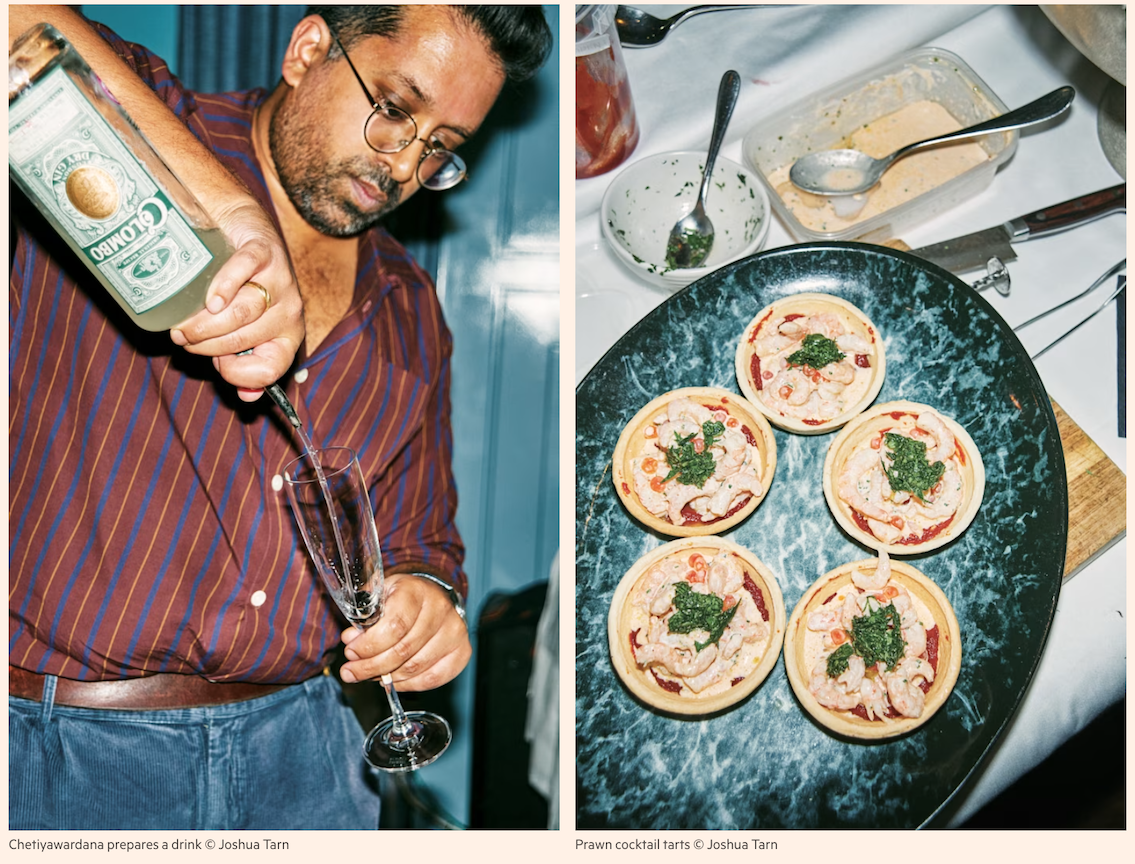
‘Serving Martinis to a big group loses its finesse quite quickly’
One of the first alcoholic drinks Ryan “Mr Lyan” Chetiyawardana tried was a Snowball, a cocktail made from lemonade, advocaat and lime, that he sneaked at a Christmas party as a kid. “It’s minimally boozy,” says the mixologist, “but there’s something about the set of flavours – creamy, citrusy and bubbly – that feels festive.”
That memory is the inspiration behind Chetiyawardana’s welcome drink: a Snowball “base” topped up with Laurent-Perrier champagne. It’s the first of many kitsch treats offered throughout the evening at his Thameside bar Lyaness, which also includes punch, parsnip “sausage” rolls and prawn-cocktail tarts.
An enthusiastic host, as happy at home as he is in one of his professional spaces, Chetiyawardana sets the mood with candles, plush sofas and moveable stools. He likes to keep things intimate: like “a great house party”, albeit one with a free-flowing and abundant bar. Guests – a mix of Chetiyawardana’s friends, colleagues and creative collaborators – include photographer Christina Kernohan, Mr Lyan co-founder Alex Lawrence and Chetiyawardana’s sister Natasha, who arrives six months pregnant in an emerald green dress. The punch is “boozeless”, a citrine-toned liquid – made up of Seedlip Garden 108, white tea, pine sherbet and sparkling kombucha – that takes centre stage in a large silver basin.
A selection of spirits and garnishes are on hand for those looking to up the ante: Glasgow Blend whisky and thyme sprigs to compliment the “fuller notes” of the punch; Porter’s Orchard Gin and cucumber to bring out the “green”. “Any preferences? Any aversions?” Chetiyawardana asks the group, a tea towel hanging out of his back pocket. All are happy to go with his suggestions.
Group serves and customisable drinks are key features of a Chetiyawardana party. Snacks, inspired by Sri Lankan “short eats”, range from homemade pastries and cod croquettes to chips and padrón peppers. His music choices are eclectic, spanning R&B, hip-hop and 2000s French rock. The goal is to be “as real as possible”, he says. Not that Chetiyawardana is a careless host – rather, a quietly fastidious one. “The idea is to map out an evening,” he says. “You want to be able to give a framework – with the idea that things will take their own path as you get into the drinks and conversations.”
The final stage of Chetiyawardana’s plan is the arrival of his “Nuked Negroni”, a seasonal take on the cocktail that he infuses in a microwave and then cools before serving. The drink is designed to be drunk slowly; large cubes of ice are in order. “Serving Martinis to a big group is a) lethal and b) loses its finesse quite quickly,” says Chetiyawardana. “This is something that has breathing room.” At this point the host can finally take a seat. A batch of croquettes have been served; more bottles of Nuked Negroni are in place. Guests pour freely throughout the rest of the night.
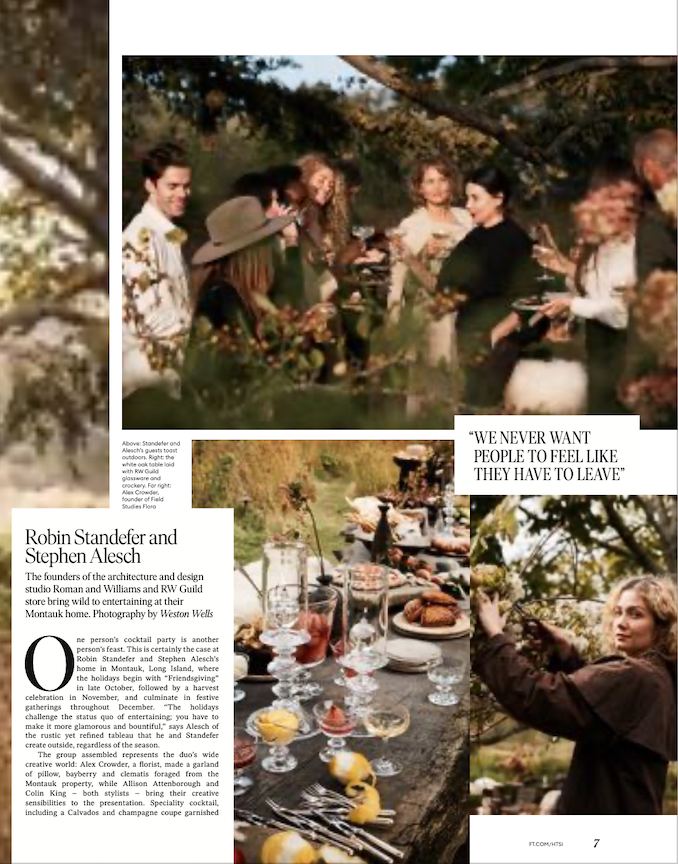
Robin Standefer and Stephen Alesch ‘We never want people to feel like they have to leave’
One person’s cocktail party is another person’s feast. This is certainly the case at Robin Standefer and Stephen Alesch’s home in Montauk, Long Island, where the holidays begin with “Friendsgiving” in late October, followed by a harvest celebration in November, and culminate in festive gatherings throughout December. “The holidays challenge the status quo of entertaining; you have to make it more glamorous and bountiful,” says Alesch of the rustic yet refined tableau that he and Standefer create outside, regardless of the season.
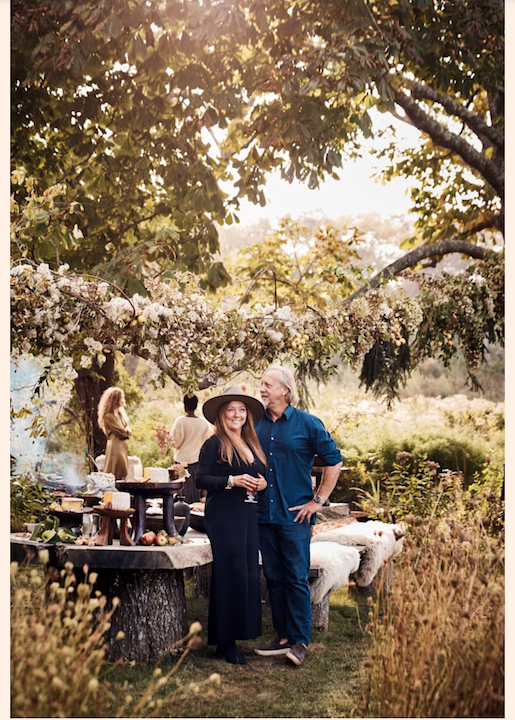
The founders of Roman and Williams and RW Guild take the festivities outside at their Montauk home
One person’s cocktail party is another person’s feast. This is certainly the case at Robin Standefer and Stephen Alesch’s home in Montauk, Long Island, where the holidays begin with “Friendsgiving” in late October, followed by a harvest celebration in November, and culminate in festive gatherings throughout December. “The holidays challenge the status quo of entertaining; you have to make it more glamorous and bountiful,” says Alesch of the rustic yet refined tableau that he and Standefer create outside, regardless of the season.
The group assembled represents the duo’s wide creative world: Alex Crowder, a florist, made a garland of pillow, bayberry and clematis foraged from the Montauk property, while Alison Attenborough and Colin King – both stylists – bring their creative sensibilities to the presentation. Speciality cocktails, including a Calvados and champagne coupe garnished with lemon verbena, and hibiscus rosehip spritzes with rosemary, pomegranate and cranberry-infused ice cubes, get the party started in unexpected ways.
A spectacular slab of white oak, designed by Standefer and Alesch, serves as a centrepiece – one that’s “an artistic installation piled high with apples, hydrangeas and sedge – all from our land”, says Standefer of the “green room” she oversees. Offerings include sharp cheeses from Vermont, a honeycomb from a local beekeeper, figs stuffed with mascarpone and drizzled with honey, bountiful shellfish towers served on an RW Guild platter designed by Heami Lee, and pistachio-garnished rose-vanilla poached pears.
An open fire pit is not only atmospheric – with the scent of juniper logs permeating the air – but is also functional for Alesch, who is a fan of open-flame cooking. “We want any party to be immersive,” says Standefer. “And we never want people to feel like they have to leave, so even if it’s billed as a cocktail party we’ll have the makings of a four-course dinner, right down to the tarte tatin flambée that Stephen cooks on a tile,” she says.
Nothing goes to waste at the end of the evening. “We divvy up everything that’s left over – especially the cheeses, which we wrap in parcel paper – and send our friends on their way,” says Standefer. “We’re sustainable from the food to the setting and that’s important to us. For example, the magnificent garland… I’ll keep that until the squirrels devour it!”
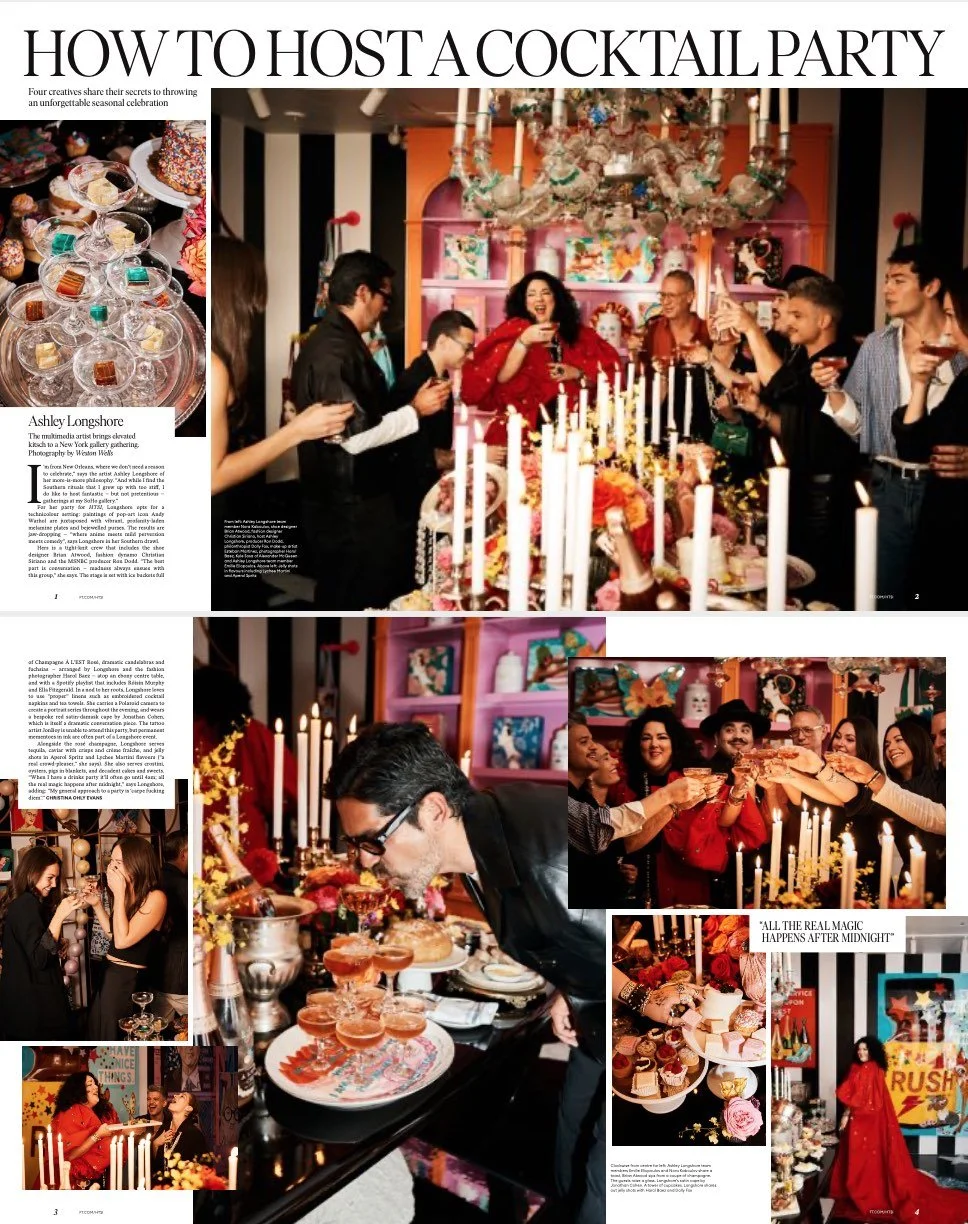
Ashley Longshore ‘All the real magic happens after midnight’
“I’m from New Orleans, where we don’t need a reason to celebrate,” says the artist Ashley Longshore of her more-is-more philosophy. “And while I find the Southern rituals that I grew up with too stiff, I do like to host fantastic – but not pretentious – gatherings at my SoHo gallery.”
The multimedia artist brings elevated kitsch to a New York gallery gathering
“I’m from New Orleans, where we don’t need a reason to celebrate,” says the artist Ashley Longshore of her more-is-more philosophy. “And while I find the Southern rituals that I grew up with too stiff, I do like to host fantastic – but not pretentious – gatherings at my SoHo gallery.”
For her party for HTSI, Longshore opts for a technicolour setting: paintings of pop-art icon Andy Warhol are juxtaposed with vibrant, profanity-laden melamine plates and bejewelled purses. The results are jaw-dropping – “where anime meets mild perversion meets comedy”, says Longshore in her Southern drawl.
Hers is a tight-knit crew that includes the shoe designer Brian Atwood, fashion dynamo Christian Siriano and the MSNBC producer Ron Dodd. “The best part is conversation – madness always ensues with this group,” she says. The stage is set with ice buckets full of Champagne À L’EST Rosé, dramatic candelabras and fuchsias – arranged by Longshore and the fashion photographer Harol Baez – atop an ebony centre table, and with a Spotify playlist that includes Róisín Murphy and Ella Fitzgerald.
In a nod to her roots, Longshore loves to use “proper” linens such as embroidered cocktail napkins and tea towels. She carries a Polaroid camera to create a portrait series throughout the evening, and wears a bespoke red satin-damask cape by Jonathan Cohen, which is itself a dramatic conversation piece. The tattoo artist JonBoy is unable to attend this party, but permanent mementoes in ink are often part of a Longshore event.
Alongside the rosé champagne, Longshore serves tequila, caviar with crisps and crème fraîche, and jelly shots in Aperol Spritz and Lychee Martini flavours (“a real crowd-pleaser,” she says). She also serves crostini, oysters, pigs in blankets, and decadent cakes and sweets. “When I have a drinks party it’ll often go until 4am; all the real magic happens after midnight,” says Longshore, adding: “My general approach to a party is ‘carpe fucking diem’.”
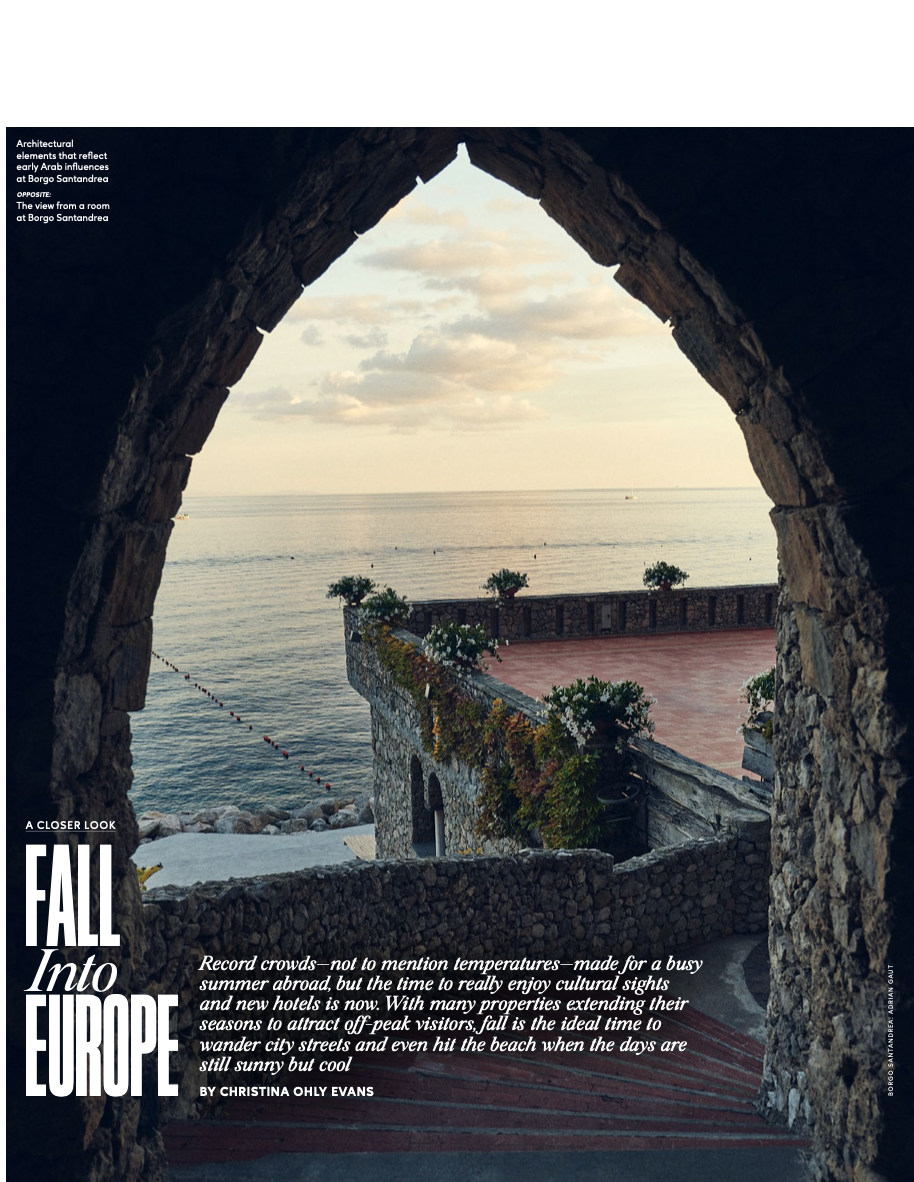
FALL into EUROPE
Record crowds—not to mention temperatures—made for a busy summer abroad, but the time to really enjoy cultural sights and new hotels is now. With many properties extending their seasons to attract off-peak visitors, fall is the ideal time to wander city streets and even hit the beach when the days are still sunny but cool.
Record crowds—not to mention temperatures—made for a busy summer abroad, but the time to really enjoy cultural sights and new hotels is now. With many properties extending their seasons to attract off-peak visitors, fall is the ideal time to wander city streets and even hit the beach when the days are still sunny but cool
BY CHRISTINA OHLY EVANS
Coastal Getaways
A 1960s design aesthetic meets pure Mediterranean chic at Borgo Santandrea, a cliffside perch overlooking the centuries-old fish- ing village of Conca dei Marini in the heart of the Amalfi Coast. From its breathtaking 30 rooms and 16 suites—each with an expansive sea view—guests are immersed in la dolce vita with scents of rosemary and jasmine wafting through the air. Furnishings are a mix of traditional and modern, with noted Italian makers such as Molteni&C in the mix. The just-opened Marinella Beach Club, with its own pebble beach and jetty, is the place to be by day or evening for an aperitivo before popping next door for coastal-inspired cuisine at the ever-stylish restaurant. borgosantandrea.it
Anantara Convento di Amalfi, a 13th-cen- tury Capuchin convent that’s built into the cliffside, is the latest jaw-dropping prop- erty from Anantara Hotels. Travel verti- cally from the outskirts of Amalfi to this truly unique perch—one with the coast’s most spectacular views—and check into one of the 52 minimalist rooms and suites where monks once slept. With its original cloister and chapel beautifully preserved and a passeggiata dei monaci—monk’s walk—bursting with bougainvillea, a stay here offers equal parts history lesson and pure pampering by way of service, an indoor-outdoor spa and attentive staff. The infinity pool with the sea below is a stun- ner, as are the pizzas made in an oven that was dropped in by helicopter to this moun- tainous idyll. anantara.com
Great in Greece
Founded in 1996, the Belvedere is a family-owned luxury boutique hotel in Mykonos offering sweeping views of Chora and the Aegean Sea. This elegant Mediterranean property offers a wide array of rooms, suites and private villas enriched with hilltop and waterfront views. The relaxing Pool Club, peaceful Six Senses Spa and bustling Belvedere Bar are just a few of the onsite offerings.
Recently, the Belvedere debuted 26 residential-style hilltop rooms and suites up the hill from the main complex that are easily accessible via shuttle service. These rooms blend an elegant Greek aesthetic with modern amenities, employing raw materials such as plaster, marble and wood.
The hotel’s Matsuhisa restaurant just celebrated its 20th anni- versary with the opening of an alfresco omakase bar. “Not only was it the first Matsuhisa in Europe, but also the first open-air Nobu Matsuhisa in the world,” says chef Nobu Matsuhisa. “I arrived in 2003 and quickly fell in love with the energetic atmo- sphere of the island. I love going to the beach, swimming daily, exploring the small villages and indulging in Greek food and culture.” belvederehotel.com
Nordic Nice
Oslo is having a cultural moment, and Sommerro is the place to stay—or try its newly opened sister property, Villa Inkognito, just next door. In the heart of the city’s West End, Sommerro has quickly become a hub with its seven bars and restaurants—includ- ing the rooftop Nordic-Japanese favorite TAK Oslo—drawing visi- tors and locals alike. Set in a historic building from the 1930s, each of the 231 rooms and luxury suites features sleek Norse accents, and the entire property is fueled by renewable energy and uses electric transport. Villa Inkognito is equally magical, but much more intimate in scale and approach. Housed in a former residence that was built in the 1870s, the reimagined villa boasts 11 suites, a private gym and dining spaces, as well as an intimate bar for use by house guests. Rooms feature an eclectic mix of antiques, original artwork and classic Scandinavian furnishings—all with art nou- veau and Japonisme touches. In addition to the feel of staying in a royal residence, Villa Inkognito guests also have full use of Sommerro’s endless amenities, including Vestkantbadet—the hotel’s 15,000-square-foot, state-of-the-art wellness center. sommerrohouse.com
Loire Living
Until recently, in order to play at the Les Bordes Golf Club in the Loire
Valley, France, a 1,400-acre estate amid a UNESCO World Heritage site,
Golf Club members and guests could only stay in one of 36 lakeside member cabins. Much of the appeal of this legendary location is its two world-renowned golf courses designed by Robert Von Hagge and Gil Hanse—and its proximity to Paris (about a 90-minute drive) and bucolic French villages like Tours, Blois and Orléans, not to mention the stunning Chateau de Chambord. Now, you can live there, too. The first and second phases of the Cour du Baron residences have launched, encompassing a total of 42 private homes ranging in size from 1,800-6,000 square feet. All but a few are already spoken for, and all should be ready for residents to move in early next year. It’s a European adventure to be sure, a bit like a Loire Valley version of Silo Ridge, the private gated community in Amenia, New York, but here, you can also practice your parlez-vous français. For guests not quite ready to make a commitment who want to dip their putters into Loire Valley life first, Les Bordes Estate also has a Six Senses Hotel and Residences opening in 2026. lesbordesestate.com
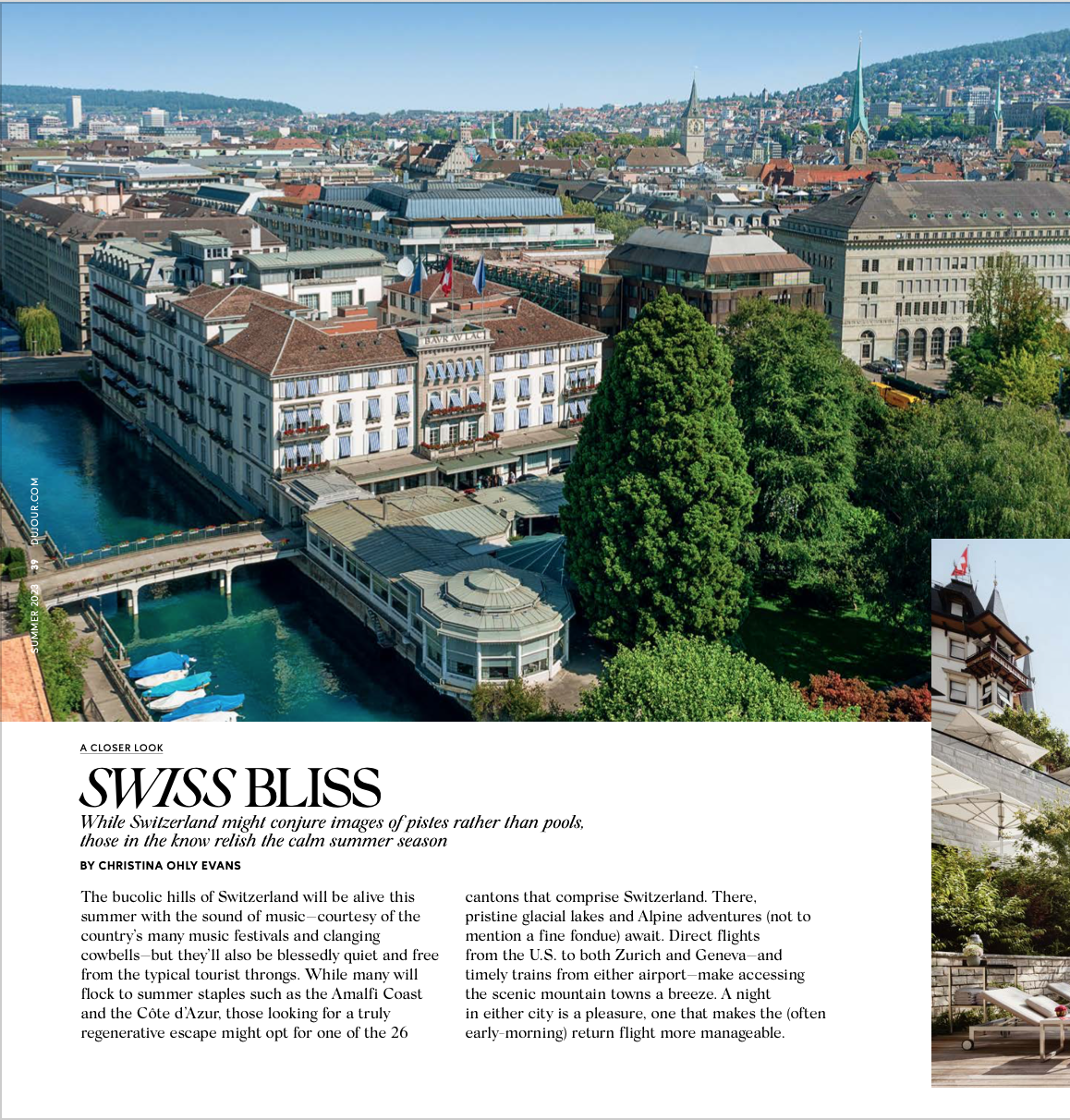
SWISS BLISS
While Switzerland might conjure images of piste rather than pools those in the know relish the calm summer season.
The bucolic hills of Switzerland will be alive this summer with the sound of music—courtesy of the country’s many music festivals and clanging cowbells—but they’ll also be blessedly quiet and free from the typical tourist throngs. While many will flock to summer staples such as the Amalfi Coast and the Côte d’Azur, those looking for a truly regenerative escape might opt for one of the 26 cantons that comprise Switzerland. There, pristine glacial lakes and Alpine adventures (not to mention a fine fondue) await. Direct flights from the U.S. to both Zurich and Geneva—and timely trains from either airport—make accessing the scenic mountain towns a breeze. A night in either city is a pleasure, one that makes the (often early-morning) return flight more manageable.
While Switzerland might conjure images of pistes rather than pools those in the know relish the calm summer season
BY CHRISTINA OHLY EVANS
The bucolic hills of Switzerland will be alive this summer with the sound of music—courtesy of the country’s many music festivals and clanging cowbells—but they’ll also be blessedly quiet and free from the typical tourist throngs. While many will flock to summer staples such as the Amalfi Coast and the Côte d’Azur, those looking for a truly regenerative escape might opt for one of the 26 cantons that comprise Switzerland. There, pristine glacial lakes and Alpine adventures (not to mention a fine fondue) await. Direct flights from the U.S. to both Zurich and Geneva—and timely trains from either airport—make accessing the scenic mountain towns a breeze. A night in either city is a pleasure, one that makes the (often early-morning) return flight more manageable.
Zurich
Zurich is full of churches, cobblestone streets and chocolate shops—all of which contrast brilliantly with contemporary art gal- leries and the latest in technology and transportation. Book in for a night at the iconic Baur au Lac (bauraulac.ch) for old-world elegance on the shores of Lake Zurich. Enjoy a sumptuous meal at the two- Michelin-starred Pavillon or savor a traditional wiener schnitzel in the more casual Martin Brudnizki–designed brasserie Baur’s. Just at the edge of the city sits The Dolder Grand (thedoldergrand.com), a castle-like hideaway with 175 rooms and suites as well as a 43,000-square-foot Foster + Partners–designed spa. Outdoor enthusiasts will love hiking and biking the trails around the lake or Käferberg and Greifensee—all with a gourmet picnic basket full of local cheeses and charcuterie in tow. Aesthetes will want to make time for the expansive Kunsthaus Zurich, which holds treasures from the 17th century as well as Alberto Giacometti sculptures and contemporary photography by Cindy Sherman
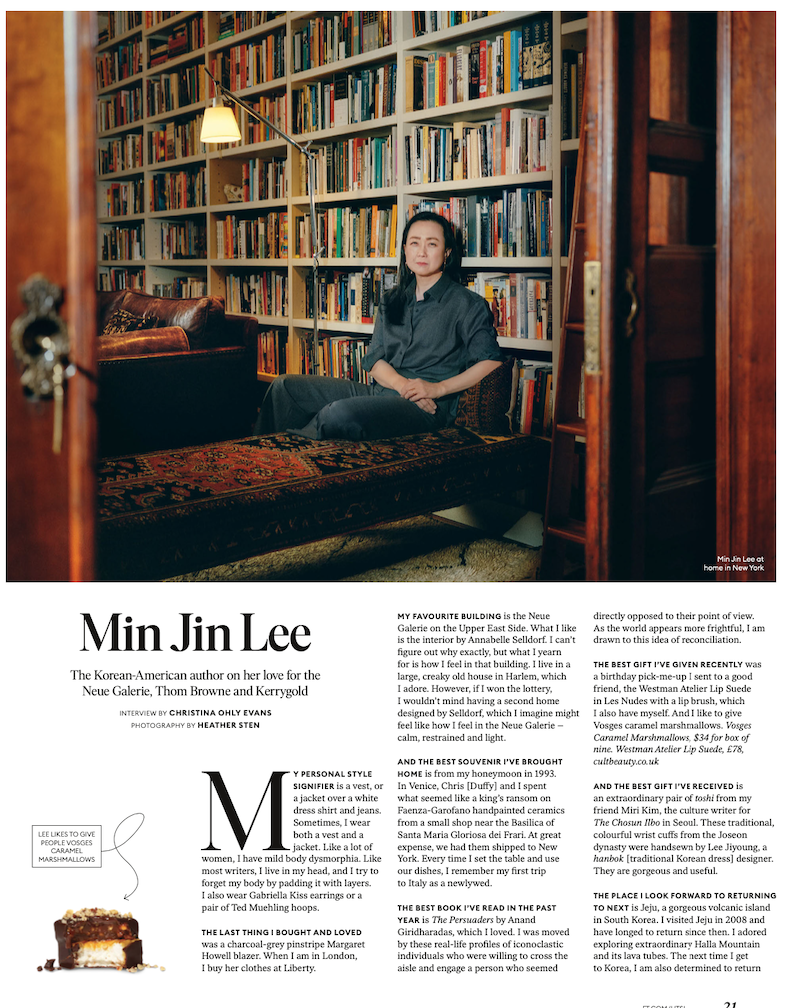
Author Min Jin Lee: ‘Dua Lipa and Beyoncé give me hope for the next generation’
The Korean-American author on her love for the Neue Galerie, Thom Browne and Kerrygold
My personal style signifier is a vest, or a jacket over a white dress shirt and jeans. Sometimes, I wear both a vest and a jacket. Like a lot of women, I have mild body dysmorphia. Like most writers, I live in my head, and I try to forget my body by padding it with layers. I also wear Gabriella Kiss earrings or a pair of Ted Muehling hoops.
The Korean-American author on her love for the Neue Galerie, Thom Browne and Kerrygold
My personal style signifier is a vest, or a jacket over a white dress shirt and jeans. Sometimes, I wear both a vest and a jacket. Like a lot of women, I have mild body dysmorphia. Like most writers, I live in my head, and I try to forget my body by padding it with layers. I also wear Gabriella Kiss earrings or a pair of Ted Muehling hoops.
The last thing I bought and loved was a charcoal-grey pinstripe Margaret Howell blazer. When I am in London, I buy her clothes at Liberty.
My favourite building is the Neue Galerie on the Upper East Side. What I like is the interior by Annabelle Selldorf. I can’t figure out why exactly, but what I yearn for is how I feel in that building. I live in a large, creaky old house in Harlem, which I adore. However, if I won the lottery, I wouldn’t mind having a second home designed by Selldorf, which I imagine might feel like how I feel in the Neue Galerie – calm, restrained and light.
And the best souvenir I’ve brought home is from my honeymoon in 1993. In Venice, Chris [Duffy] and I spent what seemed like a king’s ransom on Faenza-Garofano handpainted ceramics from a small shop near the Basilica of Santa Maria Gloriosa dei Frari. At great expense, we had them shipped to New York. Every time I set the table and use our dishes, I remember my first trip to Italy as a newlywed.
The best book I’ve read in the past year is The Persuaders by Anand Giridharadas, which I loved. I was moved by these real-life profiles of iconoclastic individuals who were willing to cross the aisle and engage a person who seemed directly opposed to their point of view. As the world appears more frightful, I am drawn to this idea of reconciliation. The best gift I’ve given recently was a birthday pick-me-up I sent to a good friend, the Westman Atelier Lip Suede in Les Nudes with a lip brush, which I also have myself. And I like to give Vosges caramel marshmallows. Vosges Caramel Marshmallows, $34 for box of nine. Westman Atelier Lip Suede, £78, cultbeauty.co.uk
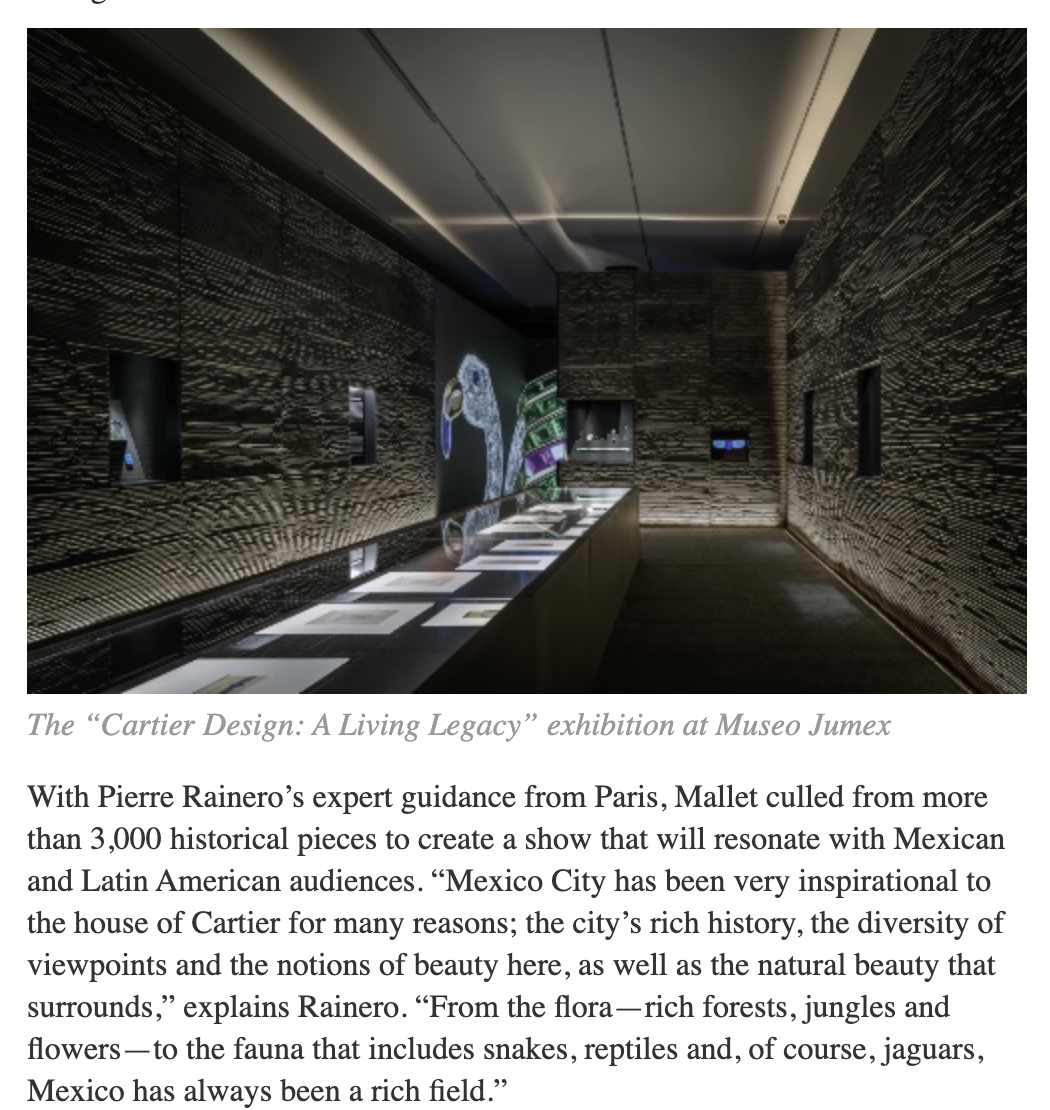
Cartier Design: A Living Legacy” Opens at Museo Jumex
This month marks the opening of “Cartier Design: A Living Legacy,” a stunning retrospective of the maison’s most iconic creations that runs from March 15 through May 14 at Mexico City’s Museo Jumex. The strikingly spare David Chipperfield-designed museum is the perfect backdrop for the collection of 160 objects that were last exhibited at the Palacio de Bellas Artes in 1999 and offer unique insights into Cartier’s strong cultural ties to Mexico as well as its timeless savoir-faire.
A new exhibition featuring jewels from the archives of the French jewelry maison opens March 15 in Mexico City
This month marks the opening of “Cartier Design: A Living Legacy,” a stunning retrospective of the maison’s most iconic creations that runs from March 15 through May 14 at Mexico City’s Museo Jumex. The strikingly spare David Chipperfield-designed museum is the perfect backdrop for the collection of 160 objects that were last exhibited at the Palacio de Bellas Artes in 1999 and offer unique insights into Cartier’s strong cultural ties to Mexico as well as its timeless savoir-faire.
Arranged across five themes—The Early Days and the Birth of a Style, Universal Curiosity, Jeanne Toussaint’s Taste, Wearing Beauty and Measuring Time and Maria Félix and Icons of Elegance—the show has been meticulously edited by local design curator, Ana Elena Mallet, with the guidance of Cartier’s Pierre Rainero. Drawing on the Maison’s extensive archives, the pieces selected for this decades-in-the-making exhibition include dazzling jewels, timepieces, accessories and decorative objects that were once worn by the likes of Mexican diva and Cartier devotee, Maria Felix, and the Brazilian aviator, Alberto Santos-Dumont, the famed namesake of the original Santos wristwatch.
“I wanted to bring attention to Cartier jewels as design,” says Mallet of her curatorial process that highlights “pieces reflective of aesthetics, technology, innovation, craftsmanship and style” across two centuries. The selection of a such contemporary setting—the Museo Jumex that opened in 2013—made perfect sense to Mallet who is supportive of bringing “different types of objects and materials into a traditional museum space to expand the field of art and to blur the boundaries between artistic disciplines and also see them in dialogue.”
With Pierre Rainero’s expert guidance from Paris, Mallet culled from more than 3,000 historical pieces to create a show that will resonate with Mexican and Latin American audiences. “Mexico City has been very inspirational to the house of Cartier for many reasons; the city’s rich history, the diversity of viewpoints and the notions of beauty here, as well as the natural beauty that surrounds,” explains Rainero. “From the flora—rich forests, jungles and flowers—to the fauna that includes snakes, reptiles and, of course, jaguars, Mexico has always been a rich field.”
Noted Mexican architect Frida Escobedo has been tapped to create the scenography for the exhibition, calling on her design experience for cultural institutions such as the Serpentine Gallery and the Victoria & Albert Museum. With the stage beautifully set, emblematic pieces designed for Maria Félix—including a 178.2 carat snake necklace from 1968 and a crocodile necklace comprised of 1,023 brilliant-cut fancy intense yellow diamonds with ruby and emerald cabochon eyes—are among the collection standouts. As with so many innovative Cartier designs, these necklaces were made to be worn separately, as brooches, or used as decorative table ornaments.
Equally impressive are the selection of ornate turn of the century tiaras, a 1920s Tutti Frutti bracelet once owned by Mrs. Cole Porter, bold platinum and diamond bangles circa 1934, and a unique scarab belt buckle with touches of gold and blue Egyptian faience. The accompanying sketches in graphite and gouache are exquisite, too, and provide a rare look at the creative process throughout the decades. “The main angle of this exhibition is the journey of Cartier style,” explains Rainero, “so beyond the pleasure of seeing these beautiful pieces, the show will illustrate the different design evolutions from the beginning of the Maison up to present day.”