
Missoni's Hands-Off Fashion Executive
CEO Emilio Carbonera Giani sees positive long-term results thanks to a laissez-faire approach.
CEO Emilio Carbonera Giani sees positive long-term results thanks to a laissez-faire approach.
You’ve spent your career in fashion—at Valentino, Salvatore Ferragamo, and the menswear brand Caruso. What has been your path?
I started in banking and then moved into textiles, which led me to the Marzotto Group, the then-owner of Valentino. From there I went on to Ferragamo, where I worked with my mentor, [former CEO] Michele Norsa. Caruso was completely different because it’s a very small company and focused exclusively on bespoke suiting. The common thread throughout my work has been that in Italy, most of the luxury fashion brands are family-owned. Working with families has major advantages: They tend to make decisions with a longer-term view, rather than being focused on short-term results or dealing with shareholders.
You’ve been COO of Missoni since 2015. What have been the biggest changes under your tenure?
I have focused on e-commerce—an important area for us—as well as next steps for merchandising. In two or three years I hope we’ll be able to add accessories like small bags and leather goods.
Where are the next big markets for Missoni?
China—and there are opportunities in India, but not in the short term. The luxury market is still very small there, and while there are many affluent people, it is just starting to grow for us. The U.S. is a traditionally strong market, so we’ll keep that up while focusing on the Far East—Thailand and Vietnam—and South America.
How would you describe your management style?
I tend to be very practical: direct and to the point, sometimes too much so. I don’t micromanage. Our offices are set in Varese, in the countryside, and most of the staff lives in and around this area, and the office culture reflects that.
Missoni has an interesting strategy around monobrand boutiques vs. multi-brand stores. How do you select where to sell and why?
We’re a small company and can’t open thousands of stand-alone boutiques—we currently have nine—and the look of the collection works well for multi-brand stores, like Shin Kong Place in Beijing. Major department stores are our biggest point of sale. In terms of stand-alone stores, Paris is our most successful, despite the difficult times there, followed by Rome, Milan, and New York.
Who is your core customer?
Americans, Germans, the British, and Middle Eastern clients are all very important, and Italians make up 10 percent of our sales. Our customer appreciates our creative process: We dye the yarn, weave the fabrics, and create the color pattern combinations. Our things are artisanal from the start through to the finished product, and this isn’t common in most fashion houses.
What is next for Missoni?
We’ll continue to develop [our less-expensive line] M Missoni, which is very important to the overall business and to our licensees. There aren’t any near-term collaborations like we did with Target, but we’ll continue to partner with other companies that are the top in their category. We’ve had recent successful partnerships with Converse and Havaianas, and we’ll continue to do more of these. On the residential side, we’re doing the Missoni Baia residences in Miami with developer Vladislav Doronin. This project allows us to offer a full image of Missoni to the world. We’ve done previous hotel projects—in Kuwait and Edinburgh, Scotland—and we weren’t particularly happy with them, so now we select partners very carefully and only link our name to super first-class properties.
What is luxury now?
It’s something very personal. Something you can’t find everywhere. Luxury is scarcity.

Clear Blue Hawaii: creative kayaks
Online inspiration for sea adventurers
Online inspiration for sea adventurers
Here’s a suggestion for adventure lovers: Clear Blue Hawaii is a website of eye-catching, portable boats suitable for all sorts of sea exploration, from paddleboards to single-person skiffs to five-person tenders. Take, for instance, the award-winning Napali ($6,351, first and second picture) – a sculptural, foldable, single-person kayak that weighs only 12kg and is so functionally beautiful that it has been made a part of the permanent collection of the Museum of Modern Art. The Napali comprises a corrosion-resistant Kevlar frame and a transparent, polyurethane shell. It measures 4m in length but can be stored easily in a backpack and put together in less than 30 minutes, making exploring crystalline waters and hard-to-reach coves a breeze.
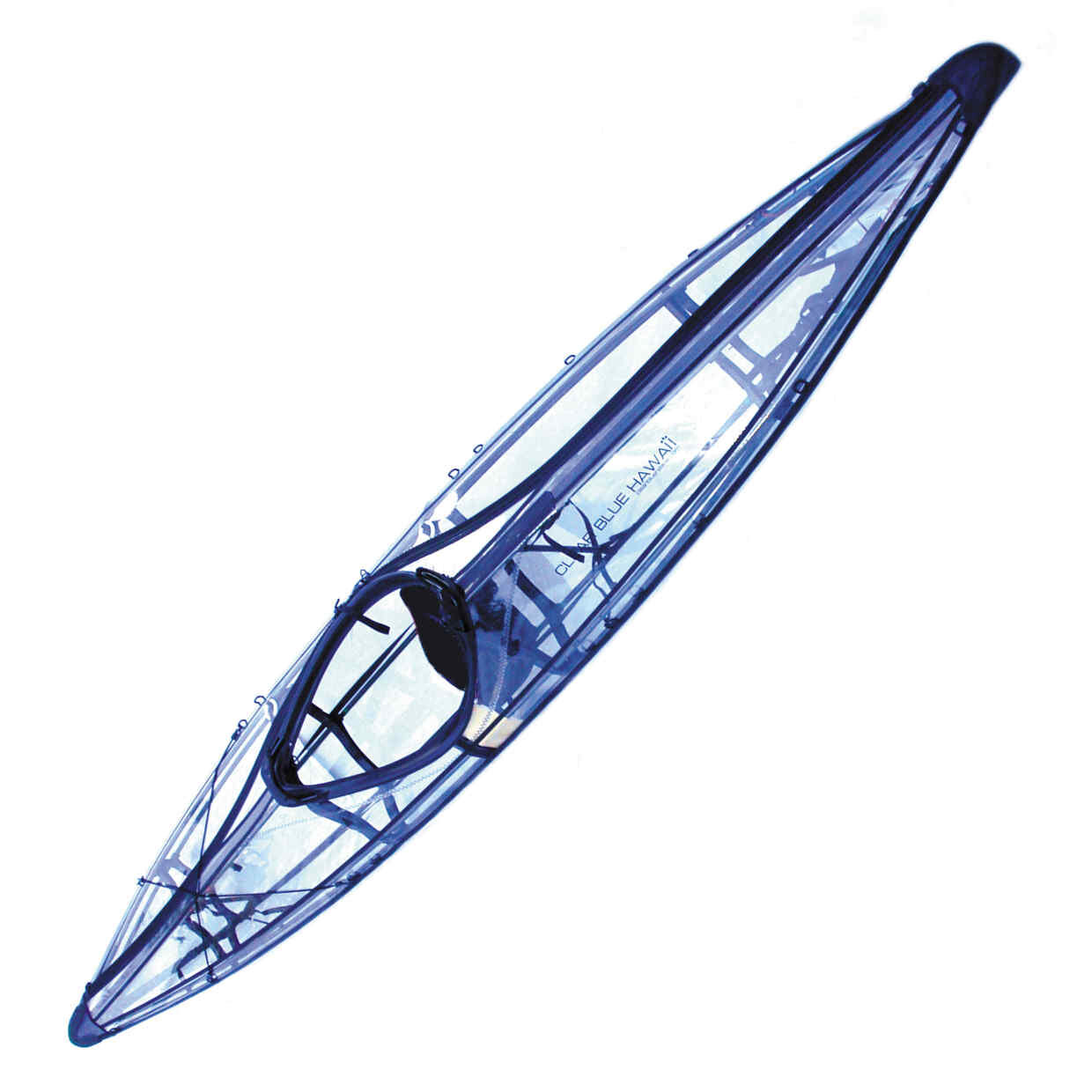
Other Clear Blue Hawaii creations include the two-person Molokini ($2,299), which has padded seats and a V-shaped hull and is perfect for beginners due to its relative stability. It is made of the same durable polycarbonate that is used to make bulletproof glass and fighter-jet canopies, yet weighs an easily transportable 18kg. The Molokai ($3,705), meanwhile, is a five-person yacht tender made of a military-grade material that comes in a vibrant array of colours – mandarin-orange, continental blue and chili red, for instance – and features a durable deck, as well as two-piece oars and two-person benches. There’s also the inflatable Hanauma II kayak ($949, third picture) that holds two people and is ideal for touring.

Many of the models feature the same transparent windows that allow for dazzling underwater discoveries. But if it’s online surfing you’re after for now, the site features detailed product information and a stunning image library of the products in a variety of settings that promises to banish the winter blues.
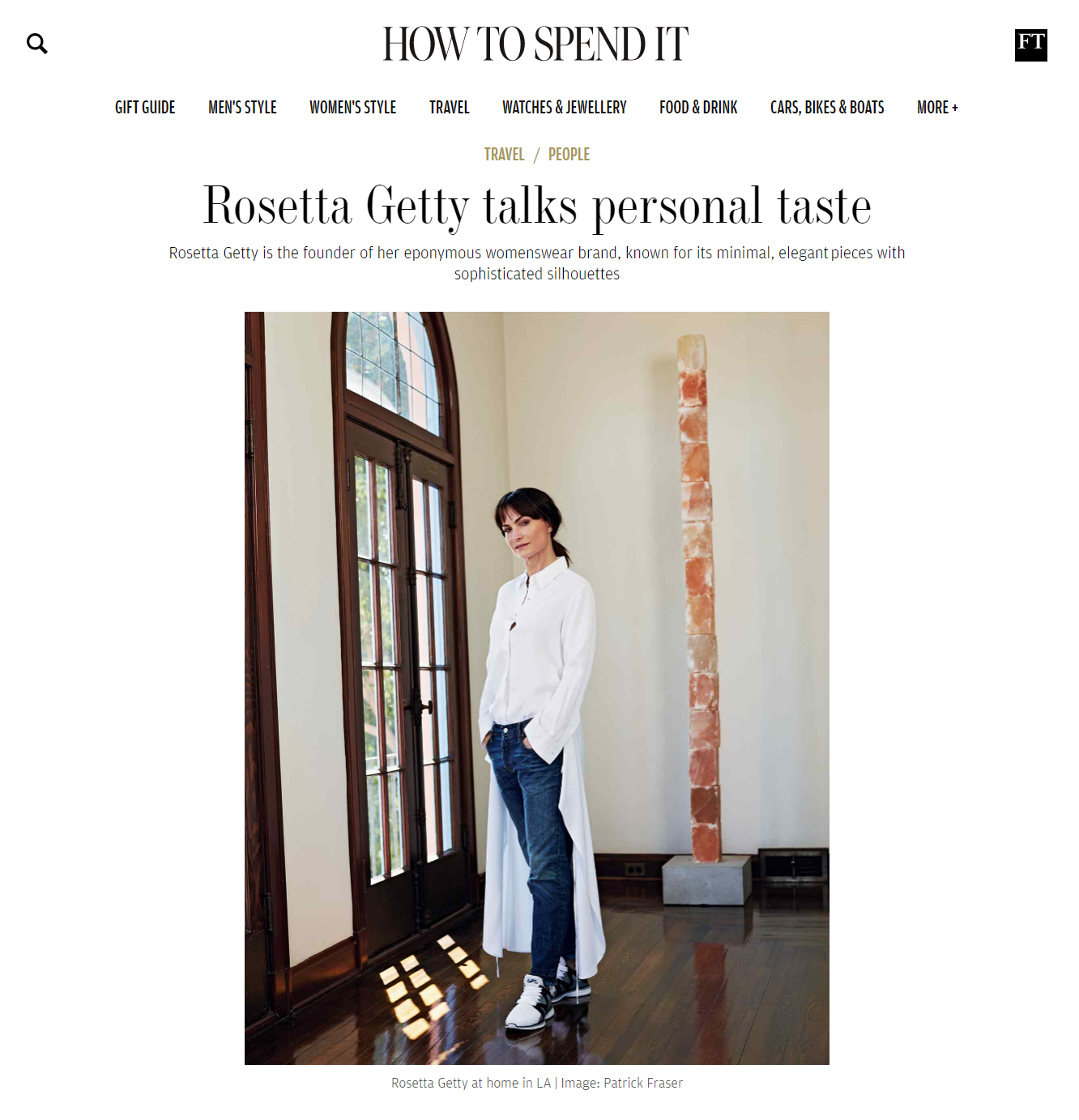
Rosetta Getty talks personal taste
Rosetta Getty is the founder of her eponymous womenswear brand, known for its minimal, elegant pieces with sophisticated silhouettes
Rosetta Getty is the founder of her eponymous womenswear brand, known for its minimal, elegant pieces with sophisticated silhouettes
My personal style signifiers are vintage Levi’s 501 jeans, white or black T-shirts, and button-down shirts of my own design. I like a uniform that is clean, classic and a bit predictable but that also has a slightly quirky edge. I wear these staple pieces with my new favourite running shoes – in either black or white – by Athletic Propulsion Labs. My clothes are all about comfort and moving from the school run to work to a business lunch and then out to dinner. $165;www.athleticpropulsionlabs.com. www.levi.com.
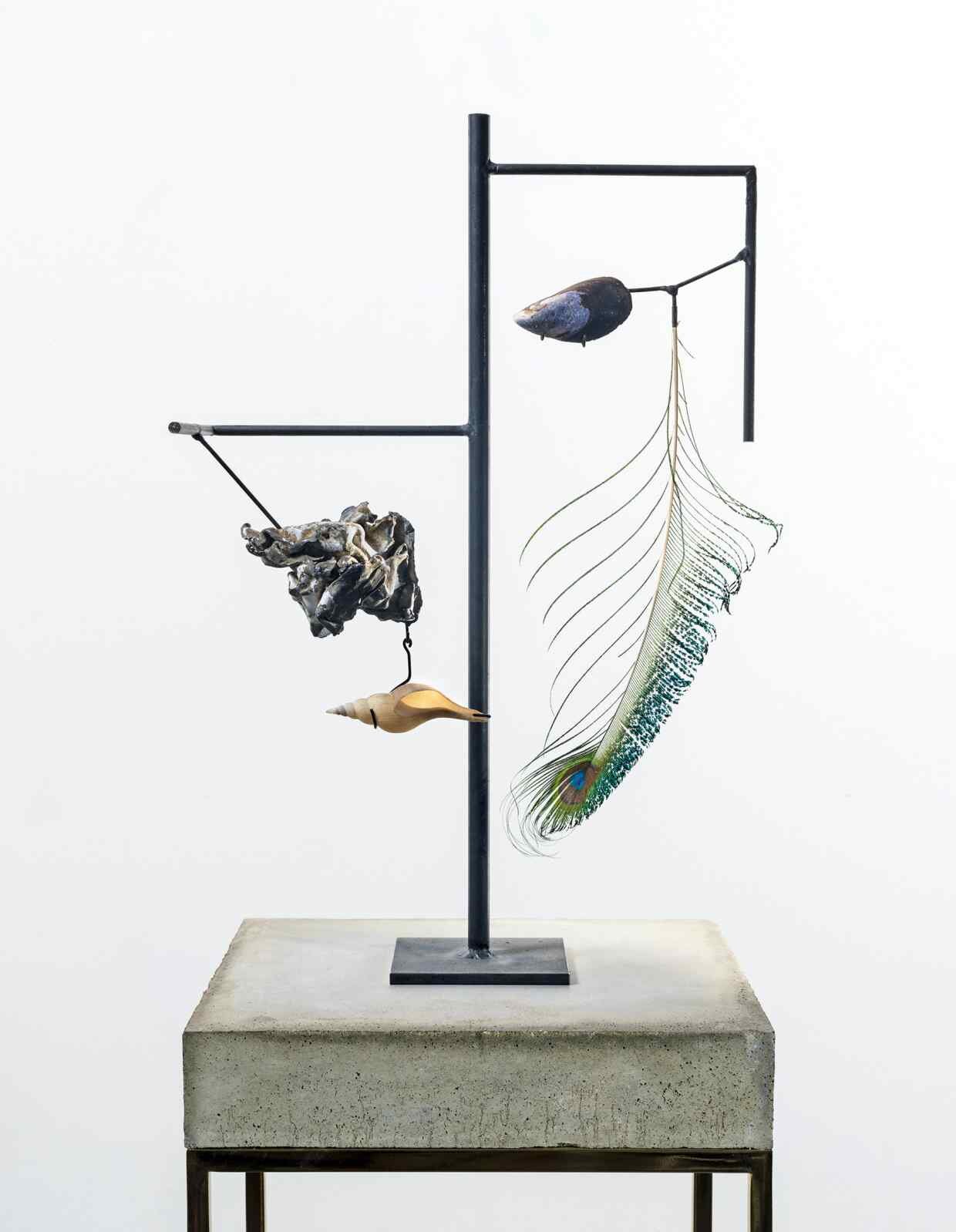
Mussel Shell sculpture by Carol Bove, price on request
The last thing I bought and loved was a simple Jil Sander Panama-style straw hat that I have been living in. I often wear hats, but have never loved one this much. It’s a bit precious so I have to put it in a box when I travel. And I recently added a pair of ultra-thin, delicate hoop earrings in 14ct gold by LA-based designer Kathleen Whitaker to my jewellery collection, along with a pair of dangly gold earrings that I found in the Céline boutique in Florence; they look beautiful with casual or dressy clothes. £310; www.celine.com. $145 per earring; www.kathleenwhitaker.com.
And the thing I’m eyeing next is a sculpture by New York-based artist Carol Bove. I am a fan of sculpture generally, but I particularly love her use of natural materials and organic shapes. She employs lines in her assemblages I am drawn toward. www.davidzwirner.com.

Café Gratitude almond I Am Joy chocolates, $3 each
A recent “find” is Ceri Vintage & Factory, an amazing, under-the-radar vintage store in Florence. It specialises in workwear from the 1920s to the 1970s, and I found leather jackets, wide-legged trousers and the most amazing vintage Levi’s there. Two of my daughters are now wearing all of my clothes, so I am trying to fill in the wardrobe gaps – this boutique was a huge help. Via de’ Serragli 26/R, 50124 Florence (+39335-839 0356).

Getty’s Jil Sander straw hat | Image: Patrick Fraser
The item in my wardrobe that I’ll keep to pass on is my entire vintage collection – hopefully to my girls one day. Though if I had to pick one piece, it would at the moment be a black wool stretch dress by Comme des Garçons from one of Rei Kawakubo’s first collections. www.comme-des-garcons.com.

Her Céline gold earrings, £310, Cartier diamond ring and Kathleen Whitaker gold hoop earrings, $145 each | Image: Patrick Fraser
The last meal that truly impressed me was at Defune in Marylebone. I have been going there for 15 years but recently rediscovered it with my children when we were staying at Chiltern Firehouse just around the corner. The space is tiny – like a Japanese café – but for an elevated dining experience you can opt for the more formal downstairs area. We loved the casual family feel upstairs, as well as the fresh sashimi and creative maki sushi rolls. The whole experience felt entirely authentic. 34 George St, London W1 (020‑7935 8311; www.defune.co.uk).
The best souvenirs I’ve brought home are exquisitely embroidered cushions from Emporio Le Sirenuse, Carla Sersale’s shop at Le Sirenuse Hotel in Positano. We visit the area every year, and her beautiful things make the best mementoes. These particular cushions are in neutral tones, but she has brighter versions as well. I always bring back her simple, soft cotton loungewear as well – I wear these pieces as pyjamas. From £164; Via Cristoforo Colombo 103, Positano (+39089-811 468; www.emporiosirenuse.com).
An indulgence I would never forgo is almond I Am Joy chocolates from Café Gratitude in Los Angeles. They’re delicious and deceptively healthy, made of shredded coconut, almonds and a hard chocolate shell, with no added sugar. $3 each; 639 N Larchmont Boulevard, Los Angeles, CA 90004 (+1323-580 6383; www.cafegratitude.com).
The best gift I’ve received recently was a square Cartier diamond solitaire, c1930 – from my husband [Balthazar Getty] on our 15th wedding anniversary. I’m not typically a diamond person, but this one is so unusual. It’s very masculine, which I love, and it’s just perfect for me. www.cartier.co.uk.

Bobbi Brown Makes It Look Easy
After 25 years in the industry, cosmetics titan Bobbi Brown continues to espouse natural beauty.
After 25 years in the industry, cosmetics titan Bobbi Brown continues to espouse natural beauty.
The name Bobbi Brown is synonymous with effortless beauty. Since she founded her eponymous brand in 1991 with $10,000 and a single nude shade of lipstick, the celebrity makeup artist has sought to empower women to look and feel their best. She must have been doing something right, because four years later the company was acquired by beauty behemoth Estée Lauder for an undisclosed sum, making Bobbi Brown Cosmetics an international powerhouse.
Brown is warm and wickedly funny, and her holistic approach to beauty appeals to women of all ages and ethnicities—throughout more than 70 countries, and in 100 brick-and-mortar stores around the globe. This wide-ranging popularity has led to sales figures that, by some estimates, account for 10 percent of all Estée Lauder revenues.
What began as a reaction to the artificial, excessive, overly contoured makeup that was so popular in the 1980s—think Cyndi Lauper, Madonna, and Debbie Harry with bright red lips, heavy eye shadows, and impasto blush—Bobbi Brown grew quickly from 10 lipsticks to a cosmetics empire that includes products like Foundation Sticks, Creamy Concealer Kits, Long-Wear Gel Eyeliner, and Shimmer Bricks. The brand has expanded from makeup and skin care to include fragrances, as well as a range of nail polishes, brushes and tools, and most recently, eyewear. The through line for all of Brown’s products is that they are designed to enhance—rather than to hide—a woman’s best features, and all are conceived with time, efficiency, and ease of use in mind.
Brown’s achievements aren’t limited to the visage: She is the recipient of numerous awards, a bestselling author, and was appointed by President Obama to the Advisory Committee for Trade Policy and Negotiations, the United States government’s senior trade advisory panel.
A visit to Bobbi Brown’s SoHo headquarters paints a clear picture of the brand’s success: It is a loft-like, airy environment where people freely share ideas and where you’re likely to see a dog or a child. Brown sat down with Surface to discuss 25 years of makeup and her other pursuits.
What was your path to the realm of makeup?
I have always loved it; the way it can make you feel instantly prettier, more tanned, glowing. I never loved school and I even considered dropping out at one point. My mom asked me, “If you could do anything, what would it be?” to which I responded, “I’d like to go to Marshall Field’s and play with makeup.” She encouraged me to follow my passion and study theatrical makeup, so I found my way to Emerson College in Boston, where they allowed me to design my own major. This was the first time in my life that I was surrounded by like-minded, creative people who were just passionate about whatever they were doing. It was there that I learned that what you put in is what you get out—this is also known as entrepreneurship.
What was the makeup world like in New York when you were starting out?
I moved to New York in the ’80s and everyone was into contouring, pale skin, and artificial everything, including fuchsia lipsticks and electric blue eye shadow. I was doing shoots featuring models with natural, beautiful, evenly toned skin and I was the only one doing it at the time. This look appealed to photographers like Bruce Weber and Arthur Elgort, who preferred a healthier look. I also worked with photographers like Steven Klein who opted for a more severe look, but this just wasn’t in my comfort zone. I did a Vogue cover with Tatjana Patitz where she appeared strong, but clean and fresh, and this was a breakthrough moment for me.
Are there other breakthrough moments that stand out?
I’ll never forget my first Vogue cover shoot in 1987. It was with Naomi Campbell and Patrick Demarchelier, on a beach at daybreak, and it changed my career. I went on to work with Walter Chin, Victor Skrebneski, and Horst P. Horst, to name but a few.
Tell me about the brand’s beginnings?
It all started with a nude lipstick. Everything on the market at the time was dry or greasy or smelly, so I asked a chemist who I’d met at Kiehl’s to formulate a lipstick for me using a combination of a taupe eye pencil, a pinkish-blue blush, and lip balm. I wanted a lipstick that looked like lips. From that first lipstick, I went on to create 10 Bobbi Brown Essentials: a targeted, edited collection of the most beautiful lip colors that included Salmon, Beige, Raisin, Brown, Rise, Pink, Orange, Blackberry, Burnt Red, and Red.
It’s astounding that you can rattle those colors off from memory? Where and how did the brand launch?
Initially, my husband, Steven Plofker, and I had two partners, Rosalind and John Landis. We joined forces and launched this brand in 1991, all while keeping our day jobs. Shortly thereafter I met the beauty buyer for Bergdorf Goodman at a cocktail party, and I pitched her then and there. Bergdorf’s took our product, and we thought we’d sell 100 lipsticks in the first month—but we sold 100 on the first day. This led to the launch of lip pencils, eye pencils, eye shadow, and so on.
How did the sale to Estée Lauder Companies come about?
When the brand was four years old, Frédéric Fekkai called me and said “Leonard Lauder wants to meet you.” I said yes, of course, although we weren’t interested in selling the company. I went to a dinner at Leonard and Evelyn’s house. I remember the night well because we sat outside overlooking the park, eating grilled fish, steamed broccoli, and brown rice, with the philharmonic playing in the distance. He had done his research and knew that I loved healthy food and good wine, so this won me over right away. He said that I reminded him of his mother when she started her business, and also that we were beating them in all the stores, so they wanted to buy us. He knew that being a wife and a mother was incredibly important to me, and he assured me that I’d have complete autonomy and the ability to balance those big parts of my life. He has never wavered on this.
Speaking of work/life balance, you’re a pro. Teach me.
I learned balance from my husband, Steven. He chose to be a real estate developer so that he could be home at night and have dinner with his kids. We have always supported each other in our work and in our family life. A perfect example of this was early in my career, when I was booked to do a cover shoot with Nikki Taylor in Florida. It was during the kids’ school vacation, and so Steven offered to fly down with them, but someone got an ear infection and couldn’t get on the plane. Instead he took the overnight train so that we could all be together. For both of us, family has always come first, and when I am with them I try to be completely present.
I’d like to think we could all have that kind of discipline. Has this sacred balance led to any missed opportunities?
There were moments early in my career that tested my priorities. When Bruce Weber asked me to do a three-week shoot for Ralph Lauren in Tahiti and I passed, or when I opted to skip a dinner with Francesco Scavullo and Jean-Paul Gaultier in favor of meeting my husband and young son, Dylan, for a planned dinner in SoHo. In these cases, however, when one door closed, another one opened and led to a new product line or an idea for a book.
For a brief time the company was located at Estée Lauder’s Midtown Manhattan offices. Now you’re in SoHo. Why?
Post-acquisition, our sales flattened. I told the CEO at the time that I felt stuck in an uncreative box and that I wanted to move downtown, and have an open-plan work environment, with music, a healthy kitchen, and people wearing jeans. I need to be able to open the windows. They supported me wholeheartedly and our sales went back up.
Just like that? Wow. Let’s talk about advice. What’s the best nugget you’ve ever received in business?
Leonard Lauder told me, “Never ask for permission; ask for forgiveness” and this is how I operate. Mickey Drexler of J. Crew is another role model, and he always says “Just keep doing what you think you should be doing,” instead of focusing on other people or fleeting trends.
Now you. What beauty advice can you offer me?
Healthy looks beautiful, and it comes from the inside. Eating well, getting enough sleep, wearing sunscreen, drinking water, and exercising are all important. Use moisturizer, as it’s the fountain of youth, and resist doing things like seeing the dermatologist too much when you’re having a down moment. At difficult times, put your hair up and don’t look in the mirror—this is when mistakes are made. Also, choose to look your age, and don’t try to erase all of the lines and imperfections.
OK, let’s pivot into broad strokes. What are the best things about your success?
I’ve been exposed to so many incredible things: I’ve seen the world, and I get to help so many different kinds of women feel better about themselves. Then there are the perks: I’ve been to a state dinner at the White House, I’ve danced with [rapper] Flo Rida, spent time with Mick Jagger, I’ve traveled with my family all over the world. I also get to be surrounded by an incredible team at work, and my life is better and fuller because of them.
The company has been around for 25 years now. Is this a major milestone for you?
When I started my business I never imagined that it would grow to be what it is today, and I’m proud that our brand philosophy remains the same as it was 25 years ago. Our products are driven by the needs of our consumers, and we are committed to empowering women. I plan to continue to develop effective products that meet the needs of all different kinds of women.
Are you going to celebrate?
Yes, we are celebrating the brand’s original mission with the launch of our “Be Who You Are” campaign that highlights the individuality of women across different ages and ethnicities and celebrates my lifelong beauty secret: to be who you are. We’ve had so many great moments, but what really stands out to me are the countless women I’ve met over the years who have inspired me with their stories. Beyond makeup, we’ve talked about life-altering events; everything from the joy of being a new mom to dealing with homelessness and divorce.
Now let’s try a little Proust questionnaire. What does the future of beauty look like?
I think it will be a combination of health and wellness—and it will be about beauty from the inside. There will be an emphasis on foods that boost health, and help nourish the skin and nails. I think you’ll see makeup that gives a natural glow—gel bronzers, cream blush—that’s very sheer, light, and clean. A glowing look versus a more matte skin finish will be popular, and good moisturizer will be key.
What’s a little-known fact about you?
I got my Today show guest beauty editor gig—one that I did for 16 years—because I met Jeff Zucker’s grandmother at a party and we hit it off. She recommended me to him, and the rest is history.
Where do you like to spend your down time?
With my kids. Whether that’s in the mountains in Telluride, or on the beach in Bayhead, on the Jersey Shore, or at home in Montclair, I love spending time with my three boys, my husband, and my dog, Biggie.
If you weren’t in the beauty business, what would you like to be doing?
I’m a big believer in foods that heal and in eating things that come from the earth. If I weren’t running this business, I’d like to own wellness cafes and provide nutritional coaching. While I’m not a great cook, I love good food and think it’s tightly tied to beauty. I also love editorial work—I was the editor-in-chief of Yahoo Beauty—and would enjoy being involved in magazine publishing.
You’re a famously healthy, clean eater. What’s your kryptonite?
Casa Dragones tequila, followed by the occasional French fry off of a friend’s plate.

Woven metal artworks with the wow factor
Dougall Paulson creates shimmering statement pieces
Dougall Paulson creates shimmering statement pieces
“We envisioned a textile that vibrates with light, like an other-worldly seascape,” says Sean Dougall of the jewellery-grade metal weavings that he and partner Andrew Paulson create from their studio in Watts, Los Angeles. “We were immediately drawn to the potential of fine wire and quickly learnt that it is a material that doesn’t really want to be woven; it’s slippery, stiff and coils up on itself. But we were determined to master this exquisite – albeit stubborn – material.”

The results of this self-taught duo’s labour-intensive efforts range from woven tatami mats (from $1.50 to $5 per square inch, second picture) and lustrous wall hangings (from $4,500, first picture) to expansive screens and installations. Using a variety of metals – including black steel, bronze, brass and nickel alloys and sterling-silver-plated brass – Dougall and Paulson weave exquisitely simple patterns, as well as horizontal and vertical bands of colour, while other recent material explorations have included cultivated silk from Assam and a Japanese material comprising pigmented pure silver on rice paper. The glimmering finished textiles all have a magical molten-metal appearance and “straddle the line between fine, decorative and graphic arts,” says Dougall.

Each commission can take several months to complete, with the loom (third picture) alone taking a week to set up. “It’s impossible to mechanise the loom,” explains Paulson, “and the hundreds of wires comprising a warp must be put in the proper sequence, under the same tension.” But for these eye-catching, cosmic-tinged works of art, it’s worth the wait.

A long weekend in Lyon with Daniel Boulud
The Michelin-starred chef takes Christina Ohly Evans through France’s undisputed capital of gastronomy. Portrait by Fabio Massimo Aceto
The Michelin-starred chef takes Christina Ohly Evans through France’s undisputed capital of gastronomy. Portrait by Fabio Massimo Aceto
Lyon has always been empowered by industry and by a rich rural history – it is south of Burgundy and Beaujolais, north of the Rhône Valley – and there are Roman and Renaissance references everywhere. But it has also played an important role in French history: throughout the wars and in times of great change, it has been famous for craftsmanship. The silks, fabrics, steel, intricate woodwork, passementerie – all have long been sought after across the world, and in recent times Lyon has been a leading supplier for luxury brands such as Hermès. From the hilltop Basilica of Notre-Dame de Fourvière to the mysterious underground traboules, this city with two rivers and multiple bridges has a similar beauty to Paris, but on a much smaller scale.

Lyon’s Hotel de Ville with the Fontaine Bartholdi in the foreground | Image: Günter Lenz/Getty Images
One of the very special aspects of Lyon is that food has always been a strong focus. Historically it’s an industrial city, so people had money to spend on it; there has always been a cuisine bourgeoise, and working-class people frequented simple bouchons, where an excellent meal could be had for the price of cooking at home. These establishments are still a staple of Lyon life. When people started driving from Paris to Nice in the 20th century, Lyon became the natural stopping point, and the city had a high concentration of Michelin-starred establishments. Lyon remains the capitale de la gastronomie, though we all still look to Paris, of course.
I visit Lyon five times a year, and I especially love the city in summer, when everyone is outside in the parks and at the farmers’ markets and there are outdoor musical celebrations, such as the festival Les Nuits de Fourvière, held in the Roman amphitheatre. One of my favourite places to stay is Le Royal Hotel, a former family home on Place Bellecour that is now a 74-room hotel. It’s part of the Institut Paul Bocuse, so it’s a culinary school and hotel all in one, elegant and traditional. Another wonderful place for accommodation is Cour des Loges, in the heart of Old Lyon. This Renaissance building has a three-storey frescoed courtyard and the rooms have a cosy, slightly austere feel. One of the most special places to stay, however, is Villa Florentine, which is a boutique Relais & Châteaux hotel in the hills overlooking the city. It has an excellent table and the best views of the town below. It’s a little challenging to get up there, as it is reached by small, winding roads, but it’s worth the effort.

Inside one of the greenhouses at the Parc de la Tête d’Or | Image: © Hemis/Alamy Stock Photo
A great day in Lyon begins at the lively food market Les Halles de Lyon – Paul Bocuse, where you can sample oysters for breakfast, followed by sea urchin, tripe, offal or even tête de veau, and perhaps a glass of wine. All the chefs go there to shop and start their day, and it’s a wonderful place to get picnic ingredients before heading to the Parc de la Tête d’Or in the sixth arrondissement. The largest urban park in France, it has everything from a boating lake to bike trails to a rose garden; it’s a lovely place to spend an afternoon.

The bar at Cour des Loges | Image: Cour des Loges/G Picout, MPM, A Rico, ME Brouet & DR
Before you go, stop at Charcuterie Sibilia to buy meats, particularly the sausage with pistachio and truffle in brioche, and the local minced pork speciality, Jésu de Lyon. For excellent cheeses, you must visit La Mère Richard; its Fourme d’Ambert, Cantal and Saint-Nectaire from the Auvergne are among the best in the world. For pains au levain and praline tarts, Boulangerie Jocteur is a must; it also offers beautiful prepared foods.

Pâté en croûte at Daniel & Denise, a traditional Lyon bouchon | Image: Daniel & Denise
But shopping isn’t limited to Les Halles. I like to buy old cookbooks in the Presqu’île – or “peninsula” – district, near the historic Place des Terreaux. On the east side of the square sits the Hôtel de Ville, a city hall redesigned in baroque style by Jules Hardouin-Mansart after a fire in the 17th century. The surrounding streets are home to bookstores such as Librairie Ancienne Clagahé, which has rare leather-bound books and manuscripts. You’ll also find the city’s most beautiful square, the Place Bellecour, which sits between the Rhône and Saône rivers and is lined with elegant 19th-century buildings.
Another area for exploration is the Croix-Rousse, a historic district that was home to silk weavers – or canuts – and is now Lyon’s answer to hipster Brooklyn. Here you’ll find all kinds of wonderful restaurants, including Balthaz’art, a retro-chic bistro with a creative Montbéliarde beef tartare mixed with black olives, capers and candied lemon. Lunch at Daniel & Denise – an authentic bouchon, complete with red check tablecloths – is another highlight; clapeton d’agneau (chilled, shredded lamb’s feet served atop salad) is a speciality. La Meunière is another such place, where most things are served communally: meals begin with bowls of lentils, celery remoulade and pickled ox muzzle, followed by thick slices of a house pâté en croûte that’s called l’oreiller – “pillow” – de la belle meunière and is filled with foie gras, duck heart, chicken, veal and more.
One newer restaurant is Le Suprême, a modern bistro started by one of my former chefs from Daniel in New York – full disclosure: I’m a minority investor. It offers an inventive, affordable tasting menu focused on poulet de Bresse prepared in many different ways – such as chicken liver mousse or stuffed chicken legs – all with wines from producers such as Jean Foillard and Saint-Joseph. For a fancier lunch place, there is La Mère Brazier – the chicken cooked in a pig’s bladder is a highlight – after which you can wander the indoor-outdoor Les Puces du Canal, where you’ll find memorabilia, antique toys, vintage clothing and furnishings – most of which can be shipped back home. The Museum of Gallo-Roman Civilisation has an incredible collection of mosaics, statues and ceramics. After an afternoon of discovery here, I recommend a visit to Bernachon for a coffee and the best chocolates and sweets anywhere. It was founded in the 1950s, and the family has been making “bean to bar” chocolate on site since the 1970s.
No trip to Lyon is complete without a meal at L’Auberge du Pont de Collonges, a temple of gastronomy that sits right on the Saône. The restaurant resembles a colourful Thai palace, and the food is just as elaborate. Loup de mer en croûte feuilletée with sauce Choron – a Béarnaise with tomato – and the oeufs à la neige are two of my favourite dishes, and you must have Bernachon’s signature Le Président cake: an incredible ganache dessert topped with shaved chocolate. It’s basically chocolate atop chocolate atop chocolate, and it’s sublime.
Vieux Lyon – or the Old City – is a designated Unesco World Heritage site; the quartiers Saint-Jean and Saint-Georges are both full of winding cobblestone streets with great examples of medieval architecture. The Cathedral of Saint-Jean, which dates from the 12th century, features beautiful stained-glass windows and an astronomical clock that is one of the largest in Europe. But then there are plenty of things to do just outside the city as well, not least a visit to the three-Michelin-star Maison Troisgros for lunch. The train takes you through the beautiful Beaujolais countryside and delivers you to the restaurant door in a little over an hour. Another worthwhile lunch excursion is, of course, the train ride to Valence for a delicious lunch at Anne-Sophie Pic’s Maison Pic. And just outside town, an easy taxi ride away, is the Henri Malartre Museum, a vast collection of everything car- and motorcycle-related – from vintage to modern vehicles – housed in a beautiful 12th-century castle.
But besides its natural and architectural endowments, and its culinary status, Lyon is beautiful because it has stayed true to its historical roots. Tradition still matters very much here. Of course, it’s a dynamic city embracing technology and investing in the future: the culture of sport (particularly football), the culture of food, the cultures of art and artisans – these are all celebrated. But the people of Lyon perfected l’art de vivre – the art of living – a long time ago and this is what has kept it a special place.

Start the Day with the World's Best Hotel Breakfasts
Fresh-baked breads. Never-ending eggs. Extravagant pastry towers. Who doesn't love a sumptuous hotel breakfast? Certainly not Christina Ohly. The hotel-hopper extraordinaire put together a list of spreads worth traveling for, which include a few recommendations from Team Fathom.
Fresh-baked breads. Never-ending eggs. Extravagant pastry towers. Who doesn't love a sumptuous hotel breakfast? Certainly not Christina Ohly. The hotel-hopper extraordinaire put together a list of spreads worth traveling for, which include a few recommendations from Team Fathom. (We couldn't help it. We're equally obsessed.)
Everyone knows that breakfast is the most important meal of the day, something that rings true and clear during a hotel stay. My daughter Kate, who doubles as my intrepid travel companion, has pointed out on numerous occasions that a fine breakfast spread — and it doesn't have to be fancy, just delicious, beautiful, and even quirky — is often worth planning an entire trip around. With that in mind, here are a few of our most memorable morning meals.

The rooftop breakfast. Photo courtesy of La Scelta di Goethe.
La Scelta di Goethe
Where: Rome, Italy
What's to love: The small all-suite hotel — which is really more like a sumptuous private apartment — offers the most spectacular spread of cheeses, salami, muesli, fruit tarts, and freshly baked breads on its expansive private terrace. No one but you, with your deliciously strong pot of coffee, will be overlooking Villa Borghese, endless cupolas, and Vatican City in the distance. The peel of church bells and seagulls standing sentry adds to the lovely, very local vibe.
Check in: Book a Room

The carb-lovers breakfast. Photo courtesy of La Mamounia.
La Mamounia
Where: Marrakech, Morocco
What's to love: Start with the service. You'll never find kinder people offering fresh juices, strong coffee, and Moroccan mint tea infusions, all in a poolside pavilion setting with lush garden views. The breakfast spread is magnificent and very authentic. Local specialties including khobz (flatbread) with olive oil and jam, sweet rolls studded with anise and sesame seeds, a version of pancakes, as well as meats, cheeses, and all kinds of eggs cooked to order.
Check in: Book a Room

The Japanese-style vegetarian breakfast. Photo by Berit Baugher.
Hoshinoya Tokyo
Where: Tokyo, Japan
What's to love: Quite possibly one of the best room service breakfasts in existence can be experienced at this new ryokan-style hotel. A beautiful wooden box is brough to your suite by a kimono-clad attendant who carefully explains each small plate. Even though it will be hard to follow most of what she says, and even though you might never know what you're really eating, you'll be delighted by each and every bite.
Check in: Book a Room

The vegan petit dejeuner. Photo courtesy of La Réserve.
La Réserve
Where: Paris, France
What's to love: The signature vitality breakfast is a gluten-free, vegan take on a classic Paris petit dejeuner, with detox juice, lemon-ginger herbal tea, pastries, buckwheat and berry muesli with almond milk, avocado with hempseed gomasio, raw everything, and even a take on French toast with coconut butter. Fashion editors, designers, and the haute couture crowd flock to this Jacques Garcia-designed gem during Fashion Week. Be sure to book ahead.
Check in: Book a Room

The savory spread. Photo courtesy of The Ritz-Carlton Kapalua.
The Ritz-Carlton Kapalua
Where: Maui, Hawaii
What's to love: Fuel-up for a day of biking down the side of a volcano with a buffet extravaganza that includes all kinds of island specialties: POG (papaya, orange, and guava) juice, Portuguese sweet bread, and a seed bar — chia, flax, poppy, sesame — more comprehensive than the Whole Foods bulk bin isle. Fresh tofu, steamed rice, and a full salad bar add savory, healthy touches.
Check in: Book a Room

The healthy option. Photo courtesy of Claridge's.
Claridge's
Where: London, United Kingdom
What's to love: Everything. The Art Deco setting, pots of proper Sri Lankan teas (theirs is bespoke), and all kinds of delicious dishes like vegan scrambled tofu on rye bread with tempeh, pork gyoza, and prawn dumplings from the Chinese menu, and flaky, gluten-free croissants. The chocolate coconut whey protein smoothies can't possibly be healthy, but sides of chicken sausage, grilled tomatoes, and wilted spinach most definitely are. Everything's to love about the old-school full English breakfast, complete with an omelette of fine herbs, granary toast, and fresh pink grapefruit juice. Plus, the people-watching is unparalleled.
Check in: Book a Room

The fashionista's choice. Photo courtesy of Four Seasons Hotel Milano.
Four Seasons Hotel Milano
Where: Milan, Italy
What's to love: The hotel has a completely different feel and clientele than most Four Seasons. Many fashion editors and other generally fabulous Fashion Week attendees have created demand for the Taste & Shine breakfast, comprised of freshly pressed juices and gluten-free everything, served while getting a quick-dry, or express-dry, manicure. Hungrier types will want to head to the dining room, where, on weekends, there is a special room dedicated to chocolate creations.
Check in: Book a Room

The best of Sicilian summer. Photo by Jeralyn Gerba.
Monaci delle Terre Nere
Where: Sicily, Italy
What's to love: Breakfast is served under a canvas canopy on a terraced hillside of pine and olive trees. The bounty is the best of Sicily in the summer: bowls of stone fruit, glass jars of sheeps' milk yogurt and local honey, blood orange juice, farm eggs, and fresh-baked loaves of Sicilian wheat — all of which have benefitted from Mount Etna's nutrient-rich soil. In the summer, a long and lazy taste-testing session (washed down with cappuccino) is unadulterated joy.
Check in: Book a Room
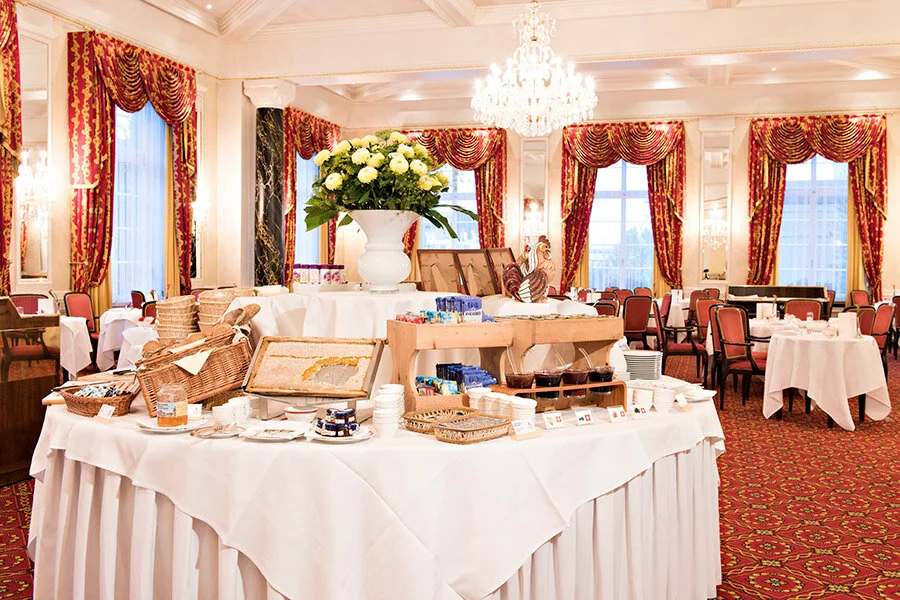
The Grand Restaurant. Photo courtesy of The Kulm Hotel.
The Kulm Hotel
Where: St. Moritz, Switzerland
What's to love: Breakfast in the baroque Grand Restaurant will leave you well-stoked for skiing, hiking, and high-end alpine shopping. Local specialties on the buffet include birchermüsli, bündnerfleisch (air-dried Grisons meat, an Engadine Valley speciality), real (thick!) hot chocolate, and the creamiest Tilsiter Swiss cheese. Other pluses include a comprehensive selection of regional butters, jams, and honeys, and perfectly formed, piping hot omelettes.
Check in: Book a Room

Il Palagio. Photo courtesy of Four Seasons Hotel Firenze.
Four Seasons Hotel Firenze
Where: Florence, Italy
What's to love: There is nothing typical about this Four Seasons. Set in a 16th-century frescoed palazzo, the Sunday brunch is, well, beyond memorable (I'm still talking about this meal five years later). The formal restaurant, Il Palagio, is transformed into a multi-station brunch by noted chef Vito Mollica, who makes killer poached eggs with Florentine-style spinach. The atmosphere is very casual (local families linger, too) and the food is delicious and all locally sourced (berries are the size of golf balls). Make this your only meal of the day.
Check in: Book a Room

The Alain Ducasse classic. Photo courtesy of Le Meurice.
Hôtel Le Meurice
Where: Paris, France
What's to love: The Michelin-starred Alain Ducasse restaurant, with its stylish Phillipe Starck update, is a magical place to kick off a day in the City of Light. The American breakfast is full-on: eggs with a truffle, Kristal caviar or salmon supplement, Ducasse's own hot chocolate, pressed juices by Nubio, and thick, crispy waffles doused in whatever you like. This is old-school luxury.
Check in: Book a Room

The outdoor spread. Photo courtesy of Belmond Villa Sant'Andrea.
Belmond Villa Sant'Andrea
Where: Taormina, Sicily
What's to love: The seaside terrace setting and the comprehensive spread are unmatched. Choose from freshly baked croissants and plum tarts, peach compote, housemade tangerine marmalade, acacia honey from nearby Etna, Parma prosciutto, and the most delicious smoked swordfish. Apricot, green apple, and blueberry juices, sipped overlooking the Bay of Mazzaro, are just sublime.
Check in: Book a Room

The brunch buffet. Photo courtesy of Peninsula Chicago.
The Peninsula Chicago
Where: Chicago, Illinois
What's to love: As a general rule, Peninsula Hotels do breakfast really well, with plenty of Chinese offerings standard. Chicago offers lobster and scallop congee and steamed shrimp dumplings, but with a hefty dose of Midwestern, carb-laden goodness added in. Think fluffy pancakes, chocolate desserts, waffles with berry compote, and serious specialty meats like steak, various kinds of bacon, and pork and chicken sausages.
Check in: Book a Room

The breakfast at Aman Tokyo. Photo by Jeralyn Gerba.
Aman Tokyo
Where: Tokyo, Japan
What's to love: It's hard to describe the sheer delight of sitting down to a proper Japanese breakfast. Each little bento box compartment offers a surprising bite of something gastronomically remarkable — it's like getting permission to open all of the advent calendar doors at once. To be able to enjoy the elevated morning ritual at Aman, itself a jewel box of architectural surprises, while overlooking the Imperial Gardens and Mount Fuji? Arigato.
Check in: Book a Room

Pilar Ordovas talks more personal taste
The Savile Row gallerist concludes her list of likes with her grandmother’s diamond ring, Michelangelo and a sculpture park in the Swiss Alps
The Savile Row gallerist concludes her list of likes with her grandmother’s diamond ring, Michelangelo and a sculpture park in the Swiss Alps
My style icon is my grandmother, Maruja, as she was always timeless and elegant. Cristóbal Balenciaga was her close friend and made many of her clothes, but it wasn’t so much what she wore as how she wore it. I also like the style of strong women like Bella Freud who are very individual and follow what they like rather than fashion trends.
The last meal that truly impressed me was at Saraghina in Brooklyn. I ate the best wood-fired pizza – one with roasted, spicy artichokes – that I’ve had outside Italy, as well as house-made cavatelli with crabmeat and simply roasted branzino. The cosy atmosphere made our group feel like we were at home and being very well looked after. I’m hoping to return for a meal in their beautiful back garden. 435 Halsey Street, New York, NY 11233 (+1718-574 0010; www.saraghinabrooklyn.com).

Pilar Ordovas’ grandmother Maruja on her wedding day | Image: Courtesy Pilar Ordovas
The sight that inspires me is the Mediterranean Sea, as it takes me right back to my childhood. I grew up diving with my father and looking at treasures in the sea – sponges, fish, Roman ruins – before I could swim properly. The sight of the clear water and the feel of it on my skin gives me so much energy and inspiration. My dream is to have a home on the water on the island of Menorca.
An indulgence I would never forgo is good Nespresso coffee. I like the purple Arpeggio capsules as they make very strong coffee that is perfect with frothed milk. I’m going on a health retreat at The Ashram in California soon, and it’s not the exercise regime or the not eating much that worry me, but the not drinking coffee.www.theashram.com. www.nespresso.com.
The best gift I’ve given recently was to my sister Paula. I framed a drawing – a self-portrait she did with her favourite doll, Robin – that she gave me many years ago. I bought a 16th-century gilded frame when I was working at Christie’s and had been waiting for a special occasion to present it to her.
And the best one I’ve received recently was a 1920s platinum and diamond ring given to me by my mother; it once belonged to my grandmother, Carmen. The ring was given to her for her 25th wedding anniversary, so it is very precious to me. I don’t wear very much jewellery, but my mother knew I would love this piece.

Pilar Ordovas’ 1920s platinum and diamond ring that once belonged to her grandmother Carmen | Image: Weston Wells
If I had to limit my shopping to one neighbourhood in one city, I’d choose Las Salesas in Madrid. It’s a very eclectic area and you can find everything, from my favourite flower shop, Margarita Se Llama Mi Amor, where they create the most unusual wildflower arrangements, to Pez and Mott – two stores full of clothes by emerging designers that you are unlikely to see elsewhere. After a bit of shopping, I love Dray Martina for a casual lunch of gazpacho and black cod bacalao, or Mamá Framboise for bocadillos and delicious, artisanal pastries. Dray Martina, Calle Argensola 7 (+3491-081 0056; www.draymartina.com). Mamá Framboise, Calle Fernando VI 23 (+3491-391 4364; www.mamaframboise.com). Margarita Se Llama Mi Amor, Calle Fernando VI 9 (+3491-310 0926; www.margaritasellamamiamor.wordpress.com). Mott, Calle del Barquillo 31 (+3491-308 1280). Pez, Calle de Regueros 15 (+3491-310 6677; www.pez-pez.es).
In my fridge you’ll always find vegetables that are in season, as well as kiwis, avocados and whole milk, which I buy at Daylesford Organic. If we have friends round, then I’ll have cheese on hand – Comté, Brie and organic Cheddar – from Paxton & Whitfield, as well as a rotating selection of wines that are chosen by my husband and voted on by our guests. The fridge is always full of bottled water as well. Daylesford Organic, 44B Pimlico Road, London SW1 (020-7881 8060; www.daylesford.com). Paxton & Whitfield, 93 Jermyn Street, London SW1 (020-7930 0259; www.paxtonandwhitfield.co.uk).

Mamá Framboise in Madrid
An unforgettable place I’ve travelled to in the past year is the Engadin Valley in the eastern Swiss Alps, where I went to visit the sculpture park of the artist Not Vital. I arrived by train from Zurich and couldn’t take my eyes away from the mountainous scenery – it’s rugged, remote and spectacularly beautiful. This place is like an amusement park for grown-ups – one that includes sculptures hanging from trees and a Corten-steel platform that juts out from the mountainside – I had to overcome my fear of heights very quickly. I stayed at the boutique hotel GuardaVal in Scuol, which has an incredible gourmet restaurant with breathtaking views to match. GuardaVal, Vi 383, 7550 Scuol (+4181-861 0909; www.guardaval-scuol.ch). Not Vital Foundation,+4181-860 0837; www.fundaziun.notvital.ch.
And the best souvenir I’ve brought home is a set of simple, carved wooden boxes from our honeymoon in Essaouira, Morocco; they are made of thuya wood and still have a wonderful scent. I also cherish a beautiful eagle feather that a friend found for me on a walk we took together in upstate New York. I’m fascinated by feathers and this one from Mombaccus Mountain takes me right back to that trip.

Stage, 2011, by Not Vital at the Not dal Mot sculpture park, Switzerland | Image: Eric Gregory Powell/Not Vital Studio
The people I rely on for personal wellbeing include Richie Kyle at Third Space, who has been my trainer for years, and the various teachers at Danceworks who take me through the weekly dance classes that I can’t live without. Adrian Parkitny and Maxine Heale at Daniel Hersheson take care of everything to do with my hair. When I am in New York, Niv Zinder is my personal trainer and I love to go to Janet Sartin for refreshing facials. Danceworks, 16 Balderton Street, London W1 (020-7629 6183; www.danceworks.net). Daniel Hersheson, 45 Conduit Street, London W1 (020-7434 1747; www.hershesons.com). Janet Sartin, 875 Third Avenue, New York, NY 10022 (+1212-751 5858; www.sartin.com). Niv Zinder, www.nzfitness.net. Third Space, 67 Brewer Street, London W1 (020-7439 6333; www.thirdspace.london).
My favourite room in my house is my bedroom in my home in Battersea. The glass ceiling is retractable and in summer I go to sleep looking at the moon and stars. The room is very serene, with lots of white surfaces and a low bed with a wooden base that almost touches the floor. It is a very calming space.
The one artist whose work I would collect if I could is Michelangelo. I particularly love his later drawings because you can see the artist’s thinking process. There are two images – Studies for the Libyan Sibyl and a small Sketch for a Seated Figure – that are part of the Unfinished show at the Met Breuer and that I would particularly love to own. www.metmuseum.org.
If I didn’t live in London and New York, the city I would live in is Los Angeles. I’ve always wanted to live by the sea and there is such a vibrant arts scene there. The Hammer, The Getty, Moca and The Broad are among my favourite museums and I’d love to be able to spend more time at all of them. The areas surrounding Venice, Santa Monica and Malibu remind me of the Mediterranean in terms of the light and atmosphere, and it was on a trip here several years ago that I discovered my love of running. LA has wonderful hotels, too, and I could happily live at Shutters on the Beach or at the Malibu Beach Inn, as they are directly on the water and have incredible views of the Pacific Ocean. For a classic with a lively scene, Chateau Marmont in Hollywood is hard to beat. It’s the combination of the sea, the sun and the energy that make this city so comfortable to be in. The Broad, 221 South Grand Avenue, Los Angeles (+1213-232 6200; www.thebroad.org). Chateau Marmont, 8221 Sunset Boulevard, Hollywood (+1323-656 1010; www.chateaumarmont.com). The Getty Center, 1200 Getty Center Drive, Los Angeles (+1310-440 7300; www.getty.edu). Hammer Museum, 10899 Wilshire Boulevard, Los Angeles (+1310-443 7000; www.hammer.ucla.edu). Malibu Beach Inn, 22878 Pacific Coast Highway, Malibu (+1310-651 7777; www.malibubeachinn.com). Moca, 250 South Grand Avenue, Los Angeles (+1213-626 6222; www.moca.org). Shutters on the Beach, 1 Pico Boulevard, Santa Monica (+1310-458 0030; www.shuttersonthebeach.com).
If I weren’t doing what I do, I would be an Egyptologist. As a child, my father constantly told me stories about Indiana Jones and I later went on to study art history and archaeology because of his tales. I have always been interested in the adventurous aspect of this profession, as well as the elements of astrology, the architecture of the pyramids and the enigmatic pharaohs that were so much a part of ancient cultures.

The Many Sides of Marriott's Arne Sorenson
The hotel executive spends around two hundred nights per year traveling to his diverse global holdings.
The hotel executive spends around two hundred nights per year traveling to his diverse global holdings.
Following the mega-merger of Marriott International and Starwood Hotels and Resorts Worldwide, CEO Arne Sorenson will helm the world’s largest hotel chain—one with a combined 1.1 million rooms, and 400,000 more coming down the pipeline. Here, he tells Surface about everything from sustainability and LBGT rights to the importance of good design and listening to the competition.
You’re the first non-family member to hold the CEO title at Marriott. Tell me about your path to the top.
I never had a clear plan. My father and both of my grandfathers were Lutheran preachers, and I was born in Japan, where my dad had been posted since 1945. I later went to college and law school, and then worked as a lawyer in Washington, D.C., where I began representing Marriott in 1992. Bill Marriott called and asked me to come to the company, and I said I would, but not as a lawyer. So my first job—more than 20 years ago—was to run mergers and acquisitions. I later became the CFO—a slightly weird move on Mr. Marriott’s part, as I didn’t have the background for it, but he said, “You’ve got a great team, use your judgment, and you’ll figure it out.” I actually don’t think he could do that today. I transitioned to the role of president for a few years, and was appointed CEO in 2012. And while I’m not a family member, everyone had a chance to think about this transition over for a few years. By the time it happened, it was easy.
What’s the culture of the company?
Across the board we put our people above our customers. Of course, our customers are important to us, but the 375,000 employees who wear our name badge are on the front line, and we want them to be empowered, motivated, and happy. If they aren’t, they won’t deliver the kind of service expected of all our brands.
Another part of the cultural story at Marriott is that people talk about people, not their pedigree. So often what we hear is “they went to Harvard” or “they’ve worked for McKinsey” or whatever it is—but that has never been the conversation at Marriott. It’s always about looking at the position a person has now compared to where they started within the company—the general manger who came in as a security guard or the woman running international operations who came in as a pool attendant.
How did the Starwood deal play out?
At first we decided to pass because it was just too expensive and looked like a lot of work. But we changed our minds because of the relative valuations of the companies, and we believe that we can accomplish something by being bigger. There had been rumors about Hyatt buying Starwood, but our announced bid was totally unexpected: It was put together in three weeks and two days.
Then Anbang steps in. They bid 11 or 12 percent more in cash, and in lighting speed, they fully financed that bid. Starwood picked it. We’d done a lot of work, and rather than just walk away, we teed up the best deal that we were prepared to do. Why give up without putting your best foot forward? We announced our revised deal on the Monday I’m in Cuba with President Obama. It then takes a full week before Anbang surfaces again with another bid, which is higher by a billion and a half dollars of financing, which they couldn’t deliver. Why they couldn’t, we don’t know—but we were back to getting our deal done.
Post-merger, will there be enough room for the 30 distinct hotel brands to retain their identities? For example, can Ritz-Carlton and St. Regis co-exist with business as usual?
All of the brands will keep their relative positioning, and the loyalty program serves as the umbrella for all of them. But we’ll try to emphasize swim lanes between the brands: Ritz-Carlton and St. Regis in the luxury segment, Edition and W Hotels in the lifestyle group, and AC Marriott and Aloft. These last two are similar in terms of psychographics, a word that I hate—AC has a European flavor while Aloft is about an American lifestyle. I don’t have all the answers—we’ll figure out what service and design cues, as well as food and beverage cues, we can implement over time to make a brighter distinction between these brands.
How important is design to the overall Marriott brand?
I’m very interested in design, but I’m a lawyer by training, so I think our owners would shudder if they thought I was going to direct them in this area. The Edition partnership with Ian [Schrager] has been great, and I’ve loved being involved with the development process of the brand. My personal preference is for Midwestern design—Prairie School, Frank Lloyd Wright—and the use of natural woods and windows. I would love to work with Tom Kundig, specifically because of his use of windows and light.
Who do you like working with from a design perspective?
I’ve been very impressed with Yabu Pushelberg, David Rockwell and his team, John Pawson, and while I haven’t worked with her, I like Jeanne Gang’s work quite a lot.
Which competitors do you think are doing interesting things and why?
The whole boutique thing is very powerful. I think a lot of credit goes to Ian Schrager. Some of the independents that have popped up in the last decade—The Bowery Hotel, the Tribeca Grand, The Mercer—are all really compelling.
How much of your time is spent on the road?
Two hundred nights a year, all over the world. I don’t attend many conferences, but Davos is an exception, because we accomplish so many different things: All of our big customers are there, and we can address travel policy issues more easily. Technology companies that we’re trying to partner with—or that we’re worried about—are also there.
How do you view the sharing economy and the rise of companies like Airbnb? Do you have plans to compete in this space?
It’s fascinating. I hope we’re not as exposed to this as the taxi industry is right now. Taxis in many cities are awful and hard to find. So here comes Uber with a better product. In the hotel business, I still think we can deliver better service, so we don’t have quite the same risk. Airbnb is fascinating. Increasingly, it’s less personal, and there are more dedicated units. The more they get into that space, they become a competitor. The story isn’t over, but we’re set up to compete well.
How is the controversial new “bathroom law” that affects LGBT rights impacting your businesses in North Carolina?
There is already $100 million of business that has run away from North Carolina because of this. I think the thing that is so sad about this legislation is that it doesn’t do justice to the people of North Carolina, who are warm and welcoming. It’s just a law intended to drive a wedge between people. It’s judgmental, bad for business, and just awful. Period.
Starwood and Marriott are the first hotels to obtain U.S. Treasury Department authorization to operate in Cuba. What does this mean for the company, and how will they take shape?
Cuba is one of those markets that totally captivates us: the history, the politics—we all want to go and experience this extraordinary culture. Starwood will open later this year, and they have three deals signed. Marriott has several deals under discussion. Cuba doesn’t have to compete by simply offering a beach vacation: It has something very powerful and distinct.
What properties and efforts are you most proud of?
Haiti and Cuba, and the forthcoming Kigali, Rwanda, hotel—these properties are producing jobs that are transformative for people’s lives. In Haiti, we now have 200 associates at the Marriott there. Most of these people never had a job that was predictable before. This affects everything—the way they house their children, education, all the things that we take for granted.
To see the rest of this year’s Power 100, order the August issue of Surface here.

Pilar Ordovas talks personal taste
A former deputy chairman at Christie’s, Pilar Ordovas founded her Savile Row gallery in 2011, showing work by the likes of Francis Bacon and Lucian Freud
A former deputy chairman at Christie’s, Pilar Ordovas founded her Savile Row gallery in 2011, showing work by the likes of Francis Bacon and Lucian Freud
My personal style signifier is a men’s IWC Portofino watch given to me by my husband for my 40th birthday. It is minimal and beautiful, with a simple black face and black crocodile strap. Dresses in lightweight fabrics by Saint Laurent are my go-to pieces, usually paired with flats by Pretty Ballerinas that are ideal for running between galleries, museums and art fairs. From £3,250;www.iwc.com. From £109; www.prettyballerinas.co.uk. From £1,569; www.ysl.com.

Giorgio Armani Acqua di Giò, about $65 for 50ml EDT | Image: Weston Wells
The last thing I bought and loved was a sleek, black Tesla Model S. I used to drive a tiny G-Wiz, so this is a luxurious change. Not only does the car seem to fly, I can also drive greater distances in it and I now have room to take friends for day trips. I like that it’s electric and environmentally friendly, but I do have to plan my route carefully so that I can find charging stations along the way. From £58,300; www.teslamotors.com.
And the thing I’m eyeing next is a gorgeous Gustavian sofa for my bedroom in New York – sourced by my friend, Scandinavian art and antiques dealer Jill Dienst. This particular piece from the late 1800s is made of light-coloured wood and is upholstered in a very pale grey fabric. I gravitate towards simple, spare, unfussy pieces and imagine that I’ll spend hours reading on this sofa. Dienst + Dotter, 411 Lafayette Street, New York, NY 10003 (+1212-861 1200; www.dienstanddotter.com).

Ordovas’ IWC Portofino watch | Image: Weston Wells
The books on my bedside table are Significant Others: Creativity and Intimate Partnership, an exploration of artist and writer couples such as Sonia and Robert Delaunay. Love in the Time of Cholera is always on my bedside table because I love magical realism and Gabriel García Márquez has the power to transport.

Significant Others, edited by Whitney Chadwick and Isabelle de Courtivron | Image: Weston Wells
A recent “find” is Chisou, an intimate Japanese restaurant near my gallery in London. I like that this place is small, the service is very good and you don’t need to book in advance. I’ll often go to the sushi bar – by myself or with my husband – and order delicious salmon sashimi and the avocado and seaweed salads. The atmosphere is lovely at night as well. 4 Princes Street, London W1 (020-7629 3931; www.chisourestaurant.com).

A Book Like This by Angus and Julia Stone
An object I would never part with is a bright yellow coat that I bought at Zara many years ago. I am particularly fond of it because one of the photos I treasure most – a picture of me with Lucian Freud in his studio, taken by my friend David Dawson – shows me wearing this coat. It is very reminiscent of Courrèges in terms of style and is perfect for adding a pop of colour on a dreary day.

Ordovas and Lucian Freud, by David Dawson | Image: David Dawson/Private Collection/Bridgeman Images
The beauty staples I’m never without are Janet Sartin Hydrating Lotion, for my face – perfect for me because it’s very effective on sensitive skin – and Armani’s Acqua di Giò, which I have been wearing for many years so it’s sort of my signature. It’s light and slightly floral – not at all overpowering. Giorgio Armani Acqua di Giò, about $65 for 50ml EDT; www.armanibeauty.co.uk. Janet Sartin Hydrating Lotion, $62 for 1.75oz; www.sartin.com.
The last music I bought was an album called A Book Like This by Angus and Julia Stone. They’re an Australian brother-sister folk-pop duo and I can’t stop listening to their upbeat music and romantic love songs. www.angusandjuliastone.com.
The last thing I added to my wardrobe was a pair of black Louis Vuitton boots that my sister, fashion blogger Paula Ordovas, introduced me to. They are kind of like motorcycle boots – a bit edgy, but very comfortable. I am living in them at the moment – they look good worn with more feminine dresses. Similar from £1,010;www.louisvuitton.com.
My favourite website is Instagram.com because it’s so creative and visual and I follow museums and cultural institutions around the world – as well as my friends, of course. Tate.org.uk is a particularly good website, with original films featuring emerging and established artists. I rely on BBC.co.uk, FT.com and NYTimes.com for the news of the day.

A Puglia hotel with charm in spades
Masseria Le Carrube: a chic boutique hotel with standout cuisine
Masseria Le Carrube: a chic boutique hotel with standout cuisine
On a recent trip to coastal, seafood-centric Puglia, one of my top finds was, rather surprisingly, the vegetarian restaurant at the lovely, limestone Masseria Le Carrube, a new boutique hotel set among endless olive groves near the charming towns of Ostuni and trullo-filled Alberobello. Owned by the family-run San Domenico Hotels – of more luxuriousBorgo Egnazia and Masseria Cimino fame – Le Carrube (first picture) is a toned-down, whitewashed oasis with an abundance of local colour – and delicious food prepared by neighbourhood nonnas.

room interior
Our group of six stayed in one of the inn’s large suites of rooms (doubles from €180, example in second picture), which share the same Zen aesthetic that I enjoyed at Borgo Egnazia just down the road. The design is all natural materials in neutral hues, with peaceful grapevine-strewn patios setting the stage for a late-afternoon Aperol spritz and poolside lounging. In the dining room, the original stone mill of this 17th-century building takes centre stage, and the space is quite magical by night, its vaulted ceilings illuminated by candlelight.
As with most meals in Puglia, baskets of circular tarallibiscuits whet the appetite – dipped in San Domenico’s own olive oil (this brilliant green variety is outstanding; tins can be bought at the front desk). Primi consisted of pasta dishes such as carob-flourtagliatelle with seasonal vegetables, and laganari with Apulian green beans. Among us we sampled spelt with asparagus and carrots, a dense cauliflower risotto, and red wild rice with shavings of Parmesan, which, for me, was the stellar standout. Sides of chickpeas with ginger and a bitter rocket salad rounded out the meal, while a glass of the Negroamaro Cabernet by Masseria Li Veli (€42) paired beautifully with the chef’s fresh flavour combinations.
After dessert of subtly sweet pear cake with Chantilly cream, or cinnamon-infused ricotta cheese with orange crêpes, even the committed carnivores among us left happily sated. But what really makes Masseria Le Carrube so special is the people working there: Valentina, Valeria and Palma are happy to help with everything and anything, and the whole experience feels authentically, rustically Puglian. Please tell them that I sent you…

Step Inside a Nature-Inspired Modern Stanford Home


Photographs by Matthew Millman
A stately ash tree anchors the yard of this Stanford property,” explains Joshua Aidlin, cofounder of San Francisco–based architecture firm Aidlin Darling Design, “and, in fact, it became the focus for the entire project.” Taking inspiration from the Eames House, the Pacific Palisades home of iconic designers Charles and Ray Eames, Aidlin conceived an L-shaped home that wraps around the expansive tree and is “not your typical suburban house,” he notes.
The building was a 1950s ramshackle bungalow when the clients acquired it, but has been transformed into a minimalist masterpiece. It all began with extensive client meetings followed by a campout, “to get a feel for the nuances of the site at all times of the day,” says Aidlin. “The clients have a very sophisticated eye and are also very private people.” The intent was to build an informal, light-filled home with a modest street presence—and one that would capitalize on the southerly views of the Stanford hills beyond. Using a series of strong north-south anchor walls, and combinations of natural, cost-effective materials—plaster with planes of cedar wood, concrete, bamboo flooring—the firm achieved a streamlined, utilitarian space with a decidedly midcentury modern feel.
On approach, the property is a naturalist’s dream: The landscape design is by Monterey-based Bernard Trainor, whose aesthetic isn’t overly groomed, and the grounds feature indigenous plants and drought-resistant wild grasses throughout its Zen gardens and walkways. Because of the shade afforded by the signature ash tree, the architects were also able to create a two-story glass façade “that makes you feel as if you’re living in a tree house,” says Aidlin.
The transition from inside to outside is made seamless through decks—particularly the sweeping one off the living room that features a sitting area protected by a cantilevered roof. Iconic Butterfly chairs and a simple Vitra cork stool invite lingering, while the ash tree once again figures prominently by providing ample southern shade during the warm summer months.
As in many family homes, the combined kitchen/living room/dining area is the nexus of daily life: A sophisticated yet practical mix of brushed stainless surfaces, custom cherry cabinetry, and a Corian island designed to withstand spills and homework sessions are key to the family-friendly space. Durable bamboo flooring connects these rooms and adds a rich, textural element to the bedrooms and bathrooms as well. The study overlooking the backyard and an understated media room both have a pared-down aesthetic.
While most of the materials and colors employed are soothing neutrals, there are occasional vibrant pops including a deep blue central staircase “that was inspired by the saturated blues and greens of Sol LeWitt’s work,” explains Aidlin. Bathrooms feature grass-green tiles with translucent Bendheim etched glass, and window treatments are virtually absent from the entire house. “The master bedroom has custom wooden louvers. But for the most part, we just relied heavily on the shade from the surrounding trees,” says Aidlin. “This project was about building an effortless, spare suburban home to a specific site.”
A version of this article appeared in the June/July 2016 issue of SFC&G (San Francisco Cottages & Gardens) with the headline: Nature Study.

Brighton-made custom creations for superior surfing
Boards to suit stance and style – or even glow in the dark
Boards to suit stance and style – or even glow in the dark
“One of my favourite creations,” says Craig Lindfield-Butler, owner of Brighton-based Supernova Surfboards, “is a 22ct-gold board that I made for the Royal Academy of Arts’ Summer Exhibition 2015. It is now on display at Norman Cook’s – aka Fatboy Slim’s – seaside restaurant in Hove.”

Craig-Shaping-Surfboard
Most of Lindfield-Butler’s custom-made surfboards, however, spend more time in the water than on display. “Whether you’re a hardened professional or an enthusiastic amateur, a custom surfboard provides a faster, smoother, easier ride,” he says. And as one of the only UK makers of bespoke boards, he has garnered a loyal following of surfers from Cornwall to Santa Cruz in western California.
Every customised Supernova creation is optimised for a client’s ability level and typical surfing terrain, and is handcrafted in the Brighton shop. Lindfield-Butler offers an in-store or home consultation, but specifications can also be discussed by phone and email. After the basics of height, weight and age have been considered, boards are further developed according to the customer’s stance and flexibility preference. All of the measuring, shaping and sanding is done by Lindfield-Butler himself, who has more than 30 years of design experience, and most commissions take between four and six weeks to complete.

There’s also the more colourful part of the commission to consider – the selection of graphics, which can range from subtle resin tints to wild neon hues, from patterns and prints to insignias and logos, all of which are sealed into the board for durability. Other options include colour-changing surfboards, as well as versions that glow in the dark for late-night carving.
“Surfing is all about feeling confident on your board and riding the waves in your own style,” says Lindfield-Butler – and his one-of-a-kind creations take diving and dropping to a whole new level.

A Luxurious Farmhouse Compound on the Adriatic
Serial hotel-hopper Christina Ohly checks into a serene beach club retreat on Italy's Adriatic shores.
Serial hotel-hopper Christina Ohly checks into a serene beach club retreat on Italy's Adriatic shores.
PUGLIA, Italy – The concept of a traditional Apulian masseria, or farmhouse compound, has been taken to the next level at Borgo Egnazia, a spare, sleek, luxurious, and tasteful hotel-cum-spa-cum-beach-club near the charming port town of Savelletri in Puglia. Open for just five years, the blissful compound feels authentically rustic with the service and attention to detail one would find at an Aman resort.
The expansive grounds are fashioned as a maze of pathways that faithfully mimic the rustic streets of the surrounding towns. What could have been tacky has been exquisitely executed, right down to the bougainvillea-laden archways found at every turn. And despite hosting several hundred guests during high season, the hotel never felt crowded. The effect was magical.

The hotel grounds. Photo by Christina Ohly.
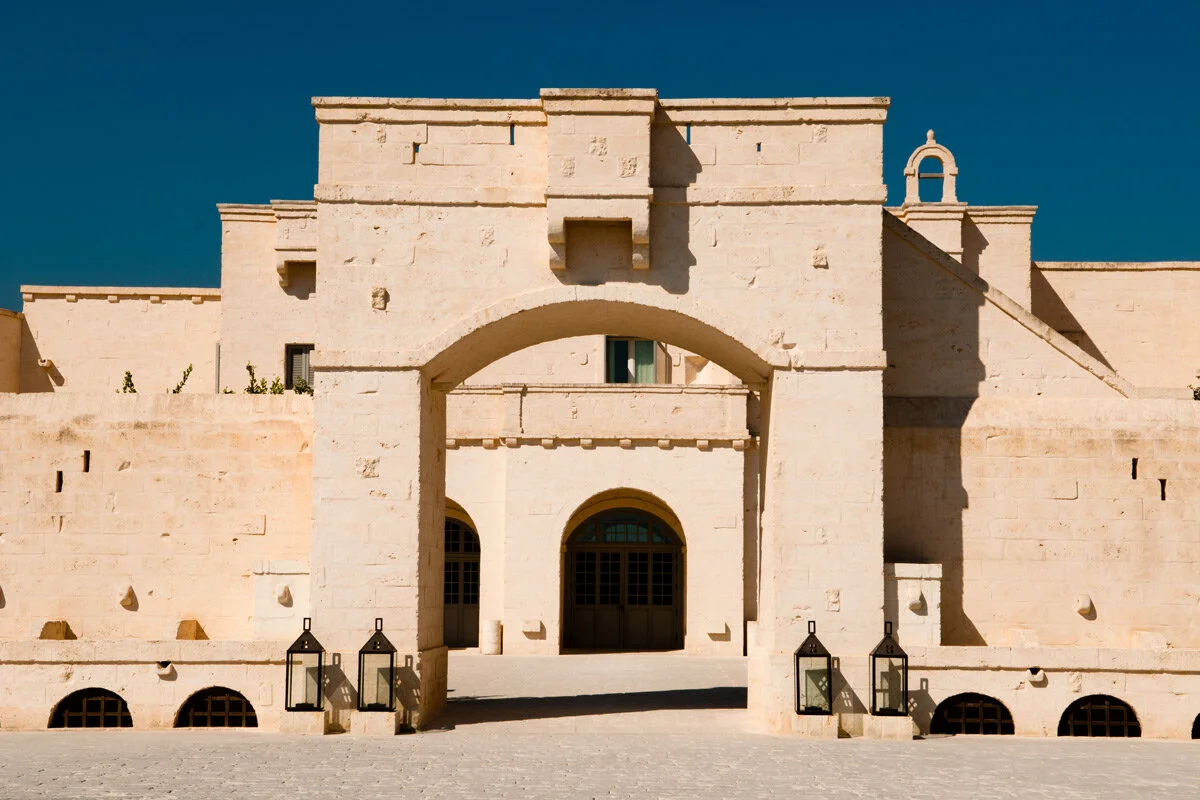
The entrance to the main building, La Corte.
What's New
Borgo focuses on "nowhere else" experiences and is always introducing something new. Recent offerings include Tarant spa treatments for women that are overseen by a local shaman; moisturizing oils and creams infused with local prickly pear, olive oil, and lemon developed by spa director Patrizia Bortolin; and beachy fashions from the concept shop, like chic caftans from UK-based niche brand Soler, tailored linen shirts custom-made for Borgo by Angelo Inglese, and the latest Allagiulia espadrilles. There is also a new pizza lunch spot and an ever-changing lunch buffet with fish crudo mixed to order.
The hotel also hosts Festa del Borgo three times each summer. The celebration features Apulian food and drink, local customs like the pizzica dance, a horse show that has steeds step in time to music (no joke), and demonstrations of beadwork and other local crafts. For kids, these nights are magical and worth planning a visit around. The luminaria-lighted central piazza and its surrounding streets twinkling with white lights make for the perfect place to stake out a table and savor the feast.
What's On Site
Literally everything you could wish for. Nothing has been overlooked by the Melpignano family, owners of Borgo Egnazia and the local boutique brand of San Domenico Hotels. The service is attentive and relaxed at the same time, from the moment you recieve a welcome drink in your spacious, light-filled room to the minute you want a spur-of-the-moment warm-stone Mascior massage.
There are several tennis courts and three pools — a swimming pool for families and two peaceful adult pools decked with sun loungers and shades and glasses of chilled Prosecco that seem to come out of nowhere. San Domenico Golf Course is across the driveway, and Cala Masciola beach club is a short bike ride away. The club is an ideal spot to spend a day in a cabana gazing out at the azure Adriatic. Water sports like paddle boarding, snorkeling, fishing, and kayaking are available to hotel guests, as are meals of grilled fish and pastas studded with sea urchin at Pescheria da Vito.
One major highlight at Borgo is Vair Spa, a sanctuary with soothing, tailor-made restorative treatments led by barefoot aestheticians. De-stress with herb-infused facials, cocooning cleansing rituals, and aromatherapies made from locally sourced ingredients. This is a destination spa, but guests are encouraged to try something as simple as a Roman bath, an Iyengar yoga class, or a relaxing pedicure. (No grueling workouts or deprivation here.)

One of two adult-only pools.
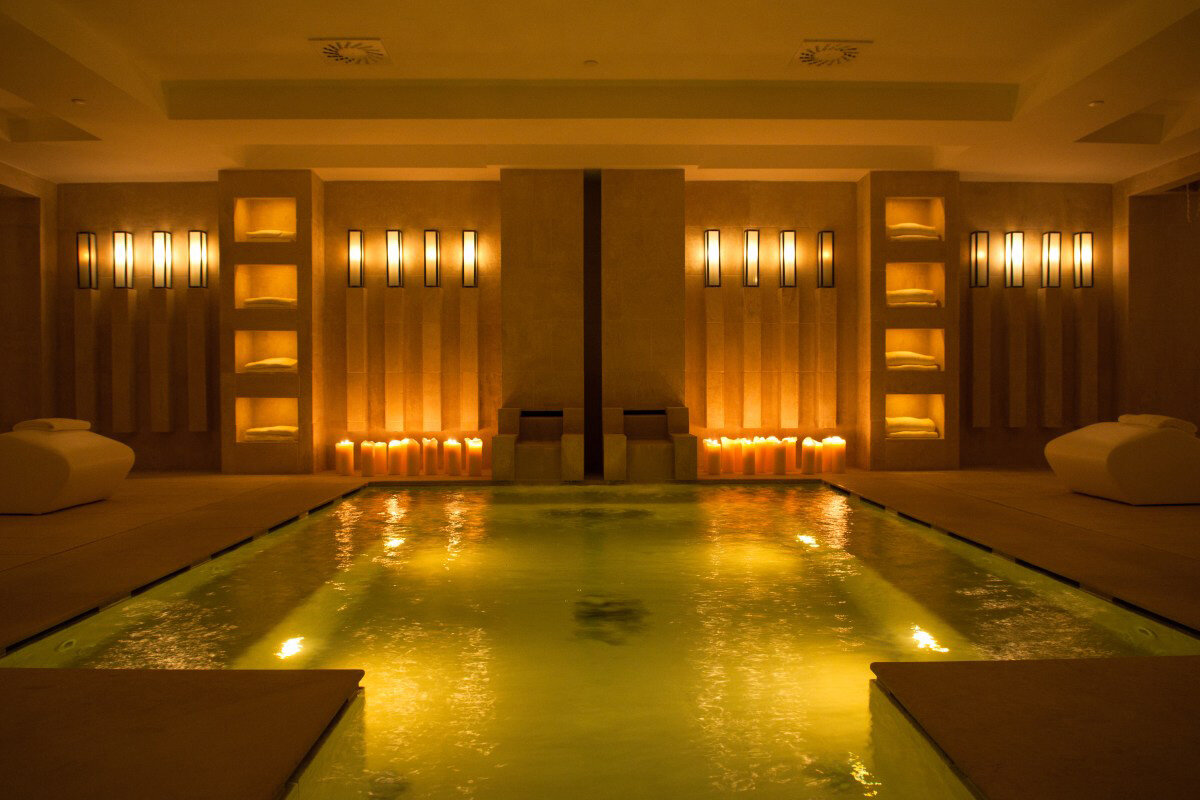
The Roman baths at Vair Spa.
The Food
It's impossible to find a bad meal in this part of the world, and this holds true for all of the restaurants at Borgo Egnazia. My favorites were the most relaxed: La Frasca for a casual breakfast buffet, Trattoria Mia Cucina for crusty, chewy pizza con prosciutto, and my top pick, the chic ocean-front Pescheria da Vito for billowing white linens and just-caught tuna tartare.
For a special evening, I highly recommend Due Camini. The hotel's fine dining option is so wonderfully designed that I barely focused on the cuisine, though it is excellent and traditionally Apulian. Neutral linens, local limestone, and exquisitely simple light fixtures create a magical backdrop reminiscent of a white-washed castle. Savor grilled octopus and house-made gnocchi with tomatoes grown on site, as well as glasses of local red and white wines. Verdeca house white and Negroamara Cabernet by Masseria Li Veli were among the highlights.
In the Room
There are 192 rooms — 63 in La Corte, the main house, and 92 in Borgo, which are sprawling, bi-level casitas. Most have patios or rooftops for sipping an Aperol spritz. Twenty-eight sumptuous villas, some with six bedrooms for all kinds of family configuration, round out the offerings.
Interiors are spacious and light-filled, but in no way showy or luxe: the epitome of understated elegance. Décor is perfectly muted — beige and cream-colored textiles, stone walls made of local materials (like tuff), sleek TVs, minibars with unlimited beverages, and terra-cotta tile bathroom suites.

La Corte Splendida.

A junior suite in Il Borgo.
Rooms with a View
I stayed in three different room types and loved them all. Bi-level room 37 in Il Borgo was perfect for our family of four (with two teens who need separate space), while room 52, a light-filled accommodation, was the ideal set up for two adults. Best of all was room 182 in La Corte, just off the central courtyard. The flowing space felt like a separate house and was in striking distance to the gym, adult pool, and subterranean spa. I'm coming back to stay at a villa. They look toned-down and tasteful, as with everything at Borgo Egnazia.
This Place Is Perfect For
Couples, families with children of all ages, stressed-out people in need of a relaxing spa experience. Also: foodies, sun-worshippers, lovers of the abundant UNESCO World Heritage sites surrounding the property, golfers, swimmers, chic shoppers. I could go on. The beauty of Borgo is that you can choose to see people or be completely, and I mean completely, alone.
But Not So Perfect For
Anyone averse to the heat or the sun. Both are seriously strong. And anyone who doesn't like fish. It's possible to subsist on pasta, but fruits of the sea are the name of the game.

Villa Magnifica.

The dining room at Due Camini.
CHECKING OUT
Neighborhood Vibe
One of the most wonderful things about Borgo Egnazia is its proximity to so much great culture (UNESCO World Heritage sites, medieval towns) and natural beauty (stunning blue grottoes, rocky beaches, and endless verdant rolling hills).
What to Do Nearby
Outside the hotel gates is Savelletri. It might not seem like much at first glance, but the fishing town is unbelievably charming at night. I especially loved dinner at the design-led Pescheria 2 Mari, with lots of glass and the freshest tuna crudo I've ever tasted. The restaurant is a wonderful place to watch the world go by on a summer evening, as is La Taverna di Umberto across the road.
Best of all was lunch at Ricciolandia (SP90, Torre Canne; +39-33-8357-3010), a massive outdoor spot serving freshly caught urchin prepared all sorts of ways. It's breezy picnic table dining that offers a glimpse into local life at very affordable prices. Ristorante Osteria del Porto is another winner for spaghetti alle vongole and grilled seafood served on a deck overlooking the harbor's fishing skiffs.
Just north of Borgo in the seaside village of Poliganano a Mare: incredible mussels and branzino at Da Tuccino, where the warm waitstaff is topped only by unparalleled people-watching from the terrace. The nearby fishing village of Monopoli is also worth an excursion, as is dinner at the atmospheric Porto Ghiacciolo (+39-34-6223-7762), which has white sandy beaches on either side. The embodiment of the Dolce Vita vibe.
No trip to this part of the world would be complete without seeing the trulli, conical stone houses, of Alberobello. It's touristy, so go in early in the morning, then visit the lovely centro storico in the quiet, sweet town of Cisternino.
Ostuni is another highlight, perched on a hillside overlooking the distant sea, where we had several of the most memorable meals of our trip: Casa San Giacomo (Via B. Continelli, 4; +39-32-8138-8457) for a cozy meal in a grotto-like setting, Il Bella Vista for stunning views of olive groves at sunset, and La Sommita for chic cocktails in a hip hotel atmosphere.
Last but certainly not least is Lecce, a historic city with exuberant Baroque masterpieces at every turn. Basilica di Santa Croce, Piazza del Duomo, and the stunning Museo Faggiano are all must-sees. A meal at the new boutique hotel at La Fiermontina is another reason to visit.

A classic combination. Photo courtesy of Osteria del Porto.
PLAN YOUR TRIP
How to Get There
Fly into Bari Karol Wojtyla Airport (BRI) or Brindisi-Salento Airport (BDS). The ride from either is an hour.
Getting Around
I highly recommend a rental car for day trips to nearby Polignano, Lecce, Ostuni, Cisternino, Alberobello, and Savelletri, the sweet seaside town right outside Borgo's front gates.
What to Pack
Bring sunscreen. The sun is searing. The highest SPF I could find was 25, which didn't do much for my pale skin.
Good to Know
The services of Emily Fitzroy, of London-based Bellini Travel, are incredibly useful when planning a trip to this part of the world. Emily is an insider and has access to hole-in-the-wall restaurants like Ricciolandia in Savelletri and scores of impossible-to-book tables at trendy spots like Masseria Cimino. Her incredible team handles everything from car transfers to cathedral tours in Lecce. Consider her the tasteful, connected Italian friend you wish you had.
BOOK IT
La Corte Bella rooms start at $831 per night. Click here for reservations.
BUT WAIT, THERE'S MORE
Do It Like an Italian: Escape to Puglia
A Little Corner of Hotel Heaven in Puglia
Holy Hotel! It's Pure Italian Magic at an Off-the-Grid Convent-Turned-Palazzo
Alice Temperley’s perfect weekend in Somerset and Dorset
The British designer is a champion of artisanal craft and embellishment and celebrated for her romantic ready-to-wear and bespoke bridal gowns
The British designer is a champion of artisanal craft and embellishment and celebrated for her romantic ready-to-wear and bespoke bridal gowns
After years of working at weekends, mine are now focused on enjoying family, food and music. I grew up in Somerset, and when the skies are clear this is the English countryside at its finest, with unspoilt views in all directions and space for the children – my son Fox, eight, and my boyfriend Greg’s two – to run wild. It is where days seem longer and silence envelops you. I think of my weekends here as la dolce vita Somerset-style; it’s a breathtaking place.
Our light-filled house is beautiful, wonderfully impractical and hopelessly romantic. It was previously owned by Lord Beaverbrook, who held secret war meetings here and played host to Winston Churchill. There’s also a folly that was built on the remains of a medieval castle; it contains the ruins of a Tudor bear pit and a dungeon, which I threaten the children with on occasion.
Saturday mornings often begin in my beloved disco bath, which is freestanding, mirrored and surrounded by gigantic windows. Then I’ll cycle down to Bridport to seek creative inspiration at the antiques and vintage market – it is full of diverse vendors and is a great place for bric-à-brac and the eclectic pieces I collect for the house. The Red Brick Café there serves delicious falafel and local greens.
This small town feels old-fashioned and otherworldly compared to London. I’ll pop into Bridport Old Books, which is good for stories about bygone Somerset and classic fairytales. I also like Malabar Trading for kilims and Indian silk shirts, and Samways, a fishmonger where I buy samphire en masse when it’s in season.
After I’ve had a good look around, I’ll try my hardest to cycle up the gruelling hills from Bridport to Lyme Regis to meet Greg and the children for lunch. We are regulars at Hix Oyster & Fish House, my friend Mark Hix’s Dorset outpost, where we’ll enjoy oysters and great rosé – particularly if Mark is in residence – which gives me a very good excuse not to cycle the 12 miles home.
Afternoons are usually spent in the garden, lounging on rugs, playing kiss-catch, making bonfires and watching the sun sink. I might spend a few hours playing old records and fiddling around with a painting I never have time to finish.
Later we’ll often go to Hauser & Wirth for a cocktail and some contemporary art before returning home for an evening of good friends, great wine and a mix of music. Thankfully Greg is a brilliant cook as we usually have 20 people around the table – an eclectic bunch of family, arty friends and kids – for a whole salmon or a big roast. In an ideal world I’m in bed by 9pm, but this rarely happens.
On Sunday mornings, after a flick through the FT and Sunday Times weekend supplements, we might go to Dennis China Works [pictured] up the road for breakfast. It has an amazing array of pottery that’s popular with collectors and is my favourite place to buy bespoke pots, plates and bowls for wedding presents.
Sunday lunches tend to be long and I have implemented a policy whereby friends and family each contribute a dish. My parents bring lamb, fresh pear cider, vegetables from their garden and my father’s amarelle cherries that have been soaked in eau du vie. My sister Mary lives in a converted chapel up the road and her family piles in too. The dining room is lively and inevitably finds the children having a breakdance contest.
Sunday evening still feels like a school night to me. We’ll stay in the country as long as possible before heading back to London with the kids in their pyjamas. Weekends in Somerset are like a tonic – a time to empty my head and enjoy the people around me. I always leave longing for one more day.

Minyatür Istanbul
This magical Istanbul emporium is packed to the gills with nautical antiques and attracts visitors from collectors to royalty
This magical Istanbul emporium is packed to the gills with nautical antiques and attracts visitors from collectors to royalty
In the heart of Istanbul’s labyrinthine Grand Bazaar is an Aladdin’s cave that seems to have been lifted from the pages of Jules Verne’s 1870 sci-fi classic Twenty Thousand Leagues Under the Sea. A magical emporium packed to the ceiling with an intriguing inventory of nautical antiques, Minyatür was founded in 1962 by Hasan Yedek and Halit Altuncu and is overseen today by Yedek’s son, Haluk, himself a passionate collector and seafaring historian.

Image: Mathias Depardon
“Every customer finds something different here, something special – objects for their homes, offices or restaurants. These are rare pieces that create a nautical ambience,” says Haluk of the enormous globes (from $500), sextants (from $1,000) and Soviet-era wall-mounted submarine phones (from $1,500) that have become a Minyatür speciality. The sheer scope of the stock – faded vintage postcards (from $20) bearing images of the Hagia Sophia and the Bosphorus, a c1790 English Dollond library telescope ($4,000) or sundials (from $1,000) of Chinese, Persian and Arab origin – attracts a wide range of visitors, from collectors to tourists to the King of Morocco.
“He bought several ships’ windows and a magnifying glass for his young daughter, but also spied a framed prayer on the wall that wasn’t for sale,” says Haluk. “He liked it so much I gave it to him. His consul later returned with a beautiful thank you letter from the king, and it now hangs in the prayer’s place.” This generous spirit is one of Minyatür’s draws, as Haluk enthusiastically shares his vast maritime know-how with all who come through the door. Indeed, many of Istanbul’s best guides bring their clients here for an intimate, museum-like experience that is both entertaining and educational.
These impromptu lessons in maritime history might focus on Haluk’s prized offerings from the Ottoman period – such as a brass compass ($1,000), pocket watch ($1,250) or ruler ($600) – which often feature exquisite inscriptions. Or they might examine some other still-functioning nautical instruments: wooden and folding cameras (from $200) by Voiglönder, Agfa and Leica; English wall clocks (from $500) by Smiths and Kelvin Hughes; and German microscopes (from $650) by Leitz, often in mint condition.
Were it not for Haluk’s guidance (lucky visitors might also find the founders in store, talking business over tea, as well as Haluk’s brother Faruk, who helps with restoration), the selection could seem overwhelming. As well as brass jewellery boxes (from $200) and even delicate Limoges tea sets ($150), all of which were once used on sailing vessels, there are collections of polished silver canes (from $300, some intricately filigreed, others sculpturally simple), delicate magnifying-glass necklaces (from $100) and ships’ bells (from $750) in varying sizes, all adding to the oceanic scene. “The way we curate the objects creates a unique experience that is part of the culture and heritage of Turkey, and specifically of Istanbul,” says Haluk. Minyatür may be in the buzzing bazaar, but it is also a portal to a bygone age of seafaring adventure.

Tour an Airy Hillsborough Home
The desire for streamlined, lighthearted living drew an active, outdoorsy family with three teenagers to this home in leafy Hillsborough, says interior designer Heather Hilliard. Built in the ’90s in a postmodernist style, the 7,800-square-foot house was transformed by Hilliard and architect Stephen Sutro from a warren of small, underutilized rooms into an elegant, light-filled space.
After taking the structure down to the studs, Sutro and colleague Brooks McDonald devised a new layout to maximize flow around a central axis, and the outdoors were drawn in via the addition of walls of glass doors to the family room, living room and kitchen. Modern stepped crown molding, millwork and new oak flooring were also added to create a “rich, layered look,” explains Sutro. Outside, the original yellow stucco was replaced by a warm gray hue “to make the corners crisp,” Sutro notes, a new metal roof was added, and landscaping updates included refreshes to the pool and tennis court.
Perhaps the most significant stroke is the new foyer, where a sweeping, circular staircase connects the first and second floors, creating a dramatic entrance. Hilliard hung sculptural, overscaled Tom Dixon Mirror Ball pendants in the 24-foot-high space. “The pendants connect the spaces, and their scale is unexpected,” says Hilliard. “It’s a rhythm we used throughout—beautiful pieces interspersed with ample negative space.” An oversized pivot door designed by Sutro also “creates a welcoming sense of arrival,” she adds.
Extending from the entry is a hall painted in Farrow & Ball’s crisp Wimborne White, a hue chosen to “create a gallery-like setting that offsets the couple’s art collection,” says Hilliard. The focal point of the space is Katy Stone’s Constellation—a wall-mounted work in metal that casts changing shadows throughout the day.
To accommodate the family’s preference for low-key entertaining, Hilliard and her associate Phebe Apgar Williams created two separate arrangements in the living room. One is a seating area anchored by a sofa in a textural bouclé weave from Zinc Textile that they paired with white Mongolian chairs and custom ottomans. The designers also showcased large-scale works by female artists including Cynthia Ona Innis, Amy Kaufman and Suzanne Caporael. The opposite end of the room features a gaming area centered on a custom billiard table and a custom leather cabinet for cue storage. Bold blue drapery panels in a Jim Thompson silk add a luxurious yet thoroughly modern feel to both spaces.
Just off the living room, the office is connected to bustling family activity, but glass pocket doors also afford it privacy. The cozy, clubby space has built-in cases lacquered in deep blue, and the walls are clad in blue tone-on-tone Phillip Jeffries grasscloth. Hilliard also designed a custom desk in varying shades of indigo. The blue story continues in the ever-so-slightly formal dining room, where C&C Milano linen sheers glow indigo when backlit, and a cloud-like Ted Abramczyk fixture seems to hover above an Antoine Proulx dining table.
One of the most dramatically altered spaces is the combined family room and kitchen, which now has 10-foot ceilings that maximize views of the terraces and plantings beyond. Many meals are enjoyed at an island topped with a Golden Laza slab. “This stone looks like a watercolor, with warm touches that are subtle and diffuse,” says Hilliard.
Upstairs, the relaxed sensibility continues. Giant Sea Urchin pendants from Coup D’Etat illuminate the playroom, where large swivel chairs, a homework table and a massive screen accommodate both studying and family movie night. Just down the hall are the children’s rooms and the master suite, a study in serene grays and blues.
“There is a lot of joy with this family,” says Hilliard. “I think this home reflects that spirit.” Adds Sutro: “The house is a balance of contemporary quality with friendly, modern elements. Above all, it isn’t too precious.”
A version of this article appeared in the June/July 2016 issue of SFC&G (San Francisco Cottages & Gardens) with the headline: Breathing Room.

Cookies for connoisseurs in Copenhagen
Leckerbaer’s sweet treats taste as good as they look
Leckerbaer’s sweet treats taste as good as they look
Everything is design-led in Denmark. And that includes the sweet treats at Leckerbaer in Copenhagen’s Østerbro district – a cosy, 16-seat patisserie housed in a former butcher’s shop that is among my favourite finds in this picturesque city. With fragrant smells wafting in from the bustling kitchen, its art-like small delicacies – from classic butter biscuits and little cakes to cream puffs, brownies and biscuits – are available in varying hues, shapes and flavour combinations (first picture), all meant to be savoured in two or three bites.

Founded in 2015 by chefs Jakob and Gabi Bär Mogensen, Leckerbaer translates their Michelin-starred training into sophisticated takes on traditional desserts. Sampling is the name of the game here, and the cookie creations can be bought singly (DKr15 each, about £1.70) or in boxes of eight (about £11, second picture), 12 (about £15) or 16 (about £18) – in streamlined brown packaging for takeaway customers.
We opted for a dozen treats – profiteroles bursting with creamy vanilla and salted caramel fillings; shortbread with hints of mint and chocolate; hindbærsnitte (raspberry slices) topped with thick marmalade and raspberry jam; and a featherweight, passion-fruit-infused meringue – all of which tasted as good as they looked. Leckerbaer also offers an elevated take on the classic Oreo cookie (mælk), which, with its crispy chocolate wafers and vanilla filling, was the perfect accompaniment to my seriously strong cup of coffee.
All of the spectacular concoctions here are made using the highest quality, sustainable ingredients such as Felchlin chocolate from Gabi’s native Switzerland. In addition to the smaller nibbles, proper puddings are on offer, including a lemon verbena sorbet – but raspberry and lemon-curd trifle beckoned.

This Kettal Executive Trusts Word of Mouth Above All Else
Alex Alorda's father launched the Barcelona-based outdoor furniture maker over fifty years ago but the young vice president has his eyes fixed on the future.
Alex Alorda's father launched the Barcelona-based outdoor furniture maker over fifty years ago but the young vice president has his eyes fixed on the future.
Your father founded Kettal in 1964 and is still the president. What did he teach you about running a business that has helped you in your role as vice president?
He taught me the enduring values of consistency and common sense, as well the importance of being humble. He also taught me—all of us at the company—how to manage and empower people. He’s no longer involved in the day-to-day running of the company, but he comes often to have lunch.
How has the marketing strategy changed from the 1960s when Kettal threw branded beach balls out of an airplane onto the crowded beach below?
Our marketing strategy today is entirely by word of mouth. The hospitality industry is a smaller world than people think, and one project often leads to the next with hotel groups, and with our other customers as well.
How important is it that Kettal products be made in Spain?
Our company is more of a “project” that’s by people, for people. Everyone who works here feels linked to the product. Our factory is set up to work directly with the designers, and because everything is produced in and around Barcelona, we can control the quality and explain our values—without anything getting lost in translation.
You’ve collaborated with design greats like Patricia Urquiola, Jasper Morrison, and Nanna Ditzel. How do you choose these partners?
We don’t collect designers. We work with people who share our passion and we help make their designs a reality. Patricia Urquiola is a godmother to us all and she helped transform the company from one that made garden furniture to one that makes design furniture for the outdoors. She changed our mentality and that was a great opportunity. Patricia’s a cat with nine lives—always reinventing herself—and we’ve been producing collections with her for more than 12 years.
What other lessons have you learned from your design partners?
One of my favorite Jasper stories happened at the Milan Furniture Fair. He came on a Sunday when five of us were setting up the Kettal booth. We were exhausted and he pointed out that this hands-on approach was actually our strength: We have fewer people doing things, but we do them right. This was a very important insight for me.
What, in your mind, is good design?
Jasper Morrison said it best: “A design that is still in production after 30 years is a good one.” You will never create a good design with only a good designer—you also need a good company to make good things. Good designs involve long-lasting materials and are still being made years after their original production. Chairs by Charles and Ray Eames and Jean Prouvé that are still being made by Vitra are prime examples of this.
Whom would you like to collaborate with?
It’s too bad the Eameses are dead, and Jean Prouvé, too, as I would have loved to collaborate with them. We are always looking for people with long-term vision, original ideas, and who understand our ethos.
What are some of your most notable recent projects?
It was an honor to be a part of the Fondation Louis Vuitton project [in Paris]: the architecture, the outdoor spaces—everything is stunning. A new project for JW Marriot Los Cabos is another very rational, timeless project, and the Oasia Hotel in Singapore that we recently did with Patricia [Urquiola] is cutting-edge and colorful.
In terms of the perfect outdoor setting, where might it be?
This is almost impossible to answer, but both Minorca and Formentera have some of the most beautiful beaches in the world.
In an ideal world, what products might be next?
The wheel has already been invented, we just need more good wheels.

Michele Bönan talks personal taste: Part Two
The architect and interior designer rounds up his list of likes with Hubert de Givenchy, Iranian caviar and David Bowie’s single, Lazarus
The architect and interior designer rounds up his list of likes with Hubert de Givenchy, Iranian caviar and David Bowie’s single, Lazarus
My style icons include the impeccable Gianni Agnelli, Hubert de Givenchy and the Duke of Windsor – all of whom were beautifully dressed and carried themselves with great ease. The restaurateur Arrigo Cipriani is another man of style who has the gift for making everyone feel perfectly at home.
I never leave home without one of the watches I like to collect and my grey New Balance trainers. I like to jog wherever I go in the world – from Taiwan to Los Angeles to London – as it’s a great way to explore. I am a bit like James Bond – a man of style – so I often travel with a tuxedo and a bathing suit. You never know… From £44; www.newbalance.com.

Tortelli being prepared at Clinica Gastronomica Arnaldo, Rubiera | Image: Nikoboi
A recent “find” is the restaurant Clinica Gastronomica Arnaldo in Rubiera, between Modena and Reggio Emilia. This simple spot serves the most delicious stuffed pastas such as cappelletti and tortelli, as well as bollito misto – the classic Italian meat stew – in a warm, familial atmosphere. Piazza XXIV Maggio 3, 42048 Rubiera (+3905-2262 6124; www.clinicagastronomica.net).
The sight that inspires me is the sunset as seen from our house in St Tropez. The flowers there – lavender, violets – are beautiful and perfume the surrounding landscape. At the end of the day, the light is gorgeous and this is the best place for me to relax and get new ideas.
My fail-safe jet-lag cure is a gin and tonic with cucumber – preferably at Claridge’s bar. Flying private helps a lot too… Brook St, London W1 (020-7629 8860; www.claridges.co.uk).
The last meal that truly impressed me was at our friend’s winery – Colle Bereto – in Chianti. This part of Tuscany is just spectacular and we sat outside under a pergola at a long, beautiful table. Everything we ate – from the mozzarella that was made before our eyes, to the tomatoes and salad from their garden – was so natural and flavourful, and, of course, the Chianti Classico and Il Tocco wines were wonderful as well. Radda in Chianti, Siena (+390577-738 083; www.collebereto.it).

The Goat, 1950, by Picasso, at Musée Picasso, Paris | Image: Tuul and Bruno Morandi/Alamy Stock Photo
An object I would never part with is a leather chair of my own design that is broken in and very comfortable. It is made of two types of leather – boar and cowhide – in natural colours, and is elegant and timeless. More importantly, I would never part with my wedding ring, which, in fact, is very difficult to take off. This simple gold band is now literally a part of my hand.
An indulgence I would never forgo is really good Iranian caviar with a little bit of tomato and blinis. Our whole family loves caviar, especially when it’s served at a special Sunday lunch at the Four Seasons in Florence. The food there is excellent and I go when I know chef Vito Mollica is cooking. Borgo Pinti 99, 50121 Florence (+3905-526 261; www.fourseasons.com).

Colle Bereto vineyard, Chianti | Image: Alessandro Moggi
The last item of clothing I added to my wardrobe was a handmade, cream-coloured cashmere sweater given to me by my aunt. It’s practical and goes well with the jeans I wear all weekend.
The people I rely on for grooming and wellbeing are Tomasso at Mario di Via Della Vigna Nuova salon in Florence for my monthly haircuts, and the masseurs at the Heurigen Spa at the Jagdgut Wachtelhof hotel in Hinterthal in Austria, where I enjoy a good, strong massage. My son Sky is my excellent personal trainer and he keeps me motivated. Da Mario di Via della Vigna Nuova, Via Vigna Nuova 22, 50123 Florence (+3905-529 4813; www.mariodiviadellavigna.it). Jagdgut Wachtelhof, Urslaustrasse 7, A-5761 Maria Alm - Hinterthal (+436584-23888; www.hotelwachtelhof.at).

Hubert de Givenchy with his afghan hound | Image: Picture Post/Getty Images
The one artist whose work I would collect if I could is Alberto Giacometti. I love his drawings and sculptures, and since they are impossible for me to buy, I advise my clients to do so instead… I also love the white Concetto Spaziale works by Lucio Fontana – one can always dream.
If I didn’t live in Florence, the city I would live in is Paris. I love the Palais Royal and would like to own a house there, to be near the gardens. Every part of this light-filled city is a museum, but I’d like to spend more time at the Louvre, the Musée d’Orsay, the Musée Picasso and the area surrounding Le Marais. I love to hunt for unusual, difficult-to-find pieces for my clients at the Marché Paul Bert Serpette, and Chez L’Ami Louis is one of my favourite restaurants anywhere for both the food and the intimate atmosphere. Chez L’Ami Louis, 32 Rue du Vertbois (+331-4887 7748). The Louvre, +331-4020 5050; www.louvre.fr. Marché Paul Bert Serpette, 96-110 Rue des Rosiers (+331-4011 5414; www.marcheauxpuces-saintouen.com). Musée d’Orsay, 1 Rue de la Légion d’Honneur (+331-4049 4814; www.musee-orsay.fr). Musée Picasso, 5 Rue de Thorigny (+331-8556 0036; www.museepicassoparis.fr).
If I had to limit my shopping to one neighbourhood in one city, I’d choose the Oltrarno in Florence. Silversmith Argentiere Pagliai is a must for beautifully made picture frames and cutlery, while Laboratorio di Moleria Locchi is a centuries-old studio full of handblown crystal vases and tableware. For contemporary furniture I like Flair for one-of-a-kind and Danish modern pieces. The Vennari Gioielli showroom is another very special place full of jewellery and cufflinks that are made using materials like onyx, mother-of-pearl and enamel. Argentiere Pagliai, Borgo San Iacopo 41R (+39055-282 840; www.argentierepagliai.it). Flair, Lungarno Corsini 24R (+39055-267 0154; www.flair.it). Laboratorio di Moleria Locchi, Via Domenico Burchiello 10 (+39055-229 8371; www.locchi.com). Vennari Gioielli, Via de’ Tornabuoni 1 (+39055-291 832; www.vennarigioielli.com).
The last music I downloaded was David Bowie’s final single Lazarus. This song is particularly powerful as it was released shortly before his death. I have to credit my son with this one as I typically listen to classical music – mostly Mozart – while I work, or when I sketch and paint.
The books on my bedside table are often from Assouline and are focused on art and design. I am currently reading The Big Book of Chic by American interior designer Miles Redd. I also like the positive psychology of the Dalai Lama’s The Art of Happiness. More often than not, though, my nights are devoted to reading history books with my children. www.assouline.com.
If I weren’t doing what I do, I would be a painter. I love to draw and paint whenever I have spare time, and this carries over into a lot of the design work I do now. I love abstraction and brilliant colour, and in an ideal world, I’d paint like Picasso. Directing movies holds appeal as well…