
Ravello: A Breathtaking Bird's Eye View
The Amalfi Coast's villa-lined hills and glistening beaches are beautiful from any angle, but hovering at 2,000 feet, Ravello's view might just take the cake. Fathom contributing editor Christina Ohly takes you there.
The Amalfi Coast's villa-lined hills and glistening beaches are beautiful from any angle, but hovering at 2,000 feet, Ravello's view might just take the cake. Fathom contributing editor Christina Ohly takes you there.
RAVELLO, Italy – Perched high on a hilltop overlooking the Amalfi Coast sits Ravello, a medieval village full of winding cobblestone streets, fragrant gardens, and breathtaking views of the Mediterranean.
WHAT TO DO
Ravello offers the perfect mix of culture — spectacular churches, villas, and expansive gardens — and complete relaxation in the form of delicious meals and luxurious lodgings with restorative sea views.
Relax
You will automatically dial it down in Ravello, where the day's major decisions tend to revolve around which concert to see or which catch of the day to order for lunch. Give yourself over to wandering the quiet streets and absorbing the art and culture that abounds on literally every street corner.

The view from the gardens of Villa Cimbrone.

An interior shot at Villa Cimbrone.
Explore the Gardens
Don't miss the Villa Cimbrone, a massive open space comprised of lush gardens, fountains, temples, and assorted follies that overlook the sea in the distance. Lovingly restored by an English lord, Villa Cimbrone is a quirky and wonderful place to relax, have a Campari soda, and enjoy an outdoor concert. Gore Vidal once described the panorama here as "the most beautiful in the world." It would be hard to disagree.
Another spot worth visiting is the Villa Rufolo, a centrally-located former watch tower with a massive main tower, an important chapel, and a Moorish cloister with Arabic decorative elements. The piece de resistance is the promontory garden filled with fragrant blossoms that was once beloved by Wagner and is now the site of the famous Ravello music festival.

A detail of the pastel interior at the Duomo in Ravello.
Spa It Up
Several of the town's top-notch hotels offer spa treatments that become even more magical because they are performed outdoors under the shade of blossoming trees or in delicate white tents. Try Palazzo Avino or Hotel Caruso, with its holistic approach, and the truly breathtaking Monastero Santa Rosa in nearby Conca dei Marini for the chic thermal baths.
Go to Church
Ravello's cathedral, built in 1087 and home to one of the most important bronze doors in Italy, is unmissable. Behind the bright white façade is a 14th-century sarcophagus, the chapel of San Pantaleone, that's notable for the glass, gold, and silver ampulla that contains the saint's dried blood that miraculously liquifies each year. (Don't ask.) This just might have been the trip highlight for my kids.
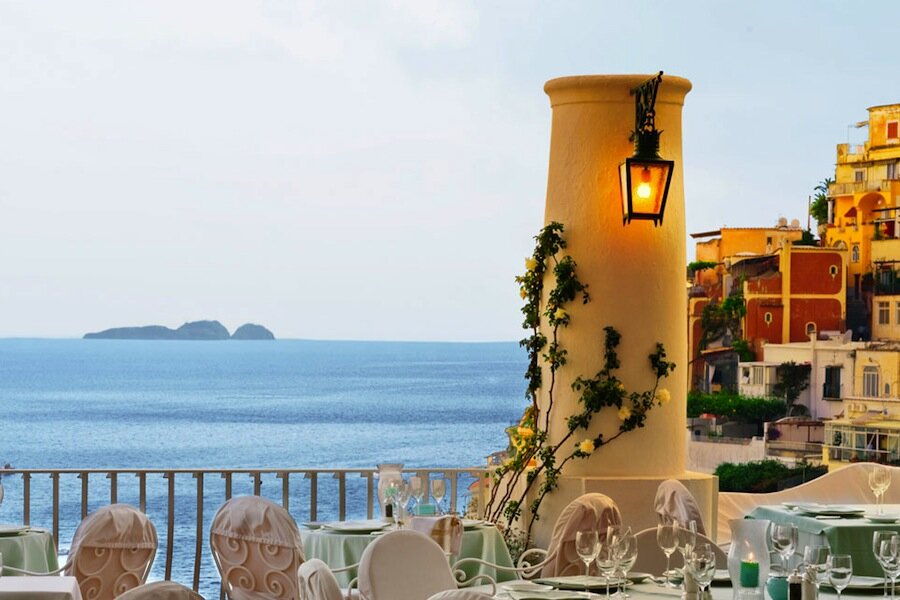
Photo: Courtesy of Le Sirenuse
Visit Nearby Towns
You will be tempted to never leave your hilltop perch, but several towns along the Amalfi Coast are absolutely worth the drive. Positano can get ridiculously crowded, but stop in for a lovely for a lunch at the legendary hotel Le Sirenuse, then take a short stroll down to the port.
My favorite areas, however, were the off-the-beaten-track towns Cetara and Atrani. Both are wonderful for local color, picturesque piazzas, and fantastic seafood restaurants. Acqua Pazza in Cetara is impossible to beat, and A'Paranza in Atrani serves incredibly fresh spaghetti alle vongole by the sea. Be sure to book your tables in advance.

Cathedral of the Apostle Saint Andrew in Amalfi.
Amalfi may be a gritty port town, but it's absolutely worth a visit for the Cathedral of the Apostle Saint Andrew. A mix of romanesque and baroque elements, the cathedral is reached by an imposing staircase and has a colorful facade with glittering gold mosaics. The interiors are no less impressive, with coffered ceilings, a mother of pearl crucifix, and a massive sarcophagus that is just one of the many highlights.


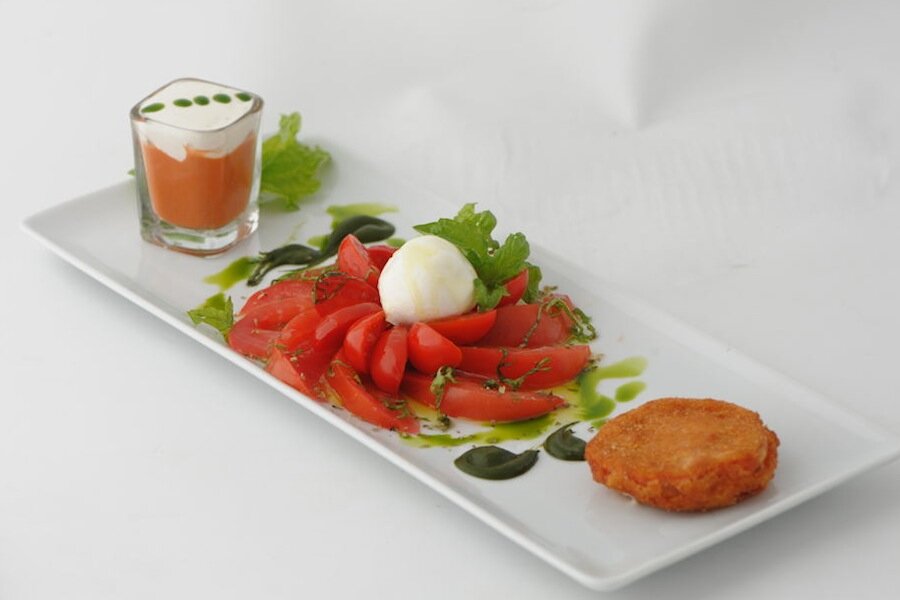
Photos of da Gemma courtesy of the restaurant.
Photos of da Gemma courtesy of the restaurant.
Amalfi brims with sweet white houses, endless terraces, and winding streets full of alleys and small shops. You could spend a whole afternoon exploring La Scuderia del Duca, an incredible boutique full of papers, prints, and etchings, followed by one of the best meals you're likely to eat — in Italy or anywhere — at da Gemma. This was a Michelin-esque surprise, complete with a reinterpretation of the classic Caprese salad, as well as a pleasant terrace setting overlooking the bustling street below.
Ruin and Islands
The fascinating archaeological ruins at Pompei, the Greek temples at Paestum, and the natural beauty of chic Capri and Ischia are all ferry or car rides away.

A detail at Villa Cimbrone.
MANGIARE BENE
Michelin stars abound here, but it was the simpler trattorias and pizzerias that captured my taste buds.
Morning Fuel
The breakfast spread at the Hotel Caruso is simply impossible to beat: house-baked bread, fruits of all kinds, lavender-infused honey, plus fluffy omelets and crispy bacon cooked to order. With the sunny patio setting, there is no reason to venture elsewhere.
Lunch
Of all the meals we ate on this gastronomic power tour, our favorite by far was lunch at the Pool Restaurant at Hotel Caruso. They pride themselves on their wood-fired pizzas — the Vesuvio with fresh rucola and tomatoes was a crowd-pleaser — and invite kids into the process of making these perfectly crusty pies. The substantial salad bar has all sorts of tomatoes, local tuna and langoustines, endless breads, and the freshest gazpacho. It is the whole relaxed feel here — under the Mediterranean pergola, overlooking the infinity pool and the mountains beyond — that makes this spot so special.
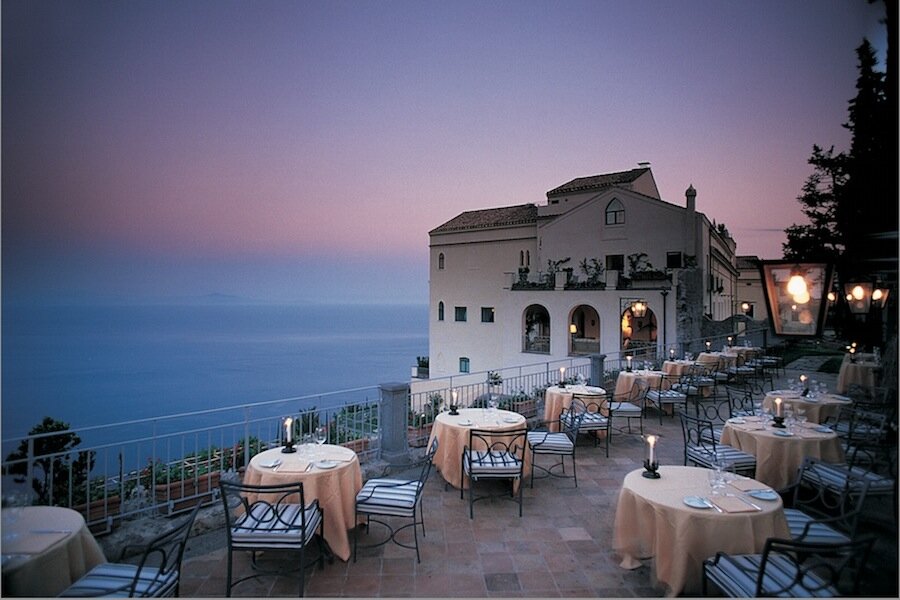
Belvedere means "lovely view," and they're not kidding. Photo courtesy of Hotel Caruso.
Dinner
Do not miss a special meal at Belvedere Restaurant, where chef Mimmo de Raffaelle made us feel like royalty with unique appetizers, interesting preparations of classic Neapolitan dishes, and the simplest grilled seafood sampling I've ever tasted. Views of the azure sea, insanely good desserts, and petits fours complete the magical experience.
Cumpà Cosimo
Just off the main piazza (Via Roma 44–46 +39 089 857-156), it's right out of a movie. The family-operated trattoria serves simple food in a relaxed setting overseen by a grandmotherly figure who just screams Italia! — meat from the family butcher, house-made pastas (gnocchi is a standout), and grilled langoustines. All delicious. Jackie O. originally made this one famous, and it is still worth a visit today.
Ristorante Pizzeria Vittoria
If you're craving a simple pizzeria with a relaxed vibe, look no further. Antipasti, lasagna, and endless variations on a pizza. Personal favorite: Ravellese, with cherry tomatoes and zucchini.
Now that's a hotel room. Photo courtesy of Hotel Caruso.
WHERE TO STAY
Hotel Caruso
The best, in my humble opinion. A former 11th-century palace that has been restored to include 48 rooms and suites, many with original architectural details and frescoes. Our room was spacious, with stunning water views and every imaginable amenity. The highlight here, however, is the incredible staff — just the kindest people I've found in any hotel, and incredibly efficient, too. Tip: Don't miss a world-class massage en plein air as well as stroll through the wisteria-laden pergola on your way to the gorgeous infinity pool.
Palazzo Avino
Another beautiful option. This former 12th-century villa houses 18th-century antiques, Frette linens, and the Lobster & Martini Bar, which, as the name implies, serves both of these delicious things as you watch the spectacular sunset.

The view downhill from Ravello.
PLAN YOUR TRIP
I'm not usually one to enlist the help of a travel agent because I prefer to go it alone. But in this instance, I relied on the help of London-based Emily Fitzroy of Bellini Travel. Her exquisite taste and firm command of the intricacies of the Italian transfer (planes, cars, ferries) made our trip seamless. She is truly an expert resource for this part of the world.
Fly: The closest international airport is in Naples Capodichino (CAP), which is roughly one hour by car. (The roads here are unpredictable at best.) Alternately, you can get to Ravello by ferry to Amalfi.
MAP IT
See all the locations mentioned in this story. (Google Maps)
MORE ON FATHOM
Amalfi Coast Guide

A La Turca
A treasure hunt through this Istanbul antiques haven turns up lessons in Ottoman history – along with a glass of cherry wine
A treasure hunt through this Istanbul antiques haven turns up lessons in Ottoman history – along with a glass of cherry wine
Tucked down a side street in Istanbul’s artistic and eclectic Çukurcuma district, in a spectacular 19th-century, four-storey townhouse, is a true treasure trove of Turkish antiques. Brimming with pieces you’re unlikely to find assembled anywhere else, this fascinating emporium feels like the private home of a tasteful collector. Indeed, a visit to A La Turca is an education in Ottoman art history and local lore, not to mention a visual feast, full of exquisite objects that cover every available surface – all lovingly amassed by owner Erkal Aksoy.

Classic Ottoman vintage rose water glasses (€250-€550, top shelf) and Anatolian vintage jars (€350-€750, bottom shelf). | Image: Emre Uzer
Visitors to his store-cum-museum are in for a treat; one that begins with a glass of cherry wine and sweets – perfect sustenance for the hours one can spend exploring the jam-packed floors. “I love sharing my culture and history with my clients, many of whom simply come to browse,” explains Aksoy – and one doesn’t feel any pressure to buy.
Starting in the rug and kilim department that A La Turca is so justly known for, one finds impressive floor-to-ceiling shelves that display a colourful array of some 4,000 carpets (from €800-€18,000), made from either wool or cotton in Turkey’s Konya and Sivas regions. The latter’s kilims are noted for their deep red hues, while simple floral and geometric motifs dominate the entire collection. Aksoy and his assistants are happy to unfurl rug after rug, sharing their knowledge of traditional weaving techniques and ancient textiles.

Ottoman sultan portraits, oil on canvas, from €1,500 | Image: Emre Uzer
In the basement there is a profusion of Turkish pottery – Aksoy’s “true passion” – including green-glazed urns (€350-€4,000), vases (from €450) and assorted Aegean water jugs (€450-€4,000). The upper floors feature beautiful hand-blown glassware in translucent shades of blue (€550-€1,500) – “traditional cheese containers that are buried below ground to age”, explains Aksoy. There are also classic Ottoman vintage rose water glasses (€250-€550, pictured left, top shelf) and Anatolian vintage jars (€350-€750).

Vintage globes, from €1,600 | Image: Emre Uzer
One of A La Turca’s most spectacular spaces houses a collection of antique globes (€1,600-€8,500) that have been gathered from all over the world, and the Ottoman portraits of sultans painted in oils (€1,500-€15,000) that adorn the walls are particularly intriguing. Dotted around are more modern paintings (€350-€3,000), about 50-60 years old and simply framed in gilded wood, while marble vases once used for traditional boza drinks (€500-€5,000), copper statuary (from €350), embroideries (from €1,650), Arabic scrolls (from €750) and enormous custom-made “great tables” (€2,500), which Aksoy commissions from the neighbouring Princes’ Islands, round out the shop’s unique offerings.
However, it is Aksoy himself – with his exacting eye and knowledge – that makes A La Turca a must. As he explains: “I am influenced by the architecture, history and chaotic energy of Istanbul, where the east meets the west.” Prepare to discover a condensed cultural history in objects, cherry-picked by a discerning curator.

An illuminating solution
Chic upcycled-plastic-bottle pendant lamps – made by Colombian artisans
Chic upcycled-plastic-bottle pendant lamps – made by Colombian artisans
Faced with the environmental problem that tonnes of discarded plastic bottles pose to the Colombian Amazon, psychologist and conservationist Hélène Le Drogou and Madrid-based product designer Alvaro Catalán de Ocón worked together to come up with an illuminating solution – quite literally.
Inspired by traditional Colombian weaving techniques, Catalán de Ocón conceived of a series of colourful lampshades made using discarded plastic bottles. With the advice of Artesanías de Colombia and the backing of the Coca-Cola Company, the duo established an ethical and economically sustainable Bogotá-based workshop of artisans (who had been displaced by the country’s guerilla warfare) to produce a collection of shades.
Based on the shape of bamboo Japanese tea stirrers, each PET Lamp is a unique creation that is woven by hand following the bottles’ original form. The lines where the plastic moulds meet serve as horizontal and vertical references for the cutting and spinning, and the top of each bottle remains in tact in order to connect the electrical components to the lampshade. The various designs reflect the different ethnic groups who have woven the shades: for example, the Emperara-Siapadara, who hail from the country’s warmer climes, use palm-tree fronds and natural dyes in their pieces; while the Guambianos, who live in the colder Andes, incorporate wool and cotton into their work.
First showcased at the Spazio Rossana Orlandi store in Milan, the textural lights were spotted by Jasper Conran, who secured UK exclusivity for the striking collection of 35 designs at The Conran Shop for their first two months of sale.
Available in eight different sizes (from £90), the lights can also be grouped in sets of three, six, nine, 12 or 21 to make dazzling installations – with colours and designs chosen to fit a specific space. “The PET Lamps are an ingenious way of transforming a discarded piece of waste into a beautiful and desirable product,” says Conran. “I love the way you can group them together to create a charming, fun and unique display – the combination of colours and shapes instantly makes one happy.”

Delicious chemistry
A bite-sized gastronomic adventure in Washington, DC
A bite-sized gastronomic adventure in Washington, DC
When it comes to molecular gastronomy, I’m afraid I’ve missed the boat. Engineered foods and bizarre concoctions have never been my passion – that was, until my recent visit to Washington, DC’s Minibar, a 12-seat gourmet extravaganza located in the city’s Penn Quarter. The brainchild of chef-cum-chemist José Andrés, Minibar – and the adjacent “culinary cocktail lab” Barmini – is an intimate space with a curved counter surrounding a bustling, open-plan kitchen. With just two sittings per night (for 24 diners in total, plus one chef’s table that accommodates just six and costs $3,000), this may be the toughest booking in town, but the email hassle to get one (no reservations are taken by phone) is well worth the endeavour.
Chef Andrés trained with elBulli’s Ferran Adrià and is in constant communication with other chef-innovators such as Heston Blumenthal. Here, the kitchen-laboratory is manned by three cooks, with five others prepping behind the scenes, overseeing everything from a liquid nitrogen bath to heat sealers, smoke guns and a candy-floss machine.

I was blown away by the theatricality of the dining experience. Elaborate tasting menus are made up of 28 “bites” with contrasting temperatures and textures – such as a “pillow” of peanut butter and jelly (second picture); coconut sticky rice with mango; and a cool dessert of “pine snow” with honey – and the effect is exhilarating. On the evening of my visit a delicate parmesan leaf; beech mushroom risotto with summer truffle; and smoked oysters with escabeche took centre stage, while one-bite puddings and a Ron Zacapa rum from Guatemala wound up the feast.
Diners really need to be prepared to give themselves over to the experience – right down to following the instructions on how to consume each tiny course. I felt like I went on a real adventure, discovering churro tendon and Oaxan marshmallow on my gastronomic travels. If the contemporary dining room (first picture) weren’t so warm and Barcelona-chic – with lots of stylish leather seats and a relaxed chef’s table nook – it might veer towards the pretentious, but as it is, it isn’t like that in the least.
A robust wine list, including Cabernets from the Napa Valley and 2002 grand cru burgundies, is matched by four menu-pairing options, and Minibar can also source virtually any wine, from any vintage, from anywhere in the world with just two weeks’ notice. For a kick-starter aperitif or calming digestif, the cocktail list is zingy, too.
Last but not least, the staff: warm, friendly and not at all stuffy – and just as excited as me about all the culinary creativity happening in their midst.

Stockholm chic
An iconic rattan tote with a colourful new spirit
An iconic rattan tote with a colourful new spirit
In my never-ending quest for a handbag sans chains, buckles or brand names, I recently came across a chicly simple Swedish number that will carry me (or rather that I will carry) throughout the summer. The classic rattan tote by Stockholm-based Palmgrens (about £264) may have traditionally been associated with a more conservative clientele, but the label’s recent versions with brighter trims – in turquoise, bright orange and fuchsia – have made it something of an alternative “it” bag among the style savvy.
I have always been a fan of natural materials and hand-sewn finishes – especially in sturdy leather and woven rattan – and this 1950s design features some incredible attention to detail and fine workmanship. Palmgrens’ basket bag is by no means cavernously capacious, but being bijou and lightweight, it rather demands thoughtful packing, restraint and a bit of careful planning. I particularly like the zippered leather pouch in a matching hue tethered to the bag’s interior, which is handy for keys, cash and cards.
Mine is in a neutral beige shade, but I would love to own totes in the full kaleidoscopic spectrum, from brilliant yellow through to sea green. I love the bag’s basic square shape and whenever I have used it outside of Sweden (where it is iconic), it has garnered myriad compliments for its simplicity and originality. It isn’t widely available – in fact, Palmgrens is the sole distributor – which, in my mind, adds to its appeal.
Streamlined and tasteful, these statement bags have inspired noted Swedish furniture designers Mathieu Gustafsson and Niklas Karlsson to create an entire line of cabinets based on their design, which launched at this year’s Stockholm Furniture Fair.
For me, this rattan bag is bling-free bliss and evokes something of the spirit of a sunny holiday in Capri – which couldn’t be further from the reality of my day-to-day New York existence. Heaven.

An interiors and botanical wonderland
Japanese bird’s-nest ferns and gargoyle lamps are among the finds at this Connecticut shop
Japanese bird’s-nest ferns and gargoyle lamps are among the finds at this Connecticut shop

My recent road trip through the hills of Litchfield County, Connecticut, yielded many fascinating finds, but the best was Pergola, a home and garden store filled to bursting with striking discoveries. These range from mahogany ferns in glazed cachepots ($26) to an unusual dining table fashioned from an antique New England barn door table ($1,975). Owners David Whitman and Peter Stiglin say they are “foragers at heart” and take inspiration from the wild woods. They seek out local artisans and craftsmen from as far afield as Japan, all of whom work with natural materials.
The store sits above New Preston Falls, just two hours from New York City, and its plants and flowers are a refreshing antidote to chaotic urban life. Inside is a uniquely curated collection of objects in a rich variety of materials – driftwood, gilt, burlap, onyx, skulls and vertebrae, feathers and coral – that sits within a botanical wonderland. Flora and fauna are a passion for Whitman and Stiglin. They have “a wonderful network of growers, greenhouses and farmers” from whom they source pairs of potted plants and floral bunches, which are displayed in galvanised sap buckets.
Weaving through the network of rooms is a journey of discovery. Past numerous chests and tables is a counter with a potted Japanese bird’s-nest fern ($68) and a spectacular printed gauze and canvas British Insects artwork by Elizabeth Lucas ($775). I bought some camellia-scented Carrière Frères candles ($48), pretty paper notecards by local artist Stephanie Wargo ($9 each) and sculptural planters by Ben Wolff ($12-$60), but my favourite piece (though I didn’t take it home, sadly) was an antique painted Chinese console ($3,950) made of elm, which was flanked by Akebia-vine armchairs ($295) with sheepskin throws ($135) – draped just so.
Elsewhere, gargoyle fragments have been transformed into lamps ($395), which look amazing with linen shades, but nothing trumps the rusted iron and glass curiosity box filled with dried vines, a small raccoon skull and preserved fungi ($420). Could any other curio better sum up Whitman’s ethos for the shop: “Making connections and nurturing the bond between nature and man”? Surely not.
7 East Shore Road, New Preston, Connecticut 06777 (+1860-868 4769; www.pergolahome.com).

Gothic wonderland
Fantastical creations by a Florentine jeweller in a magical setting
Fantastical creations by a Florentine jeweller in a magical setting
Any visitor to Florence is likely to make a beeline for the Uffizi, the Duomo or the Boboli Gardens for a hit of Renaissance beauty. But add to this list of cultural highlights the 15th-century atelier of jeweller Alessandro Dari, a self-taught goldsmith-cum-classical guitarist who creates fantastical “wearable sculpture” from precious metals and unusual gemstones.

Image: Tommaso Fontanella
All of Dari’s thematic collections – Venezia, Music, Space & Time, Alchemy & Magic, Sin, Metamorphoses, Angels and Moon Time, to name a few – are presented in his magical San Niccolò shop in ethereal glass boxes that draw out the architectural and spiritual nature of his work.
I happened upon the space – part showroom, part workshop – while walking down a quiet back street and instantly felt as though I’d taken a step back in time. Dari’s guitar music was wafting from the high-ceilinged room into the street, as was the tinkling chatter of his apprentices – busily crafting pieces using traditional techniques and materials. With selections from 15 collections on display (prices from €3,000 to €12,000), including those from his latest Garden of Life series, the hundreds of pieces of jewellery, artefacts and pedestals spread throughout the gallery were a feast for the senses.

Image: Tommaso Fontanella
This ended up as a museum visit for me rather than a buying trip, but I highly recommend seeing the intricacies – and eccentricities – of Maestro Dari’s work. All his pieces are one of a kind and are crafted using combinations of 18ct gold and sterling silver, with diamonds, rubies, sapphires, pearls and tourmalines creating figures, cupolas and entire cities in miniature.
Rings are a particular Dari strength and many appear fit for a medieval king or sorcerer. A chunky Pia Tolomei design (first picture, price on request) includes citrines and diamonds in an architectural setting, while the Istanbul ring (third picture, price on request) features an impossibly small, detailed mosque and minarets. Rings from The Garden of Life series (example in second picture, price on request) are perhaps the most dramatic as they incorporate big stones with themes of childhood, purity and rebirth that pay homage to Florence’s Foundling Hospital (Ospedale degli Innocenti).
Gothic pendants, chunky bracelets, such as the magnificent Moon Compass, as well as stand-alone objets d’art are showcased throughout the space and visitors – many of whom come simply to admire Dari’s skill and imagination – are encouraged to explore and learn about the work that goes into each piece. Located just over the Ponte Vecchio, Alessandro Dari’s Oltrarno atelier offers a fairytale profusion of gemstones and stories – and it is a wonderland that I will not soon forget.

Richard James talks personal style: Part One
Richard James is renowned for leading a new wave of fashion-focused tailors and re-energising Savile Row with his bold suiting
Richard James is renowned for leading a new wave of fashion-focused tailors and re-energising Savile Row with his bold suiting
My personal style signifier is one of my own two-button mohair suits. This slim‑cut design pretty much sums up the Richard James aesthetic and is all about the striking shade of blue. From £1,645; 29 Savile Row, London W1 (020-7434 0605; www.richardjames.co.uk).
The last thing I bought and loved was a set of small, delicate dishes by Tom Dixon. They are quite fragile and have a lovely wash of gold. They are perfect for serving peanuts or olives. £65; www.tomdixon.net.

The Grill Room at the Café Royal in London’s Regent Street | Image: James Bedford
And the thing I’m eyeing next is a white Superoblong sofa by Jasper Morrison. It is part of a modular seating system and looks incredibly soft and comfortable. From £1,130; www.cappellini.it.
An unforgettable place I’ve travelled to in the past year is Lake Como. I travel to the area for business, but I recently visited the Canottieri Lario rowing club on the lake and it is spectacular. The main building was built in the 1930s and is the perfect modernist example of Italian rationalism. I found the overall setting to be just magical. www.canottierilario.it.
A recent find is the beautifully restored Café Royal in Regent Street. I especially like the Grill Room, with its red and gold hues and delicious champagne and caviar lounge. The building is very iconic, and the overall atmosphere incredibly pleasant. 68 Regent Street, London W1 (020-7406 3333; www.hotelcaferoyal.com).
The grooming staple I’m never without is Cleansing Foam by Shiseido Men. I also like the Moisturizing Emulsion.Both products are very fresh and light. Cleansing Foam, £23 for 125ml, and Moisturizing Emulsion, £35 for 125ml;www.shiseido.com.

Shiseido Men Moisturizing Emulsion, £35 for 125ml
The books on my bedside table are Vanished Years by Rupert Everett and The Russian Court at Sea by Frances Welch. The first is a wickedly funny memoir that people are raving about. The second is about the Russian Imperial Family fleeing their country for a new life. I’m finding it very sad. I tend to favour biographies, and non-fiction in general.
An indulgence I would never forego is the Sea Salt Organic Milk Chocolate Bee Bar from Rococo. I enjoy a little almost every day. £1.30; www.rococochocolates.com.

Vanished Years by Rupert Everett
My favourite room in my house is the top floor of my flat, located just off Regent Street. It has two glass walls and a partial glass roof, and is home to my kitchen and dining area. From this space I can look out over the rooftops of London and towards Buckingham Palace – where I can see the flags that let me know whether the Queen is in residence or not.
An object I would never part with is an oil painting by optical artist Bridget Riley that I purchased 18 years ago. It takes up almost an entire wall and features stripes in all sorts of colours. Her blues, oranges and purples just work beautifully together.

Rococo’s Organic Milk Sea Salt Chocolate Bee Bar, £1.30
The last meal that truly impressed me was at the small, rather simple restaurant La Petite Maison in Nice. It serves delicious fresh fish and also offers the perfect truffle sandwich on a baguette. It is unlike anything else I’ve ever tasted – my mouth is watering just thinking about it. La Petite Maison,11 Rue Saint François de Paule, 06300 Nice (+334-9392 5959; www.lapetitemaison-nice.com).
If I didn’t live in London, the city I would live in is Stockholm. It is surrounded by water and is the perfect place to wander. In addition, the food is wonderful and I love the restaurants, such as Lisa Elmqvist, which specialises in fresh salmon and prawns – all served with lots of dill. The shopping is fantastic, too, with design stores such as Svenskt Tenn, which has a lovely tea salon. For Scandinavian furniture and glassware, I like the auction house Bukowskis, and the Moderna Museet is a treasure trove of contemporary art. Bukowskis, Arsenalsgatan 4, 111 47 Stockholm (+468-614 0800; www.bukowskis.com). Lisa Elmqvist, Ostermalms Saluhall, 114 39 Stockholm (+468-5534 0410; www.lisaelmqvist.se). Moderna Museet, Exercisplan 4, 111 49 Stockholm (+468-5195 5200; www.modernamuseet.se). Svenskt Tenn, Strandvägen 5, 114 84 Stockholm (+468-670 1600; www.svenskttenn.se).

Richard James talks personal style: Part Two
The tailor’s second style instalment reveals Mark Rothko, Donald Sutherland and Diana Ross
The tailor’s second style instalment reveals Mark Rothko, Donald Sutherland and Diana Ross
My style icon is Donald Sutherland in the 1970s film Don’t Look Now. It is set in Venice – my favourite city – and his tweedy look was perfect for the times, but is also spot-on for today.
The sight that inspires me is that from the water in Venice. I go two or three times a year. In the winter I love to stay at The Gritti Palace, and in the summer at The Cipriani. I find that just sitting on the terraces and watching the world go by is very calming. The light in winter is particularly beautiful. The Cipriani, Giudecca 10, 30133 Venice (+39041-240 801; www.hotelcipriani.com). The Gritti Palace, Campo Santa Maria del Giglio 2467, 30124 Venice (+39041-794 611; www.thegrittipalace.com).

Donald Sutherland in Don’t Look Now, 1973 | Image: Rex Features/Everett Collection
The people I rely on for personal grooming and health are Kieran, my personal trainer at Home House, who leads me through mat exercises that are designed to strengthen my back, and Matt Mulhall, a stylist who has cut my hair for the past 25 years. Home House, 20 Portman Square, London W1 (020-7670 2000; www.homehouse.co.uk). Matt Mulhall, 020-7706 8200.
The one artist whose work I would collect if I could is Mark Rothko. His mix of colours is just magical; from the lighter, warmer periods to his later, darker works that feature deep violet, black and grey. I think his paintings are perfection.
The best gift I’ve given recently was a pair of Converse trainers that I decorated with Swarovski crystals. They were for a friend who lives in the South of France and are incredibly sparkly – perfect for going on boats. My intention was to make them as glam as possible. www.converse.com. www.swarovski.com.
And the best gift I’ve received recently was a pair of tickets to A Chorus Line at the London Palladium. They were a gift from a friend with whom I was reminiscing about the original production from more than 30 years ago, so these tickets were a lovely, thoughtful surprise. 8 Argyll Street, London W1 (0844-412 2957; www.londonpalladium.org).

View of the Piazza San Marco from The Cipriani Hotel, Venice
The last music I downloaded was Baby Love by The Supremes. I love anything to do with Motown and I think Diana Ross is fantastic. I once sat next to her at the Beverly Hills Hotel, so I am very happy to have this album on my playlist.
My favourite websites are focused on fashion and design. I visit Ten Magazine regularly for the latest trends and designer updates. I find the tone to be quite funny. I also like getting daily updates on everything from style to politics on British GQ. www.10magazine.com. www.gq-magazine.co.uk.

Tiptree Gooseberry Conserve
In my fridge you’ll always find Skippy peanut butter – I alternate between crunchy and smooth varieties – as well as Poilâne bread. I also keep Tiptree Gooseberry Conserve on hand, as well as milk and a good bottle of sancerre. Poilâne, 46 Elizabeth Street, London SW1 (020-7808 4910; www.poilane.com). Skippy, www.peanutbutter.com. Tiptree, www.tiptree.com.
The best souvenir I’ve brought home is glassware from Venice that was designed by the late Gianni Versace. I purchased some of his colourful pieces at Venini and they serve as decorative objects in my home. San Marco 314, Piazzetta Leoncini, 30124 Venice (+39041-522 4045; www.venini.it).
The last accessory that I added to my wardrobe was a pair of proper leather brogues of my own design. These are heavy, dark-brown shoes that are perfect for winter. £365; www.richardjames.co.uk.
If I had to limit my shopping to one neighbourhood in one city, I’d choose Mayfair in London. My shops are located there, but it is also home to wonderful purveyors such as Allens butcher on Mount Street, where I like to buy lamb chops. I also purchase unusual books at Heywood Hill, a well-edited shop with a pleasant atmosphere. And I am a fan of Dover Street Market – the Rose Bakery on the top floor is a wonderful find. Allens, 117 Mount Street, London W1 (0844-880 2460; www.allensofmayfair.co.uk). Heywood Hill, 10 Curzon Street, London W1 (020-7629 0647; www.heywoodhill.com). Dover Street Market, 17-18 Dover Street, London W1 (020-7518 0680; www.doverstreetmarket.com).
If I weren’t doing what I do, I would be a photographer. I studied it at art school and it was my first love. I am particularly partial to the work of Bruce Weber and Guy Bourdin. So if I weren’t designing clothes, I’d likely be doing some sort of fashion photography.

Connecticut’s cabinet of curiosities
From fossils to architectural fragments and colourful textiles, this shop’s curios make it well worth a detour
From fossils to architectural fragments and colourful textiles, this shop’s curios make it well worth a detour
“I traffic in beautiful things,” says Michael Trapp, owner of his eponymous shop-cum-house in the picturesque town of West Cornwall, Connecticut. “Regardless of where these objects come from or when they were made, I am most interested in presenting something for everyone. Hopefully, my store is not off-putting or elitist, as you’ll find pieces ranging from $3 to $3,000 – with the $3 items much more difficult to source.”
On my recent visit, as I wove from corridors of wild plants in the lush gardens to between shelves of carefully curated collections of objects, I found fabulous pieces at every turn. Michael Trapp is something of a well-kept “insider” secret, and I’m indebted to a tasteful friend who lives locally for the introduction to what can only be described as a magical, one-off emporium.

With his unerring eye for everything from 17th-century textiles to Dutch baroque furniture and antique glass (first picture), Trapp spends several months each year on buying trips in the Middle East and southeast Asia, as well as summer visits to the European markets of Parma, Avignon and Paris.
Stepping into his 19th-century space (third picture) you’ll see this worldview in the plants, light fixtures and assorted furnishings that are thoughtfully placed throughout. The inventory is constantly changing: “It’s not a museum after all,” he says, and each room has a fascinating yet comfortable feel that fuses high and low, ancient and new, intact and fractured pieces.
Highlights for the home include a Tsung Dynasty shipwreck vase ($525) covered in corroded coral and 17th-century Chinese granite courtyard tiles ($125) that are elegant in their simplicity. The garden is a particular focus for Trapp, and the environs of the shop – meandering streams, Italianate vistas – are full of flora in urns and planters of unusual shapes. Teak and woven bamboo Dutch colonial planters’ chairs ($725 each) contrast beautifully with contemporary teak and aluminium chaises longues ($1,900) and this juxtaposition encapsulates what makes Michael Trapp so special: all the pieces are best of breed, and all are unique and combined in unexpected ways.
Interiors – and textiles in particular – are a real strength and I found tufted silk cushions (from $28) and an Uzbek silk velvet ikat pillow ($135) that add brilliant dashes of colour to my otherwise rather beige surroundings. Some of my favourite pieces were Trapp’s decorative objects – a slate Borneo ceremonial disk ($245), geometric gathering baskets and Japanese glass fishing floats ($95).

Architectural elements are found in every corner of the shop and gardens, too: terracotta Corinthian capitals, an Indonesian sambal barrel ($650) and Provençal tiles (from $28 per ft) all contribute to a serene ambience.
A strand of Borneo trade beads (from $48, second picture) in cobalt blue (tangerine, aquamarine and violet, too) might not be precious jewellery, necessarily, but it makes a sculptural, bold accent piece that I thought would make the perfect gift for a friend. Trapp’s cabinets of curiosities display moths or beetles (both $245) as well as butterflies ($185), while a fossilised giant clamshell ($1,600) and delicate dolphin vertebrae ($28) are all wonderful examples of his quirky marine collections.
With wonderful natural light, muted fabrics and “finds” at every turn, Michael Trapp’s perfectly imperfect space has to be seen to be believed – I almost need to pay a second visit to make sure I wasn’t dreaming.

Flower power
The scent of the Swiss alps in one anti-ageing-cream jar
The scent of the Swiss alps in one anti-ageing-cream jar
New York City is an awfully long way from mountainous Megève – and in particular the idyllic Les Fermes de Marie, an Haute Savoie hotel with a classic ski-chalet vibe. While travelling away from the Big Apple, I had the chance to visit this rustic-chic spot – and its sensational Pure Altitude Spa – last summer, and it was here that I discovered a skincare line made up of simple alpine plants, minerals and nourishing antioxidants.
I am not typically a spa-goer, but the low-key nature of this particular spot enticed me, and Pure’s signature Crème Edelweiss No 1 (€50) has been a beauty staple of mine ever since. This protecting and hydrating cream is wonderfully lightweight and free of cloying scent, which means that I can use it year round – morning, noon and night. I have naturally dry skin and this edelweiss-infused potion provides instant hydration and appears (if my constant scrutiny has shown correctly) to have decreased the fine lines and wrinkles around my sensitive eye area.
The secret in this little wonder jar is the Swiss edelweiss that has been harvested by hand and later dehydrated and infused into all of Pure’s formulations, mixed in Valréas, France. I’ve come to learn that this hearty special ingredient – which is considered to have potent anti-ageing benefits – is especially soothing and protective to distressed skin that has been exposed to harsh pollutants (that would be mine), changes in weather and the sun’s harmful rays.
More than the pre-make-up mosturising benefits that the cream provides, I find this fresh, clean product to be emotionally transporting. I may be looking out over a bustling Manhattan skyline each day, but after a dollop of Crème Edelwiss No 1, the peaceful, pristine Alps don’t seem that far away at all.

Culinary California
A spectacular Santa Barbara restaurant nestled amid fragrant citrus blossom
A spectacular Santa Barbara restaurant nestled amid fragrant citrus blossom
“Spectacular” is a word to be used with hesitancy when it comes to food, for fear of diminishing its impact. Yet with regards to the culinary experience I recently enjoyed at The Stonehouse in Santa Barbara, California, it is certainly apt. Set in the Montecito foothills, this exceptional restaurant is housed in a 19th-century former citrus-packing house surrounded by orange groves and a sweeping ocean view.

Nestled amid the fragrant blossoms and quaint cottages of the San Ysidro Ranch, The Stonehouse is destination dining for locals and foodie pilgrims alike. The simple setting – think barrel-vaulted ceilings, exposed beams and flowering bougainvillea – is a fitting backdrop for the relaxed Californian cuisine. My evening visit began with cocktails under a canopy of trees strewn with twinkling lights, and moved onto a spacious patio with wood-burning fire and radiant heated floors designed to keep the slight evening chill at bay.
While the setting may be magical, it can’t steal the limelight from the food. Much of the ingredients for the menu are sourced from the chef’s organic garden – harvested every Thursday morning, often with guest participation. The result is appetisers ranging from a bright chilled yellow heirloom tomato consommé with fresh crab and lobster meat ($17) to hamachi marinated in chef Jamie West’s garden basil oil ($19), to crispy smoked Muscovy duck and avocado spring rolls ($17).
The Stonehouse’s signature entrée is a parmesan-crusted Alaskan halibut ($45) with housemade herb gnocchi, artichoke hearts and asparagus that was picked 200 yards away. The local fish was succulent, the Snake River Farms grilled pork chop with black mission fig jam ($41) wonderfully juicy. Sides of pomme purée ($10) and organic Brussels sprouts with sea salt ($8) were paired with Chardonnay by the glass ($18) from the nearby Brewer-Clifton vineyard – a rewarding choice. The Stonehouse offers more than 1,600 wines from around the world – with a strong emphasis on those from Napa, Sonoma and the Central Coast – and the sommelier is both knowledgeable and affable.
I’d recommend the Meyer lemon tart with a light lavender cream ($14) because, in the words of managing director Seamus McManus, “this dessert is the embodiment of the ranch” with its bright colour and light citrus flavour, courtesy of San Ysidro Ranch’s endless lemon trees. Who can say whether it’s true, but it tastes sublime.

Bee inspired
Exotic honeys from across the US are gathered in one inviting e-store.
A growing appreciation of the importance of honeybees and the role they play in the health of our agricultural systems finds a sweet spot at Bee Raw Honey, an e-shop devoted to the mellifluous nectar (and the artisanal beekeepers who promote it). The unprocessed, unblended honeys on its site are sourced from all over the US, the product of family-owned apiaries from Connecticut to California. Each honey is made from a single organic or wild flower type that yields a distinct flavour and hue. All are extraordinarily tasty and beautifully packaged.
Exotic honeys from across the US are gathered in one inviting e-store

A growing appreciation of the importance of honeybees and the role they play in the health of our agricultural systems finds a sweet spot at Bee Raw Honey, an e-shop devoted to the mellifluous nectar (and the artisanal beekeepers who promote it). The unprocessed, unblended honeys on its site are sourced from all over the US, the product of family-owned apiaries from Connecticut to California. Each honey is made from a single organic or wild flower type that yields a distinct flavour and hue. All are extraordinarily tasty and beautifully packaged.
The e-store’s Raw Honey section contains a robust and rare selection of single varietals – from a light amber Aster Honey ($15), with hints of thyme and eucalyptus, to Blueberry Honey ($12) from Maine and a dark, complex Buckwheat variety ($12) from Washington State, which is perfect drizzled over plain Greek yogurt. The site also provides information about each grower and the honey’s floral source, as well as offering inventive ideas for cheese, fruit and tea pairings.

In addition to unique honeys, such as Sourwood ($14), Star Thistle ($14) and Meadowfoam ($15), there is also a large selection of assorted packages that allow for experimentation. The 4 Cheese Complementing Varietal Honey Flight ($45) includes four hand-corked vials presented in a sleek oak block, while the Six Times as Fun gift set ($79) offers such honey highlights as Florida Orange Blossom and New York Basswood – all presented in an understated, elegant box complete with Bee Raw’s signature cherrywood dipper ($12). The pièce de résistance, however, is the 9 Varietal Honey Flight ($78, second picture), a cross-country sampler of 1oz honey-filled tubes that are sealed with beeswax.
Tea lovers will delight in unusual pairings such as Karigane Kukicha Green Tea with Colorado Yellow Clover Honey ($30) – plus lessons on how to steep the perfect cup – as well as a Mount Olympus herbal variety with Wild Black Sage Honey ($28) that perfectly melds mild, smooth sweetness and a slight pepperiness.
With recipes for everything from cocktails to honey-peppercorn duck, not to mention ideas for easy entertaining and a subtle education on helping the environment, its hard not to take up this inspiring site’s motto: “Bee inspired”.

Grandscale garden glory
Handmade customised ceramic vases with statuesque splendour
Handmade customised ceramic vases with statuesque splendour
“Clay is amazing,” says ceramicist Philip Simmonds of the material he uses to craft bespoke urns and large-scale decorative pots. The Devon-based artist – who is a Chelsea Flower Show award winner for outstanding presentation – has carved a unique niche in the garden design arena, and his sculptural pieces can be found in spaces from London town-house gardens to the courtyards of palaces in the United Arab Emirates.

Indeed, with his predilection for traditional shapes with a contemporary sensibility, Simmonds’ pots make stunning centrepieces for a variety of settings. Strong, clean lines and hues that range from bronze to deep green to iridescent blue, allow his work to make an impact amid rolling hills and urban, architectural environments alike.
The process of creating the right piece for a particular location often begins with a look at his past projects – at the designs, colour schemes and textural possibilities exhibited in his Grecian urns and massive vases inspired by Cornish beach stones – such as the “serious and serene” Trust (£3,000-£5,500) and the “grandiose and statuesque” Majestic (£20,000). These exquisite objets d’art measure from 80cm in height to an impressive 1.7m, with spiraling stripes, concentric ripples and personalised messages ensuring that no two pieces are alike.

Simmonds works in specially blended British clay and he coils, throws and hand-builds each piece from scratch. Every grand pot is fired twice – with the second firing designed to enhance the nuances of colour as well as variations in glaze.
With Simmonds’ work much in demand – and with each vessel requiring meticulous attention to detail – commissions take between eight and 12 weeks to complete. And to ensure the personal experience runs consistently from beginning to end, he prefers to deliver and install the work himself, right down to the Bath stone plinths.

Revamped Land Rover Defenders
The classic all-terrain vehicles are customised with state-of-the-art technology and sumptuous interiors
The classic all-terrain vehicles are customised with state-of-the-art technology and sumptuous interiors
When it comes to all-terrain vehicles, the sturdy yet stylish Land Rover Defender takes some beating. And while they are fairly commonplace in the UK, these vehicles – especially vintage versions – are more difficult to come by in the US because they simply haven’t been manufactured for that market. Luckily, a classic car (one that is 25 years or older) can be imported into the US, and this is where the just-launched West Coast Defender comes in.
Founded by car enthusiast Matthew Perlman, West Coast Defender scours both Europe and the US for classic 90 and 110 editions of these beloved cars and then sets about testing, replacing parts, and refinishing both their interiors and exteriors. Each of West Coast Defender’s vehicles is subjected to a rigorous 230-point safety and reliability inspection in the UK, where the technical staff is based, and each is guaranteed to be in top condition upon entrance to the US market.
Working closely with each client, a team of specialists ensures that everything from customised paint colours and carpets to exquisite leather interiors meets exacting client specifications. State-of-the-art sound systems, fog lights, grills, the latest navigational equipment and Bluetooth are all possible. West Coast Defender strives to “reimagine the original vehicle with modern amenities, while staying true to the Defender’s classic heritage”, explains Perlman.
With prices ranging from $95,000 for the classic two-door 90 Defender to $110,000 for the nine-seater 110, further customisations are priced on application and generally take between two and four weeks to complete. With a stellar safety track record over the vehicle’s 65-year history, the Defender is a machine that is clearly built to stand the test of time. The addition of West Coast Defender’s bespoke services ensures that they will endure Stateside as well – and super stylishly, no less.

A creative culinary crucible in Cape Town
Extraordinary food combinations, hip design and innovative flair distinguish this lively restaurant
Extraordinary food combinations, hip design and innovative flair distinguish this lively restaurant
The standard of cuisine in Cape Town – where farm-fresh fruits and vegetables, locally sourced seafood and innovative chutzpah are commonplace – is exceptionally high. While I’d find it hard to pull out the very best restaurant from such a spectacular field, The Test Kitchen, by talented chef Luke Dale-Roberts, is certainly one of the most stellar. Located in the hip Biscuit Mill complex in the Woodstock area of the city, it has a winning mix of design-forward décor and wholesomely creative, market-inspired cooking.

Image: Michael le Grange
After a recent trip, I am still awed by all of the flavour combinations that Dale-Roberts and his talented team managed to bring together in one meal. Patrons can choose between three- and five-course options at dinner, as well as gourmand and vegetarian menus. Meanwhile, an à la carte option for lunch includes many of the chef’s signature dishes, such as pan-fried line fish with calamari, marjoram and cherry tomato ragout (about £9) and Luke’s Caprese (about £5) – the chef’s take on the traditional mozzarella and Roma tomato salad with added gooseberries in basil and black pepper syrup, stracciatella, yoghurt snowballs, olive tuiles and basil granite. The delectable beetroot mousse, slow-cooked baby beets, lemon and thyme purée, horseradish and mixed-nut crumble, fennel confit with puff shards is shown in the second picture. His are not traditional recipes passed down through the generations.
Our dinner group opted for the three-course menu (about £27.50), plus vegetarian extras. The menu presented a mouthwatering mélange of emulsions, purées, jus and salsas that added zest to the various cuts of meat and poultry. Starters of slow-cooked sweet potatoes with smoked goat’s cheese mousse, beetroot and apple purée and puff shards, and a fricassee of exotic mushrooms with a corn and miso velouté were light and delicious. Meanwhile, mains including South African speciality springbok – here pan fried with foie gras Catalan, black pudding and Jerusalem-artichoke-stuffed sprouts with beetroot and Jagermeister jus – were a symphony of contrasting yet complementary flavours.
I had a special penchant for the figs prepared two ways – one with an unlikely olive-oil ice cream and burnt nougat pairing, the other with yogurt curd, almond galette and fig vinaigrette – but the frozen cashew and cinnamon parfait with a saffron lassi foam and pineapple tarte tatin came a close second.
I am still trying to work out how the chef comes up with these extraordinarily colourful and characterful combinations that are incredible on both the plate and the palate.

A New England hotel with old-school charm
The lavish renovation of a cosy, picturesque inn only adds to its rustic appeal
The lavish renovation of a cosy, picturesque inn only adds to its rustic appeal
I am no great fan of change, especially where classic hotels and favourite holiday spots are concerned. So when I learnt about the planned $20m renovation of the beloved Weekapaug Inn in coastal Rhode Island, I groaned. A longtime spot for family reunions and beachy holidays, it was delightfully low-tech (make that no-tech), with an absence of televisions, phones, air-conditioning and just about any other modern amenity in its simple wood-panelled rooms.
What it always had in spades, however, was incredible charm: a shingle-style main building (perfectly weathered by time), large communal dining tables, croquet games on the expansive lawn and the possibility for endless walks along the picturesque Quonochontaug Pond. In short, it possessed an entirely casual vibe that I was sure would be destroyed – or at least altered – by big city developers or the like.

I’m happy to report – after my recent stay – that the warm ambience of the Weekapaug Inn remains in tact and the entire guest experience has only been enhanced, and in subtle, sophisticated ways. The new inn has 27 guest rooms plus four two-bedroom Signature Suites, all with understated furnishings from the old property as well as newer pieces – sumptuous beds, state-of-the-art bath fixtures. The cosy New England feel thrives. Fenway Cottage is its new, fully-kitted-out fitness and wellness centre, complete with an outdoor 23m heated lap pool (virtually unheard of in this part of the world).
What hasn’t changed one bit is the wonderful white-sand beach, while the views of neighbouring Block Island and Montauk on Long Island remain breathtaking. Sailing on the three-mile “pond” in one of the inn’s restored Beetle Cats – locally made, gaff-rigged 4m wooden boats – is actively encouraged, as is borrowing bicycles to explore the area. A resident naturalist is also on hand to lead anglers to the best saltwater spots, while culinary classes and croquet clinics at its sister property, Ocean House in Watch Hill, are also on offer.
One of the most delightful changes at the inn relates to the food. Meals were always simple and straightforward – think big breakfasts, lunches of local lobster with drawn butter – but new farm-to-table menus offer imaginative interpretations of such New England classics as clam chowder and grilled tuna steak. I love the stone patio for al-fresco dining, but have my eye on the sprawling fireplace for a return trip in cooler months.
Here, at the Weekapaug Inn, I can truly disconnect, read good books, curl up and enjoy the views – it’s simple. It is an old-school hotel in the very best sense, and the makeover is elegant, not tarty. The only thing I worry about now is that this well-kept secret (an hour and a half from Boston, two and half hours from New York City) will spread like wildfire.

High-quality, high-perormance sea kayaks
Hand-crafted, sublimely elegant boats that are as glorious to place on a pedestal as to paddle
Hand-crafted, sublimely elegant boats that are as glorious to place on a pedestal as to paddle
“There is a particular quality about a finely crafted wooden kayak; its motion through the water seems somehow smoother than other kayaks, and the sweep of the sheer and smooth arc of the deck draws the hand as well as the eye,” says designer Nick Schade of Guillemot Kayaks.
Based in Groton, Connecticut, he has been crafting high-quality, high-performance sea kayaks for nearly two decades, and his loyal following stretches from the rocky coast of Maine to the sands of Bondi Beach and the crystal-clear waters off Dubai.

Commissions for Schade’s custom kayaks take between three to six months – depending on the complexity of the project and the waiting list – and he enjoys working collaboratively with clients on the specifics of design. After taking into consideration how and where the boat will be used, Schade then sets about crafting a kayak by hand-fitting hundreds of pieces of wood (although he can work in Kevlar, carbon fibre or plastic if required). His Standard model kayaks (from $15,000) are strip-built, often made of red cedar or marine plywood, and feature surface-mounted deck hardware. Each exquisitely laminated vessel includes subtle accent stripes and is designed to provide responsive motion whether in high seas or calm inlets.
For all-around performance, the Guillemot ($15,000-$30,000) with its shallow V bottom and hard chine is the ultimate choice. Schade offers this kayak – complete with rich mahogany finishes, recessed wooden hardware and custom upholstery – in a range of sizes. Bespoke graphics are his specialty and he meticulously matches wood strips and incorporates inlaid marquetry.
Other customisable boats include the Night Heron (first and second picture, $15,000) – a hybrid stitch-and-glue construction with an elegant exterior – and the Io ($3,900), a good choice as a child’s first kayak. Rugged Coot dinghies ($10,000-$16,850), canoes ($10,000) and sculptural Petrels ($18,150-$28,850) for sheltered waters round out the offerings. Paddles are also made to order (from $500) to ensure proper weight and fit.
Despite subtle cosmetic differences, all of Schade’s kayaks are designed to be quick and efficient, to track straight, to turn easily and to stand the test of time. So sleek and chic are these boats, however, that many opt to simply display them as works of art in their great rooms – the Night Heron kayak is in the permanent collection of New York’s Museum of Modern Art.

Paradise Found: Sugar Beach, St. Lucia
Contributing editor Christina Ohly was on a Goldilocks quest for the sunny holiday getaway that fit perfectly. She found it in St. Lucia.
Contributing editor Christina Ohly was on a Goldilocks quest for the sunny holiday getaway that fit perfectly. She found it in St. Lucia.
ST. LUCIA – I am forever in search of the perfect holiday destination. One that provides a bit of sun, offers plenty of activities for a diverse family of four (parents and two tweens), serves delicious yet uncomplicated food, and is serviced by large aircraft and doesn't require intricate changes of planes. I also try to avoid places with too much poolside politicking for chair and room. I don't want to fight for a sun lounger at zero dark hundred, which I've had to do too many times in the Caribbean and Mexico. Lastly (and I swear I'm not high maintenance), I prefer to stay for a shorter time — six or so nights, and not the ten-night minimum generally required at peak holiday times. Yes, it's damn near impossible to find a spot that ticks all the boxes.
I picked Viceroy Hotel's newest resort Sugar Beach (formerly Jalousie Plantation) on a lark after reading about it in an upscale but off-the-radar travel publication because I liked the sound of intimate villas in an informal setting. I was not disappointed. The recent $100 million+ redo has resulted in minimalist, tasteful cottages with plunge pools and all the amenities I've come to rely on (WiFi, flat-screen TVs, AC) as well as charming low-tech touches (ceiling fans and atmospheric mosquito netting canopies that are drawn each night).

Sugar Beach is a completely sybaritic experience. You're waited on hand and foot — and I mean this literally, as guests are driven everywhere in Mule carts. (Mere golf carts wouldn't cut it on the the resort's steep hills.) I'm generally a pretty hearty type, but after one round trip from my room to the beachside restaurant, I got lazy like everyone else and would simply call our butler (every house has a dedicated person on call) on the small mobile phone that they give guests to arrange rides and reservations. This was the first major holiday season for Sugar Beach (read: major crush time), but I was amazed by the friendliness and efficiency of the staff, to say nothing for their ability to whisk everyone around from room to beach to restaurant with never more than a 60-second wait.
The price tag, of course, is not for the faint of heart. But on the plus side, they don't nickel and dime you for things like WiFi, replenishing the drinks in the minibar, endless hours of Kids Club time, and snorkeling/sailing equipment. So while it is extremely expensive, you feel like you get what you pay for — quality fresh food and your every whim attended to, while keeping it all low-key and casual. There's not a lot of pretense, and that's exactly what I look for in a holiday.
In fact, they did everything right. Here's the highlights reel from my week in paradise.

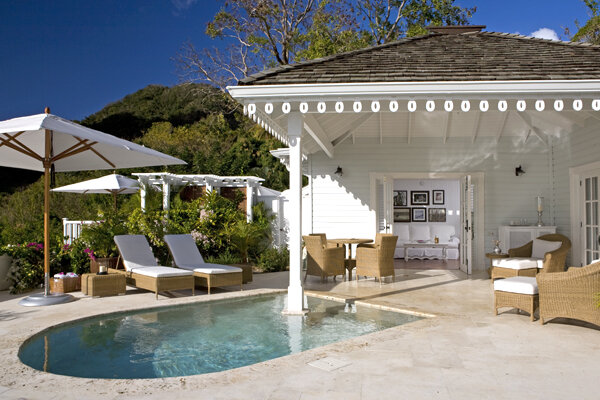

The villa and its plunge pool.
DAY 1 - Decompress
Rest, recover, and enjoy exquisite views of the dramatic Pitons in the distance. Regardless of where you're coming from (direct flights from the UK on British Airways and Virgin; three hours from Miami on American; occasional direct flights from New York on JetBlue), St. Lucia is a haul, and simply sitting once you arrive feels pretty wonderful. Sugar Beach whisks guests from the airport straight to their suites — no check-in or paperwork necessary — where cold drinks and a butler await. I decline the unpacking service as I feel it might take my laziness to a whole other level (though I am totally tempted), but immediately dip into my serene pool to wash away the travel grime.


Bayside Bar.
We head to Bayside, the casual restaurant where you can watch fisherman haul in the catch of day. We devour wood-fired pizzas and ogle international passers-by. (Fathom fan Gywneth Paltrow, rocker Chris Martin, and their adorable kids prove impossible not to watch.) This a pitch-up-in-your-swimsuit kind of place, with terrific roti, sashimi, and assorted Creole specialties. The value-oriented consumer will appreciate the abundant lunchtime salad bar filled with beautiful, locally-sourced vegetables, mountains of marinated shrimp, and ceviche made to order. There is no rush here, and guests are encouraged to relax and listen to live music, even during peak lunch and dinner services.
With all the wonderful eating and lounging, a bit of movement is in order. Sailboats, sea kayaks, paddleboards, and snorkeling gear are all available, and brilliantly colored fish are just a gentle swim off the crescent beach. Full-on scuba trips, remote beach picnics, and water-skiing can be arranged, and the beach personnel are ready to grant your every wish (like cold Diet Coke) at the wave of a flag.


The Great Room, inside and out.
Dinner is in The Great Room in the original grand plantation building, where a more formal menu (chilled organic watermelon gazpacho, roasted snapper, steaks) is served on the sweeping porch. The best thing at the Sugar Beach restaurants is the local fish (mahi mahi, tuna, shellfish galore) served raw, tiradito, roasted, grilled, or barbecued.
Day 2 - Local Color
Days start with a breakfast buffet of local fruits, cereals, and freshly baked breads, eggs made to order, and the New York Times fax. Everything is extremely casual, and my kids loved the freedom to choose chocolate pastries, then wander over to the Kids Club to hang out.
Sugar Beach is wonderful for families. My kids generally bypass organized activities, but the people who run this Kids Club proved irresistible, with scavenger hunts, endless ping pong games, water balloon fights, and archery lessons. They won my MVP award.

The hotel pool, which was never crowded.
The pool is a large, sleek affair that, regardless of the time of day, is usually empty. The pool chairs are tasteful white, minimalist beds, and broad umbrellas allow for peaceful reading. After a morning of relaxing (are you sensing the theme?), we explored the surrounding mountainous rain forest: the drive-in volcano and a rainforest zipline tour. The excursions are a great change of scene and take about 45 minutes. I'm always a fan of local shopping — particularly at grocery stores — but I'd give it a pass here, except for a Saturday morning excursion to the nearby markets in Soufriere.

The drive-in volcano a short drive away.

A treatment room at Rainforest Spa.
Back to Sugar Beach for more pampering at the spectacular Rainforest Spa. Treatments run the gamut from hot rocks and scrubs to Ayurveda and are done in seven rooms suspended amidst the trees. I am generally one for massages and such, but this peaceful setting — and a therapist who taught me all about the island's history and the havoc wreaked by Hurricane Thomas — is unlike any other I've experienced.
Day 3 - In the Groove
Mornings are the best time for tennis (less intense sun, free courts). The kids love Titus, the local pro, so we often hit twice a day. The resort's gym — an air-conditioned house with plenty of equipment, yoga mats, and TVs — is next door and offers total privacy throughout the day. Fitness enthusiasts can take outdoor yoga classes, conditioning workshops, and hikes into the surrounding Pitons.
Another off-campus excursion worth the pricey cab ride takes us to lunch at Ladera, a resort nestled on the hilltop overlooking Sugar Beach. Their restaurant, Dashene, specializes in reinterpretations of traditional St. Lucian dishes made with locally harvested ingredients: jerk poulet sausage, sweet potato and coconut soup, and plantains with delicious rum sauce. This is not a light affair, and the views are spectacular.
Afternoons are spent in Sugar Beach's secluded gazebos or reading in any number of well-placed hammocks. The beachside bar has delicious snacks (fish tacos, pizzettas) and killer caiprinhas, so you can just park it and watch the world go by. People-watching makes for excellent sport on the small but lovely beach. The sand is imported from Ghana and the clientele that hails predominantly from the UK and Europe. I loved this global aspect of Sugar Beach best of all. We met friendly, interesting, and lovely people throughout our stay, and I felt as though we'd been to Europe as well. Bonus!

Cane Bar.
Nights are spent at the on-site restaurants, but I recommend the little-publicized Cane Bar, an impossibly hip new resort add-on with a pool table and ambient house music, for a local Piton beer and terrific sushi. It's also great for cocktails or a late night rendezvous, though I'd be lying f I said I had one of those during my stay.

Days 4-7: Rewind, Replay
The rest of the trip was a variation on a theme. If it's complete and total relaxation you're after, you'll have no choice but to do exactly that at Sugar Beach.
Fifteen back issues of The New Yorker and two novels later, I've never felt so completely Zen.
PLAN YOUR TRIP
Fly: Hewannora International Airport (UVF) near Vieux Fort Quarter from Miami is a three-hour flight on American Airlines. JetBlue flies direct from New York (four hours), Delta flies from Atlanta, British Airways and Virgin Airlines fly direct from the UK.
FIND IT
Sugar Beach
Val des Pitons
P.O. Box 251 Soufriere
Saint Lucia, West Indies
+1-758-456-8000
sb.info@viceroyhotelsandresorts.com
MORE ON FATHOM
The Secrets of Harbour Island
It's All Good at Round Hill
Fathom Caribbean Guide

April Bloomfield’s New York
The Michelin-starred British chef co-owns New York restaurants The Spotted Pig, The Breslin, The John Dory Oyster Bar and the newly opened Salvation Taco
For many years I never had a weekend off, so when I opened my last restaurant, I decided to take them back for myself. Now those two days are my sanctuary.
I’m a big tea drinker and Saturday mornings begin with PG Tips – five large Le Parfait jars full of proper builder’s brew – and a browse through the Daily Mail and the Guardian on my iPad. Then, I like to walk through Madison Square Park down to the Union Square Greenmarket, where I stock up on fruit, vegetables and bread for the weekend. My first stop is always Berried Treasures, where Franca, the stall owner, sells my favourite things – shelling beans, pole beans and Jerusalem artichokes. She’s such a dear and always gives me punnets of delicious tomatoes or strawberries.
After working up an appetite, I will often head to Saravana Bhavan, an Indian restaurant in my Curry Hill neighbourhood that specialises in dosas filled with spicy potatoes, onions, coriander and sesame seeds. If I feel like some vegetables, however, I’ll go for lunch at Eataly, where I sit at the counter and enjoy a good eggplant Parmesan with bitter greens, olive oil and lemon, and a glass of wine. It’s an ideal spot for people watching, and as I’m working on a cookbook about vegetables – ones with complex flavours – this is a great place to think about produce and recipes.
Saturday afternoon is the perfect time to browse for homeware. Sur La Table is wonderful for tabletop accessories, as is the flea market on West 25th Street, where I pick up kitchen things such as 1960s bowls and Dansk cookware. The shop I like best, though, is Bonnie Slotnick Cookbooks in the Village for stocking up on gifts to give my staff.
Saturday nights involve a visit with friends to my local, the Waterfront Ale House, where there is an amazing selection of beers and cask ales. I’m partial to Oregon’s Rogue Morimoto Soba Ale, not to mention the delicious chicken wings with homemade hot sauce. From there we might head to Maialino, where I love the malfatti, a delicious pasta with suckling pig that is not at all heavy, and a side of crispy artichokes with anchovy dressing. If we’re feeling more casual, then we’ll go to Blue Smoke, also nearby, and have pulled-pork sandwiches. A lovely end to an evening is a movie – action, adventure or comedy – at the Angelika Film Center in SoHo, or a documentary from Netflix watched from my couch.
If I can sleep in on Sunday, I will. This is my day for washing, reading cookbooks and enjoying the sourdough loaf I bought at the Greenmarket. I love it toasted with lots of butter, sea salt and apricot or greengage jam from my friend Claire Ptak, who runs Violet Cakes in London. If I’m feeling in need of something more substantial, I’ll head to A Salt & Battery for an incredible sausage sandwich, before checking in on one of my restaurants to see how things are going.
When I am missing home and in search of comfort, I will roast a poulet rouge and some potatoes for a Sunday supper with friends. I love the smell of chicken roasting and we’ll likely combine that with watching a classic film such as Roman Holiday, or a bit of BBC America or Graham Norton, who I find hilarious.
At the end of the day, I like to enjoy a bath and a glass of wine – white, red, whatever I’ve got to hand. And in the summer I can take in the sunset from my rooftop. I tend not to think about work too much over the weekend, as I know that by 7am Monday morning the texts and emails will be pouring in. But by then I will be rested and ready to hit the ground running.