
Craft gets a contemporary spin at a Mexico City lifestyle boutique
A Mexican showcase for contemporary craft with a fresh, modern feel
A Mexican showcase for contemporary craft with a fresh, modern feel
Mexico City is abuzz with creativity right now,” says Maria Eladia Hagerman, co-founder of the enticing boutique Onora. “From art and architecture to design, music and food, it is at the forefront of innovation and vision – and an enormous amount of exchange and collaboration is taking place between disciplines.” In a quiet corner of the upmarket neighbourhood of Polanco, Hagerman and her friend and fellow designer Maggie Galton are adding contemporary Mexican craft to this exciting melting pot.

Huichol bowls, $30 each | Image: Pia Riverola
“We liked the idea of creating a whole lifestyle store,” says Hagerman of the space they launched in 2014, “but one that isn’t overly artisanal or folksy, as is so often the case in Mexico.” All their wares – from the delightfully understated bedding (duvet with pillowcases, from $500) combining linen and intricate gauze work, to huipil tunics with Oaxacan embroidery (from $125) – are created in collaboration with artisans while also adhering to the duo’s design-led brief. “We focus on authentic Mexican design, but the pieces are made more minimal for us,” explains Galton.
Thus, the traditionally Mexican riot of colour is largely replaced with the pair’s preferred palette of muted beiges, blacks and greys, displayed to subtle effect alongside indigenous volcanic rock floors and whitewashed walls. “There is a dialogue between the space and the pieces,” says Galton, pointing out the striking wooden shelving system that showcases the duo’s latest discoveries. These might be sublimely simple black lacquer gourds (from $100) lined in gold and copper; brocade pillows (from $100) woven in rural Chiapas with traditional motifs; or richly patterned black and white Talavera pottery (set of three plates and two bowls, $90) from Puebla.
Vibrant pops of colour do, however, make their way into the mix: the shallow, beaded Huichol bowls ($30 each), for example, feature bold patterns in bright mint green, azure blue, yellow and orange as well as black, and the wonderfully soft wool throws ($250), made using locally sourced plant and insect dye, come in hues of indigo and pink. Also adding flair to the otherwise zen environment are one-of-a-kind wall hangings: handwoven, feather-fringed rebozo shawls (from $250) in both earthy shades and bright reds, pinks and turquoises; and vibrant multilayered artworks (from $2,500) by Margarita Cantu crafted from recycled materials.
This alluring, ever-changing inventory unsurprisingly draws an international clientele, from interior designers to Jean Paul Gaultier and Japanese tourists, “whose aesthetic resonates with ours”, says Hagerman. And the duo is always scouting for new artisans to add to this diverse collective; among their recent discoveries are the enormous – some 2m high – ceramic pots (from $100) from Cocucho in a rich red patina, which are lovingly hand-moulded and burnished by Michoacán potters, “who will now have more economic opportunities and alternatives,” says Galton. “We work with communities and family-run workshops in over 10 different states, and since our volume of production is small, people don’t need to sacrifice their crops or participation in village life in order to fulfil our orders. Our mission is to revive dying craft traditions through innovation.”

Step Inside a Parisian-Inspired San Francisco Home

It was a nondescript Edwardian stucco building that brought interior designer Lauren Nelson and architect Stephen Sutro together for their first design collaboration. The project began with a circa 1925 building in such disrepair that it was ultimately brought down to the studs. Working closely with the clients, Nelson and Sutro brought a Parisian sensibility to the space, showcasing its soaring ceilings and delicate moldings, and playing with juxtapositions of era, texture and color. “From the onset, the vision for this project was influenced by contemporary French interior design; there is an innate sense of style, effortless elegance, and a mastery of blending classic and more modern pieces,” notes Nelson. “We went for feminine details mixed with a high contrast palette and touches of glamour. But as the project evolved, we all sought to balance that formality with a casual California sensibility.”
Starting with a north/south orientation and maximizing the window openings at both ends to allow for light to penetrate deep into the center of the house, the main living level was transformed into a nexus for family life that now includes casual and formal rooms that can flow together seamlessly or be separated by pocket doors. A magnificent sculptural staircase, inspired by an image of an English Victorian newel post (provided by the client), serves to connect all four floors, as well as adding a “traditional yet slightly whimsical touch,” says Sutro. Stained oak floors, windows with an industrial-chic sensibility, and large slabs of Negro Marquina stone enhance the serenity of the space.
True to Parisian sensibility, the interiors are a mix of classic and contemporary, where crown accents, wall paneling and vintage light fixtures meet a mostly monochromatic palette and carefully curated furnishings. The entry sets the stage: A spare foyer features a cool, dark gray Pietra marble floor, a custom chevron-paneled door, and a selection of the owners’ graphic prints and illustrations.

Photographs by Aubrie Pick

Photographs by Aubrie Pick

Photographs by Aubrie Pick

Photographs by Aubrie Pick
From here, the stairway curves upward to the dining room, where a stunning table—handcarved of solid blackened maple—is surrounded by custom brass chairs in a Pierre Frey black mohair-velvet and an Osborne & Little stripe. An enormous black-and white photograph of a Scottish Highland cow (“a humorous image that appealed to the owner and me instantly,” says Nelson) adds an unexpected, cheeky touch.
The sensibility is slightly more formal in the living room, which is a study in neutral tones with crisp, high-contrast blues and greens that are also found throughout the home. Again taking design cues from contemporary French interiors, the room boasts sleek finishes: Walls in Benjamin Moore’s Boothbay Gray set the stage for a Schumacher teal velvet-swathed sofa, while a custom Lindstrom rug (Nimbus, in custom hues) complements brass chairs covered in a tonal, geometric Mary McDonald for Schumacher print. Above the bespoke marble mantel hangs a luminous seascape, a commission by painter Louise LeBourgeois.
Upstairs, the master bedroom features subtle silk Weitzner wallcovering, Cowtan & Tout silk-embroidered drapes and a greige, velvet-wrapped headboard that contrasts with a custom walnut faceted bedside table. A dressing table devoid of clutter adorns one corner of the room and is paired with a streamlined Jonathan Adler chair.
In a masterful transformation, Sutro turned a two-story San Francisco residence into a space that now measures just over 5,500 square feet and spans four airy, light-filled floors, while Nelson created an environment that is modern, not overly decorated and layered with California ease. The result is a warm, vibrant house that accommodates casual family gatherings and formal entertaining in high style. Concludes Nelson, “I think this home speaks to the clients, their personalities and their sense of place.”
A version of this article appeared in the June/July 2017 issue of SFC&G (San Francisco Cottages & Gardens) with the headline: Vive La France!

Andrew Bolton’s perfect weekend in New York
The curator of The Met’s Costume Institute oversaw blockbuster shows such as Alexander McQueen: Savage Beauty and Manus X Machina. His latest, Rei Kawakubo/Comme des Garçons, is open now
The curator of The Met’s Costume Institute oversaw blockbuster shows such as Alexander McQueen: Savage Beauty and Manus X Machina. His latest, Rei Kawakubo/Comme des Garçons, is open now
“Saturday begins at 7 or 8am with several cups of English breakfast tea, while I watch CNN for the latest world news. It’s difficult to turn it off these days. I’ll catch up on emails that I’ve let slide during the week, then try to keep the rest of the day clear of work-related matters.
One of my favourite rituals is getting coffee and doughnuts from Nougatine, just down the street from where my partner Thom Browne and I live. Depending on the weather, we’ll take our breakfast over to the plaza at Lincoln Center and eat by the Henry Moore sculpture, or bring it home and sit out on our terrace overlooking Central Park.
Whatever I do, the day revolves around Hector, our miniature dachshund, who rules the roost. I take him for long walks in the park, designed to tire him out. We like to stop off at Le Pain Quotidien, just across from Sheep Meadow, where they provide water and treats for him.
At lunchtime, we are again thinking of Hector. We might go to Lincoln Ristorante, a modernist Italian spot with outdoor seating – they know us and always have a bowl of water waiting. Or we’ll walk along the High Line – the old rail track that’s been transformed into a lovely urban path along the Hudson – and have lunch at Cookshop in Chelsea, which serves an excellent chicken salad – good after my decadent breakfast.
In the afternoon I like to visit other museums, such as the Guggenheim or MoMA, and particularly love the Frick Collection for its opulent rooms full of Old Masters and sculpture – I always go to see Whistler’s Comte Robert de Montesquiou-Fezensac. If I’m working at The Met – which was all the time while we were installing the Rei Kawakubo show – I often escape to the garden at the Cooper Hewitt, a design museum a short walk up Fifth Avenue. I love this quiet oasis for a cup of tea and a slice of cake.
As our week is so hectic, Saturday nights tend to be just for Thom and me, or we might meet a small group of friends at a restaurant downtown. I Sodi is a must for the cacio e pepe [pasta with cheese and pepper] and baked branzino [seabass], and I love the warm, rustic atmosphere at Morandi in the West Village. The place I’ve been going to forever, though, is The Waverly Inn for its old-English pub ambience and crab cakes. In any case, I am home and in bed by about 11pm.
Sundays begin in much the same way, with tea and maybe a cinnamon roll from the new Breads Bakery, and lots of reading. As well as The New York Times, I like to catch up on back issues of The New Yorker, visit Vogue.com and do a bit of online shopping at Mr Porter.
After a walk with Hector, I’ll go to the Yogaworks gym early so that we can have a long, leisurely lunch at home around 2pm. We don’t cook, so Epicerie Boulud is our go-to for provisions such as Niçoise salads, quiches and excellent chilli. I am not a huge clothes shopper – Thom tends to provide them – but I try to get over to Dover Street Market for unusual pieces. My passion is bookstores, and I especially love 192 on 10th Avenue for its vast selection of art and history books. It’s a wonderful place to browse and learn.
We’ll spend the evening at home, maybe watching a TV series such as The Crown or Victoria. Then we’ll get a takeaway from Shun Lee, which does outstanding shrimp dumplings and chicken fried rice, or indulge in a delivery from Morandi. They will bring our meatballs, Brussels sprouts salad, fried olives and steak by car.
Weekends are a time to decompress. By Sunday night I’ve had a chance to reflect on the past week and look forward to the next, which might involve anything from cataloguing to a trip to Europe or Tokyo for the collections.”

A long weekend in Cartagena with Lauren Santo Domingo
Old-world chapels and high-design hotels, 2am salsa and island afternoons: the Moda Operandi founder tells Christina Ohly Evans how to savour the Colombian city. Portrait by Miguel Winograd
Old-world chapels and high-design hotels, 2am salsa and island afternoons: the Moda Operandi founder tells Christina Ohly Evans how to savour the Colombian city.

Colombians are very proud and protective of their culture, and I think there’s nowhere that is more apparent than in Cartagena, the coastal city where all the country’s beauty, culture and character have been retained. When I started coming here 18 years ago there was an element of a narco-terrorist state about the place, and for me that fear only added to the intrigue and excitement. But Cartagena is now much safer; it’s a Unesco World Heritage Site and it’s full of beautiful Spanish colonial architecture, stylish cafés and design-led boutique hotels – with plenty of relaxed, tropical flavour.
The best time to visit is between December and April, and the weather at Christmas and New Year is just perfect. I also like the city in mid-November, because it is a time of local celebrations; beauty pageants, regattas and school holidays all make it feel festive. I like to manage expectations, though: Cartagena is not a beach resort à la Phuket or St Barths. It feels more like old San Juan in Puerto Rico – you won’t find P Diddy hobnobbing with the jet set, or flowing champagne, or any chic stores or familiar brands. It’s all very local and authentic, which makes it a pleasure to wander the picturesque plazas and streets. They’re lined with terracotta mansions and palaces, all in shades of pink and turquoise, their balconies dripping bright-pink bougainvillea. There is a touch of magical realism to the whole place.

The eclectic colours of Catedral de Cartagena | Image: Alamy
Whenever I direct friends to places to stay, Casa Pestagua – an intimate 11-suite former home furnished with 19th-century antiques – and the Hotel Sofitel Legend Santa Clara both top my list. The latter is located in a converted 17th-century monastery with many traditional design elements that have been combined with modern twists. Both have sleek rooftop or courtyard pools. These pools are key in Cartagena, because midday temperatures soar and the beach in town isn’t great for swimming. Most guesthouses and boutique hotels come with their own boat, chef and porter, so you can be whisked away to a local beach club, such as El Pescador de Colores, for lunch and a swim.
Cholon, a little island about a 45-minute boat ride away, is also a beautiful escape with pristine white-sand beaches, crystal-clear waters and thick mangroves. It’s relaxing just to watch sailboats pass by on their way to the Caribbean. There are small cafés in the bay that are accessible by boat, and they make ceviche and grilled lobster – and catch sea urchins – right before your eyes. You can drink from freshly split coconuts to get the full escapist experience.
The Hotel Agua is another excellent choice. It’s a colonial-era-turned-mod villa rental with six rooms. The 250-year-old, perfectly renovated Tcherassi Hotel, overseen by the incredibly stylish Silvia Tcherassi, is the most couture boutique hotel in town, the one that draws the international fashion crowd. Also lovely is Casa San Agustín – a rustic-chic 30-room hotel with historic frescoes, wooden balconies and old-world furnishings alongside more contemporary colours and other touches. The terrace offers sweeping views of the city, as well as the 300-year-old aqueduct that cuts right through the property. It’s a great spot for cocktails; I sent Poppy Delevingne here recently.
The perfect start to any day in Cartagena is a Colombian breakfast – preferably at El Centro, in the 16th-century old town, with its fortified walls. The local fruits – papaya, grenadilla, pink grapefruit, and fresh mandarin and watermelon juices – are unlike anything you’ve ever tasted. Arepas – eggs in corn tortillas – are another local speciality. Strong coffee is part of the culture, and it’s served from street carts throughout the day – along with abundant food, including delicious empanadas stuffed with spicy meat.

The rustic-chic Casa San Agustín hotel houses a 300-year-old aqueduct
Food is a major focus here, but shopping for artisanal things is another favourite pastime. I always tell friends to look for woven hammocks and mochilas, the traditional cross-body bags that are now so in fashion. Artesanías de Colombia is a wonderful resource, because all of the goods – textiles, pottery, furniture – are sustainable, with most made by Colombian women who support families living in areas ravaged by drug trafficking.
For more contemporary finds, head to Casa Chiqui, a souk-like store full of fun beachy things and unique hostess gifts overseen by the incredibly fashionable Chiqui de Echavarría, who I like to call the tropical Daphne Guinness. She has a huge assortment of products from all over the world, and it’s always exciting to see her latest finds. The expertly curated concept store St Dom is another favourite; there’s a striking selection of clothes and homewares by Colombian designers and it’s a lovely minimalist space. OndaDeMar has the best range of bikinis and stylish cover-ups in town. And for a night out, you’ll need a pair of the lavish costume earrings from Mercedes Salazar.

Cartagena’s old city is alive with colour and activity | Image: Finn Beales
The streets of Cartagena’s old town are primarily cobblestone, so heels are out – as are sequins or anything else too flashy. The vibe is a bit bohemian – always bright and playful – and quite relaxed, no matter where you eat or drink. One of my favourite restaurants is Juan del Mar, where everyone sits outside; there is live music and the crowd is always fun. It’s a very popular spot with the locals – don’t expect to have a quiet, candlelit meal here. But its pizzas are excellent; at the end of an evening, you may end up ordering one and starting your night all over again. La Mulata is a great spot for a casual lunch, with a mix of locals and tourists, and the daily set menu with a coconut lemonade on the side is outstanding.
The afternoon sun can be very strong, so the window from 4pm to 7pm is ideal for culture and sightseeing. I always tell people to start at the Zenú Gold Museum to see pre-Colombian jewellery and pottery. There are also many churches to explore – all situated along the city’s main plazas, prime examples of the Spanish colonial, baroque and republican architectural styles. One of the most beautiful – and the oldest in Cartagena – is the Iglesia de Santo Domingo, where my husband, Andrés, and I were married in 2008. It was built in the mid-16th century and has soaring ceilings. I matched my bridesmaids’ dresses to the rich salmon and pinky-beige colours of the stone walls. A brief stop here offers a cool break from the busy streets outside, which are almost always filled with musicians and performers of all kinds.

The unassuming La Cevichería offers outstanding dishes | Image: David Crookes
Then there’s the Catedral de Cartagena, one of the oldest episcopal sees in the Americas, as well as the Naval Museum, which is, appropriately, right by the sea. After a hefty dose of culture, you’ll want a snack from La Cevichería – an unassuming little shop situated on an alleyway that serves the freshest ceviche in little paper cups.
Because the days start so much later here – breakfast is never before 10am and dinners start at 10pm – I always advise a siesta before heading out. La Vitrola, for Cuban food and live music, is a must. This is the gathering spot for the crème de la crème of society, who come for both the air-conditioned bar and excellent dishes such as ropa vieja and camarones. This place is quite swanky by Cartagena standards, and there is a definite hierarchy to the tables: the closer you are to the bar and the band, the better. From there, it’s on to Café Havana around 1am, where everyone – regardless of class or age – mixes for fabulous mojitos and salsa dancing into the wee hours.
While there is so much to do in El Centro, there are also all kinds of incredible excursions. One is to hike up to Castillo de San Felipe de Barajas – the old fortress – for stunning views of the city below. A day trip by boat to the rustic Rosario Islands – Navega Colombia is an excellent charter service – is another highlight; and Playa Blanca, on Isla Baru, is the perfect place to do some deep-sea fishing or just disappear for a day.
Cartagena is an exotic city, and visiting here is an immersive experience – much like seeing Tokyo for the first time. Because it’s quite close to Jamaica, you’ll find a Caribbean flair mixed in with the Spanish elements, and an underlying African influence too. It all combines to create a city that’s historically remarkably rich – literally multilayered, like all the buildings that were originally painted in bright, tropical Caribbean colours and then whitewashed by the Spanish. And the incredible acoustics of the walled city, and the bustling plazas, and the unique sights and smells… the ambience here is like no other place on earth.
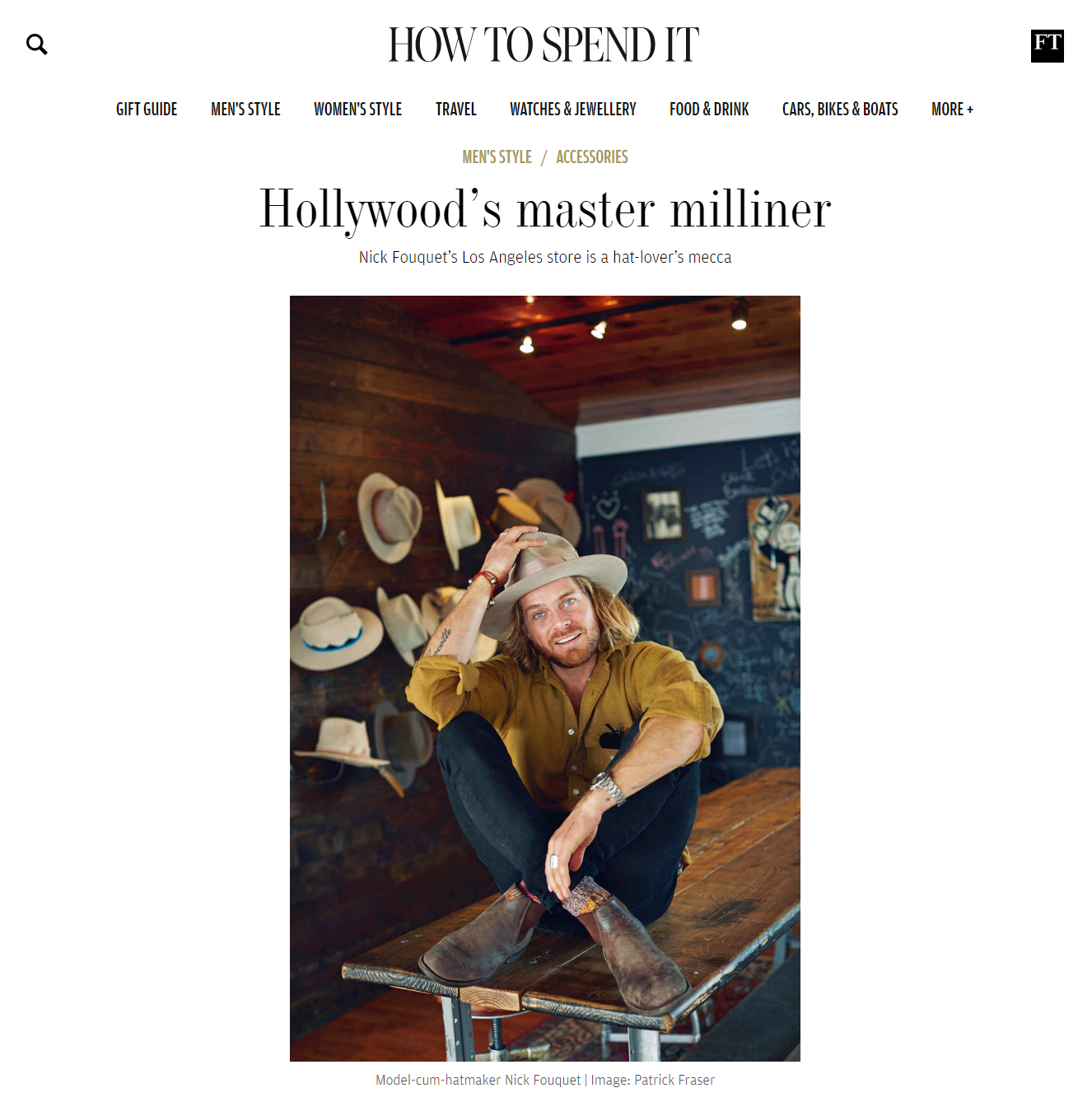
Hollywood’s master milliner
Nick Fouquet’s Los Angeles store is a hat-lover’s mecca
Nick Fouquet’s Los Angeles store is a hat-lover’s mecca
It was a surfing injury that led to the creation of Nick Fouquet’s thriving hat business. “During my recuperation, I learnt about garment and accessory design from Christophe Loiron, who runs Mister Freedom, a vintage clothing store and retro-inspired workwear line in LA,” says Fouquet. “I’m passionate about hats and making them just clicked with me; it’s the perfect way to express myself.”
The New York-born model-cum-milliner grew up in France and moved to LA in 2008. Three years ago he set up shop in a craftsman bungalow on the edge of bohemian-chic Venice. In his onsite workshop, kitted out with vintage flocking machines and flanges (blocks), Fouquet handmakes the super-cool fedora styles that attract the likes of Kate Moss, Georgia May Jagger, Anne Hathaway, Madonna and Bob Dylan. The accompanying boutique space exudes a “homey, comfortable” vibe, displaying on wooden tables and crate-like shelves some 40 to 50 hats in a profusion of different styles and colours.

Straw Coco Palm, $625 | Image: Patrick Fraser
“Many are unisex and seasonless,” says Fouquet, whose made-to-measure bestsellers include the Raven ($1,325) – a classic black design with a low crown that’s distressed and embellished with linen – and the Maritime ($1,175), a reversible fedora with a short brim. “These hats are all really wearable, but some are more eccentric, more theatrical.” Among the more statement-making, ready-to-wear chapeaux are the Burning Man ($1,975) – a tie-dye open-crown fedora with a Cayman crocodile band and striking electric blue feather – and the Little Cypress ($1,375), a teardrop fedora available in shades from granite to subtle gold.
“Our signature hats are made from 100 per cent beaver-fur felt,” explains Fouquet, who is often on hand to personally fit his toppers. “Our felt is American, sustainably harvested and of a very high quality.” The hats are then subjected to Fouquet’s trademark finishes – they are variously steamed, burned (with a blowtorch) and sanded (“to give them a silky finish”). Each features a roan sheepskin sweatband, as well as a decorative grosgrain or leather hatband, while the array of embellishments ranges from vintage silver charms from New Mexico and exotic feathers sourced in Macau to Parisian flea-market finds. Finally, each hat has a matchstick tucked into the band. “It’s a strike-anywhere match,” says Fouquet, “and it symbolises the spark of creativity.”
There are straw hats available too, such as the pink Coco Palm ($625) and the purple Aquapulco ($650), which has a bandana in lieu of a band. And Fouquet will also work with clients on custom creations (from $600 for straw, $1,100 for felt), which take 12 weeks to complete.
“Hats are the pinnacle of elegance,” says Fouquet, who has recently collaborated with 150-year-old luxury Italian hat brand Borsalino and has been stocked at Browns in London since 2015. “They are an undervalued accessory that can transform a look, make a statement. I believe there is a hat for everyone, but you’ve got to wear it with confidence.”

Strike London Hotel Gold at Charming, Posh (and Shockingly Affordable) Flemings Mayfair
Can it be? A gorgeous, centrally located, family-owned hotel in Central London that's actually affordable? Contributing editor and London regular Christina Ohly strikes hotel gold at Flemings Mayfair.
Can it be? A gorgeous, centrally located, family-owned hotel in Central London that's actually affordable? Contributing editor and London regular Christina Ohly strikes hotel gold at Flemings Mayfair.
LONDON – Visitors to London are spoiled for choice when it comes to fantastic hotels, so I am always on the lookout for the latest, greatest, newest offering when I return to this city that I consider my second home. I tend to stay in more residential areas — Chelsea, Kensington, Notting Hill — but my latest favorite find is in the heart of Mayfair, tucked away on sweet Half Moon Street. I literally can't stop raving about this hidden gem.
Originally opened in 1851, Flemings Mayfair was converted from thirteen adjoining Georgian townhouses, which gives it an intimate, smaller feel than the other surrounding luxury hotels. I love the warmth of the place — the very personal greeting at check-in, the helpful concierges, the bartender in the Drawing Room who was happy to replenish my endless pots of tea — as well as the ease of access to everything from Piccadilly and the Green Park tube to the restaurants and shops of tony Mount Street.
Flemings Mayfair, which is still a family-owned hotel (a rarity in the luxury space) achieves the perfect balance of being very high-touch yet perfectly low-key.

CHECKING IN
Location
Just past Park Lane, mere steps from Green Park, Flemings Mayfair is set on quiet Half Moon Street, with several private apartments accessed by Clarges Street just round the corner. The surroundings feel very local and touristy at once, given the number of nearby sites. There's a small café at the end of the street, an independent bookseller and, Kiku, a delicious off-the-radar Japanese restaurant next door. Best of all, a mini Marks & Spencer around the corner carries the edible essentials (prawn crisps, chocolate chip cookies) that you might crave. Its location between Park Lane and Berkeley Square means multiple tube possibilities. Getting around on foot couldn't be easier.
Hotel Style
The hotel recently received a £14 million facelift courtesy of London-based interior design firm Tully Filmer. The results are a series of serene spaces throughout the 129 guest rooms, the jewel box Drawing Room bar, and subterranean Ormer Mayfair restaurant and Manetta's Bar. The sleek furnishings are in neutral hues, with the punches of aqua and rose gold adding cheerful flair.
High-ceilinged bedrooms often include Art Deco touches like desks and custom chairs made of dark sycamore as well as contemporary photography by Andy Gotts, MBE. The juxtaposition of the artist's portraits of Kate Moss, Kylie Minogue, Harrison Ford (many taken at the hotel) with period finishes isn't totally obvious, but it adds to the overall fun, personalized approach of the hotel.
This Place Is Perfect For
Flemings Mayfair is ideal for the business traveler because of its easy access to the City and surrounding Mayfair, and it would work equally well for the well-heeled tourist interested in the many excellent museums, restaurants, parks, and shops nearby.
What's on Site
The striking restaurant in the basement, Ormer Mayfair, helmed by Michelin-starred chef Shaun Rankin, is definitely a highlight. The inventive menu is full of Jersey-grown produce, meat, and fish. I loved the breakfast spread (excellent charcuterie and gluten-free options) as well as one late-night dinner of sweet lobster ravioli in crab and tomato bisque with shallots, followed by a dark chocolate brownie with sticky popcorn, salted caramel sauce, and ice cream. Nirvana! The wines selected by award-winning sommelier Andreas Rosendal were outstanding. Oenophiles will love selections like the magnum of 2009 Classic Cuvee from English estate Nyetimber, which can be enjoyed by the glass. Keep drinking at dark and moody Manetta's Bar, where the walls are lined with portraits of famous literary figures of yore like Gertrude Stein, Alice B. Toklas, and Oscar Wilde.
My favorite part of the hotel is the Indian-inspired Drawing Room, done in conjunction with The East India Company. It's the perfect place to sip Darjeeling and work on the laptop. Hand-painted de Gournay wall panels in jewel tones, velvet seats, shelves of Assouline books, and a crackling fire add to the clubby ambience.
While I am not likely to use it, I am a fan of having a gym on premises (option value when dealing with jet lag), and the gym here is clean, light, and state-of-the-art. Nothing over the top — just four machines, sets of weights, and a TV — but it is a rare find for a hotel of this size in central London.
Number of Rooms
There are 129 bedrooms, suites, and apartments, with a top floor penthouse that sleeps six and has a private lift and roof terrace for entertaining al fresco. The Townhouse features several beautifully appointed bedrooms and can be booked in a series of suites or taken over as a whole property. Junior suites and studio suites, as well as one-, two-, and three-bedroom apartments accessible via Clarges Street round out the slightly quirky offerings. This lack of uniformity adds to the charm: No two rooms are exactly alike, and you feel like you're staying in someone's opulent, velvet-swathed home, circa 1932, if 1932 had modern everything.
In-Room Amenities
The mark of any good hotel is free, excellent WiFi, and Flemings Mayfair has this covered. Ditto the mini-bar stocked with Cadbury's chocolate and the vast marble bathrooms with Miller Harris amenities. Discreet flat-screen TVs include hundreds of channels (literally) and don't detract from the Zen design scheme. If you don't want to lose yourself to the tube, spend a few hours flipping gorgeous hardcover volumes of Penguin classics. While it may be hipped-up, this is England, so there is definitely no yoga mat in the closet.
Perhaps the most unique in-room offering is a complimentary gin bar. I can't stand the stuff, but the idea of my own bar comprised of five different gins (including Flemings' own signature blend) curated by spirits experts Joel Harrison and Neil Ridley almost won me over.
Drawbacks
The only drawback is that some of the rooms are a bit small and dark side. This is London, so many of the rooms are courtyard-facing, and on a dreary day…well, it can be a bit dreary. Looked at another way, these same rooms are particularly excellent for quiet, uninterrupted sleep.
Standout Detail
The standout details for me all involved impeccable service: the helpful front desk person who graciously checked me in at 11 a.m., even though I wasn't due until 2 p.m. Another striking personality was the bartender in the Drawing Room, who happily accommodated everyone from afternoon tea drinkers to late-night champagne enthusiasts. I cannot forget the concierge who arranged for the delivery of my work-related packages to various locations throughout the city, seemingly free of charge (I'm still waiting for this bill).
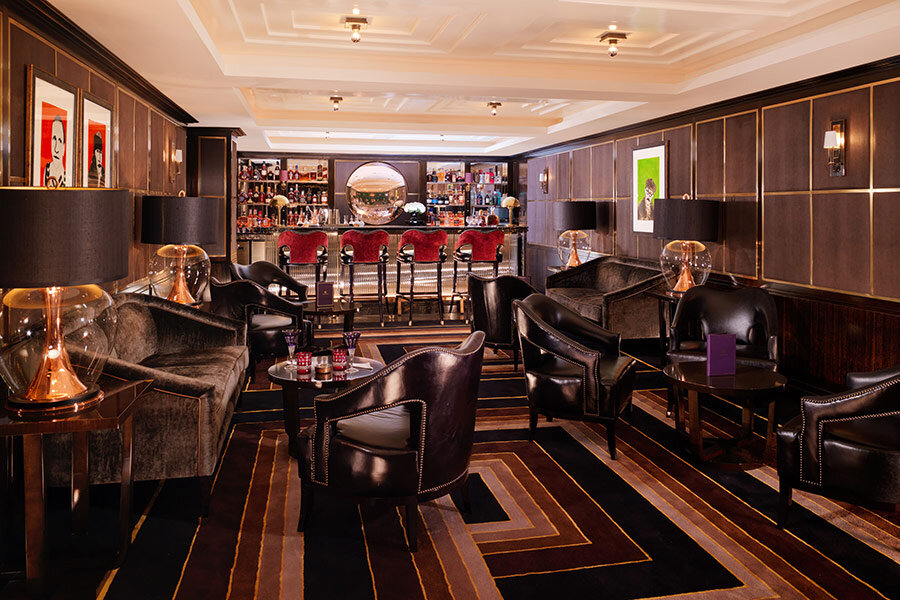
Manetta's Bar.
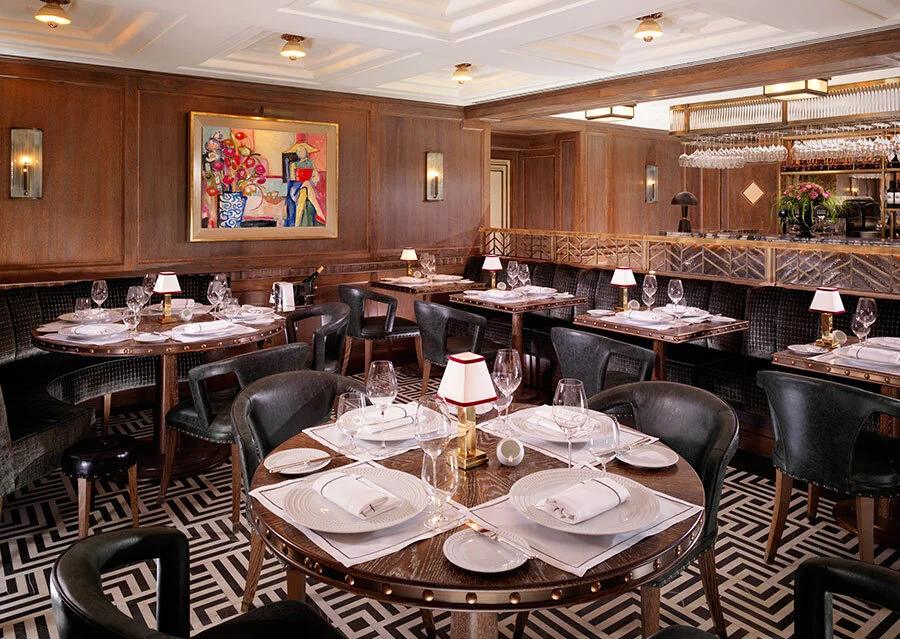
Lunch from another era. Photo by Niall Clutton.
CHECKING OUT
Mayfair has it all — great shopping, beautiful Georgian architecture, picture-perfect mews, and some of the world's finest museums and restaurants. There is a mix of outdoors — parks, sidewalk cafes, and the ubiquitous pubs that spill out in the streets in warm weather — as well as culture, so there is literally something for everyone within a half-mile radius of the hotel.
What to Do Nearby
This is prime London park territory, and two of my favorites — flower-filled Green Park and St. James' — are basically across the road, and Hyde Park is a stone's throw away. Nearby museums include Buckingham Palace, The Royal Academy of Art, The National Gallery, and The Wallace Collection.
Some of the world's best galleries are in Mayfair, including David Zwirner, Gagosian, and the recently opened Marian Goodman Gallery. Shoppers will be in heaven with everything from the established luxury houses along Bond Street (Chanel, Bulgari, Hermès) to more niche finds like the French designer Vanessa Bruno, whose two-story shop on Grafton Street is full of chic, functional finds. Selfridge's, with its impressive food hall and endless array of clothing and accessories, is still the superstore to end all superstores.
The restaurant options within a half mile span the globe from Italian to Lebanese and range in style from scene-y (Asian fusion Sexy Fish) to classic (Scott's, The Wolseley, Helene Darroze at the Connaught, and The Ritz), to cheap and cheerful (Itsu). In terms of (relatively) newer area additions, Mount Street Deli is the place for a casual breakfast, with its beautiful flora outside, while lunch at Selfridge's — particularly when they host interesting pop-ups, like Dan Barber's recent wastED residency — is always worthwhile. High tea feels like an American construct, but if you must, there is no better venue than Claridge's: The pastries, sandwiches, and fresh infusions in that magical, Art Deco setting just can't be beaten.
Lunches in Mayfair can vary between an affordable chicken schwarma wrap and a full-on, four-course feast at La Petite Maison, a Provençal delight tucked just behind Claridge's. Another long-standing gem is Ikeda on Brook Street, where you'll find seriously authentic Japanese food with little fanfare. The best tables in this part of town include members clubs like 5 Hertford, The Arts Club, and George, so if you can score an invitation, know that the quinoa salads and people-watching are both unparalleled.
Evenings should always include a drink at The Connaught Bar — the best ambience in London, I think — followed by dinner at Sexy Fish or Roka (for sushi) or at Fera at Claridge's if you're feeling seriously adventurous (be prepared for funky, foraged ingredients). The classics remain just that, and the Dover sole at Scott's and contemporary Indian cuisine at Gymkhana are all worth a stop.
Good to Know
I wish I'd known about this hotel earlier, as it really offers good value for money. It is chic, quiet, understated yet luxurious, with perfect attention to detail. I would also highlight the restaurant — and not just to hotel guests — as I feel it gets a little lost for its underground location. Which is too bad, as it is a remarkable culinary experience.
MAP IT
BUT WAIT, THERE'S MORE
Living an Art Deco Fantasy in London
Madonna! London's High-Fashion Hotel Is, of Course, Italian
Sleeping with London's Upper Crust in Mod Style

An unmissable Swiss tea and coffee emporium
H Schwarzenbach also offers a vast array of chocolate and honey
H Schwarzenbach also offers a vast array of chocolate and honey
When I spent a 24-hour layover in Zurich earlier this year, it wasn’t tea that was top of my to-do list. But I told my foodie friend Kathy YL Chan about my trip, and the tea specialist and writer pointed me firmly in the direction of H Schwarzenbach, a gourmet emporium in the city’s picturesque Niederdorf quarter known for stocking every imaginable variety of loose-leaf tea.
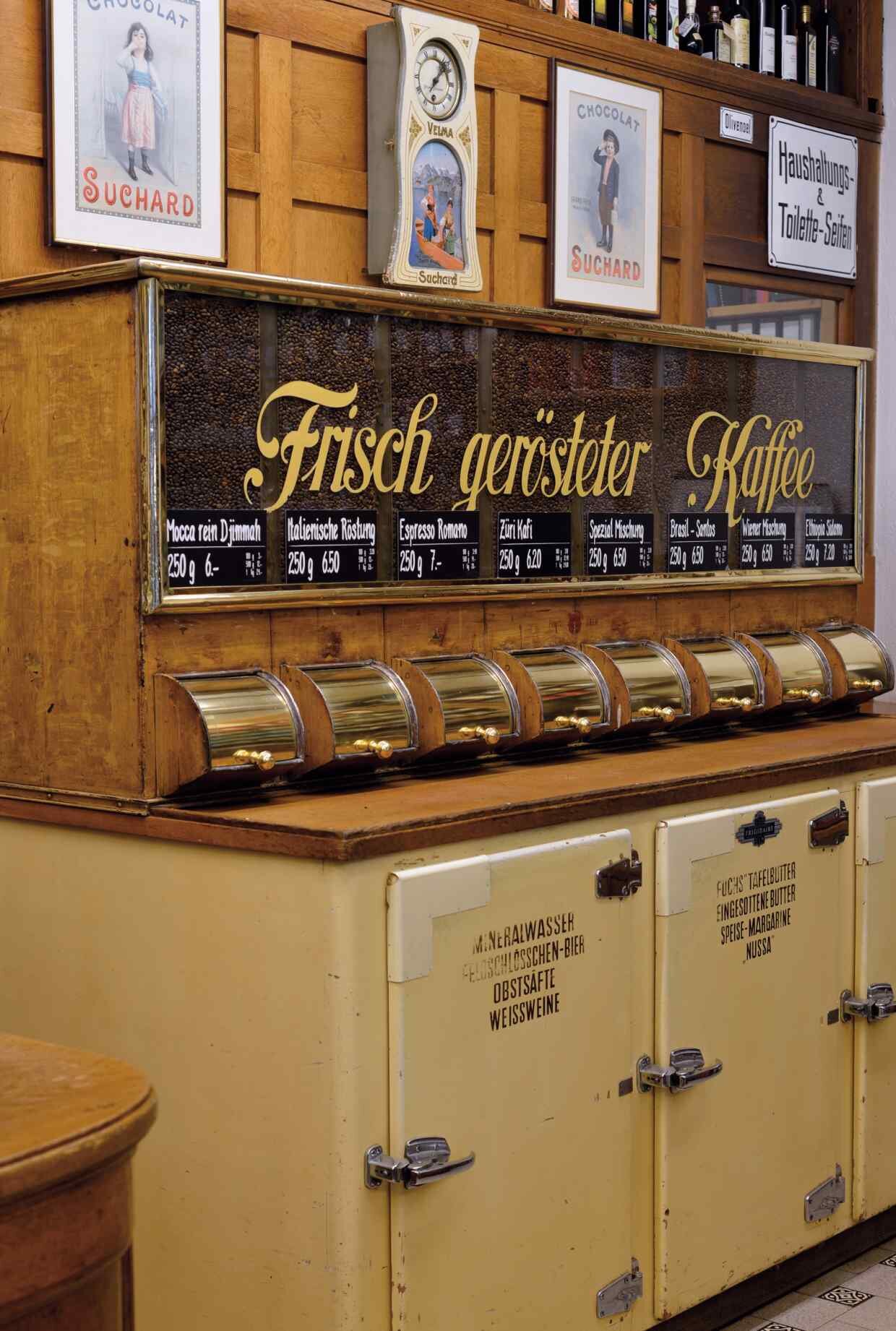
The shop stocks a range of coffee beans, which are roasted in-house
Under the guidance of the store’s owner Heinrich Schwarzenbach – the fifth generation to run this over-100-year-old family establishment – I sniffed and sampled a fragrant Ceylon (SFr9, about £7, for 100g), a Uruguayan yerba mate (about £13 for 1kg) and a Fujian jasmine tea (about £8 for 50g), but it was a bright rooibos (about £5 for 100g) that I ended up leaving with, and that has found a place in my daily routine alongside my morning green and afternoon oolong.
The shop also stocks an equally vast selection of intensely flavourful coffee beans (roasted in-house), aromatic spices, chocolate and dried fruit from all over the world. Schwarzenbach took me through cases of Chilean walnuts (about £4 for 100g) and exquisitely packaged honey (about £16) from Neufchâtel before introducing me to a chocolate selection that is anything but predictably Swiss – there are bars and nibs from Brazil, Bali, Madagascar and beyond, as well as tempting chunks of German marzipan, candied ginger and Provençal Chabert & Guillot nougat (about £5).
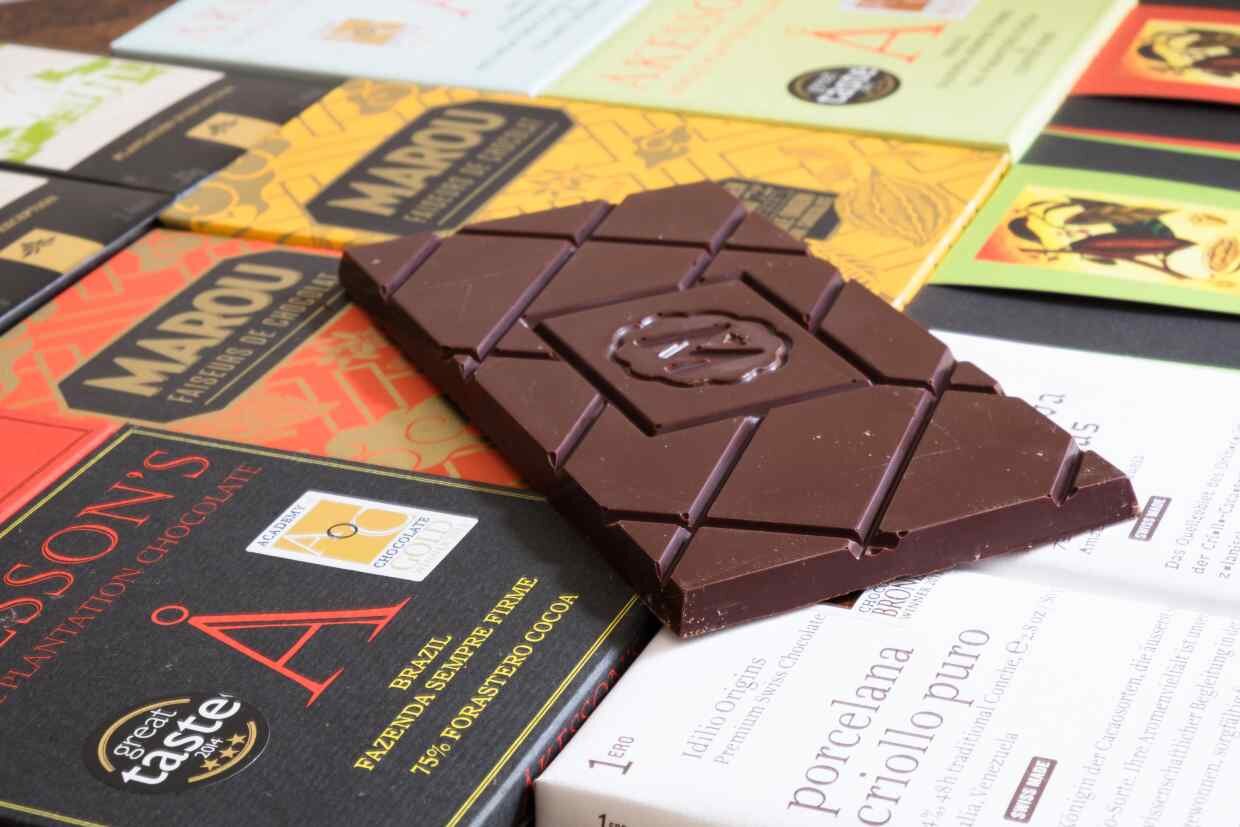
Customers can buy chocolate from all over the world
And just next door is Schwarzenbach’s TeeCafé, where I digested all my new-found foodie knowledge with a cup of chamomile and a traditional straumann hüppen – a crispy wafer roll with a delicious gianduja filling.

Top chefs gather to cook the ultimate dinner party and support Edible Schoolyard NYC
Every table eats a different menu – and bids at the live auction
Every table eats a different menu – and bids at the live auction
Some of the world’s most noted chefs will come together for nonprofit the Edible Schoolyard NYC’s fifth annual Spring Benefit on April 24, cooking a one-off dinner to help support children in underprivileged New York communities.

David Chang, chair of Edible Schoolyard NYC’s Spring Benefit and chef at Momofuku
The night (from $1,500 per person) will kick off at the Metropolitan West at 6pm with canapés by Sam Goinsalvos of Tartine Manufactory and Nick Curtola of The Four Horsemen, alongside drinks from mixologist Dave Arnold. This will be followed by surprise four-course menus courtesy of a roster of notable names including David Chang of Momofuku, Danny Bowien of Mission Chinese, Eli Kaimeh of Per Se, Justin Smillie of Upland and Joseph “JJ” Johnson of Harlem’s Minton’s. There will also be a live auction featuring lots such as cooking masterclasses, private dinners and a “skip the line” item which give the winner access to hard-to-get-into restaurants.
Last year’s event raised more than $1m for many projects – among them helping fund teachers who provide hands-on food education to young New Yorkers through school gardens and kitchen classrooms. “It’s an education I wish I’d had in my school,” says JJ Johnson. “To see children gain this tool for life by learning about how to grow and cook food, and how to replenish their bodies and take care of themselves gives me a lot of inspiration and hope for the future.”
Playful portraits of the students at Edible Schoolyard NYC’s demonstration school in East Harlem will help to decorate The Metropolitan West for this year’s fundraiser, which will be reimagined as a garden nirvana featuring lush greens hung from ceilings and columns courtesy of celebrated events planner Bronson van Wyck, whose clients have included Beyoncé, Barack Obama and Bill Clinton.

Inside Elie Saab’s Atelier in Beirut
The Lebanese fashion designer invites us into his world.
The Lebanese fashion designer invites us into his world.

Truly beautiful bespoke wooden canoes
Trent Preszler builds traditional boats layer by layer in Long Island
Trent Preszler builds traditional boats layer by layer in Long Island
“This is a meditative art,” says artisan boat maker Trent Preszler. “I love that it takes so long to make canoes. It’s like the seasons of the year; everything happens in due time.” Indeed, each exquisitely handcrafted wooden vessel ($100,000) is slowly built up in hundreds of layers of different woods – from ash, cedar and walnut to zebrawood, purpleheart and ziricote – and takes around a year to complete in Preszler’s Long Island studio: a former blacksmith’s barn built in 1820.
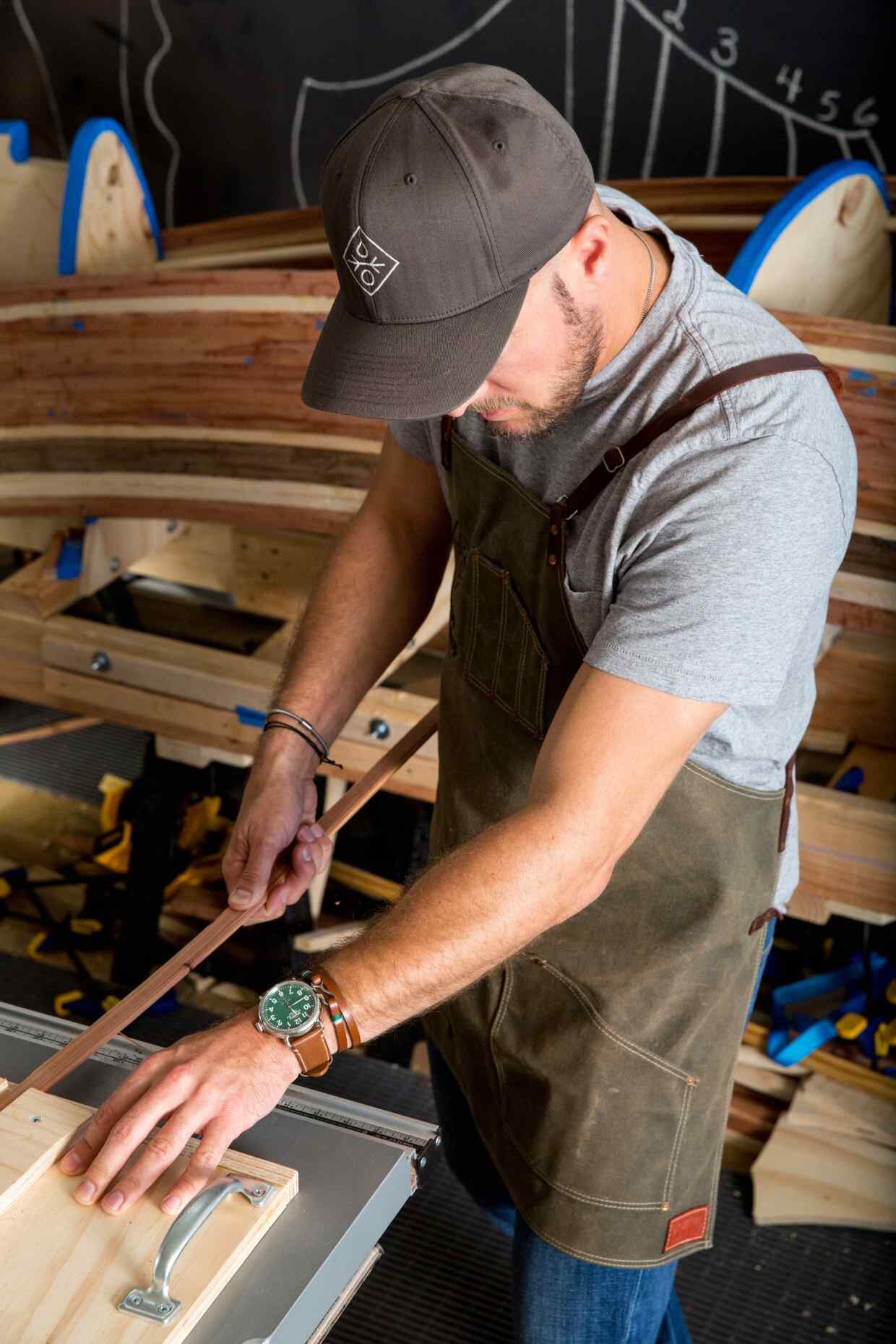
Boatmaker Trent Preszler at work in his Long Island studio
But the wait does not deter Preszler’s clients, many of whom live in the nearby Hamptons, Canada or the Great Lakes, and patiently wait for the 0.5cm-thick wooden layers to be steam-bent and glued into the curved shape of the hull, before being further sanded and shaped. The canoe is then coated in fibreglass and epoxy to make it watertight, and finished with six coats of glossy marine varnish for a brilliant, streamlined sheen.

Each handcrafted canoe is built using hundreds of layers of different woods
The interior finishes are just as elegant as the exterior, with woven hemp and leather seats specially crafted by Jason Thigpen of Texas Heritage Woodworks, while solid bronze cutwaters, cast by Kristian Iglesias of Long Island’s Kai Design, add to the modern profile. So sleek and sculptural are the final results that it’s little wonder some clients have purchased them purely as works of art, but Preszler says this defeats the purpose. “I always tell people they have to paddle it, because that’s what it was intended for,” says the self-taught South Dakota native, who grew up surrounded by cattle, not kayaks, and is also the CEO of 100-acre vineyard Bedell Cellars. “It’s like owning a thoroughbred horse: you don’t want to leave it tied up in the stable all the time, you want it to run.”

Zaha Hadid talks personal taste: Part Two
The Pritzker Prize-winning architect rounds up her list of likes with Madonna, Russian tchotchkes and New York’s Upper East Side
The Pritzker Prize-winning architect rounds up her list of likes with Madonna, Russian tchotchkes and New York’s Upper East Side
My style icon is Madonna. She has always experimented with fashion: I attended the Met Gala two years ago when the theme was punk and, while many missed the mark, Madonna really got it. She popularised Jean Paul Gaultier’s bustiers and has never been afraid to try creative new things. The same can be said of Grace Jones – she is always pushing boundaries.
The last meal that truly impressed me was at Spring, Skye Gyngell’s new restaurant in Somerset House. Several friends and I enjoyed a lunch of shared starters -– calamari, scallops with polenta, and carpaccio of beef – veal chops with artichokes and an excellent panna cotta with blood-orange jelly. That day was particularly bright and the light from the river streamed through the very stylish room. Somerset House, New Wing Lancaster Pl, London WC2 (020-3011 0115; www.springrestaurant.co.uk).

Madonna at the Costume Institute Gala, New York, 2013 | Image: WireImage
The last items of clothing I added to my wardrobe were two Junya Watanabe patchwork leather and organza jackets. I bought one at Dover Street Market in New York and liked it so much I got a similar one at Selfridges. Dover Street Market, 160 Lexington Ave, New York, NY 11216 (+1646-837 7750; www.doverstreetmarket.com). £1,835; Selfridges, 400 Oxford St, London W1 (0800-123 400; www.selfridges.com).
An unforgettable place I’ve travelled to in the past year is Mexico City. It is an incredibly dense, vast place and the architecture is incredible. Real highlights include Luis Barragán’s brutalist buildings from the 1960s; the street murals by José Clemente Orozco; and amazing churches by Félix Candela, whose pioneering thin concrete shells look almost lightweight.
The best gift I’ve given recently was a collection of 50 ties I had handmade for a friend’s 50th birthday. The designs are inspired by my drawings for The Great Utopia show at the Guggenheim Museum and are made of all kinds of different materials: silk, paper, transparent tissue. The gift is an inside joke: this friend and I once met for a drink at a dressy place and he didn’t have a tie so they loaned him a very short one. I thought he could use a few more, so I made him 50.
If I didn’t live in London, the city I would live in is New York. I might have an apartment overlooking the High Line and Hudson River; the light in this area at dusk – when the setting sun hits the buildings – is particularly beautiful. I especially like the buzz and sense of street life downtown, where I’d single out the Japanese food at Morimoto in Chelsea and the minimalist aesthetic of The Mercer hotel in Soho, which I call home whenever I come to visit. I also love the culture in New York: the Metropolitan Museum of Art, the Guggenheim and the sculpture garden at the Museum of Modern Art are particular favourites. I have many friends in Manhattan, which would make living there easy. Guggenheim Museum, 1071 Fifth Ave (+1212-423 3500; www.guggenheim.org). The Mercer, 147 Mercer St (+1212-966 6060; www.mercerhotel.com). Metropolitan Museum of Art, 1000 Fifth Ave (+1212-535 7710; www.metmuseum.org). Morimoto, 88 Tenth Ave (+1212-989 8883; www.morimotonyc.com). Museum of Modern Art, 11 West 53rd St (+1212-708 9400; www.moma.org).
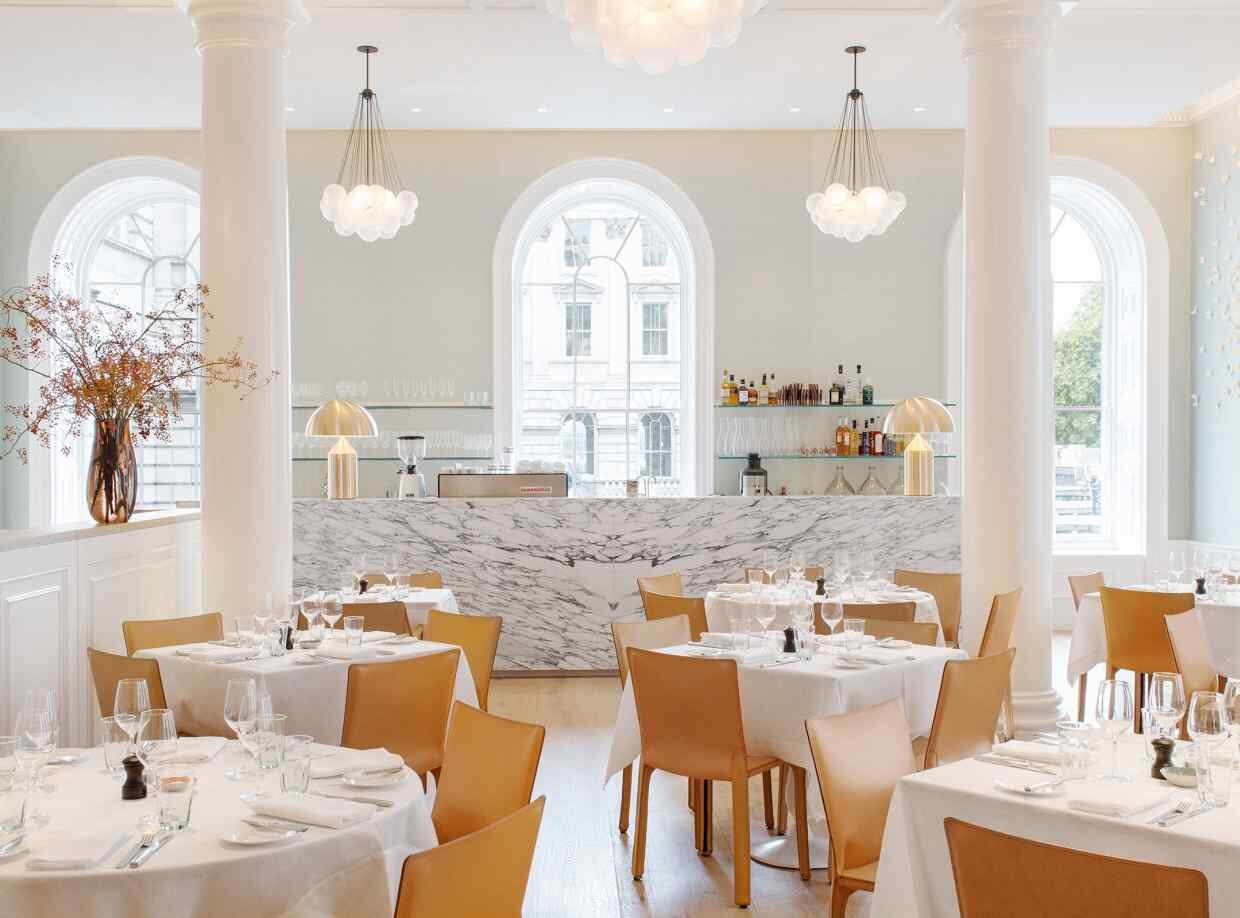
Spring restaurant at Somerset House, London | Image: Courtesy of Spring
An indulgence I would never forgo is weekly manicures and pedicures – either at home or at the Cowshed Spa at Shoreditch House. I find them relaxing and I love nail polish – I have every colour, from reds, blues and greens to gold and silver, and like to change my nails according to my mood. 1 Ebor St, London E1 (020-7749 4531; www.shoreditchhouse.com/cowshed).
The sites that inspire me are the city of Baghdad, with its position on the Tigris River, and Moscow’s Red Square at night. Each has a beauty and timelessness that makes it memorable.

Hadid’s Junya Watanabe faux leather and organza jacket, £1,835, from Selfridges | Image: www.selfridges.com
The books on my bedside table are more likely to be magazines. I am overly tidy so there are no large stacks of books in my bedroom, but I always have the Japanese, Chinese and Italian editions of Vogue, Architects’ Journal and back issues of Building Design.
The best souvenirs I’ve brought home are various Russian tchotchkes from a trinket shop in Moscow – little toys and figurines inspired by the Sputnik satellite; I love anything to do with space.

The Cowshed Rooms at Shoreditch House, London
My favourite room in my house is my sitting room. It is a stark, white space punctuated by two bright green sinuous couches I designed for Cassina in 2013 and the asymmetrical Aqua table I designed for Established & Sons in 2005. It is so glossy the surface almost looks liquid.
If I had to limit my shopping to one neighbourhood in one city, I’d choose New York’s Upper East Side. I like Barneys for its extensive shoe department and leather bags by Mark Cross, and Bergdorf Goodman for its selection of designers, Edie Parker’s gold acrylic clutches and its jewellery department, which is great for discovering emerging labels. Prada is also always a favourite and my go-to place for one-off special pieces for events. Barneys, 660 Madison Ave (+1212-826 8900; www.barneys.com). Bergdorf Goodman, 754 Fifth Ave (+1212-753 7300; www.bergdorfgoodman.com). Prada, 724 Fifth Ave (+1212-664 0010; www.prada.com).
If I weren’t doing what I do, I would be either a musician or a politician. I love music and like to sing, but I also find politics exciting and important. My father was a politician and his commitment, his ability to put the needs of others first and his foresight were inspirational to me.

Zaha Hadid talks personal taste: Part One
The Pritzker prize-winning architect’s projects range from London’s Serpentine Sackler Gallery to the residential 520 West 28th Street in New York
The Pritzker prize-winning architect’s projects range from London’s Serpentine Sackler Gallery to the residential 520 West 28th Street in New York
My personal style signifiers are black capes, particularly ones by Yohji Yamamoto and Issey Miyake; their early pieces are stunning. I love Japanese designers because their clothes are often asymmetrical and quite theatrical. www.isseymiyake.com. www.yohjiyamamoto.co.jp.

Gerhard Richter’s 2009 tapestry, Abdu | Image: Courtesy of Marian Goodman Gallery
The last thing I bought and loved was a hand bracelet made by Russian sisters Katia and Sonia Gaydamak. I like the way this delicate, unique piece wraps around the palm of the hand instead of the wrist. I bought it at an extraordinary shop called The Alchemist, a Herzog & de Meuron-designed glass box in a multistorey car park in Miami. From about £2,000; 1109 Lincoln Rd, Miami Beach, FL 33139 (+1305-531 4653; www.shopalchemist.com). www.gaydamakjewellery.com. www.joshwoodcolour.com).
And the thing I’m eyeing next is a stunning tapestry by Gerhard Richter. I love its unexpected, muted colours. I’m not usually a fan of tapestries but this is an exception. Marian Goodman Gallery, 5-8 Lower John St, London W1 (020-7099 0088; www.mariangoodman.com.

Tom Ford Bruised Plum lipstick, £37
An object I would never part with is my parent’s wedding photo from the 1930s. I left Iraq as a child to go to school in Switzerland and most of my family things are gone, so this picture is very special to me.
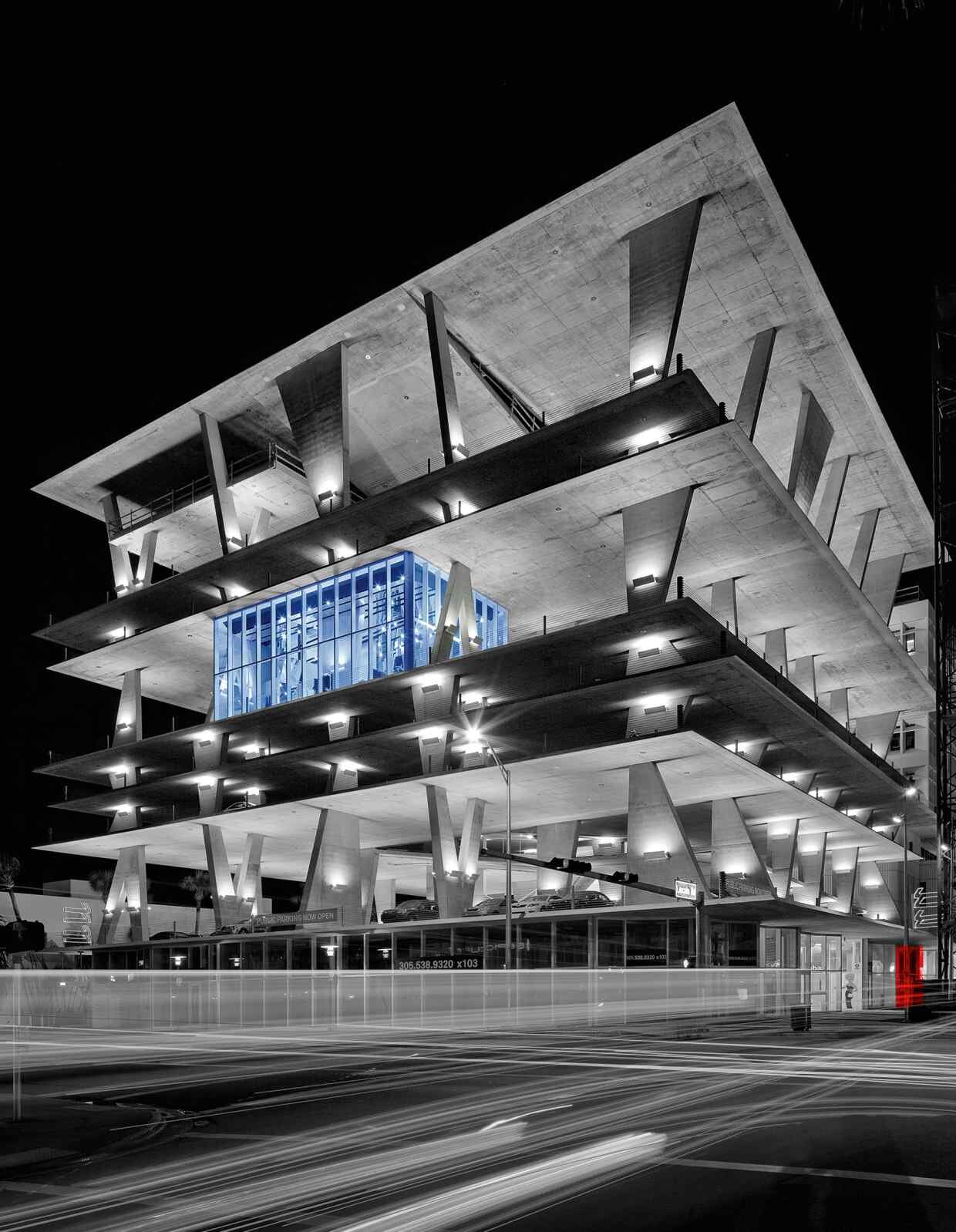
The Alchemist shop in Miami | Image: Michael Stavaridis
The beauty staples I’m never without are dark berry-coloured lipsticks. I am not loyal to a particular brand but I like Tom Ford’s Violet Fatale and Bruised Plum, and Mac’s Diva lipstick and Currant lip pencil. I also like make-up by Shiseido, including its eyeshadow palette in green, yellow and black and its Sheer and Perfect Foundation. Diva lipstick, £15.50; Currant lip pencil, £12.50; www.mac.com. Luminizing Satin Eye Color Trio, £35.50; Sheer and Perfect Foundation, £39.50 for 30ml; www.shiseido.com. Violet Fatale and Bruised Plum lipsticks, £37 each; www.tomford.com.

Miami’s Seaspice restaurant | Image: Bruno Frontino

Hadid’s Perrin Paris 1893 Eiffel glove clutch
The best gift I’ve received recently was a Perrin Paris 1893 glove clutch. I always get wonderful gifts and this black evening bag is the perfect size for a credit card and some cash. www.perrinparis.com.
In my fridge you’ll always find water, pears, oranges, mangoes and eggs. I rarely cook and don’t have an oven, so if I have friends over, I have to order in.
The last music I downloaded includes Sam Smith’s Stay With Me – I love his voice; Lost Stars by Maroon 5, a band I discovered thanks to Adam Levine on The Voice; and Mark Ronson’s upbeat Uptown Funk, which puts me in a good mood.
The people I rely on for personal grooming are John Vial at Fudge in London, who comes to my home to cut my hair, and Josh Wood for my colour and rinses. Both are excellent and have been looking after me for years. John, his partner Tracy Hayes and the whole Fudge team also come to our gallery during London Design Festival and Fashion Week to open a pop-up salon for the people working there. They create a fun atmosphere and it is a sight to see everyone’s hair in foils. www.fudge.com. Josh Wood Colour, 6 Lansdowne Mews, London W11 (020-3393 0977;
The artists whose work I would collect if I could are Anish Kapoor – I like his seamless concave and convex shapes and his newer concrete pieces – and Richard Serra, whose minimalist, compounded steel cube, Grief and Reason (for Walter), I saw in New York; it’s stunning. I am intrigued by their use of materials.
A recent “find” is a restaurant called Seaspice in an undiscovered part of Miami. It’s on the river and you can arrive by boat, which adds to the draw. It serves very good seafood and the music is wonderful as well. After dinner people get up and dance on the tables. 422 NW North River Drive, Miami, FL 33128 (+1305- 440 4200; seaspicemiami.com).
My favourite websites are the BBC, Al Jazeera and CNN for news, Shazam for music and Style.com for fashion. And Flightracker is very useful when I’m travelling. www.aljazeera.com. www.bbc.co.uk. www.cnn.com. www.flightracker.com. www.shazam.com.
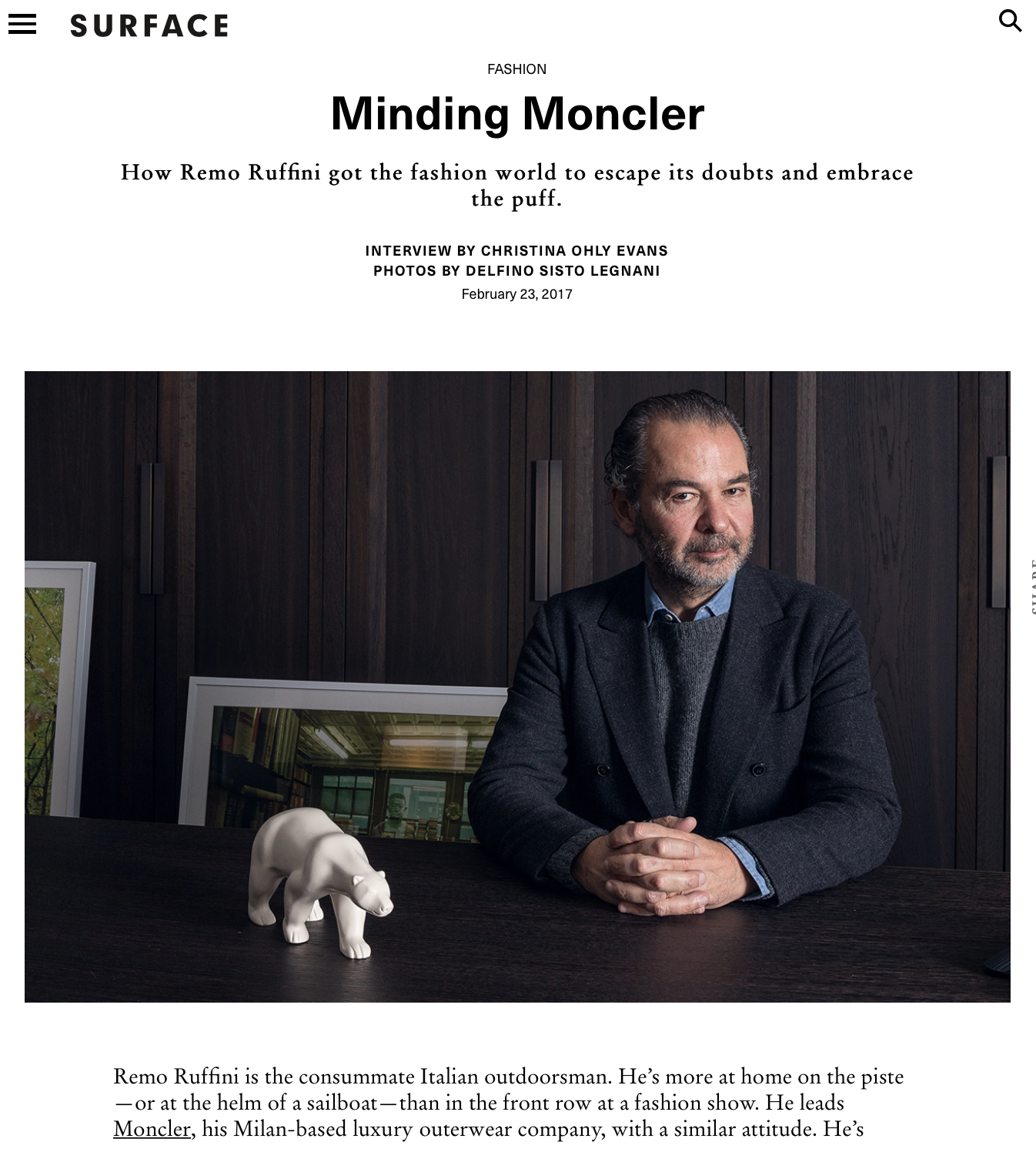
Minding Moncler
How Remo Ruffini got the fashion world to escape its doubts and embrace the puff.
How Remo Ruffini got the fashion world to escape its doubts and embrace the puff.
Remo Ruffini is the consummate Italian outdoorsman. He’s more at home on the piste—or at the helm of a sailboat—than in the front row at a fashion show. He leads Moncler, his Milan-based luxury outerwear company, with a similar attitude. He’s exactly what the storied French brand needed.
Despite an illustrious history dating back to 1952, when René Ramillon founded Moncler in the town of Monestier-de-Clermont, in southern France, the company had begun to falter in the ’90s. Squeezed by high fashion outerwear offerings from Prada Sport and Gucci, as well as by more mainstream outfits like The North Face and Patagonia, Moncler struggled to find its niche, and in 2003 saw profits of just $62 million. Enter Ruffini, who brought with him a new sense of urgency and excitement. By 2016, the brand was raking in more than $685 million in revenue.
In part, Moncler’s comeback can be attributed to Ruffini’s push for diversity of aesthetic; not relying on one single vision allows the brand to speak to a wider demographic. Not only are there multiple lines that appeal to twenty-something, hard-core skiers as well as an older couture crowd, there is also a rotating roster of creative talent behind them that keeps the brand fresh and each season’s offerings unexpected. Moncler has expanded to include multiple collections including the classic sportswear line Grenoble; Gamme Rouge by Giambattista Valli; Gamme Bleu by Thom Browne; and Longue Saison, Moncler’s entry into the competitive marketplace for lightweight, season-less jackets. In addition to the ongoing design talents of Valli and Browne, as well as Virgil Abloh, Ruffini has enlisted pop stars like Pharrell Williams to create everything from limited-edition puffy parkas to eyewear and expanding accessory offerings. Ruffini delights in the design talent that he helps identify each season, and believes that constant creativity is key to the brand’s continued success.
Surface recently spoke with Ruffini on topics including his love of a preppy New England aesthetic, Japan’s affection for good backpacks, and global warming. It’s these varied fragments, sprung from Ruffini’s mind, that promise to shape Moncler in the years ahead.
You grew up in the textile industry. How does your background inform your work now?
I was raised in Como, near the Swiss border, and was always surrounded by the textile industry. My grandfather and my parents were both involved with fabrics and the clothing business, so production, runway shows, and marketing were always topics of discussion at home. When my father moved his company, Nik Nik, to the U.S. in the ’70s, I followed him there. But my story—from a design and quality standpoint—was always Italian.
What first attracted you to the ski jacket, and to Moncler specifically?
Skiing was always my passion, and Moncler jackets were popular when I was about 14 or 15 years old. When I was a kid, I traveled to school on the back of a scooter in the freezing cold, so a Moncler jacket was not only fashionable, it was also very practical. Later, in the ’80s in Milan, the paninari—a group of rebel Milanese teens—started wearing colorful, graffitied Moncler puffers, and they became very cool. The brand went into decline in the ’90s, but when I saw that it was for sale in 2002, I was very excited because it had been a part of my life forever.
I’ve read that you were inspired by American prep from your time spent in New England in your college years. What did you take back to Milan?
I briefly went to Boston, and while I didn’t end up studying, I instantly liked the attitude and the understated, classic style I saw there. Martha’s Vineyard, Nantucket, and Hyannis Port were all inspirational; the relaxed sensibility resonated with me. I liked the look of chinos, button-down Oxford shirts, and all of the traditional clothes. Instead of going to college, I returned to Italy and founded the New England Company when I was 21. It fused a Brooks Brothers and Ivy League look with Italian tailoring and details—including a trimmer fit.
Is there a city with particularly interesting street style now?
The style in northern Europe—Stockholm and Copenhagen, in particular—where it’s cold, and the attitude is very sporty, are both very interesting. The way they dress and how they use bright colors is very different than in Milan or New York.
You’ve done interesting collaborations with everyone from Pharrell to Junya Watanabe to Erdem. How were they chosen, and what have they added to your brand?
Pharrell is not a classic clothing designer, but someone from the music world, so it made for a totally different, very interesting collaboration. The ones we did with Japanese designers have been a highlight as well. I love Japanese style and we’ve worked with designers including Chitose Abe and Sacai from 2010 to 2013, Junya Watanabe in 2004, and Visvim, who understood our DNA particularly well. The Japanese always start from the original, from the basics of our brand, but then add incredible twists.
How did Moncler O, the latest collaboration with Virgil Abloh and Off-White, come about?
Virgil is a creative director and DJ, but he has incredible energy. Using oversized logos and designs inspired by North Sea fishermen, as well as our technology, he married streetwear with skiwear and it was very successful.
Who do you think does fashionable skiwear or outerwear really well?
One of the best companies is the small Swiss skiwear brand Kjus. They do a great job with lightweight, technical jackets, and the quality is excellent. This is one of my preferred companies. Prada Sport was an interesting concept, too.
Tell me about your theatrical New York and Milan Fashion Week presentations.
We never wanted to do a classic catwalk show in New York. We put on spectacular performances that also showcase the technical side of our products. This year’s show was an icy, winter festival. In Milan, for example, Thom Browne for Gamme Rouge has played with the idea of the great outdoors—right down to the tents and sleeping bags.
About your production process, why did you move it from Madagascar to the Veneto region when you acquired the company in 2002?
When I bought Moncler, they were purchasing finished garments from the Far East and the Middle East, but I wanted to control the production and quality 100 percent. That means we now buy all of the raw materials: the down, the specially designed nylon, the zippers, and the accessories. I’ve structured the company around this process. We cut everything ourselves and oversee the stitching and assembly at our facilities in Piecenza, before the finished pieces are delivered around the world.
How do you see the future of Moncler?
I want to continue keeping to our roots, and to focus on jackets. We don’t have to make everything, we just have to make our products the best. I think the strategy is more or less there, but we will always improve upon what we already have on the table.
What keeps you moving?
I’m inspired by my life: from skiing in St. Moritz, to sailing in the Mediterranean, to spending time with my family. The biggest inspirations, however, are the people in the streets, and people in the mountains. In a mountain village people tend to dress in strange ways because they are on vacation—they try different things because they are more concerned with comfort and functionality. My job is to travel the world to see what normal people love.
And what about non-normal people? Drake, for instance, wears a Moncler jacket in the “Hotline Bling” video.
Celebrities use our jackets for music videos or in life, but we often don’t know about it in advance. I had no idea, for example, about Drake—my friend called to let me know. It’s great advertising.
On the sales side, how does the international marketplace affect your business?
The world is obviously very volatile now. The U.K. market, for example, was quite depressed, but post-Brexit it is very successful. The British pound lost power, and the U.K. attracts customers from Asia and the U.S., so it has become one of our strongest performing markets. Japan is the opposite; the Yen became strong, so Asian tourists are going elsewhere. This is especially true in Tokyo and Ginza—it has been very difficult for us. The best region is still Europe—the U.K., France, Italy—and for anyone in the luxury market, Asia is quite successful now as well. Russia, however, has softened quite a bit over the last two or three years.
Do you ever think about global warming? In the outerwear business—and as an avid skier—weather must be everything.
We are making jackets that can be used year-round. I am always interested in global weather patterns, especially in colder climates. Our business is winter.

Top Chefs Take Over St. Moritz’s New Norman Foster-Designed Dining Room
The historic Kulm Hotel in the Swiss Alps goes cutting edge.

(Photo: Daniel Martinek)
St. Moritz has long reigned as the European capital of wintertime indulgence, where the stream of private jets carrying business titans, film stars, and royals is as common a sight as the snowy pistes above the Engadine Valley. It’s the kind of place where the atmosphere is described as “champagne” and Cartier sponsors an annual polo match atop a frozen lake. The Kulm Hotel has served as the place to see and be seen for more than 160 years, hosting events at two Olympics and counting everyone from Charlie Chaplin to Alfred Hitchcock to Audrey Hepburn as guests.
But even grande dames need a refresh now and again, and who better to lead the charge than architect and part-time resident Norman Foster, whose firm, Foster + Partners, was commissioned to renovate the landmark. (A wing of guest rooms was recently given a makeover by French designer Pierre-Yves Rochon.) “This project is very close to my heart,” Foster says. “The old building had been abandoned for many decades. I saw a great opportunity to revitalize the hotel and this part of town by bringing it back to life.”
At the center of the restoration lies Kulm Country Club, a pop-up restaurant that hosts a rotating slate of chefs with award-winning pedigrees. Switzerland-bred Daniel Humm, of the Michelin three-starred Eleven Madison Park in New York, kicked things off in January. In February, the kitchen was helmed by Nenad Mlinarevic, the 2016 Gault Millau Chef of the Year, who is turned out unfussy classics like pork belly steamed buns, “just like I eat at home,” he says. In March, Italian-Argentine chef Mauro Colagreco, of the Michelin two-starred Mirazur in Menton, France, will close out the season by serving up his vibrant, produce-centric cuisine. “I try to take out the green of the vegetables and express that on the plate,” Colagreco says.
Each menu will be served in a space lined with regional materials—such as larch, ash, oak, and walnut—detailed in a contemporary style. St. Moritz’s sporting heritage is referenced by vintage bobsleighs suspended from the ceiling, black-and-white skiing photographs, and assorted winter memorabilia—just enough kitsch to solidify its ski chalet credentials.
Outside, clean-lined wood pavilions with copper-edged curves add strikingly modern structures to the historic grounds. “In winter, parents can have a coffee at the bar and watch their children skate; in summer, terraces offer the perfect vantage point for viewing events such as the Classic Car Meet,” Foster says. “This will become a new gathering place for the community.” New, yes, but for the longtime visitors to St. Moritz, happily familiar.

Dan Barber’s WastED restaurant pop-up heads to Selfridges London
A host of top chefs will create cuisine from discarded ingredients
A host of top chefs will create cuisine from discarded ingredients
Michelin-starred chef Dan Barber of New York’s Blue Hill and Blue Hill at Stone Barns is taking his zero-waste, holistic cooking approach to the top of Selfridges London, from February 24 to April 2, with rooftop pop-up WastED.

The juice-pulp burger | Image: Daniel Krieger
As well as demonstrating menus for lunch, dinner and afternoon tea that incorporate discarded ingredients – “everything from misshapen fruits, to stale bread, to parts of animals,” says Barber – the restaurant will broadcast a broader message about agricultural practices and redistributing global food waste through artisan furniture and collaborations with sustainable suppliers such as E5 Bakehouse, Neal’s Yard Dairy, Gilchesters Organics and Selfridges Food Hall.
A star-studded line-up of chefs, including Brett Graham, Jason Atherton, Gordon Ramsay and Clare Smyth, overseen by Barber, will reinterpret British classics such as fish and chips (made with discarded potatoes and bony fish), bubble and squeak, and bangers and mash. Also on the menu will be a juice-pulp burger – a reprise from New York’s 2015 WastED edition – made using leftover vegetable pulp from juicing machines. “It looks like a rare beef burger,” says Barber. Sharing dishes (£15) will feature ingredients such as cabbage cores, sprouts and waste-fed pig parts, all prepared with Barber’s trademark creativity.
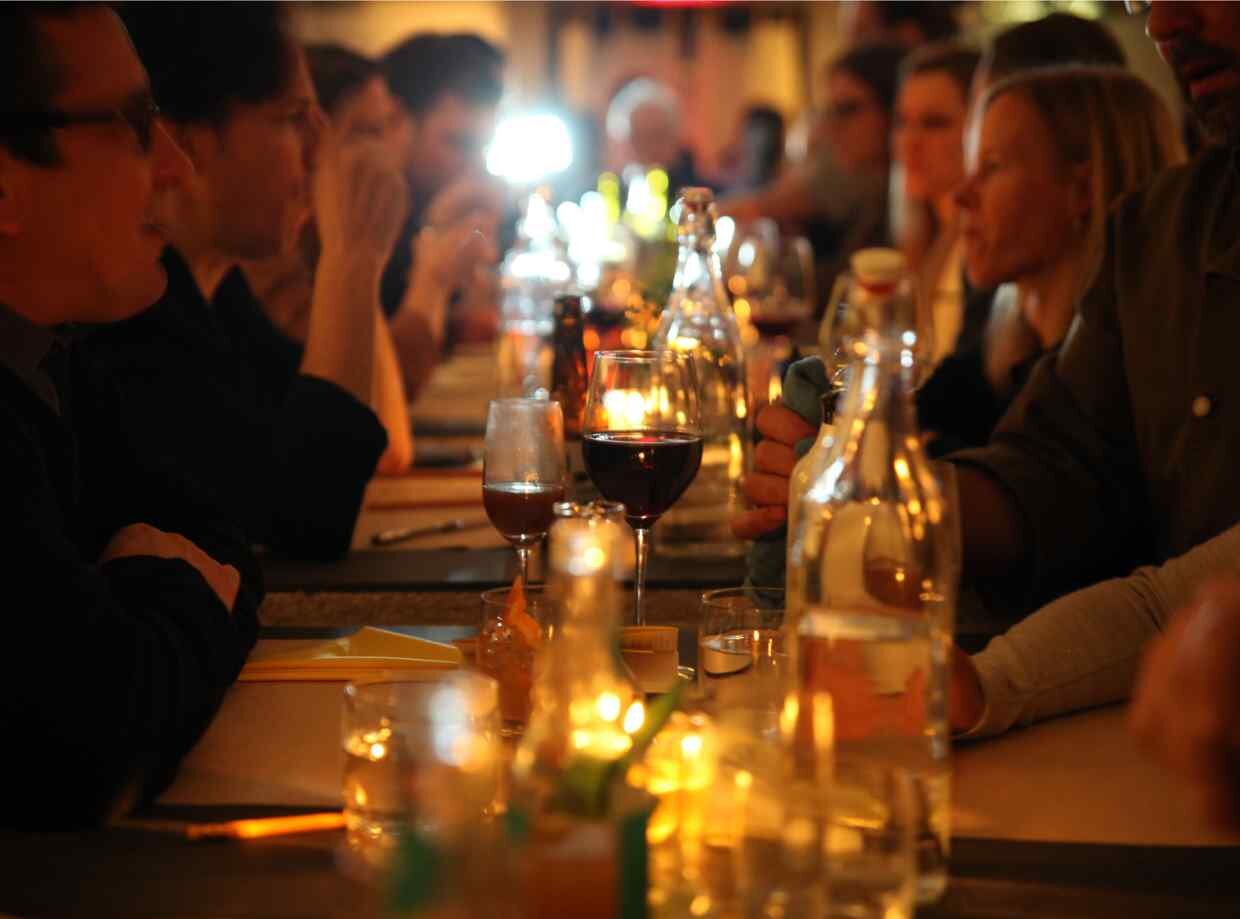
The WastED dining room | Image: Mark Ostow
On the drinks front, Iain Griffiths of Mr Lyan will reimagine classic cocktails through the WastED lens, while Henrietta Lovell and the Rare Tea Company will curate the afternoon tea (Tuesday-Friday, 3-5pm, from £32) during which visitors can linger in an art gallery-cum-listening café featuring vitrines that tell the story of the ingredients featured on the menu.

Nut-pressed cakes | Image: Aliza Eliazarov
The decor by Blue Hill design director Laureen Barber, and Garrett Ricciardi and Julian Rose of Formlessfinder also focuses on upcycling, transforming the Selfridges rooftop into a garden/exhibition space with lamps crafted from seaweed and mushrooms by Jonas Edvard and Nikolaj Steenfatt. Eco-plastic tables and chairs and stools made from artichoke thistle and resin by Kizis Studio will sit next to vitrines and bar surfaces crafted from salvaged wood by Wonderwall Studios; even Kristie van Noort’s Cornwall plates are decorated with ceramic paint made from recycled materials.
“Almost one third of the world’s food gets cast aside, but as chefs it’s not in our DNA to be wasteful,” says Barber. “We’ve been refashioning discarded bits into delicacies for centuries: bouillabaisse is made with damaged fish; pot-au-feu with leftover beef and vegetables. The food-waste movement has really taken hold in the UK, so the timing is perfect to work in partnership with chefs and industry leaders to spread the word.”

A long weekend in Kuala Lumpur with Jean-Michel Gathy
The Brussels-born architect shares culinary highlights, clean green spaces and local craft troves in his adopted hometown with Christina Ohly Evans. Portrait by Ian Teh
The Brussels-born architect shares culinary highlights, clean green spaces and local craft troves in his adopted hometown with Christina Ohly Evans. Portrait by Ian Teh
What makes Kuala Lumpur special is its people. They’re a wonderful mix of Malay, Chinese and Indian, all considered equally important, so everyone is kind to each other. They are genuinely friendly and welcoming, and since everyone speaks English, a visit is very easy. The racial mix means a rich variety of foods, types of worship, ways of dressing and also, of course, different kinds of architecture. The diversity, tolerance and acceptance of everyone: these are the city’s most powerful assets.

The dramatic golden statue at Batu Caves | Image: Getty Images/EyeEm
If you like celebrations – and particularly fireworks – then this is the place, as there are holidays and festivals for the country’s myriad faiths throughout the year. Because of its variety of religions, Malaysia has earned itself the reputation of having one of the highest numbers of public holidays in the world. And in KL, there’s almost always something fun going on.
Because Malaysia was a British colony until 1957, the courts of law, the infrastructure, the police and the medical systems are all very balanced, much like you’d find in western Europe. Despite Kuala Lumpur’s lush, tropical feel – we’re basically on the equator – with the jungle that surrounds the city, you will still feel quite at home here as a foreigner.
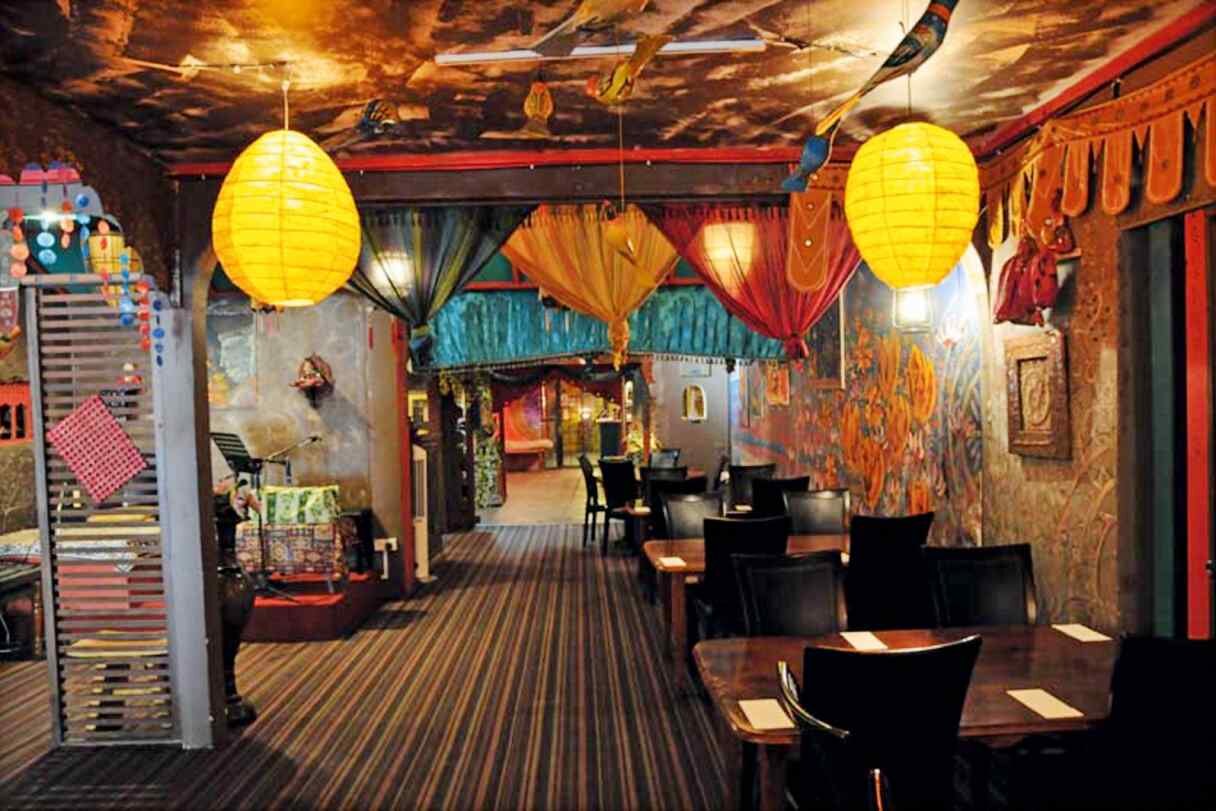
Passage Thru India restaurant, which has a magical atmosphere and a memorable prawn masala
The city is a bit like Singapore in terms of its urban landscape, but I think of it as a more of a residential-feeling, cosy place. We have rain every day, which is good for the palm trees, the many golf courses and our public parks, and because we’re so close to the sea – it’s just 30km away – I think KL must be the world capital for incredibly dramatic lightning. I often recommend the very central Shangri-La hotel, not just because my office is there, so I gravitate towards it, but because everyone is drawn to the buzzing lobby. I’m a big fan of its Japanese restaurant, Zipangu, where the uni sushi is fantastic, but so is the hotel’s Sunday brunch in the Lemon Garden restaurant. Next to the city-centre KLCC Park, just below the iconic Petronas Twin Towers, is the Mandarin Oriental, where rooms with floor-to-ceiling windows overlook all the greenery, and there are great views from its MO Bar too. I think it’s the best location in the city – but almost as good is the Grand Hyatt, which is just 300m from the towers and has a very contemporary look.

Malacca has many ornate temples and makes for a great day trip out of Kuala Lumpur | Image: Alamy Stock Photo/Adrian Baker
KL has many suburbs, and each has a weekly market with a mix of Malay, Chinese and Indians selling goods of all kinds. In Petaling Jaya, for example, you’ll find day and night markets with every single kind of fruit and an abundance of vegetables. But the fish stalls are the stars – it’s not so much about the butcher here – and they sell everything from seabass to prawns to rock lobsters, as well as famous local dishes: nasi goreng, or fried rice, and nasi lemak, a mixture of rice with coconut milk, cucumber, chicken or seafood, and egg, which is delicious.

The lobby of the city’s Shangri-La hotel is a popular meeting place
People don’t really entertain at home in Malaysia, so restaurants with all types of cuisine to choose from are plentiful. To enjoy real Malay food, I send people to Bijan, for the nice ethnic feel – soft lighting, stone floors and wooden screens; it’s quite romantic – and the classic kerabu pucuk paku, the local fiddlehead fern salad, which is very good. The Chinese restaurants here tend to be the opposite: overlit, quite noisy and always very showy. But South Sea Seafood in Kampung Baru Subang and Hakka Restaurant in Jalan Kia Peng are both reliably good – bright and festive, and offering good versions of standards like spring rolls and stir-fried crab. The Indian restaurants here are visual feasts, always red or pink – they worship these colours! – with lots of gold decoration. The best place for prawn masala and all kinds of roti is Passage Thru India, with its magical, slightly exotic atmosphere.
One of the best go-to restaurants in general, though, is Marini’s on 57, a lively Italian spot on the 57th floor of a building next to the Petronas Twin Towers – from the terrace, it feels as if you could touch them. The cocktail bar has good music and is always full of stylish people – it’s the place to be. And the founder of the restaurant, Cavaliere Modesto Marini, has another restaurant called Marble 8 that serves the best steak in town.
There are so many cultural highlights in KL, but top of the list is the Hindu temple Sri Mahamariamman. It’s the oldest (and richest) temple in Kuala Lumpur, founded in 1873 at the edge of Chinatown, on Jalan Tun HS Lee. The Batu Caves is another Indian temple in the limestone hills near the city; it’s in a very dramatic grotto and has a tall golden statue at the base of a staircase that leads visitors up to the snug cave temple. It’s not for everyone, because it can be a messy walk, but I think it’s really worth making the trip. The city’s main mosques – Masjid Jamek Sultan Abdul Samad and the National Mosque of Malaysia – are both must-sees; the latter is set in 13 beautiful manicured acres and holds 15,000 people. And my golfing friends are always happy about the 15 courses within about a 10km radius of town, including the famous Kuala Lumpur Golf & Country Club, where they host PGA and LPGA tournaments.
For real local immersion, I always recommend Bangsar Shopping Centre, where you’ll find a little of everything: spa and beauty products, clothes, shoes and a massive food hall. It has a very local feel – it’s not at all about big chain stores. One of my favourites to browse in is Jasons, the food hall, which has other locations in Singapore and Hong Kong and is basically a department store for all things edible. The huge selection and incredible lighting make it special, and its mangoes, my favourite fruit, are the best. For jewellery that’s influenced by Asian culture and mythology, it has to be Lotus Arts de Vivre: it makes use of raw natural materials – seeds, coconut shells, scarab wings, ebony and precious woods, sea shells, bamboo – and you’ll see wonderful examples of traditional craft techniques.
It’s well worth exploring KLCC Park in the middle of town. It isn’t Hyde Park or Central Park, but it is 20 beautiful hectares and makes the city feel so clean. It’s a wonderful place for children to play and there are running tracks too. For a city escape, take a day trip to Malacca. It’s just 120km south of KL and, since it was variously a Dutch, Portuguese and British colony, there’s an unusual mix of architecture with many ornate temples and a lovely harbour.
Kuala Lumpur is growing rapidly – we have good subways, elevated trains and everything is wired, which makes a visit here very user-friendly. But I hope it keeps its private, slightly homey feel, because when things get too urban, you lose the intimacy. Most of all, I love the genuine kindness of the people; they are what will continue to make it such a special place.

Switzerland's Kulm Hotel Expansion Draws Michelin-Starred Chefs and Sports Fanatics
The historic Ice Pavilion in St. Moritz gets an upgrade, courtesy of Pritzker Prize-winner Norman Foster, with new modern, cantilevered sports venues and a world-class restaurant.
The historic Ice Pavilion in St. Moritz gets an upgrade, courtesy of Pritzker Prize-winner Norman Foster, with new modern, cantilevered sports venues and a world-class restaurant.
Visitors to Switzerland’s Engadine Valley—home to high-end ski haven St. Moritz at 6,000 feet—have a new destination to consider, thanks to the opening of the Kulm Country Club at the storied Kulm Hotel. Following a £9 million (USD $11.3 million) renovation and expansion of the original Ice Pavilion—a two-story structure built in 1905 that figured prominently in the 1928 and 1948 Olympic Games—as well as a serene oak-paneled restaurant, lounge, and sprawling sun terrace, the new spaces will create a vibrant arts and events hub for the entire Alpine community.
“I have lived in St. Moritz for many years, so this project is very close to my heart,” says Lord Foster of the year-long project, inspired by “the sporting heritage of the region. "It connects with the history of the building, while adapting it for new uses.” Designed to enhance the flourishing arts and athletics scene in the perpetually chic ski resort, the Foster + Partners buildings have been reimagined using larch, ash, and oak—local timber in keeping with the tradition of the region. The results are spare, light-filled spaces that showcase the Kulm’s vintage sports memorabilia—bobsleighs, skis, photographs, and assorted artifacts—and capitalize on the breathtaking mountain views beyond.

One of the most exciting aspects of the Kulm project is the permanent pop-up restaurant concept that will kick-off with multi-Michelin-starred Daniel Humm of Eleven Madison Park, followed by inventive takes on bistro classics courtesy of 2016’s Gault Millau Chef of the Year, Nenad Mlinarevic, for the month of February. Next up in the rotating residency line-up will be chef Mauro Colagreco, of two Michelin-starred Mirazur in the south of France, who will prepare his signature South American-inflected, Mediterranean specialties that are vegetable-centric and focused on simple (yet striking) color and flavor combinations.
“Designed in the spirit of a mini stadium,” says Foster, of the multipurpose pavilion overlooking the expansive skating rink, “it is envisaged as the focus of the annual calendar of sporting and cultural events such as the medal ceremonies for the World Ski Championships in February (6–19), the Festival da Jazz, and the British Classic Car Meeting in summer.” The restaurant and lounge will complement these Kulm Park events, and, as Foster hopes, “become a new social space for the community, a place for everyone to come together and celebrate.”

Bespoke Scottish-made hardwood skis
Lonely Mountain Skis are made with adventure in mind
Lonely Mountain Skis are made with adventure in mind
“Our customers are skiers looking for adventure,” says Jamie Kunka, head designer and craftsman at Scotland’s Lonely Mountain Skis (LMS). “They want something that can take on piste skiing, ski touring or even freeride ski competitions.” From a workshop in Perthshire, Kunka crafts handmade custom skis using a unique mix of traditional and modern materials and methods to provide a smooth ride – whether in powdery Patagonia or the icy gullies of Aonach Mor in the Scottish Highlands.

Jamie Kunka, of Lonely Mountain Skis, carrying Sneachda skis (from £750) at Carn an Tuirc in the Scottish Grampians | Image: Alun Callander
Each commission (from £1,100) begins with a consultation – in person or by phone and email – with Kunka, to determine desired fit, performance goals and the types of terrain to be covered, as well as graphics, finishes and veneers. Clients can take inspiration from several of the firm’s existing designs: the all-mountain Sneachda (from £750), which is perfect for use in Europe and beyond; the lightweight-yet-stable expedition Crua (from £750), which plays well in Scandinavia and the Alps; and the Ord (from £900), a powder and freestyle ski with a light balsa/flax core that’s ideal for use in North America and Japan. Kunka is happy to adapt these shapes, as well as to devise new concepts and work to varied ski lengths – which usually range between 168cm and 189cm.
Each hand-finished pair – made of an eight-layer laminate of natural and synthetic fibres with a beech, poplar or maple core – takes between three and five weeks to complete. The bases are sintered 7000 PTex (a polyethylene plastic) and the entire ski is pressed in a vacuum moulding system that ensures even flex. Flax and carbon fibres add strength and flexibility, while the top layer is a beautiful one-of-a-kind hardwood – maple or cherry. Most are capped with a discreet LMS logo, but bespoke clients can request any graphic finishes they fancy. One new embellishment this season is custom pyrography engravings of Scottish nature scenes by graffiti artist-cum-naturalist LeRoc.

Jamie Kunka making hardwood ski cores in the company’s workshop | Image: Alun Callander
These high-performance skis are also pleasingly friendly to the environment. “We use as many sustainable and natural materials as possible; 80 per cent are from grown sources,” says Kunka. “And for every ski we sell, we aim to plant two trees to offset the carbon dioxide we produce.”
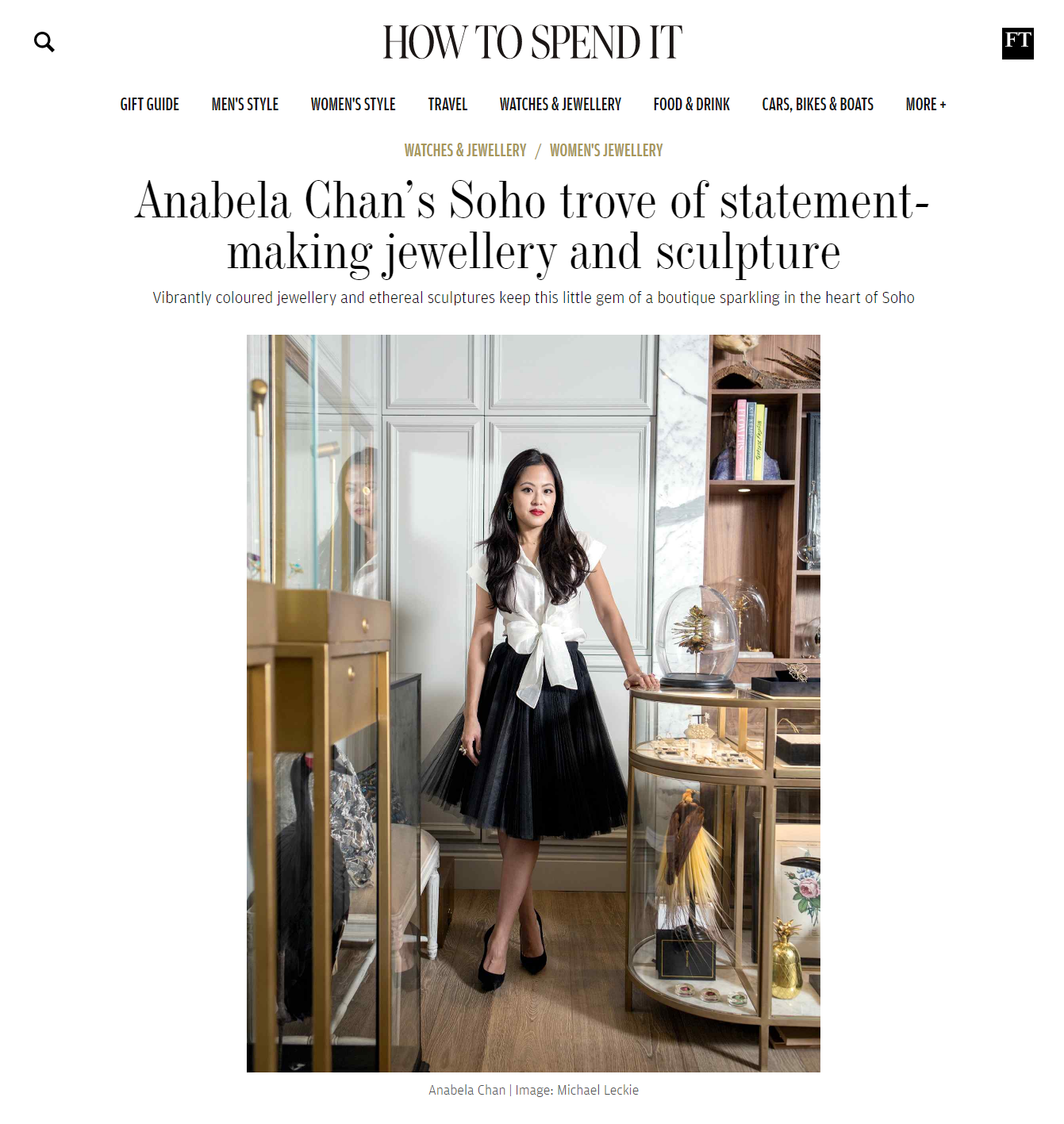
Anabela Chan’s Soho trove of statement-making jewellery and sculpture
Vibrantly coloured jewellery and ethereal sculptures keep this little gem of a boutique sparkling in the heart of Soho
Vibrantly coloured jewellery and ethereal sculptures keep this little gem of a boutique sparkling in the heart of Soho
“I wanted to create an exquisite gem in the city,” says Anabela Chan of her bijou fine-jewellery boutique in the courtyard of the Ham Yard Hotel in Soho. Showcasing her exuberant, statement-making pieces alongside her personal collection of taxidermy birds and her intriguing artworks, the space is an art deco-esque tour de force – designed by her husband, Jimmy Hung, an architect at Heatherwick Studio. “He devised every cabinet and fixture, as well as the Italian marble, brass and walnut finishes.”
Gold-edged vitrines hold ornate cuffs (from £2,200) and feathered necklaces (from £1,990), while a stuffed crane and preserved parrots stand sentry over Chan’s exotic Butterfly Bloom sculptures (from £9,000). These ethereal arrangements, sourced from the jungles of Brazil and mountains of Mexico, are housed in sculptural, tinted-glass domes “reminiscent of water droplets” that are hand-blown in Wiltshire.

Gold and diamond Morpho Bloom cuff, £13,900 | Image: Michael Leckie
The grandchild of a noted Chinese film director and cinematographer, Chan first trained as an architect, practising with Richard Rogers, before turning her passion for drawing flora and fauna into print and embroidery design work for Alexander McQueen. “But I craved making things with my hands,” says Chan, who then headed to the Royal College of Art to study jewellery design.
She launched her eponymous brand in 2013 with 20 spectacular cocktail rings, and today her creations – “full of the magnificent colours, textures and geometries of nature” – have an international following, including Kit Kemp and Lady Gaga. Known for her use of vibrant stones such as sapphires, amethysts, garnets and peridots, Chan handcrafts each piece in her Chelsea atelier – from the dramatic Bumble Rose Ring (£910) with enamel and coral flowers and gem-encrusted bees surrounding a stunning aquamarine solitaire, to the dazzling Aqua Papillon drop earrings (£1,360), in 18ct gold vermeil with peridots and diamonds.
Unlike many fine jewellers, Chan delights in using laboratory-grown gems – such as the aquamarine mentioned above, as well as champagne diamonds and Japanese opals – but some of her most striking pieces focus on natural stones. The sculptural, modern Morpho Bloom cuff (£13,900), for example, is encrusted with ethically mined white diamonds, and the ornate Cinderella ring (£26,000) in white, yellow and black gold is set with a vivid, multifaceted 13.6ct blue topaz. Equally eye-catching are her one-off Triton earrings (price on request) – clusters of red and pink coral, Swarovski crystals and glass beads inspired by reefs in the Aegean Sea – and the bold Poseidon necklace (price on request), which combines turquoise and hand-dyed blue coral to spectacular effect.
Chan welcomes bespoke work too; she delights in setting treasured gems into new rings (from £30,000); a more outré commission was a tribal-inspired neckpiece in red macaw feathers for Game of Thrones actress Sophie Turner. “Jewellery isn’t rocket science,” says Chan, “but it can bring immense joy and empowerment. It’s often a celebration of the past and the future. I find that endearingly romantic.”