
Farmaesthetics
An online bounty of herbaceous eco-beauty
An online bounty of herbaceous eco-beauty
Farmaesthetics is a curious name for a skincare range. But all becomes clear when it transpires that the entire collection of tinctures, serums, oils and mists (in their chic apothecary-style bottles, first image) is made using whole-herb ingredients sourced from American family farms. The company was named in TIME Magazine’s “Green Style & Design 100: The People and Ideas Behind Today’s Most Influential Design”. Brenda Brock is the brains behind the brand and her formulations are garnering an increasingly loyal international following, now that they can be bought online and dispatched globally.
Shop by either skin type or category (from body zone to cleanser); the Standard Regimen option is a great place to start. This nine-item collection includes many of Farmaesthetics signature basics including rose-water and glycerin ($26), a fine herbal cleanser ($38) with witch hazel, and the herbal hydration mask ($48) – a refreshing paste designed to lift oils while moisturising the skin with beeswax, shea butter and soybean oil.

Dry and sensitive skin types are particularly well served. Fine facial oils ($58) with evening primrose and sweet cherry-seed oil extracts promise to brighten (and can also be used a primer before applying make-up), while nourishing lavender milk ($38, second image) is light enough to use even on children’s skin. One of the key ingredients in both products is calendula, which repairs skin damaged by sun, severe weather conditions and scarring.
The baby range, and gift sets for men, new mums and jetsetters (from $58) – each including Farmaesthetics favourites in TSA-approved miniature vials are also work checking out.
For more chemical-free beauty, try this natural night cream, or this organic Icelandic range.

Firle Place Herb Garden Collection
An e-cache of beauty products from a Sussex estate garden
An e-cache of beauty products from a Sussex estate garden
Fresh from the Sussex gardens of Lady Alexandra Gage comes The Firle Place Herb Garden collection – a small-batch range of medicinal balms, beauty ointments and teas made using herbs and wildflowers from the expansive estate. The 17 products in four categories (beauty energy balms, teas, soaps and medicinal balms) are designed to enhance both body and mind; Gage contends that self-realisation and all-natural formulations are the keys to beauty.
Three jars of energising balm (£15 for 30g) – wood violets, snowdrops and daffodil and stone – all moisturise and relax as well as proclaim the importance of self-love, truth and acceptance. Yes, it’s a bit hippy-dippy, but endearingly so.
Less philosophical are the medicinal balms targeted at specific ailments and areas. Hints of petitgrain, blue chamomile and patchouli in the Calming Balm (£12 for 30ml or £22 for 50ml) aid sleep, while lavender, spearmint and rosemary with a touch of vitamin E in the Gardener’s Hand Balm (£12 for 30ml) nourish cracked fingers. A special apis, ledum and tea tree oil balm treats bee and nettle stings (£12 for 30ml). And the Summer Skin Balm (£12 for 30ml) soothes sun-weary skin with its cooling geranium and hypericum extracts.
Naturally caffeine-free teas (all £4.50) include Digestive Comfort using lemon balm, chamomile and verbena, Happiness and Restful Sleep. Last but not least are handcrafted soaps (£5 each, 90g), made using pure plant oils including clary sage, calendula, lavender and spearmint – each designed to restore tranquillity while cleansing.
Before you leave the site, be sure to visit the photo gallery full of images of the walled gardens and allées of trees. If bucolic could be bottled, these would help the fantasy thrive.
Check out these fruity and floral fragrances or organic, chemical-free wrinkle cream that uses violet leaf extract to reduce fine lines.
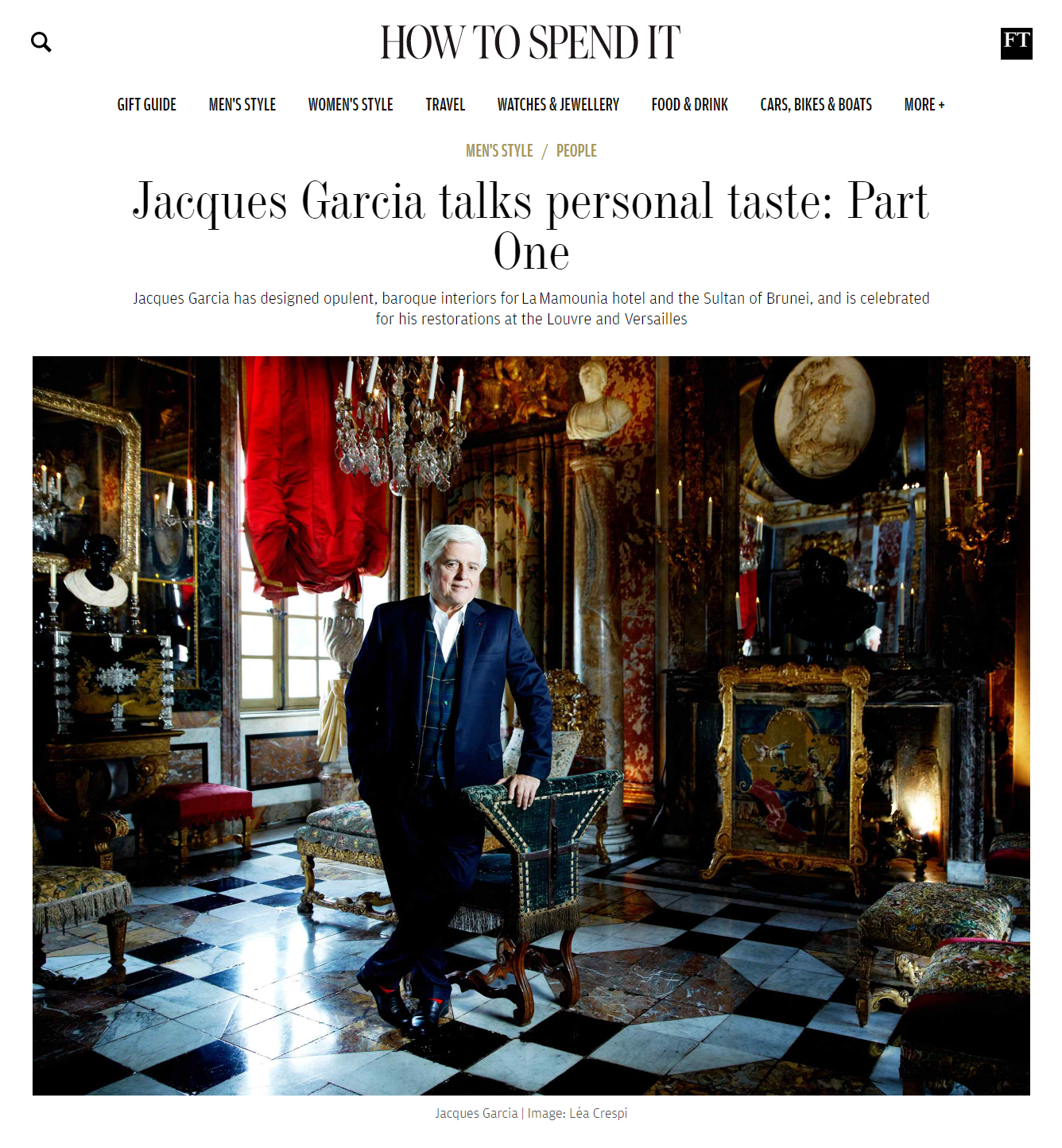
Jacques Garcia talks personal taste: Part One
Jacques Garcia has designed opulent, baroque interiors for La Mamounia hotel and the Sultan of Brunei, and is celebrated for his restorations at the Louvre and Versailles
Jacques Garcia has designed opulent, baroque interiors for La Mamounia hotel and the Sultan of Brunei, and is celebrated for his restorations at the Louvre and Versailles
My personal style signifiers are dark navy Ralph Lauren suits and bright red Berluti socks – a simple but sharp “uniform” that serves me well in a variety of situations. www.berluti.com. www.ralphlauren.com.
The last things I bought and loved were two huge antique ceramic armchairs that look like tree trunks, from Ann-Morris in New York. Their peculiarity is that one often sees them made of wood but never ceramic. This pair received a gold medallion in the Universal Exhibition at the end of the 19th century. I love their timelessness, elegance and technical prowess. 239 E 60th St, New York, NY 10022 (+1212‑755 3308; www.ann-morris.com).
And the thing I’m eyeing next is a painting by young French artist Claire Tabouret. I like her slightly haunting figurative images and her strong link to the past. www.clairetabouret.com.
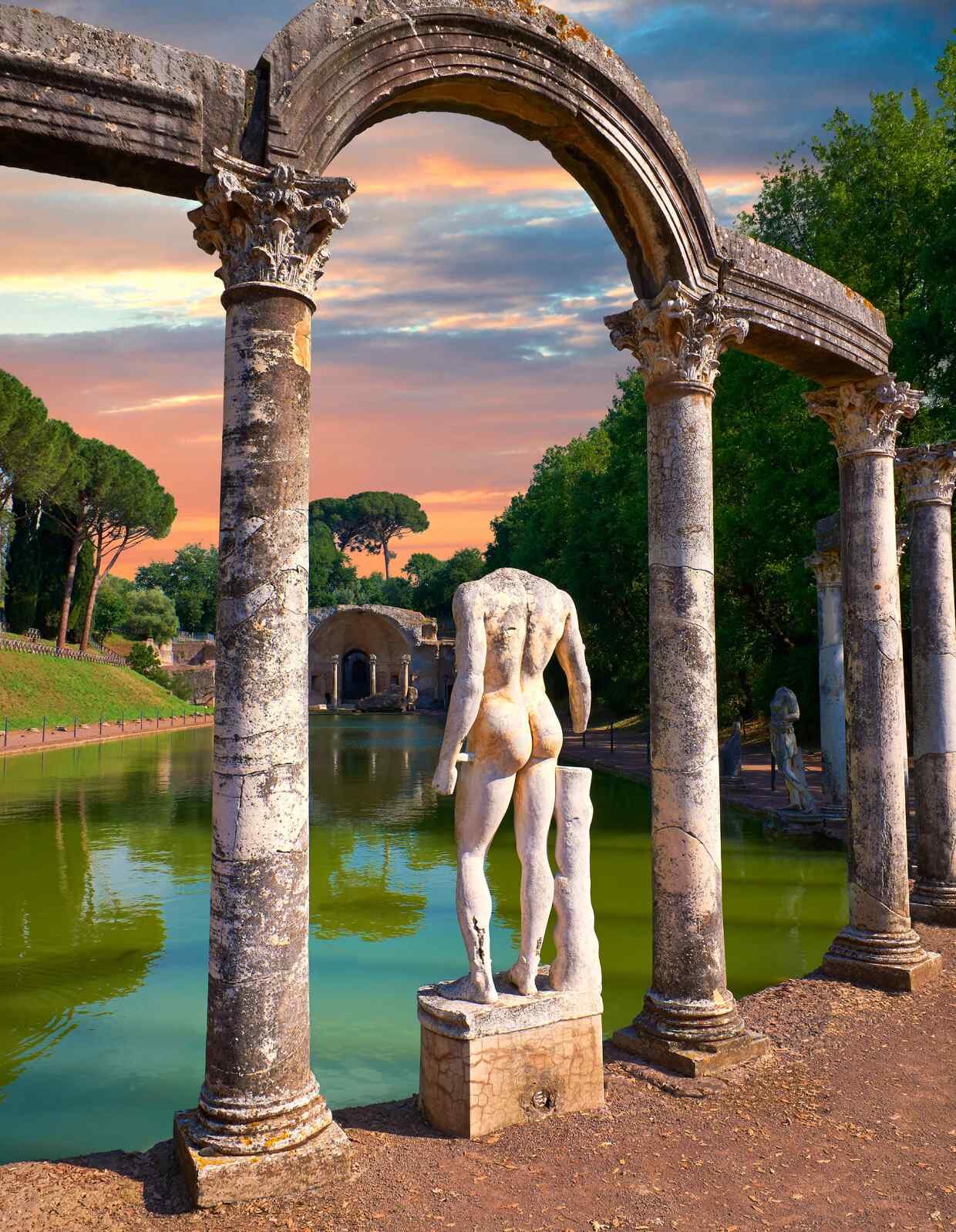
The Serapaeum at Hadrian’s Villa, in Tivoli
An unforgettable place I’ve travelled to in the past year is Sicily, specifically the beautifully preserved areas between Catania, Syracuse, Noto and Ragusa. In this part of Italy time stops, and I feel very close to ancient civilisations. The mid-17th-century Duomo in Noto – with its glorious cupola – was a particular highlight, as was the Via Cavour in Noto with its wonderful succession of baroque buildings, including the impressive Palazzo Impellizzeri and Palazzo Trigona.
And the best souvenir I’ve brought home is my dreams. I travel very lightly and don’t like to accumulate things on any journey.
The last accessory I added to my wardrobe was a pair of simple black leather loafers from JM Weston. I love this iconic, elegant French brand and these are exceptionally comfortable. www.jmweston.fr. (+331-4260 6364; www.meyrowitz.com).
A recent “find” is Ganesh Handicrafts in Jodhpur, which sells the most beautiful ethical textiles. I love shopping for decorative pieces in India; it’s a journey of thrilling discovery. 84-85 Nai Sarak, Girdikot, Kandoi Bazar, Jodhpur, Rajasthan 342001 (+91291-262 4165).
The last music I downloaded was Les Pêcheurs de Perles by Georges Bizet. Performed by French tenor Alain Vanzo, it features a beautiful mix of opera and orchestral music.
The beauty staple I’m never without is a light fragrance called Habit Rouge by Guerlain. I love its combination of citrus with something leathery. £68 for 100ml EDT; www.guerlain.com.
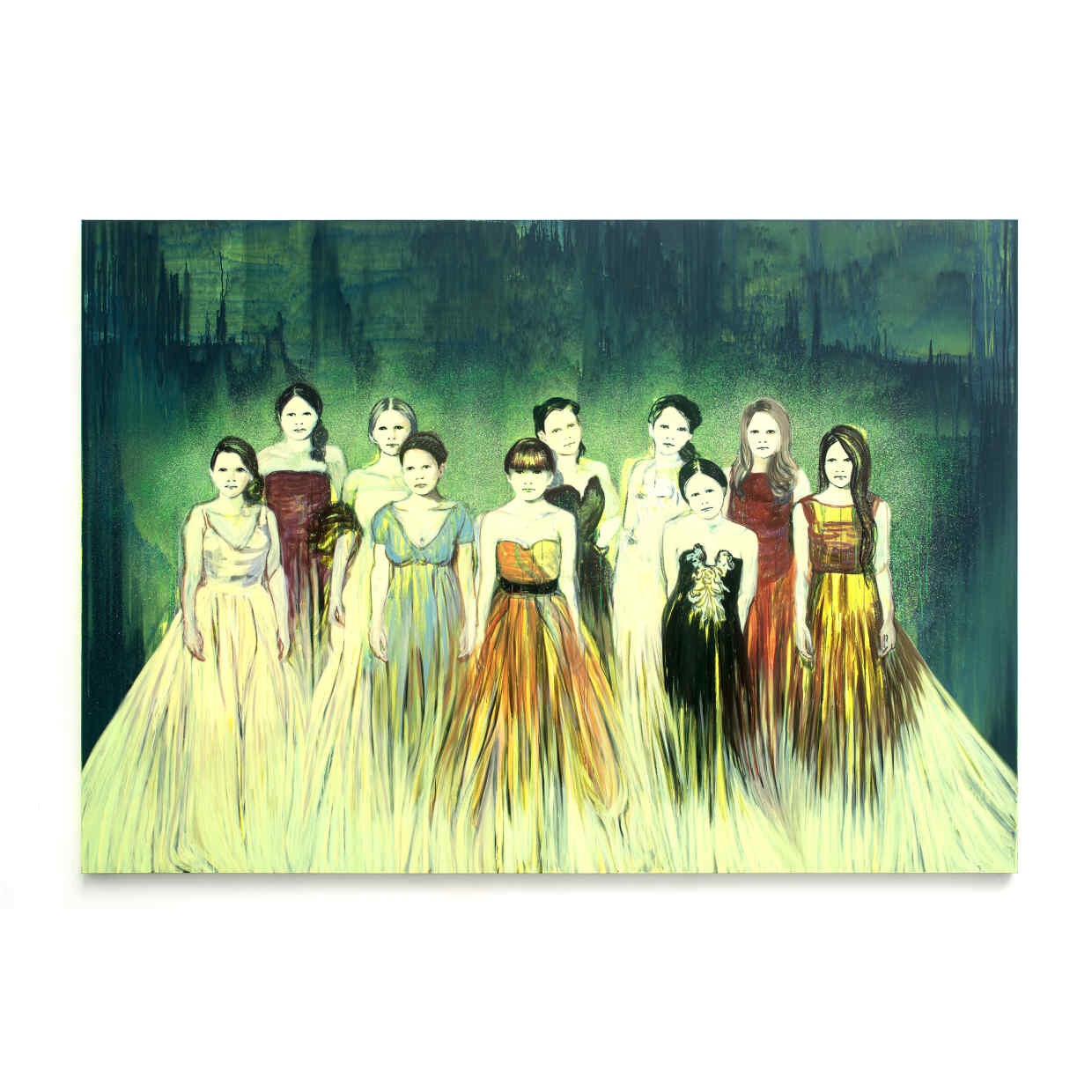
Les Débutantes (vert émeraude) by Claire Tabouret
The site that inspires me is Hadrian’s Villa in Tivoli. The beautiful ruins and collection of sculpture, marble statuary and mosaics is incomparable. I love the design of the extensive gardens, as well as the sheer exuberant, Italian feel of the place.
An object I would never part with is my bespoke tortoiseshell EB Meyrowitz glasses. I am entirely dependent on them and have worn this style for many years. 5 Rue de Castiglione, 75001 Paris.
If I didn’t live in Paris, the place I would live is Normandy, at my château in Bataille; I have spent 20 years restoring the house and gardens and dream of spending more time here. I’d like to escape city mayhem – and all the flying and travelling – and simply relax and enjoy the countryside. The hunting salon is my refuge, and I love the architectural contrasts of the château, the Jaipur-inspired Moghul house and the greenhouse – moving between them, I make a magical discovery every time.

Garcia’s EB Meyrowitz tortoiseshell glasses | Image: Léa Crespi
An indulgence I would never forgo is buying 18th-century antiques, particularly books about fine art from Librairie Galignani on the Rue de Rivoli. This elegant bookstore is always full of surprises. 224 Rue de Rivoli, 75001 Paris (+331-4260 7607; www.galignani.fr).
My favourite websites are few and far between. It is my goal to unlock the secrets of the web one day, but in the meantime I stick to auction sites such as Interencheres and Auction FR for interesting pieces of furniture, and Sotheby’s and Christie’s for objets d’art. www.auction.fr. www.christies.com. www.interencheres.com. www.sothebys.com.
Discover the personal style files of the multidisciplinary architect and designer David Rockwelland the man behind The Ritz’s renovation Thierry Despont.
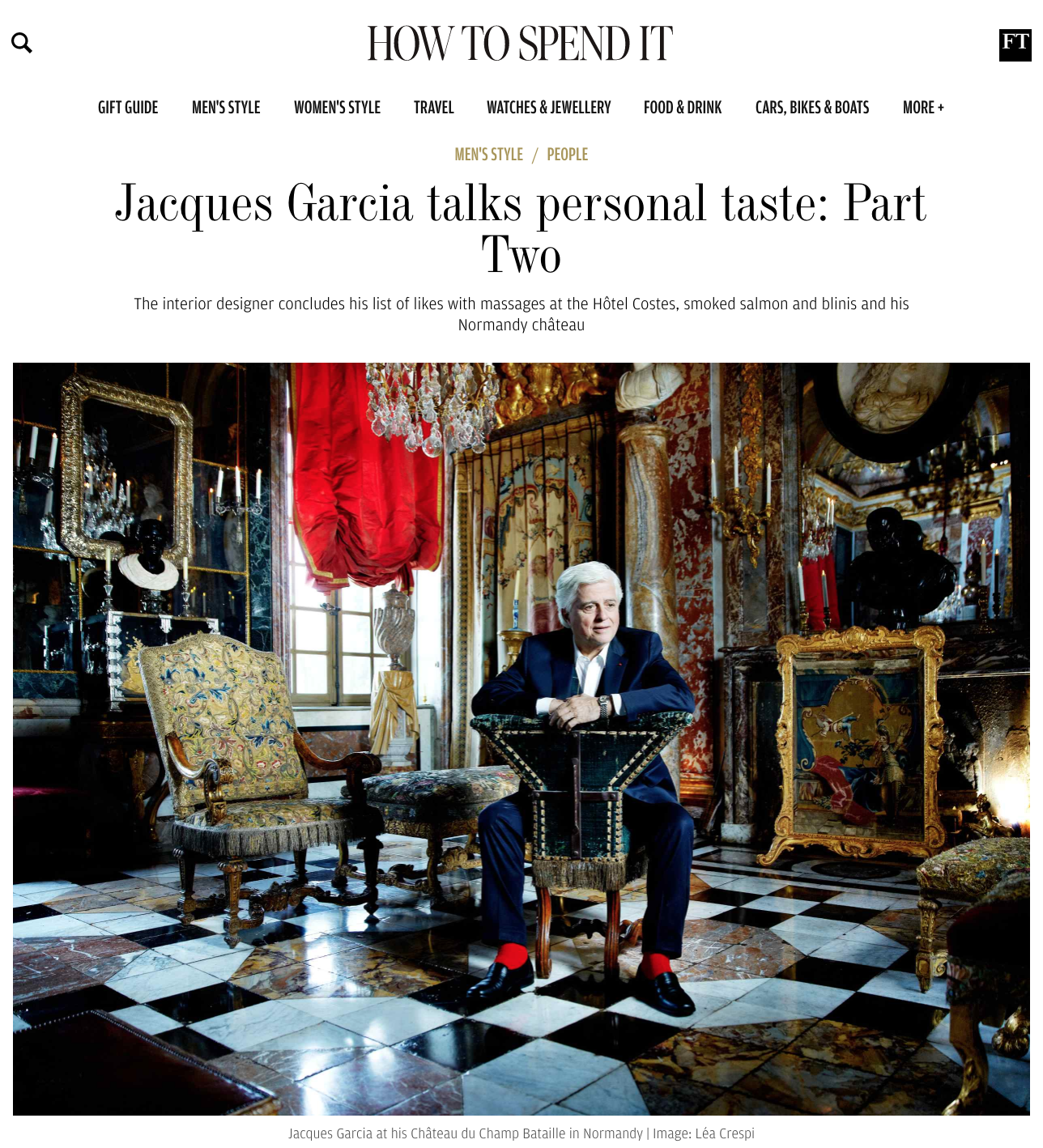
Jacques Garcia talks personal taste: Part Two
The interior designer concludes his list of likes with massages at the Hôtel Costes, smoked salmon and blinis and his Normandy château
The interior designer concludes his list of likes with massages at the Hôtel Costes, smoked salmon and blinis and his Normandy château
The people I rely on for personal grooming and wellness are Tessa Theolier, my lifelong friend, collaborator and the only person I ever allow to cut my hair; and Julien Montenot, a masseur extraordinaire at the Hôtel Costes spa, for his restorative massages with essential oils. I’d have a very hard time giving these up – they are the perfect way to unwind after a busy day. Hôtel Costes, 239-241 Rue Saint-Honoré, 75001 Paris (+331-4244 5000; www.hotelcostes.com).

The Hôtel Costes spa, Paris | Image: Frédéric Baron-Morin
The books on my bedside table are typically about Roman architecture from the 17th century, but you’ll also find a copy of Monochrome by photographer Vanessa Von Zitzewitz, a coffee-table book of her black and white nudes, and Lost Divas by André Tubeuf, a beautiful Assouline book about the glamorous – and gossip-filled – lives of great opera singers.
The best gift I’ve given recently was proof of my loyalty to a dear friend.

Lost Divas by André Tubeuf
And the best one I’ve received was a beautiful bouquet of lilies and white roses from Parisian florist Moulié Fleurs. It was sent by a close friend to celebrate the reopening of the Louvre’s decorative arts galleries, which I have spent years restoring. 8 Place du Palais Bourbon, 75007 Paris (+331-4551 7843; www.mouliefleurs.com).
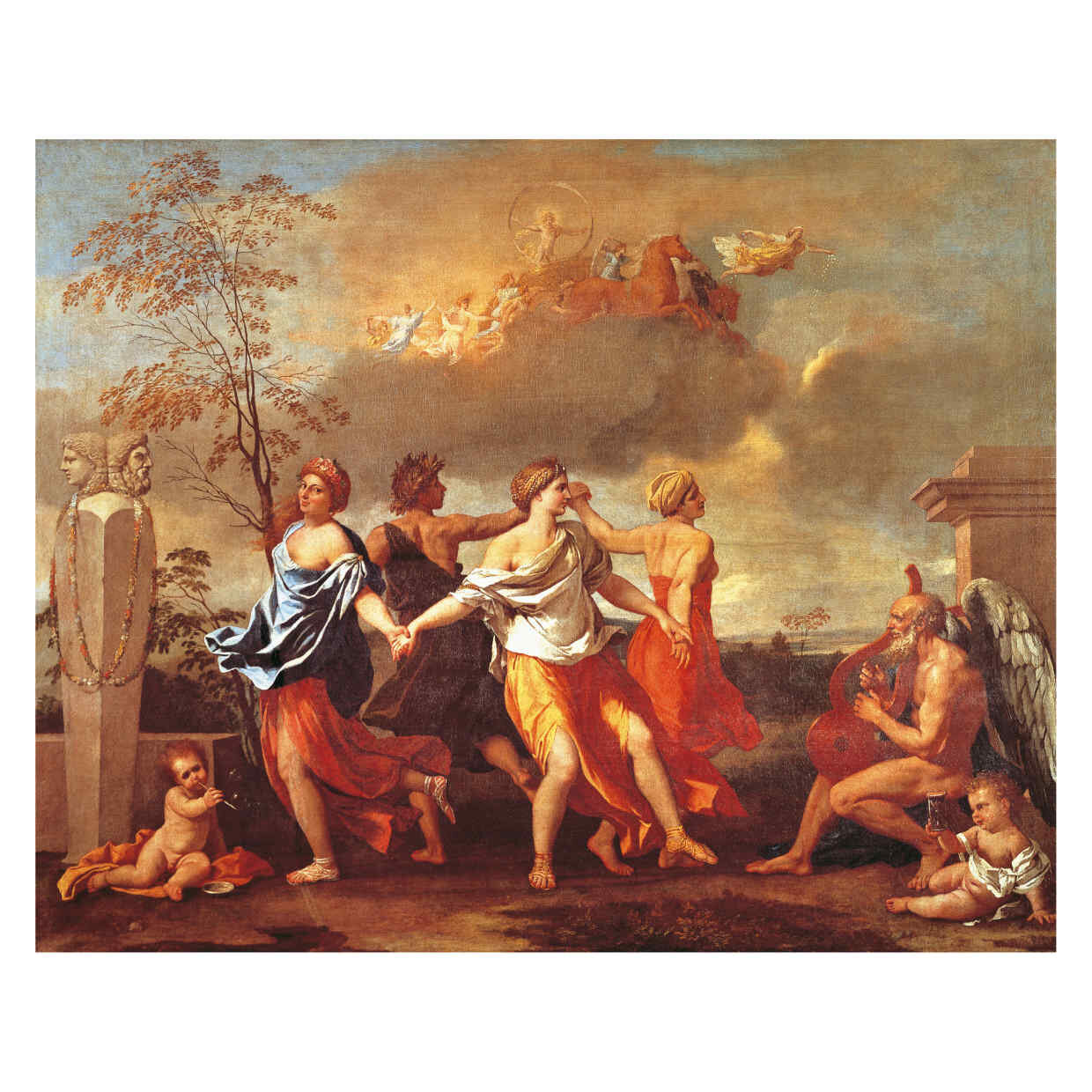
A Dance to the Music of Time by Nicolas Poussin | Image: Getty Images
The last meal that truly impressed me was a private dinner hosted by Marie-Hélène de Rothschild in the Galerie d’Hercule at the Hôtel Lambert in Paris. This exquisite, 17th-century mansion – set on the tip of the Ile Saint-Louis – was the magical setting for an evening that will forever be in my memory.
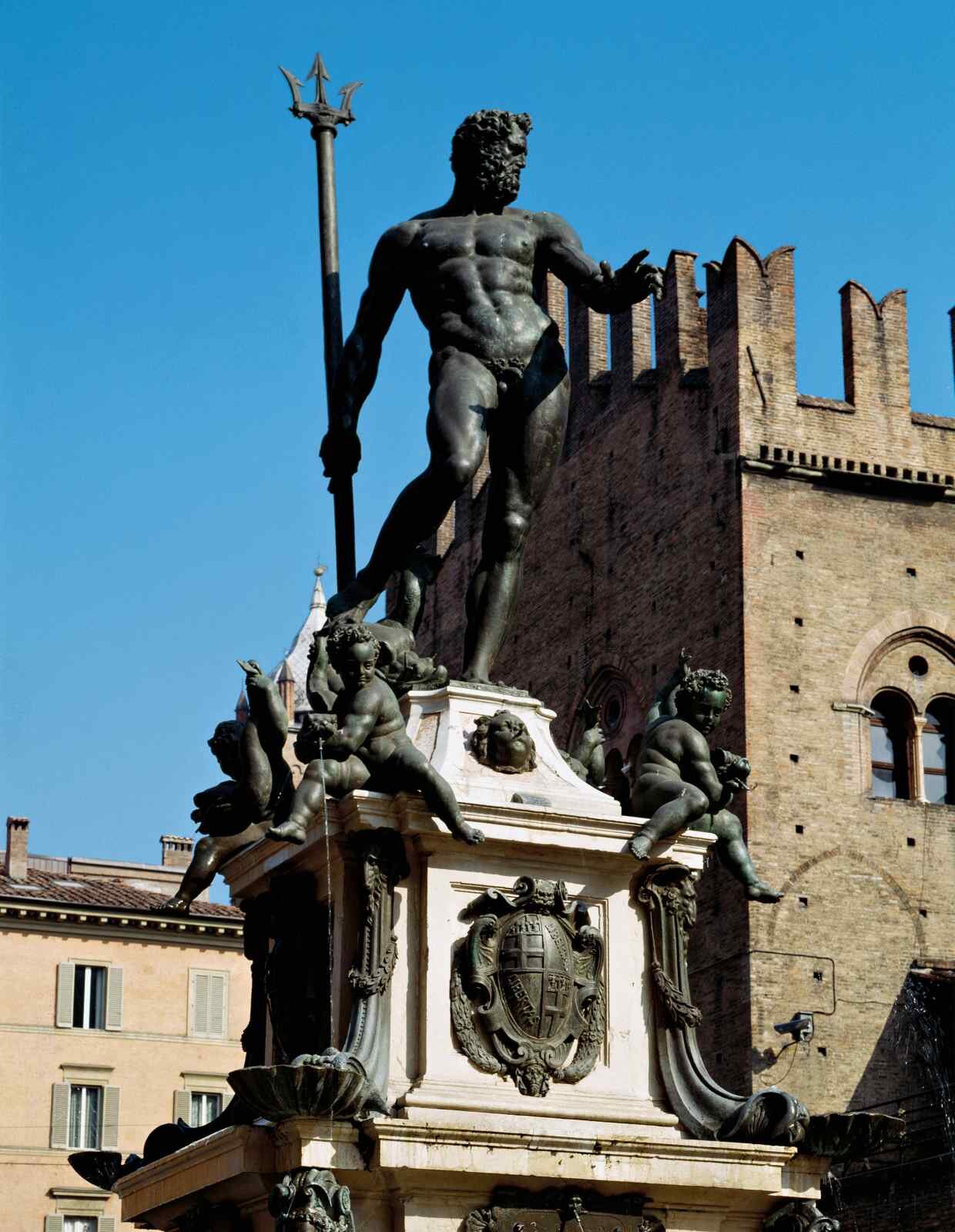
Fountain of Neptune by Jean de Bologne | Image: Getty Images
The artists whose work I would collect if I could include Michelangelo, Nicolas Poussin, Turner, Picasso and Matisse, among many others. I admire them for their use of colour, and each of their works evokes a distinct sense of place and time.
My favourite room in my house is my bedroom at my château in Normandy. It is a grand, jewel-toned space that has painted Peking silk walls and an elaborate, green velvet canopied bed. I like being surrounded by the rare books and antiquities I have assembled, as well as the complete quiet and calm.
In my fridge you’ll always find smoked salmon and blinis; I travel a lot but like to have something in case friends drop by. There’s also a bottle of Cos d’Estournel Blanc; I like its fresh, fruity flavour and stay particularly loyal because I helped design the chais at Château Cos d’Estournel.
If I weren’t doing what I do, I would be a sculptor. I particularly admire the work of Renaissance sculptor Jean de Bologne and would love to create such beautiful, lasting works of art.

Barry Sternlicht’s dining boltholes
The chairman and CEO of Starwood Capital Group oversees $42bn in assets under management and a property portfolio that includes 1 Hotels and Baccarat Hotels & Resorts
The chairman and CEO of Starwood Capital Group oversees $42bn in assets under management and a property portfolio that includes 1 Hotels and Baccarat Hotels & Resorts

Barry Sternlicht at Blue Hill at Stone Barns in Westchester County, New York | Image: Weston Wells
Sharing a meal tells you a lot about a person – their taste, their manners – and I often interview people at the table because everyone lets their guard down. Restaurants and clubs are also key to getting deals done because the setting takes the edge off: the meal serves as a kind of romantic seduction. Instead of gladiators sizing each other up in the boardroom, a rapport-building lunch or dinner in a disarming setting leads to a broader conversation.
A perfect example of this was our acquisition of Baccarat from Société du Louvre. That deal started with a four-hour dinner in Paris between chairwoman Anne-Claire Taittinger and myself. The company wasn’t for sale then, but when it did come onto the market, the bank involved, Rothschild, came to us because we had established a trust over that meal. Anne-Claire recognised that we weren’t just another private equity firm and that we had a people-focused approach.
Choice of venue is key and I always research what my clients like. If I’m trying to impress offshore bankers or real-estate investors, I’ll book a formal restaurant like New York’s Marea for its quiet atmosphere. I’ll take architects and designers to fun, less serious places like Barbuto or The Little Owl, which have a stylish, downtown vibe.
I find breakfast meetings tough because no one really eats and they are not that much fun. Lunches work well, as do celebratory dinners. For special occasions or dinners with spouses, I’ll opt for Blue Hill at Stone Barns in Westchester County, near our Connecticut offices. The farm-to-table menu is excellent, and we looked to them for inspiration in the restaurant design at our new 1 Hotels group. I like to eat well and stay in shape, so this is also a perfect choice for like-minded, health-conscious clients.
In Asia, I’m usually the one being wined and dined so I follow my host’s lead. But if I’m choosing, like when I’m meeting our client Jin Jiang, I’ll opt for the buzzy Café Gray Deluxe in Hong Kong’s The Upper House, which has views of the harbour. In Seoul, drinking is a big part of doing deals and we tend to establish a friendly rapport over the course of the evening. Shuchiku is a Japanese place in Building 63 – one of the city’s tallest, landmarked buildings – with incredible views and great sake.
I spend a lot of time in Miami and love Casa Tua’s spectacular food and outdoor setting, which is great for meeting with real-estate partners. For more boisterous evenings, when privacy isn’t a prerequisite, both Zuma and Prime 112 work well. Clubs are also great places for conversation and in London I like to entertain at 5 Hertford Street and The Arts Club. The former feels warm and cosy and has great acoustics, as well as nooks and crannies that allow for private negotiations, while The Arts Club has energy and caters to a more international, creative clientele.
For confidential deals, I’ll book a restaurant’s private dining room; in New York that might be at midtown’s The Core Club, which is convenient for meetings with bankers and lawyers, or at Casa Lever or Eleven Madison Park. This is down to an important lesson I learnt early in my career, when I was working in Chicago. I had a business dinner at Spiaggia with representatives from a company we were trying to acquire. At some point I went to the bathroom and overheard two of them talking about how they were going to negotiate and the price they were ultimately seeking. You definitely have a leg up when you know what figure will get a deal done. In a public restaurant, you never know who is sitting next to you.
WHERE TO FIND
5 Hertford Street, 2-5 Hertford St, London W1 (020-7408 2100; www.5hertfordstreet.co.uk). The Arts Club, 40 Dover St, London W1 (020-7499 8581; www.theartsclub.co.uk). Barbuto, 775 Washington St, New York, NY 10014 (+1212-924 9700; www.barbutonyc.com). Blue Hill at Stone Barns, 630 Bedford Rd, Pocantico Hills, New York, NY 10591 (+1914-366 9600; www.bluehillfarm.com). Café Gray Deluxe, The Upper House, 88 Queensway, Hong Kong (+852-3968 1106; www.cafegreyko.com). Casa Lever, 390 Park Ave, New York, NY 10022 (+1212-888 2700; www.casalever.com). Casa Tua, 1700 James Ave, Miami Beach, FL 33139 (+1305-673 1010; www.casatualifestyle.com/miami). The Core Club, 66 East 55th St, New York, NY 10022 (+1212-486 6600, www.thecoreclub.com). Eleven Madison Park, 11 Madison Ave, New York, NY 10010 (+1212-889 0905; www.elevenmadisonpark.com). The Little Owl, 90 Bedford St, New York, NY 10014 (+1212-741 4695; www.thelittleowlnyc.com). Marea, 240 Central Park Sth, New York, NY 10019 (+1212-582 5100; www.marea-nyc.com). Prime 112, Browns Hotel, 112 Ocean Dr, Miami Beach, FL 33139 (+1305-532 8112; www.mylesrestaurantgroup.com). Shuchiku, 60 Yeoeuido-dong, Seoul (+822-789 5751; www.63restaurant.co.kr). Spiaggia, 980 N Michigan Ave, Chicago, IL 60611 (+1312-280 2750; www.spiaggiarestaurant.com). Zuma, 270 Biscayne Blvd Way, Miami, FL 33131 (+1305-577 0277; www.zumarestaurant.com).

The hidden wonders of the Casa Cavia in Argentina
Shop, dine and recline in Buenos Aires’ hottest new space
Shop, dine and recline in Buenos Aires’ hottest new space
Across from the leafy Plaza Alemania in Buenos Aires’ Palermo Chico neighbourhood is the latest addition to that city’s vibrant culinary, cultural and retail scene. Part-concept shop, part-restaurant, Casa Cavia is set in a beautiful, whitewashed mansion and is now overseen by creative director and owner Lupe Garcia. From the street, an arched entryway (first picture) leads to a series of unexpected spaces and airy courtyards where sleek finishes create a Paris-meets-South America aesthetic.

My first stop was the store’s tiny but well-curated bookshop (third picture), overseen by Ana Mosqueda of Ampersand Publishers. A mix of titles by the great Argentine writers, as well newer coffee-table tomes line the shelves. From there you can smell the pain au chocolat and espresso wafting from Próspero Velazco’s pâtisserie next door.
The main courtyard has been given over to Casa Cavia’s casual restaurant (second picture), where the soaring central space is dotted with minimalist lighting and Bertoia-esque chairs – a study in spare chic – setting the stage for sophisticated yet accessible food. Our group feasted on pasta pomodoro, a spinach salad piled high with Parmesan cheese and soft-boiled egg, and a stacked club sandwich made with local jamón. A salad of quinoa and grilled langoustines passed by too late, but looked delicious. A return trip to try chef Pablo Massey’s decadent chocolate ganache is definitely in order. The food was the unexpected hit: I came to explore the boutiques and left a fully sated fan of Casa Cavia’s fresh creative cuisine.

Last, but certainly not least, are two small boutiques that are studies in streamlined simplicity. Flores Pasión flowers features exquisite arrangements of lilies and wild roses – most in a single colour palette – while Julian Bedel’s Fueguia 1833 offers exquisite glass bottles filled with floral scents sourced from the rainforests of Brazil and the peaks of Patagonia.
Designed by London- and San Francisco-based firm Kallos Turin, Casa Cavia is bit of design perfection as far as I’m concerned. Garcia has even bigger plans for the future, with a series of rotating art exhibitions in the pipeline. Until then, this lovingly renovated townhouse remains BA’s one-stop shop for delighting the senses.
Read more about Fueguia 1833 perfumery, or get more inspiration for a long weekend in Buenos Aires.
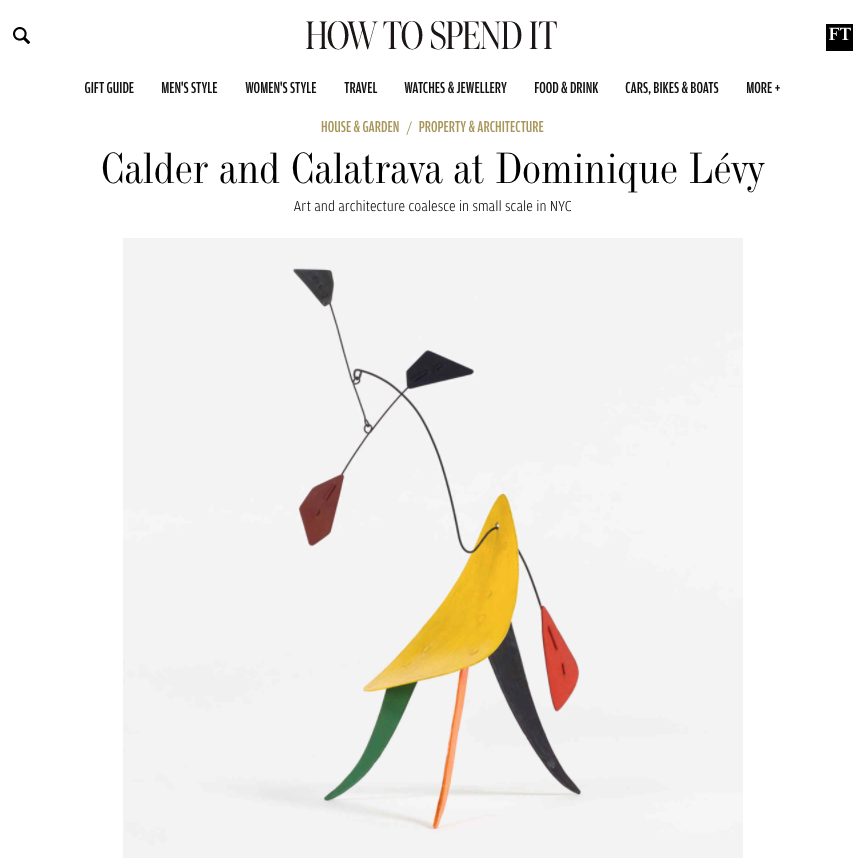
Calder and Calatrava at Dominique Lévy
Art and architecture coalesce in small scale in NYC
Art and architecture coalesce in small scale in NYC

New York gallerist Dominique Lévy’s new Alexander Calder show Multum in Parvo, opening on April 22 and running to June 13, takes its name from the Latin phrase “much in little”. This title hinges on the fact that all 45 (18 of which are for sale, from $175,000-$8,500,000) of the iconic artist’s small-scale sculptures on display will be showcased in specially conceived installation designs by internationally noted architect Santiago Calatrava.
Calder’s pieces range in size from just one to 30in in height and many have never been seen together before. The collection also includes miniature works created for Calder’s wife Louisa as a birthday gift in 1948. Five tiny standing mobiles that fit inside a cigar box, these works “serve as a powerful metaphor for the strength of his most private feelings for his beloved wife,” says Lévy. Other pieces were originally created as models for larger installations, or as gifts for Calder collectors and architect friends.
The inclusion of Calatrava – an architect known for spectacular bridge designs and sets for the New York City Ballet – in the project makes the two-storey exhibition all the more exciting. “I have a strong belief in the reunion of different disciplines, such as visual art and architecture,” says Lévy. “Calder and Calatrava share an interest in blurring boundaries. Both explore the ways in which delicacy and strength can co-exist in combinations of curving lines, basic forms and diminutive details.” The result is Calatrava’s series of biomorphic pedestals – each with a mirrored disc – that enhance and magnify Calder’s pieces – from Untitled(c1942, first picture), a colourful sheet-metal and wire stabile, to free-standing sculptures such as Caged Stone and Fourteen Dots and Red Moon – both from 1948 – which illustrate the artist’s interest in post-second world war travel, technology and communication, and also display the influences of his close friend, dadaist Marcel Duchamp.
Among the most interesting pieces in the show are two works from a 1945 exhibition at Paris’s Louis Carré. Red T with Black Flags and Shoe with Split Heel were both created using scraps from other larger-scale works, and the tiny structures sent to France by airmail.
This is set to be an exquisite – often playful – exploration of the relationship between scale and form, and a bright light on the spring art scene.
For other interesting exhibitions currently on, try Make Yourself Comfortable at Chatsworth or Samantha Roddick’s Hidden Within at the Michael Hoppen Gallery.

Joe Hogan: Bespoke basketweaving
Traditional skills reinterpreted with contemporary verve
Traditional skills reinterpreted with contemporary verve
“I was drawn to basket-making because it allowed my wife and I to live in the Irish countryside,” laughs artisan weaver Joe Hogan, by way of explanation for his move to Loch na Fooey, in County Galway, 35 years ago. This verdant area is where his willow plantation grows today and where he creates traditional Irish baskets and bespoke sculptural reinterpretationsusing lichen, dry bark, tree roots and bog pine.

For those seeking something sublimely classic, bowls (from €230-€1,000) and baskets (from €300) interlace willows of various widths and shades into traditional curvilinear forms. “I use several types of willow but mainly Salix pupurea, which tends to be long and slender and resistant to disease,” says Hogan. Vivid reds come courtesy of Salix alba chermesina, and blue or purple hues from Salix daphnoides. They]re not only colourful, their strength and lightness is such that during the second world war these were the rods that were used to craft the British military’s airborne panniers.
Many of Hogan’s artistic organic takes on baskets often incorporate ancient tree roots foraged from nearby bogland (such as Ebb and Flow, €4,500, third picture), which create sensual shapes. Once the size, purpose and tone have been locked down for a commission, Hogan sketches designs and sources the materials. Some have peat-stained or bleached driftwood “collars”, while smaller bog wood pouches (from €900-€2,400) and bowls (such as one made of lichen, second picture) evoke the wildness of nature in their untamed beauty. Ethereal vessels (such as Up For Air, price on request, first picture) resemble large nests – their entwined birch, myrtle and lichen-encrusted twigs add texture and depth.

Hogan also delights in weaving site-specific pod-like, swirling installations in green catkin, cone-studded larch twigs and rhododendron – many of which are displayed in groups by enthusiastic collectors and added to over time. Pieces range in size from just 10cm in diameter to 1m or more in length and take anywhere from two weeks to several months to complete, depending on the complexity of the work and the materials involved.

These creations are not only a glorious celebration of nature and one-of-a-kind sculptural delights, but they’re also a wonderful way of preserving the vanishing craft of Irish basket making.

A Spare, Industrially Inspired Home by Aidlin Darling Design Melds Seamlessly into the Mill Valley Landscape

Photography by Matthew Millman
Achieving a meaningful connection with the site of a future home is more than lip service for San Francisco architecture firm Aidlin Darling Design. A recent project saw co-founder Joshua Aidlin and associate principal Kent Chiang camping out on the property in order to truly understand it: to feel how the wind shifted throughout the day; to hear what the acoustics were like at sunset; and to see how the moon rose at night. It was only then that they proceeded to work with their clients to develop an idea that has, says Aidlin, “resulted in a timeless building that represents their values on this very specific piece of land.”
The 4,000-square-foot home in Mill Valley is sited to leverage sweeping views of the layered valley vistas and iconic Horse Hill in the distance. “The great benefits of this particular property are its two optimistic anchors,” says Aidlin of the landscapes to the north and south. “The clients wanted a very private home that engaged the garden in every way,” he adds. The program also needed to accommodate the owners’ passions for art collecting and cycling. “A courtyard house was the perfect solution for this family,” says Chiang.
To achieve the desired connection with the garden, the architects designed the main living space—housing the vaulted living room, dining room and kitchen—to be transparent to the outside. A sliding glass wall opens to a gracious deck, patio, gardens and the solar-powered reflecting pool in the distance. Passively cooled rooms, including a writer’s studio, gym and art court, all radiate from this central area. The garage also does double duty as the bike shop, featuring an impressive hanging rack that holds 8–10 bicycles, and plenty of space for fine-tuning and repairs.
But eyes aren’t always turned to the outside. To showcase the clients’ art collection, Aidlin and Chiang chose simple, raw materials to create an industrial, loft-like look. Matte black corrugated siding, waxed steel surfaces, poured concrete floors and white plaster walls—on which to exhibit the work of emerging, experimental artists—all figure prominently.
The interior design, by Sausalito-based Susan Collins Weir, is intentionally spare, focusing on curated vignettes of furniture, objects and textiles. Floor-to-ceiling drapes in Great Plains fabric ripple and fold in response to corrugated steel surfaces, all “in neutral hues that are sympathetic to the architectural materials, textures and scale being used,” notes the designer. In the dining area, the reclaimed eucalyptus worktable of British sculptor David Nash—complete with the artist’s chain-saw markings—now serves as an immense dining table. Classic elbow dining chairs by Carl Hansen, a pair of exquisite leather Poul Kjaerholm lounge chairs, and a vintage Carl Auböck side table are just a few of the pieces that have also been carefully selected by Collins Weir. And, as a nod to the couple’s love of cycling, she sourced a chair by Max Lipsey that is “comprised of industrial bike parts, but refined at the same time.” The overall effect is “a house that lives effortlessly,” explains Collins Weir, and that is at once both comfortable and cutting edge.
Seamlessly fusing architecture with art and the surrounding landscape, the home ultimately focuses on design for all the senses. “We are on the human side of modernity,” notes Aidlin. All the more reason to sleep out underneath the starry California sky.
A version of this article appeared in the April/May 2015 issue of San Francisco & Gardens with the headline: The Open House.

Joseph Altuzarra’s New York
The designer launched his eponymous label – lauded for its snappy tailoring with a seductive twist – in 2008, and last year won the CFDA Womenswear Designer of the Year award
The designer launched his eponymous label – lauded for its snappy tailoring with a seductive twist – in 2008, and last year won the CFDA Womenswear Designer of the Year award
“Weekends are for relaxing and spending time with my husband, Seth – either at home or out and about exploring Chelsea. This is how I spent my weekends growing up in Paris, with family and lots of unstructured time. Unlike many New Yorkers, I don’t have that fear of missing out.
Saturday mornings begin with walking our miniature schnauzer, Bean, to the local Starbucks. We’ll order Venti iced coffees and egg sandwiches, which we’ll have at home reading the papers and attempting The New York Times crossword.
At about 1pm we’ll venture out for brunch at one of our favourite spots. Montmartre is an excellent French-inspired bistro, packed in the evening but usually empty at lunchtime, which I love. I’m also a big diner person and The Rail Line is a fabulous retro classic. At either place I’ll order eggs Benedict but skip the baked goods. I consider myself a croissant connoisseur and find there’s something different about the water and flour in New York; they just don’t taste the same.
Saturday afternoons are for shopping uptown. I might visit Save Khaki, a pared-down, no-nonsense menswear store, great for high-quality khakis, of course, as well as T-shirts and sweaters. I also love the inspirational visual merchandising at Dover Street Market, a space that’s constantly evolving as it introduces new voices and fashion narratives.
I’ll pop into City Bakery for a mid‑ afternoon pick-me-up – ideally, decadent chocolate-chip cookies – before a browse in the independent bookshop 192 Books. The selection isn’t endless but the staff are knowledgeable about everything from current fiction to the Russian Revolution. On the way home I’ll stock up on flowers by Miho Kosuda, a floral genius who sells the white flowers and peonies I love.
Saturday evening is often date night and Da Umberto, a delicious Italian, has a wonderful atmosphere and incredible white truffles. Basta Pasta, a Japanese-influenced Italian, is great for a fun night out with friends, with a bustling open kitchen and good food. Afterwards we might head to a movie – a blockbuster like Interstellar at the Bow Tie Chelsea Cinema or an independent film at the Angelika. But I’m just as happy going home to watch an old classic like Belle de Jour.
Sundays are especially sacred – no emailing or work allowed – which stems from my childhood in Paris, when everything was shut and life slowed down. They begin with our favourite television programme, CBS Sunday Morning, followed by a workout with my trainer at the Equinox gym.
The afternoons are often spent at art galleries around Chelsea. I recently discovered Yossi Milo Gallery at Pulse Miami, and have become very interested in the photographers Pieter Hugo and Simen Johan who are represented here. I always enjoy popping into the Gagosian Gallery too, but just to look. More wandering might take in a stop at De Vera, an antiques shop with a great selection of rare jewellery and Venetian glass; the owner, Federico de Vera, has an incredible eye.
Then I like to retreat home for an evening of Japanese take-out and great TV. Sashimi from Hana Sushi is the perfect accompaniment to a good series like Girls, Homeland or The Good Wife. The day ends with a massive email to a co-worker that encapsulates my thoughts and observations from the weekend. I like to line things up to discuss on Monday morning, and this helps me get excited for the week ahead.”
You might also like Ian Schrager’s or Zac Posen’s New York.

CW Pencil Enterprise
Scented Viarcos, rare wood silver tips and an early Eberhard Faber draw creatives to this New York paean to the pencil
Scented Viarcos, rare wood silver tips and an early Eberhard Faber draw creatives to this New York paean to the pencil
“It started with my first Caran d’Ache set when I was about six,” says the “amateur pencil collector” Caroline Weaver (first picture), who has turned her obsession into a niche New York store.
A fine art graduate of London’s Central Saint Martins and Goldsmiths colleges, Ohio-native Weaver discovered a whole new world of pencils while travelling in Europe. “I wanted to create a place where people could try pencils produced in old family-run factories,” she says, “and learn the difference between a Japanese brass bullet pencil and a Czech Triograph.”

Image: Dorothy Hong
CW Pencil Enterprise began life online in November 2014, before opening in the bustling Lower East Side shortly after. The small space stocks over 250 pencil varieties, all neatly displayed in glass jars and labelled by country of origin. From Japan, for example, there is the thick, triangular Kita-boshi ($1) and the dark-graphite Mitsu-bishi Hi-Uni ($2.50), “the holy grail of Japanese pencils that writes like a dream”.
“My goal was to create a meticulously organised space that didn’t feel too precious,” she says. “I want people to feel free to scribble and experiment.” As a result, the midcentury-inspired store – with its black-and-white chequerboard floor and vintage advertising posters – features a writing desk for sampling the everyday HB models or vintage finds, such as “the earliest version of the legendary Eberhard Faber Mongol [$30] we’ve ever found”. Each item is enriched by Weaver’s palpable passion; she delights in expounding on a pencil’s provenance and graphite qualities, as well as its optimal use – from sketching to novel writing to crossword puzzling.
Among the store’s more unusual offerings are the Portuguese Viarco pencils ($10) scented with indigenous floral notes – lily-of-the-valley, jasmine, peony and fig leaf. Rare wood Caran d’Ache pencils with silver tips in an exquisite walnut box ($275) are displayed next to volumes ($60) of Tombow coloured pencils, which are organised by rainforest, woodland and seascape hues. Design-led accoutrements are artfully arranged on stark white tables. “All of the accessories here are better versions of everyday things,” explains Weaver of an inventory that includes stunning-yet-spare Japanese legal pads ($12) by Craft Design Technology and brass pencil cases ($67) by Midori. In fact, Weaver is almost as serious about sharpeners – “never electric; I prefer small, sculptural ones” – as she is about pencils. A weighty gold-plated and chrome sharpener ($500, second picture) by Spanish maker El Casco uses “intricate internal mechanisms, not unlike a fine watch”.
So who pops in for a pencil or two? “Local architects, writers and calligraphers,” says Weaver, but the shop is also attracting a broader global clientele. “In general, analogue tools are making a comeback. Our customers are returning to the simplicity of the pencil because it is both practical and sentimental.” And occasionally personal: a Kingsley hot foil stamp machine from the 1960s is used to personalise products, including the recent commission of a marriage proposal written in gold lettering on a bright red pencil. At CW Pencil Enterprise, the pencil itself is an art form.

David Rockwell talks personal taste: Part One
The architect and designer counts Nobu restaurants, Edition hotels and London’s iconic Battersea Power Station among his clients. He is also a Tony Award-nominated set designer
My personal style signifiers are casual James Perse T-shirts in charcoal, black and light grey, Levi’s and suede New Balance trainers. For smarter occasions, I’ll wear slim-cut, dark-blue Prada shirts and a grey Prada sports coat that works well for meetings with clients. www.jamesperse.com. www.levi.co.uk. www.newbalance.co.uk. www.prada.com.
The last thing I bought and loved was a black nylon field jacket by Burberry. I was recently in Paris for a design show and needed a warm, waterproof layer. It is tailored and practical and I love the way this traditional brand is forever finding ways to stay relevant. £795; www.burberry.com.

A Steinway & Sons grand piano | Image: Jo van den Berg
And the thing I’m eyeing next is a Steinway Hamburg grand piano. Every home I have ever lived in has had a piano, including my current flat in Tribeca, where we have an upright Steinway. I love to play and think having music in the house is important for my children. Steinway has an app that lets you visualise a particular piano in your home and the Hamburg Grand would look terrific in our space, though it will require some negotiating with my family. From £31,000; eu.steinway.com. Steinway Augmented Reality ViewAR app; www.itunes.com
An unforgettable place I’ve travelled to in the past year is the Fondation Louis Vuitton in Paris. The sculptural Frank Gehry-designed building is extraordinary – the way it sits on the water, its wonderful mix of glass and steel and beautiful gardens. The Olafur Eliasson exhibition I saw there was reflected in the surrounding pools and made a huge impression. www.fondationlouisvuitton.fr.
A recent “find” is Second Hand Rose, a store in the Flatiron District of Manhattan that specialises in vintage wallpaper. It has an incredible selection, from florals to geometric patterns and damasks, but it was the papers from the 1930s that really caught my eye. 230 Fifth Avenue, New York, NY 10010 (+1212-393 9002; www.secondhandrose.com).
The one artist whose work I would collect if I could is Joseph Cornell. I have always been fascinated by his art and find his mini worlds inspirational. I love the density of his pieces, their backstory, and how, when you zoom in, the complexity and architectural qualities just get richer and richer. I’d love to own the Medici Slot Machine and Magic Soap Bubble Set but could happily live with anything by him.

David Rockwell’s Burberry field jacket, £795 | Image: Circe Hamilton
The people I rely on for wellness are Peter Anthony, who has been my personal trainer for almost 20 years, and the massage therapists at Mohonk Mountain House near my weekend home in New Paltz. Peter is a trainer-turned-gallerist and we meet five days a week to do cardio, lift weights and talk about art. Mohonk’s massages include Swedish techniques, Thai stretches, even power naps; my week’s stress disappears after a 90-minute session. Mohonk Mountain House, 1000 Mountain Rest Road, New Paltz, NY 12561 (+1855-883 3798; www.mohonk.com). Peter Anthony Fitness, 89 Franklin Street, New York, NY 10013 (+1212-274 9003; www.peteranthonyfitness.com).
The best gift I’ve given recently was a midcentury bronze candelabra that I bought for a friend who works in lighting design. It’s a slightly brutalist, sculptural piece that holds the candles at varying heights so each casts a beautiful glow. Weinberg Modern, New York Design Center, 200 Lexington Avenue, Suite 407, New York, NY 10016 (+1646-291 2059; www.weinbergmodern.com).

David Rockwell’s photograph of his mother as a vaudeville dancer | Image: Circe Hamilton
And the best ones I’ve received were a fabulous ikat bolster pillow from Suzanne and Christopher Sharp of The Rug Company, who I worked with recently, and a kaleidoscope that contains beautiful little prisms suspended in oil. It’s like a Busby Berkeley movie in a tube.
An object I would never part with is a photograph of my mother as a vaudeville dancer. She died when I was 15, but her love of the theatre has always inspired me.
My favourite websites include Food52 for recipes and chic tableware, and The Architect’s Newspaper to keep an eye on new buildings. www.archpaper.com. www.food52.com.

David Rockwell talks personal taste: Part Two
The architect and designer concludes his compendium of likes with steak tartare at Chiltern Firehouse and kicking for the Chicago Bears
The architect and designer concludes his compendium of likes with steak tartare at Chiltern Firehouse and kicking for the Chicago Bears
My style icons are the artist Ruben Toledo and his fashion designer wife Isabel. These longtime friends always look fabulous: his aesthetic is sleek and streamlined, especially in contrast to hers, which is baroque and more flamboyant. They are also masters of spontaneity and forever generous with their time and ideas.
The last item of clothing I added to my wardrobe was a beautiful Prada tuxedo I bought to wear to the Tony Awards, when I was nominated for my Kinky Boots and Lucky Guy set designs. It is slim-cut and exquisitely crafted, with beautiful stitching along the lapels – I will wear it forever. www.prada.com.

Giant Cubebot at the David Weeks Studio | Image: Floto+Warner
The site that inspires me is Dia:Beacon, the Dia Art Foundation’s gallery in Upstate New York, where the sprawling former factory itself is as important as the art it houses. The indoor and outdoor spaces flow seamlessly and inspired me when I was designing the Center for Civil and Human Rights in Atlanta, while the daylight galleries and their 34,000sq ft of skylights are particularly impressive. It is a wonderful place to see work by artists such as Richard Serra, Dan Flavin and Louise Bourgeois. 3 Beekman Street, Beacon, New York, NY 12508 (+1845-440 0100; www.diaart.org).
The last meal that truly impressed me was at Chiltern Firehouse, where I enjoyed a festive lunch with a great group of friends. The restaurant is a perfectly cast piece of theatre: the quality of light is beautiful and the space feels warm and lively. The steak tartare – my absolute favourite dish – was especially memorable. 1 Chiltern Street, London W1 (020-7073 7676; www.chilternfirehouse.com).
The last music I downloaded was Beethoven: The Complete Symphony Collection, performed by the London Symphony Orchestra. I heard the LSO live when I was a student in London and have always wanted this comprehensive recording, conducted by Josef Krips, for my library. I also bought the album of the 1978 musical The Wiz, featuring the original cast, which is perfect for my morning workouts.
If I had to limit my shopping to one neighbourhood in one city, I’d choose Tribeca in New York. Favourites include Urban Archaeology and Wyeth, which sell wonderful decorative objects, and David Weeks Studio is a must for original furniture and lighting. I also love good coffee and The Smile and Fika are two of the best places for a caffeine hit before shopping. David Weeks Studio, 38 Walker Street (+1212-966 3433; www.davidweeksstudio.com). Fika, 450 Washington Street (+1212-706-0565; www.fikanyc.com). The Smile, 177 Franklin Street (+1917-728 3023; www.thesmilenyc.com). Urban Archaeology, 143 Franklin Street (+1212-431 4646; www.urbanarchaeology.com). Wyeth, 315 Spring Street (+1212-243 3661; www.wyethhome.com).

Tennessee Williams: Mad Pilgrimmage of the Flesh by John Lahr
The best souvenir I’ve brought home is a catalogue from the Barbican exhibition Constructing Worlds: Photography and Architecture in the Modern Age. Images by Berenice Abbott, Walker Evans and Andreas Gursky grace the pages, and I ended up buying multiple copies for friends and family. The Barbican’s gift shop is a wonderful hidden gem. £39;www.barbican.org.uk.
The books on my bedside table are very varied. I am currently reading Tennessee Williams: Mad Pilgrimmage of the Flesh by John Lahr, and Walker Evans: Decade by Decade, a beautiful book of photographs by this chronicler of American history. Pop Up City, a book about mobile designs, a current obsession, and Pierre Christin and Olivier Balez’s graphic biography Robert Moses: The Master Builder of New York City are next on my list.

A display at the David Weeks Studio | Image: Floto+Warner
My favourite room in my house is actually my rooftop garden. It’s surrounded by the landscape of Tribeca and the ever-changing skyline, yet it’s quiet and overlooks the Hudson River; it’s the perfect place to be at the end of the day.
If I didn’t live in New York, the city I would live in is Barcelona. I grew up in Mexico so I’m fluent in Spanish, and I love its café culture and the fact that it’s a city that never sleeps. There’s the Palau de la Música Catalana, a place of great beauty, wonderful for listening to music; Gaudí’s Park Güell; the Boqueria food market, a favourite for the sizzling shrimp and seafood paella; and the light and airy Hotel Arts, with Frank Gehry’s enormous fish outside. Most of all, though, I like the people, who are proud but not arrogant. La Boqueria, La Rambla 91 (+3493-318 2584; www.boqueria.info). Hotel Arts, Calle Marina 19-21 (+3493-221 1000; www.hotelartsbarcelona.com). Palau de la Música Catalana, Calle Palau de la Música 4-6 (+3493-295 7200; www.palaumusica.org). Park Güell, Carrer d’Olot (+3490-220 0302; www.parkguell.cat).

Palau de la Música Catalana | Image: Matteo Vecchi/Teolds Photography
In my fridge you’ll always find lots of fresh pineapple, red grapes, watermelon, mangoes and berries from the Union Square Greenmarket outside my offices. Then there’s sliced turkey; DiPaola’s turkey sausage for making stir-fries; pitchers of freshly brewed Tazo green iced tea; Edy’s fruit popsicles in grapefruit, tangerine and lemon; and the ingredients for making chocolate-chip cookies. Union Square Greenmarket, East 17th Street, New York, NY 10003 (+1212-788 7476). www.dipaolaturkeyfarm.com. www.edys.com. www.tazo.com.
The grooming staples I’m never without are Triple Oxygen + C Energizing Cream by Bliss – at whose spa I have a facial once a year – and Juniper Ridge Big Sur Trail Crew Soap for the bath. Big Sur Trail Soap, $30; www.juniperridge.com.Triple Oxygen + C Energizing Cream, $55; www.blissworld.com.
An indulgence I would never forgo is chef Nobu Matsuhisa’s rock-shrimp tempura. I was introduced to the dish at the Feast of the Many Moons almost 30 years ago and it has been a favourite ever since. It comes with two dipping sauces – one creamy but spicy and the other a light ponzu; I always opt for the latter. www.noburestaurants.com.
If I weren’t doing what I do, I would be a concert pianist. I have played my entire life and love the idea of having incredible skill. And if I weren’t doing that, I’d be a kicker for the Chicago Bears.

Shigeru Ban talks personal taste: Part One
Pritzker Prize-winning architect Shigeru Ban designs private homes, disaster-relief housing made from recycled materials, and museums, including Centre Pompidou-Metz and Aspen Art Museum
Pritzker Prize-winning architect Shigeru Ban designs private homes, disaster-relief housing made from recycled materials, and museums, including Centre Pompidou-Metz and Aspen Art Museum
My personal style signifier is always wearing black. My mother, a couturier, designs and makes my jeans at her atelier, which is in the same building as my Tokyo offices. She also makes jackets in a variety of fabrics – linen, cotton, wool – so I can wear them throughout the seasons and across the globe.
The best gift I’ve given recently was a set of sculptural white-wine glasses designed by Josef Hoffmann. The “muslin” crystal is super-thin. I gave them to someone in my office who is a wine lover like me. $500 for four; www.mosspop.com.

Camper leather boots, £130 | Image: www.camper.com
And the best one I’ve received was a silkscreen print by Japanese architect Arata Isozaki. It is very special, not only because I’ve worked with Isozaki, but also because it was given to me by a client who became a dear friend.
The objects I would never part with are my special Utrecht black sketchbooks that I have been using since I was a student at The Cooper Union in New York in the 1980s. I draw in them wherever I go, preferably with a fine-point Muji Aluminum Hexagonal pen in black or red ink. I keep these pens clipped to my shirt pocket so that I’m ready to sketch any time, anywhere. Muji Aluminum Hexagonal pen, £3.95; www.muji.com. Utrecht sketchbook, from £3.91; www.utrechtart.com.
An indulgence I would never forgo is Henri Giraud Code Noir champagne. It’s not very well known because until the 1990s it was only sold privately to customers in France and Italy. It is fermented in oak casks and has a delicious, complex flavour. From £70; www.champagne-giraud.com.
The last thing I added to my wardrobe was a pair of chocolate-brown short leather boots by Camper. They are very simple and I love them because I like to travel light and can wear them every day. £130; www.camper.com.
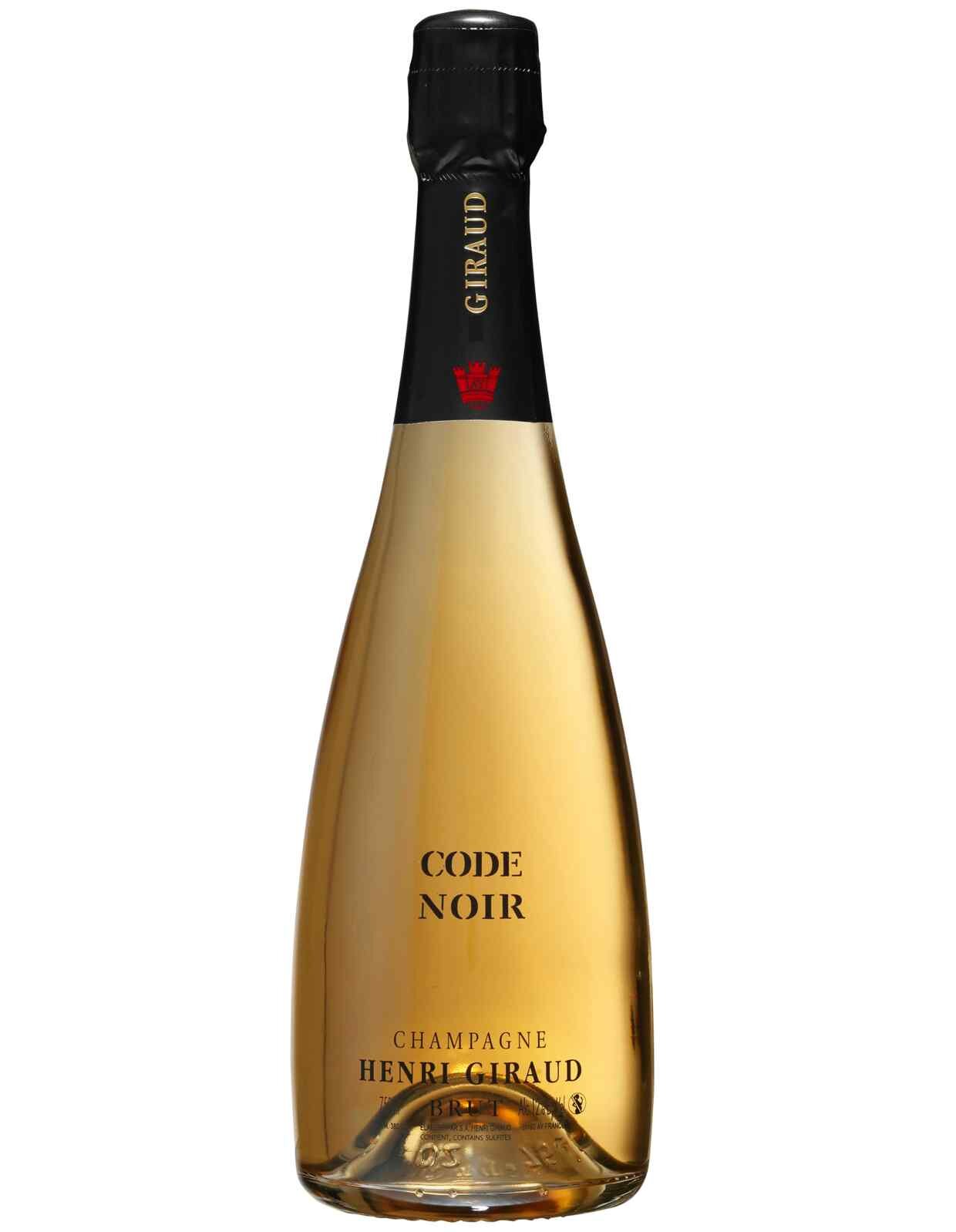
Henri Giraud Code Noir champagne, from £70 | Image: Code Noir
An unforgettable place I’ve travelled to in the past year is Daanbantayan on Cebu island in the Philippines. This area was ravaged by a typhoon two years ago, but the natural beauty I saw everywhere was incredible. The ocean was a particular blue I haven’t seen elsewhere and I found the local fishermen’s houses made of bamboo and nipa-palm leaves especially charming. The strength of the people was inspirational.
A recent “find” is Sushi Ginza Onodera, a very pure sushi restaurant in Paris. This place isn’t about fusion cooking, nor is it influenced by French cuisine. I love the omakase menus, the beautiful plates of fresh nigiri, the very warm ambience and authentic decor. 18 Rue du Louvre, 75001 Paris (+331-4020 0930; www.sushi-onodera.com).

Silkscreen print of Fukuoka City Bank head office by Arata Isozaki | Image: Arata Isozaki & Associates
My favourite space in my house is the central courtyard in my Tokyo home, where trees grow up through the building to the sky. It is in a forest and I didn’t want to take down any trees to build this light-filled house.
The last music I downloaded was Paganini: 24 Caprices for Solo Violin by the Japanese-American violinist Midori. In addition to being a wonderful musician she is also a United Nations Messenger of Peace, which I admire. I also bought Mendelssohn & Tchaikovsky: Violin Concertos by Akiko Suwanai, and Berliner Philharmoniker: 125 Years by conductor Seiji Ozawa, who is a huge talent and also a friend.

Umeboshi, or pickled plums | Image: Getty Images/amana images RF
In my fridges you’ll always find sake in Tokyo and wine in Paris. And traditional Japanese umeboshi – or pickled plums. My mother used to make me eat them when I was a child and I hated the salty, sour taste, but recently I got very bad food poisoning in Rwanda and these plums literally saved my life. I now eat them every morning.
My favourite websites are the Oita Prefectural Art Museum and the Aspen Art Museum, for video tours and information about their exceptional exhibitions. Also the Centre Pompidou-Metz site, which is an excellent contemporary art resource. www.aspenartmuseum.org. www.centrepompidou-metz.fr. www.opam.jp.

Shigeru Ban talks personal taste: Part Two
The Pritzker Prize-winning architect rounds up his list of likes with Issey Miyake, J Sheekey and Cloudy Bay
The Pritzker Prize-winning architect rounds up his list of likes with Issey Miyake, J Sheekey and Cloudy Bay

Shigeru Ban | Image: Lea Crespi
My style icon is Issey Miyake. I admire his distinctive but minimalist aesthetic and the way he never follows the crowd. I’m particularly impressed by the new fabrics he invents; he’s a true innovator.
The last thing I bought and loved was a Tumi suitcase for my travels. I buy practical pieces based purely on their performance. This Alpha 2 rolling suitcase is ultra-lightweight and allows me to get through airports quickly. From £387; www.tumi.com.
And the thing I’m eyeing next is a book called Who Built That? Modern Houses by Didier Cornille, which highlights some of the most important architects and houses of the 20th and 21st centuries. I teach at Kyoto University of Art and Design, and the book’s colourful drawings illustrating the construction of each building will be illuminating for my students. $16.95; www.papress.com.
The last meal that truly impressed me was at J Sheekey in London. They really know how to take advantage of natural materials – excellent cod, Atlantic prawns – and don’t smother them in rich sauces. Everything about my dinner there was wonderful: the wine list, the vibrant ambience, the knowledgeable and attentive staff and, above all, the perfectly grilled salmon. 28-32 St Martin’s Court, London WC2 (020-7240 2565; www.j-sheekey.co.uk).
The one artist whose work I would collect if I could is Korean painter and sculptor Lee Ufan, whom I met recently in Paris. He’s part of a group of artists I admire called Mono-ha [School of Things], and his sculptural works made from everyday, recycled materials like paper, stone, rope and steel are simply beautiful.
The best souvenir I’ve brought home was a case of wine from Christchurch, New Zealand. I love wine – white, red, champagne – but the Cloudy Bay Chardonnay from my time spent there building the Cardboard Cathedral has become a particular favourite. www.cloudybay.co.nz.

Image: Mark C O’Flaherty
The books on my bedside table include novels by Go Osaka, a writer who specialises in crime and spy fiction; a handful of works published by The Cooper Union that focus on architecture and global urban planning; and some of John Hejduk’s writings and drawings, which are particular favourites.
The site that inspires me is the port village of Onagawa in Miyagi Prefecture, Japan. The colours of the Pacific and the steep, verdant hills leading down to the town are beautiful.

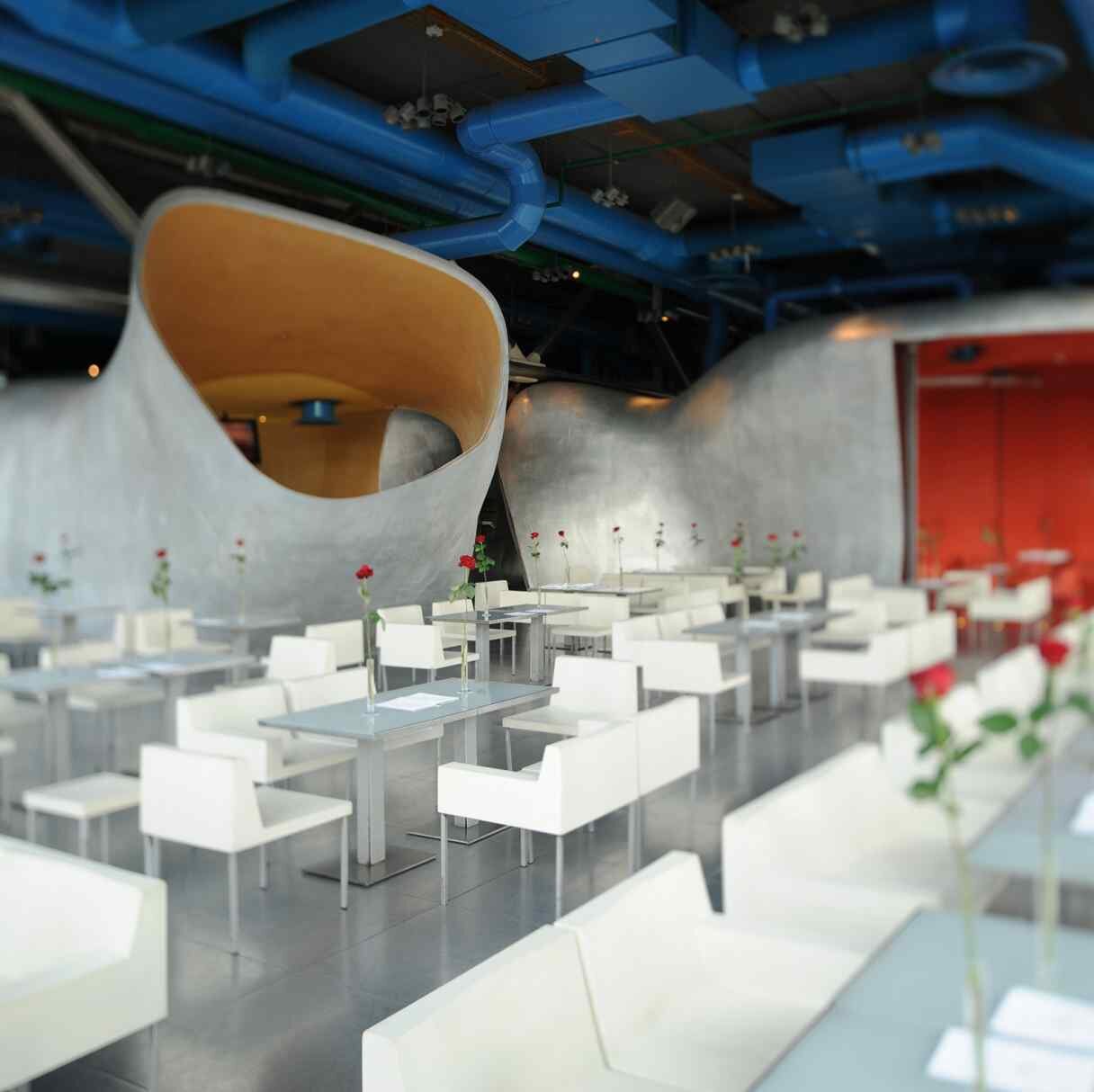
If I didn’t live in Tokyo, the city I would live in is Paris. The area around the Marais, where I have an apartment, is full of wonderful places, including the Centre Pompidou and the shops of Les Halles. Taschen is a favourite store for books about architecture and design, and after shopping and a visit to the museum, I like to have lunch at the Pompidou’s French-fusion restaurant Georges; the view overlooking the Parisian skyline is beautiful. Centre Pompidou, Place Georges-Pompidou (+331-4478 1233; www.centrepompidou.fr). Georges, Centre Pompidou, Place Georges-Pompidou (+331-4478 4799; www.beaumarly.com). Taschen, 24 Rue de Buci (+331-4051 7922; www.taschen.com).
If I weren’t doing what I do, I would be running an NGO. I already have my own – Voluntary Architects’ Network – but I would also like to work with the United Nations Refugee Agency to help those displaced by natural disaster. Or I’d be a carpenter – I love to build with my hands, which ties nicely into architecture and design.

Laboratorio Paravicini: custom ceramics
This Milan atelier is inspired by the old, glorious ceramic and porcelain houses of Europe
This Milan atelier is inspired by the old, glorious ceramic and porcelain houses of Europe
“Our aim is to create beautiful plates and ceramic pieces that bring back the warmth often lost through the industrial production of porcelain,” says Laboratorio Paravicini co-founder Costanza Paravicini. Together with her partner Benedetta Medici, the duo produce custom pieces “inspired by the old, glorious ceramic and porcelain houses of Europe, including Capodimonte, Royal Copenhagen, Meissen and Herend”, says Medici, “as well as by the worlds of contemporary art and fashion.” Their one-of-a-kind serveware can incorporate particular patterns or colours, family crests, monograms or bucolic scenes.

What started as a hobby for the two friends 20 years ago has become a thriving Milan-based business that now counts noted decorators, assorted royals and varied private clients among its global clientele. Many are inspired by a visit to the studio, where the duo’s existing collections often provide a starting point for a bespoke design. Signature series include Calligraphario(first picture), Snakes, Circus, Balloons(second picture) and Auto d’Epoca – the latter depicting vintage cars. Others seek out the atelier to fulfil a very specific commission.
So that colours don’t fade, the duo hand-paint or hand-apply serigraphs under glaze. This labour-intensive application process is rare today, but the pair are committed to producing pieces of the highest lustre that are also dishwasher safe and suitable for regular use. In some instances intricate decoration is realised by pressing a dry stamp onto the pieces when they are still soft, with subsequent glazing used to create unusual chiaroscuro effects. In addition to tableware, many of Laboratorio Paravicini’s celadon and gold-trimmed creations (various colour combinations and metallic finishes can be specially mixed) are designed to be displayed in wall mounts as decorative sets.

From coats of arms on plates (from €60) to specialised chinoiserie (€80-€150 per plate) to ashtrays (from €120) featuring the family dog, no request is too outlandish – or too small. Vases embellished with villas and fantastical insects (€180-€300) are a particularly popular request, as are those featuring birds and hunting scenes. Every commission includes a final sample before the larger order goes into production.
Laboratorio Paravicini “takes delight in creating very particular, very personal things,” says Paravicini. “The moment we succeed in designing something that is exactly what our client wants, that’s the greatest achievement.”

White Hart, Connecticut
A picturesque, historic inn is restored to its former glory in Salisbury, New England
A picturesque, historic inn is restored to its former glory in Salisbury, New England
Litchfield County, Connecticut, may not be short of picturesque, historic inns, but few are more charming than the recently reopened White Hart Inn in Salisbury. Situated on the village green in the heart of this quintessential New England town, the White Hart has served as a social and culinary hub since opening in 1806. Abruptly closed in 2010, the White Hart was recently rescued by part-time village residents Meredith and Conley Rollins, and with the help of an all-star roster of investors (that includes local writers and artists, such as Malcolm Gladwell), returned to its position as a community lynchpin.
The new incarnation is a delight on many levels, but chief among them is the food, served in both the casual Tap Room – the inn’s original tavern – and in the elegant main dining room (opening next weekend, 13 Feb). This is due in no small part to British chef Annie Wayte’s menus, some of which are inflected with UK touches (her impressive CV includes stints at Clarke’s, and she opened Nicole’s in London and Café 202 in New York and London).

Our group of six enjoyed a wonderful, wintry lunch that began with soups of the day (lentil with bacon and a delicate potato and leek puree; $8), scotch eggs with pink chorizo and panko ($7), and a warm sweet onion and gruyére tart ($8). Main dishes may sound basic, but they are anything but: hearty and artisanal grilled cheese with housemade potato crisps ($8); baked eggs with prosciutto and cheddar ($10), and a traditional ploughman’s lunch ($14). The White Hart’s version of the patty-melt burger – accompanied by thick cheddar and crispy dill pickles - might just be the most sublime version I’ve ever tasted.
On the day of our visit, the dining room was also testing new dishes and we were treated to a preview of tasting plates of crab, avocado and oro blanco salad with freshly baked chilli flatbread ($15), a hearty vegetable curry with apple raita and basmati rice ($24), and a luscious butterscotch pot de crème.
The owner/investors aim to return this landmark to its place as a community cultural hub, and talks and events are planned for the months ahead. Also in the works is a marketplace to stock up on locally sourced jams, cheeses, and chocolate.
Sadly I wasn’t staying the night, but a peek into several of the 16 rooms (example, first picture) revealed crisp white linens, enormous soaking tubs, and CO Bigelow accoutrements; temptation enough to book a return – overnight – trip.
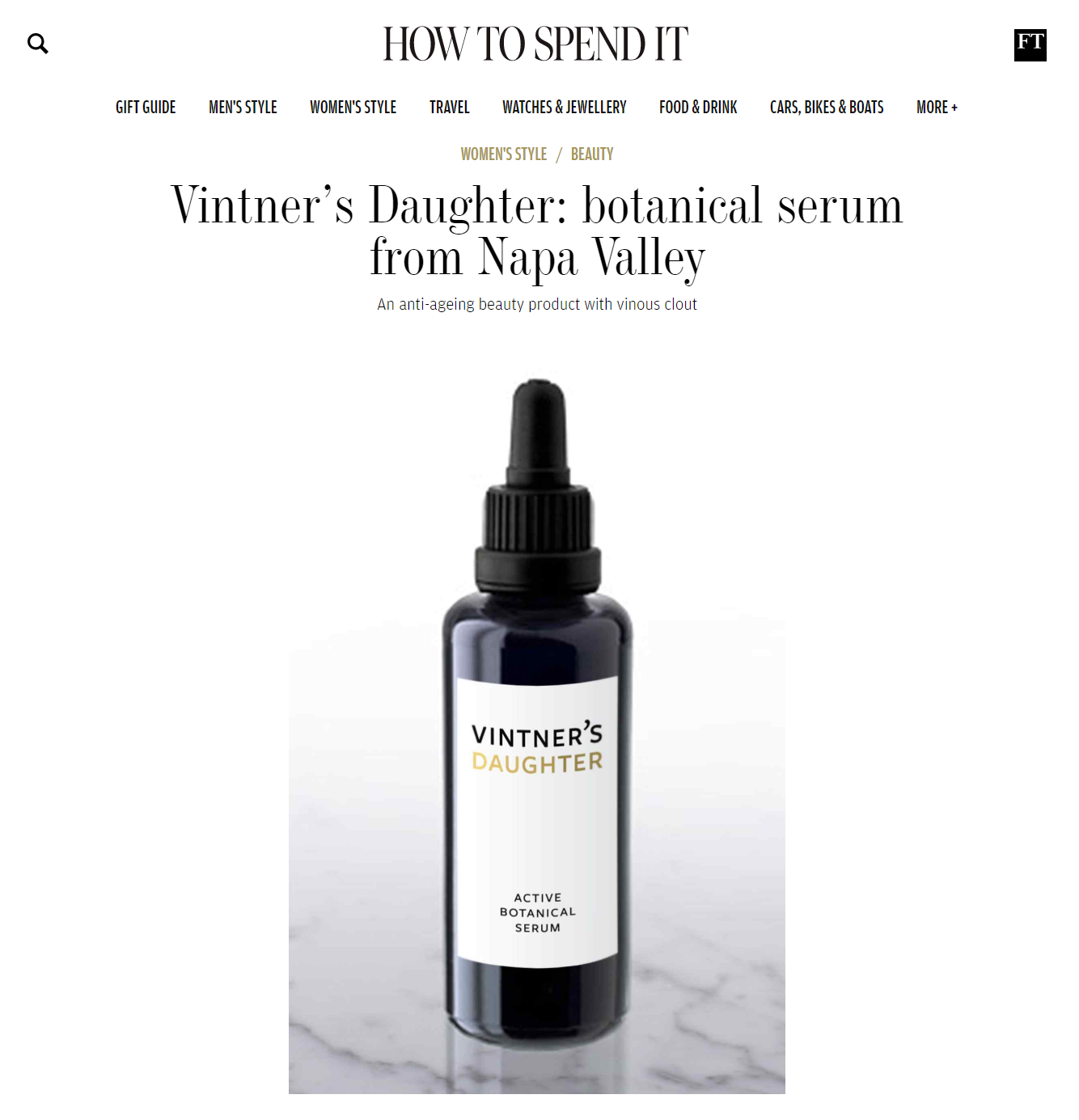
Vintner’s Daughter: botanical serum from Napa Valley
An anti-ageing beauty product with vinous clout
An anti-ageing beauty product with vinous clout
When it comes to beauty products, I won’t sacrifice results for eco-friendliness, all natural ingredients or the complete absence of parabens, chemicals and fragrances. Bottom line: I seek serums, creams and cleansers that really deliver – and if they do so in a green way, well, so much the better.
And so to Vintner’s Daughter Active Botanical Serum ($185 for 30ml), a luxury phytoactive for the face that contains 22 of the world’s most powerful botanicals and essential oils, and which left my skin brighter, more evenly toned and with reduced sun spots.
The force behind this liquid gold is April Gargiulo – a winemaker who co-owns Gargiulo Vineyards in Napa, California, and who set about creating a skincare formulation that was safe to use while she was pregnant. Drawing on her extensive knowledge of winemaking, she knew about the positive effect of grapes on the complexion. Starting with a base of grapeseed oil, Gargiulo then researched the most active herbal ingredients that would hydrate, nourish and calm even the most sensitive skin types. Hazelnut, avocado and rosehip oils strengthen elasticity and target UV damage; lavender, alfafa and nettle leaf are incorporated to infuse the skin with vitamins and combat wrinkles; while rosemary keeps acne at bay.
My current regimen includes twice-daily applications of the serum to the face and neck, followed by a light foundation. The cherry on the cake is that five per cent of each purchase goes to ending violence against women – and that’s a beautiful thing indeed.

Where to Stay Now: Miami's Hot New Boutique Hotels
Miami is topping our hotlist of hot places to travel in 2015 in no small part because of all the great new hotels that are opening. Contributing editor Christina Ohly gives us the rundown of four of the best new ones.
Miami is topping our hotlist of hot places to travel in 2015 in no small part because of all the great new hotels that are opening. Contributing editor Christina Ohly gives us the rundown of four of the best new ones.
MIAMI – Everyone and their mother is building or has recently opened a sleek, design-led hotel in South Beach. They all pay homage to Miami's rich architectural history, but differ slightly in tone, finishes, and food options. I spent a week in Miami checking in and checking out a few new hotels.

Traymore restaurant. Photo courtesy of Metropolitan by COMO.
Metropolitan by COMO, Miami Beach
2445 Collins Ave., South Beach; +1-305-695-3600
Specs: A boutique bolthole from hotelier Christina Ong, the latest COMO is comprised of just 74 rooms designed by noted interior designer Paola Navone. Rooms are simple, spare, and elegant, and the in-house Traymore restaurant (so named for the original Deco gem in which it is housed) serves exquisite ceviches, brick oven pizzas, and straight-from-the-sea stews.
Pluses: The intimate setting and the Zen spa make this place feel like a chic escape. There is no scene here.
Minuses: Not many.
Unique Selling Point: The relaxing Indian head massage at the sleek spa. Also, the completely peaceful pool area which features the perfect mix of sun, shade, and gourmet snacks.
This Place Is Perfect For: Anyone seeking a quiet, restorative long weekend.
But Not So Perfect For: Those in search of late-night action or anyone on a tight budget.
Rates: City rooms start at $269 per night.

Impeccable, chic rooms at EDITION. Photo courtesy of The Miami Beach EDITION.
The Miami Beach EDITION
2901 Collins Ave., South Beach; +1-786-257-4500
Specs: This just-opened "next generation urban resort" from Ian Schrager and Marriott Hotels occupies a sleekly renovated 1950s landmark on Collins Avenue in the mid-beach section of South Beach. The latest of Schrager's EDITION hotels for Marriott (London and Istanbul are thriving) has 294 minimalist rooms and suites, many with breathtaking ocean vistas.
Pluses: Everything is spotlessly clean, and white linens and neutral wood finishes abound. The staff — from room service to cheerful concierges — are eager to please.
Minuses: It draws a slightly louder crowd — possibly for the disco bowling downstairs.
Unique Selling Point: There are several. Market by Jean Georges Vongerichten serves delicious food 24/7 in a vibrant, open air space. The poolside restaurant Tropicale serves perfect shrimp cocktail in an Art Deco, bouganvillea-strewn landscape. But really, this place is such a one-stop hotel shop that you could bring an entire family here and find an activity, spa treatment, luxury suite, or amenity for everyone.
This Place Is Perfect for: Art Basel attendees and start-up CEOs.
But Not So Perfect For: Anyone seeking total quiet or anyone who prefers overstuffed chairs and chintz.
Rates: Standard King rooms start at $349 per night. Click here for reservations.
Read More: An interview with Ian Schrager about the EDITION collection.

Arches around the hotel. Photo courtesy of Casa Claridge.
Casa Claridge
3500 Collins Ave., South Beach; +1-305-604-8485 and reception@casaclaridge.com
Specs: Originally built in the Mediterranean Revival style, the 50-room hotel recently purchased by hotelier Alan Faena feels like a relaxed guest house — as well as an arts hub — a counterpoint to the Saxony Hotel and Norman Foster-designed apartments Faena is builing across Collins Avenue. Casa Claridge rooms have touches like Frette linens and bottles of Argentinean malbec, not to mention peace and quiet in plentiful quantities.
Pluses: The atmosphere is sweet — think sophisticated house party — where people congregate in the main sitting room underneath a giant paper cut-out ceiling installation by Manuel Ameztoy.
Minuses: There's no swimming pool and the bathrooms could use a sprucing up.
Unique Selling Point: A three-way tie between the killer tuna tartare served on the patio, the rotating art exhibits, and the musical tertulias on Friday nights that feature guest curators.
This Place Is Perfect For: Those seeking a low-key vibe on a budget.
But Not So Perfect For: Anyone looking for bells, whistles, or bowling alleys (see The EDITION down the street).
Rates: Casa Queen Rooms start at $129 per night. Click here for reservations.

The garden area. Photo courtesy of Thompson Miami Beach.
4041 Collins Ave., South Beach; +1-786-605-4041
Specs: This 380-room beachfront spot captures the mid-century modern aesthetic through interior design by noted British tastemaker Martin Brudnizki. Rooms feel spacious: Many have ocean views, and more than 30 suites have expansive terraces, full kitchensm and living rooms. The furnishings are eclectic and more colorful than the stark, white environments found in neighboring hotels.
Pluses: The pool and garden areas are perfect for people watching, and the hotel's restaurant Seagrape is run by James Beard Award-winning chef and local food hero Michelle Bernstein. A Miami native, she plays to the area's seafood strengths in a relaxed, retro setting.
Minuses: The lobby feels slightly strange — lots of dark colors and no clear sitting areas.
Unique Selling Point: The tenth floor spa has lovely sea views and the Crown Room is the perfect spot for a cocktail connoisseur.
This Place Is Perfect For: The younger set and fans of a slightly funkier design aesthetic.
But Not So Perfect For: Anyone looking for a highly personal, intimate environment.
In addition to these spots and others like Hotel Croydon and Circa 39, 2015 promises to be a year of spectacular openings. The two best to watch are Faena's Deco gem The Saxony and the very green 1 Hotel in the former Gansevoort space. Happy Miami. It's going to be a hot winter.

Antonio Citterio’s perfect weekend in Milan
The architect and industrial designer explores the city’s paintings, porticos and botanical gardens and Brera backstreets
The architect and industrial designer explores the city’s paintings, porticos and botanical gardens and Brera backstreets
“Saturday mornings start at my local newsstand, Reno Giornalaio, at the end of Via Brera. I love the ritual of walking and getting the papers – everything from Corriere della Sera to the FT and The New York Times for my wife [American architect and interior designer, Terry Dwan] – and then settling into one of the local bars, Caffè Fernanda, inside the Pinacoteca di Brera, for coffee and brioche. The sense of community in these places is wonderful, but I also like that there’s no pressure to talk to anyone.
After a long while spent reading, I might go to any number of galleries and museums. I’m an art collector, and I find inspiration at places such as Gallery Massimo di Carlo; it’s a fantastically inspiring space by Piero Portaluppi who also designed the famous Villa Necchi. I’m drawn to the Palazzo Reale, especially during Salone del Mobile, and the Brera Museum, which has one of the best collections of Italian Renaissance paintings and an exemplary Lombard baroque courtyard – its portico has an unrivalled collection of full-size casts of monumental classical sculptures, and real 19th-century marble sculptures.
I’m a member of the advisory committee of the Museo del Design Italiano on the ground floor of the Triennale. The centre has constantly changing architecture exhibitions – our practice has designed installations here – and is a source not only of inspiration but also debate. There’s also a nice design café, where I’ll sit outside and have seabass carpaccio and salad for lunch.
The Triennale has constantly changing architecture exhibitions and a design café | Image: Stefan Giffthaler
People come to Milan for the creative energy, the food and the fashion – and there is no better time to watch this all unfold than at the weekends. I’m not a trendy guy, but I am also not above taking a touristy stroll past La Scala, through the Galleria Vittorio Emanuele II and on to the Duomo, before heading to quieter stretches such as Via Mozza and Via della Passione, which have a truly Milanese spirit.
Quadrilatero – or the Golden Triangle – is lovely, too, for window shopping. The thing that most sparks my curiosity is the constant change of storefronts and tenants, a never-ending cycle of activity bringing new brands and installations. I walk through this area at the end of every work day, so sometimes at the weekend I prefer to explore the calmer neighbourhood streets. There is so much to explore near my house in Brera, including one of the city’s most beautiful churches, the neo-gothic Santa Maria del Carmine, with its terracotta façade. And the nearby Botanical Garden is one of my favourite escapes. After a period of neglect, this place, which was created at the behest of Maria Theresa of Austria, has now been restored. Today, passing through an area of monumental buildings, you suddenly enter a peaceful oasis full of nature and history.
The highlight of any day is aperitivo and I always go to the bar at the Bulgari Hotel Milano. They make me a special margarita il solito just the way I like it, with reposado [aged in oak barrels] tequila, and Niko Romito’s finger food is excellent. I might meet a friend here to discuss art and design and I feel it’s an important, enjoyable conclusion to the day, but one drink is always enough.
I’ll meet Terry for dinner at Torre di Pisa, a classic place that was once a favourite with Ettore Sottsass and the Memphis group, as well as fashion designers and journalists. It still feels very ’60s and the simple dishes of spaghetti alla puttanesca and ribollita go well with a glass of Tuscan red. They make a special insalata mista for Terry: I like it when a restaurant feels like your own private kitchen.
Sunday mornings start with a walk in Sempione Park and on to the Castello Sforza – I enjoy the wide-open spaces. For lunch, we might go to L’Arabesque, a design store with a café that serves excellent risottos and grilled fish, or to the Mudec Museum, a contemporary art collection that does a nice Sunday brunch. On the rare Sunday night that we don’t eat at home, we’ll go to Langosteria, which has the best seafood tartares, or maybe to Nobu, near our house. I like the cleanliness and fresh taste of Japanese food, and it can be a nice change at the end of a weekend with a typically Milanese flavour.”