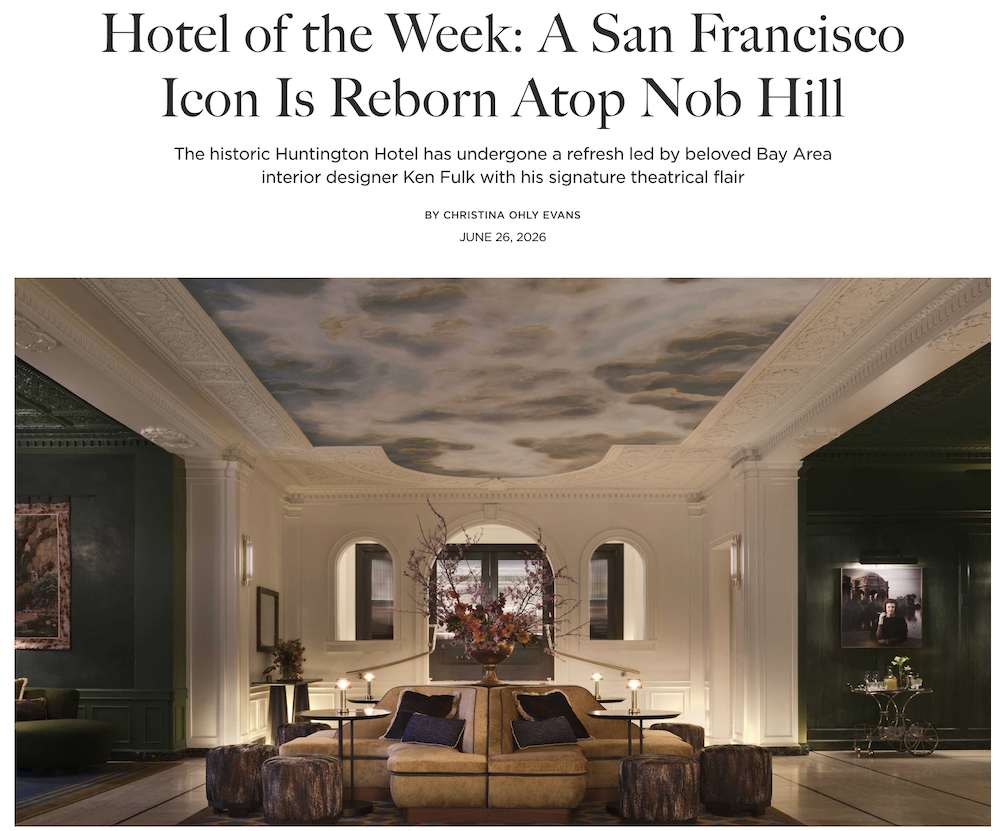
Hotel of the Week: A San Francisco Icon Is Reborn Atop Nob Hill
Founded in 1924 and named after Collis P. Huntington—one of the “Big Four” California railroad magnates of the time—the 12-story Georgian-style Huntington Hotel has welcomed worldly, loyal guests ever since. A shutdown at the beginning of Covid in 2020 provided an opportune moment for Flynn Properties and Highgate, a hospitality and investment management firm, to undertake a thorough reimagining of the hotel’s sumptuous rooms and suites.
The historic Huntington Hotel has undergone a refresh led by beloved Bay Area interior designer Ken Fulk with his signature theatrical flair
Founded in 1924 and named after Collis P. Huntington—one of the “Big Four” California railroad magnates of the time—the 12-story Georgian-style Huntington Hotel has welcomed worldly, loyal guests ever since. A shutdown at the beginning of Covid in 2020 provided an opportune moment for Flynn Properties and Highgate, a hospitality and investment management firm, to undertake a thorough reimagining of the hotel’s sumptuous rooms and suites.
Together with interior designer Ken Fulk—a colorful creator synonymous with cinematic experiences and luxury hospitality—the team has also reinvigorated The Big Four restaurant and the luxurious Nob Hill Spa. The results of their combined efforts are flawless; from the elegant reception desk to the in-room amenities (hyperlocal snacks and sumptuous linens) to the indoor-outdoor pool deck where light lunch is served, no detail has been overlooked at this unique urban oasis.
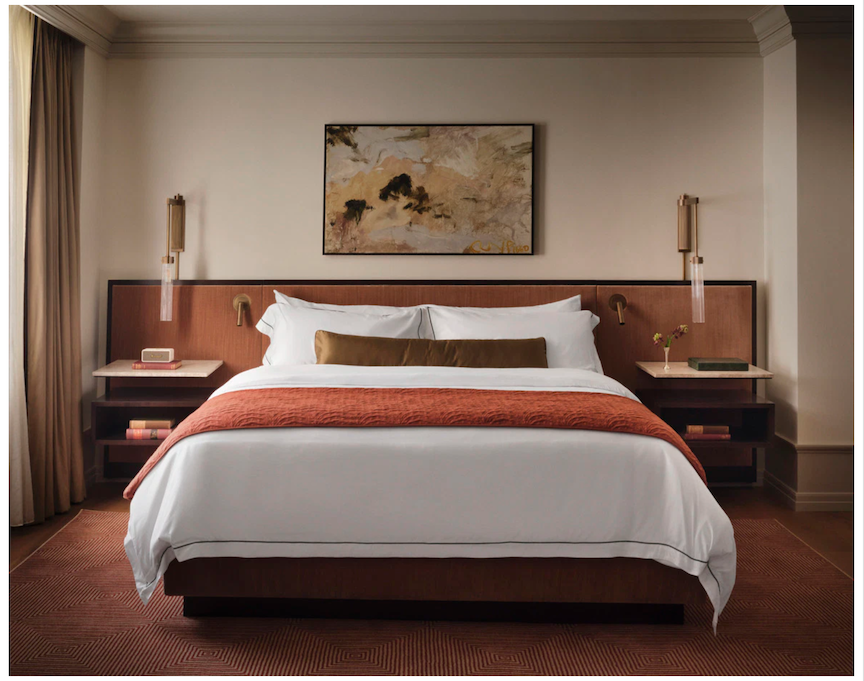
Long favored by savvy tourists and local tech types, the Huntington has retained its collegial, old-world elegance, but with added comfort and flair. Each of the 143 guest rooms—72 are spacious suites—are appointed in soothing hues of cream and olive, with original plasterwork ceilings and boiserie panels, and with endless light-filled views of Grace Cathedral, the San Francisco Bay, and the Pacific Ocean beyond. “The Huntington has a built-in legacy for gracious suites, a beloved restaurant, and the most luxurious spa in town,” explains Fulk, of the hotel-as-neighborhood-nexus. “Our design reflects Nob Hill’s residential character, presenting a destination with the comfort and charm of a grand residence for repeat visitors and locals alike.”
In addition to cossetting overnight stays, visitors are returning to The Big Four—the hotel’s all-day dining destination—for everything from morning breakfast meetings to evenings with the signature Chicken Pot Pie (a comforting classic, with a delicate puff pastry crust) and a perfectly chilled Vesper or Cable Car cocktail. In addition to the main 72-seat dining room with its leather banquettes, rich green palette, and walls lined with historical imagery, there is the adjacent Crimson Room—the ultimate clubby private dining space with rich wool and felt wall coverings, and original stained-glass elements.
For intimate evenings and the best drinks in town, the bijou 25-seat Arabella’s salon is just steps from the lobby. Named for the effervescent Arabella Duval Huntington—once one of the wealthiest women in America—the theatrical, art-filled space channels her exuberant spirit through murals and more. Rich mahogany wainscotting and a trompe l’oeil ceiling add to the enveloping atmosphere—one where guests are immersed in Gilded Age romance.
“When I first discovered Arabella’s story, I was struck by both the life she lived and the mark she left on the city,” says project developer Greg Flynn. “This space is our way of honoring that legacy—an experience shaped by true storytelling, elevated hospitality, and a sense of occasion from the very moment you enter the room.”
Nob Hill Spa at the Huntington Hotel.Photo: Douglas Friedman
In addition to wining and dining, The Huntington is now home to the destination-worthy Nob Hill Spa, which offers 9,000 square feet of luxurious treatment rooms, a terrace with sweeping city views, and that rarest of city amenities, a swimming pool. Encompassing12 treatment rooms, saunas, and steam rooms, and a state-of-the-art fitness facility, this luxurious oasis is the perfect place to retreat for a relaxing afternoon.
The Huntington remains the grand dame of Nob Hill and sets guests up for everything from sailing on the Bay to exploring nearby Chinatown—always in discreet elegance.
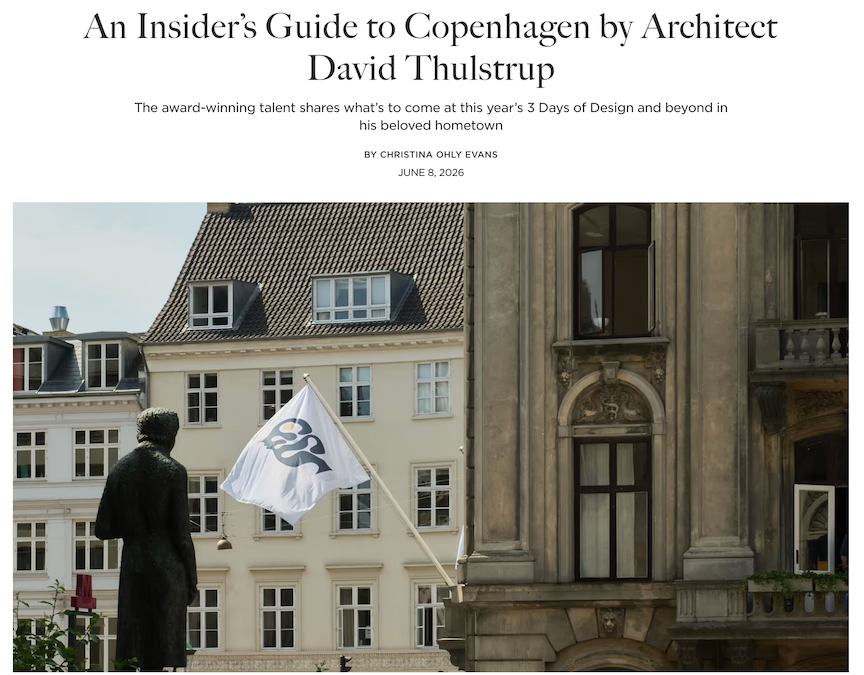
An Insider’s Guide to Copenhagen by Architect David Thulstrup
For award-winning architect David Thulstrup, his hometown of Copenhagen is at its very best during 3 Days of Design—a three-day design festival that is free and open to all. With immersive art and sound experiences, exhibitions, and talks spread throughout eight design districts, the city is sure to highlight the best of furniture, lighting, and design. With Nordic summer as a backdrop—and 17.5 hours of daylight and endless gardens in bloom—Thulstrup’s city is a design-lover’s dream.
The award-winning talent shares what’s to come at this year’s 3 Days of Design and beyond in his beloved hometown
For award-winning architect David Thulstrup, his hometown of Copenhagen is at its very best during 3 Days of Design—a three-day design festival that is free and open to all. With immersive art and sound experiences, exhibitions, and talks spread throughout eight design districts, the city is sure to highlight the best of furniture, lighting, and design. With Nordic summer as a backdrop—and 17.5 hours of daylight and endless gardens in bloom—Thulstrup’s city is a design-lover’s dream.
What is special about Copenhagen during 3daysofdesign?
The city is transformed by this major international art fair now. It’s not Milan, but it’s pretty close. It’s in June, so people are outdoors, swimming, and you’re close to nature—all while walking and biking to galleries and events. It’s great that it’s condensed and is for three days only; it’s limited, and that makes it feel special and intimate. It is also nice that it hasn’t been overtaken by fashion companies—it’s a pure design industry show, very curated, and Copenhagen, as a design-centric city, is the best place to showcase talent on a manageable scale.
Are there shows and installations that you are particularly interested in?
There are more and more curated shows every year, and this year promises some exciting new venues and collaborations. Different talent, agencies, and brands coming together. I look forward to seeing what Tadaima does—they opened up a new beautiful showroom exhibiting everything from furniture to small Japanese handcrafted ceramics, it feels like walking into a beautiful home with unique craft and objects. Other things I am looking forward to seeing include the design at E15 and fabrics at Magniberg, the Dinesen exhibition, and the Knife, Fork, Spoon exhibition by Dung Ngo and Marta LA.
How does the city influence your work?
I love Copenhagen! I start my days with morning walks either in the nearby park or down towards the water. It’s a very green, safe city, and we use the water. Then there is the food scene; this city has some of the best anywhere in the world. I am always inspired here—we have it so good as Danes, and I try to take my social conscience with me for projects from San Francisco to Shanghai. Danes are humble people, and I try to take an appreciation of this paradise to my work.
Are there places that you recommend visitors stay?
We have a mix of everything—from five-star luxury hotels to small apartments or boutique hotels, but what we are missing are more design-led, material-driven hotels. In the meantime, I recommend Hotel Sanders and The Darling Art & Design Guest House, which both offer an excellent location with all the comforts.
Do you have favorite spaces—public parks, bike paths, places on the water—that you can share?
For color and classical architecture, both Nyhavn and Christianshavn are quintessential Copenhagen, with very walkable, scenic streets and harbor fronts in the city center. One of the newer, more interesting areas is Nordhavn—pronounced Nor-how in English—which was an old industrial port and is now full of Scandinavian architecture. It gives a glimpse into real waterfront living, and there are a lot of design showrooms as well. I live in Østerbro, which is very green and residential, with many cafes and bakeries. This area is also very close to the iconic Little Mermaid statue and the Kastellet fortress. These are places where people really live. Wherever you are, you are close to the water. Copenhagen harbor has platforms for swimming, but I prefer to swim and go to the sauna year-round in Nordhavn.
In terms of parks, one of the most romantic is Ørstedparken, very near the busy Nørreport Station. The King’s Garden is also very central and has so much history, with the Rosenborg Castle and Nordic Renaissance gardens. The Opera Park, designed by architecture design studio Cobe, is an entire harbor-front park scheme with six gardens, a central greenhouse, a reflecting pool, and much more. And because it is so centrally located. right next to the Danish Royal Opera, this is a fantastic place to explore during 3 Days of Design.
What are the best restaurants, cafes and bars now?
My absolute favorite is Restaurant Alf in Frederiksberg. It’s a French-Nordic restaurant where the food is just so beautiful, and while it’s a small, intimate place, they serve some of the best food in Copenhagen. Another favorite is akmē, which just won a Michelin star. They serve wonderful fusion cuisine—Asian, Nordic, with a lot of raw fish, but it’s not sushi.
I was just in Paris last week, and I mean it when I say you will not find a better croissant than you will here. We have the best bread makers in the world! My two favorite bakeries are Anderson & Maillard and Hart—the latter was founded by former Noma and Tartine bakers Richard Hart and Søren Westh. They are famous for their cinnamon buns and cardamom buns. Here, it is all about the baking element versus sweet pastry-making. La Cabra is another outstanding coffee option.
Are there cultural spots that are not to be missed?
I recommend Copenhagen Contemporary, which is a modern exhibition space, and also Cisternerne, which is an underground art space that’s set in an old water reservoir. Thorvaldsens Museum is a tribute to the artist Bertel Thorvaldsen’s Neoclassical sculptures and an interesting collection. I also love going to galleries: we’ve got Nicolai Wallner, which is excellent, and then you’ll find galleries throughout different parts of the city. For midcentury Danish design, there are many galleries and shops along Bredgade Street including, Dansk Møbelkunst Gallery and KLASSIK Moderne Møbelkunst.
Are there shops that are worth a detour?
One of the best shops is Dansk Furniture Art for pieces by Arne Jacobsen, Finn Juhl, Kaare Klint and many others. There is also Room 58, which is a great resource for furniture, ceramics, and lighting, and Secher Fine Art & Design are specialists in 20th-century Scandinavian mid-century furniture and European fine art.
Are there any day trips outside of the city that you recommend?
Just outside of the city, near the airport, you’ll find Dragør, which is a perfectly preserved 12th-century fishing village that looks like something from a Hans Christian Andersen fairytale. Further north, just 20 minutes from Copenhagen, you have Bellevue, a beautiful beach at Klampenborg, that also has some Modernist design elements. There is Finn Juhl’s house, Ordrupgaard, and further away, the iconic Louisiana Art Museum. Lastly, there’s the Rudolph Tegners Museum—a unique, self-funded museum devoted to the plaster sculptures of the artist of the same name.
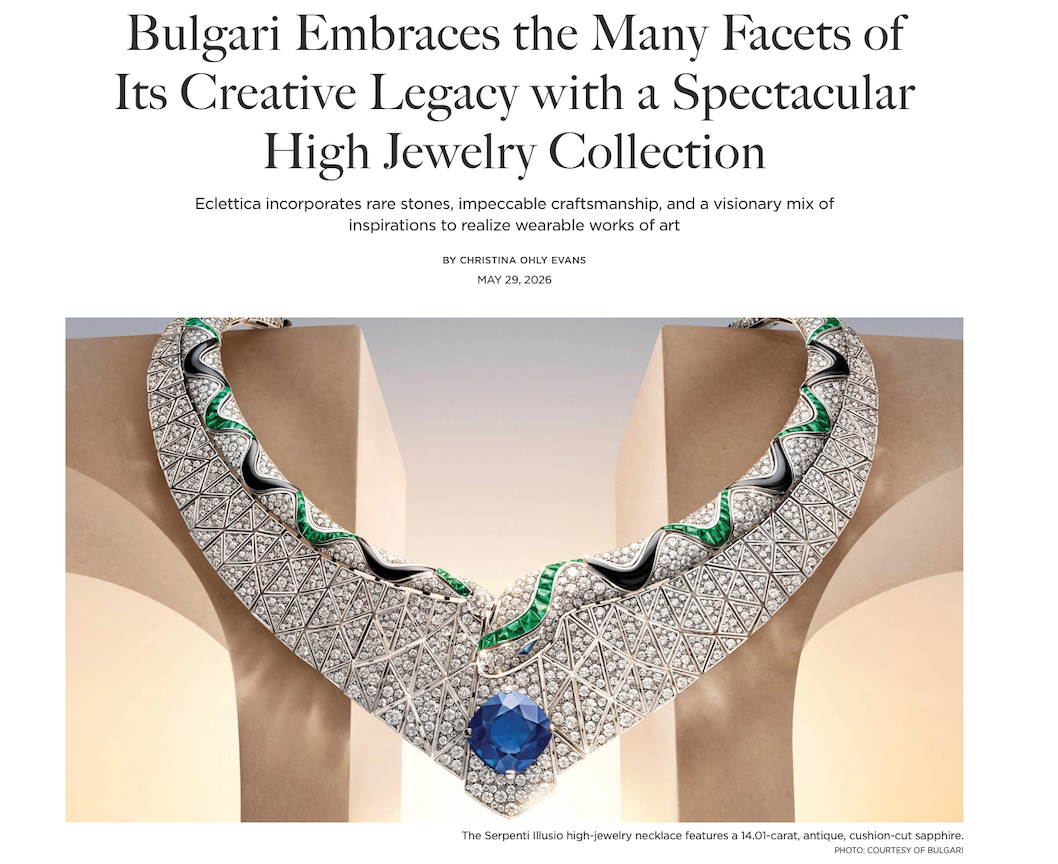
Bulgari Embraces the Many Facets of Its Creative Legacy with a Spectacular High Jewelry Collection
Long synonymous with the glamour of la dolce vita, Bulgari has introduced its latest wildly imaginative collection, aptly named Eclettica to reflect the rich depth and range of Roman art and design that inform each of the exquisite pieces. Under the guidance of creative director Lucia Silvestri, the array includes 15 transformable high-jewelry masterpieces as well as 50 “millionaire pieces,” all of which are evocative of the chromatic vocabulary of painting, the dimensionality of sculpture, and the precise balance and proportion of Italian architecture.
Eclettica incorporates rare stones, impeccable craftsmanship, and a visionary mix of inspirations to realize wearable works of art.
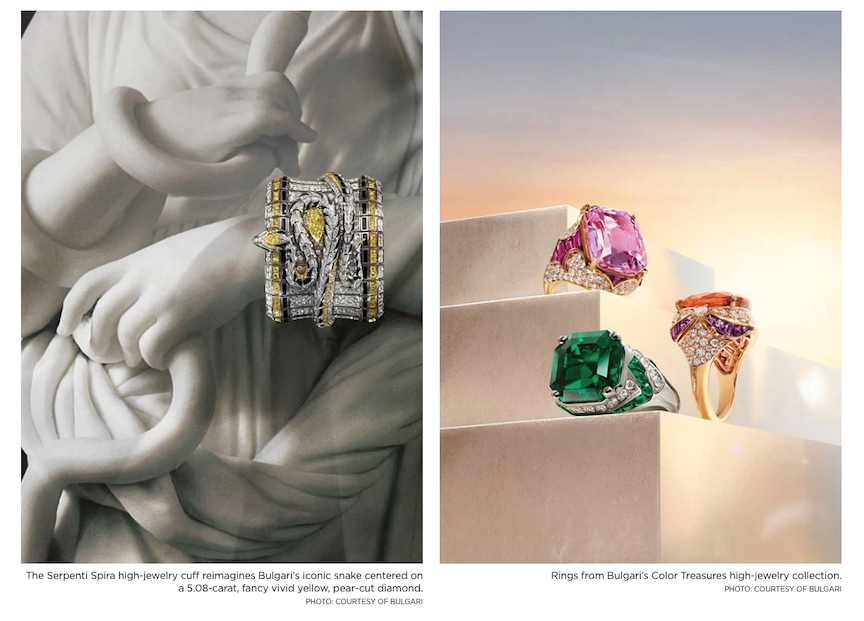
Long synonymous with the glamour of la dolce vita, Bulgari has introduced its latest wildly imaginative collection, aptly named Eclettica to reflect the rich depth and range of Roman art and design that inform each of the exquisite pieces. Under the guidance of creative director Lucia Silvestri, the array includes 15 transformable high-jewelry masterpieces as well as 50 “millionaire pieces,” all of which are evocative of the chromatic vocabulary of painting, the dimensionality of sculpture, and the precise balance and proportion of Italian architecture.
A natural evolution for Bulgari, Eclettica is the pinnacle of bold aesthetics and technical prowess with innovation at its core. “The concept of ‘artsmanship’ is central to this collection,” explains Silvestri. “It’s an even closer dialogue between artistic intuition and exceptional craftsmanship. The result is an assortment that feels incredibly vivid, cohesive, and, above all, authentically reflective of who we are.”
Particularly captivating are the nine Capolavori, the most spectacular examples of the collection, each set with brilliantly colored, extremely rare gemstones to produce dynamic objets d’art. “Each creation here embodies the harmony of contrast, born of multiplicity and transformed into wearable art,” explains Silvestri.
Eclettica includes such stunning bijoux as the Seres Scarf necklace in white gold with 1,180 individual components that mimic the flow of fabric and a 31.90-carat sugarloaf sapphire from Sri Lanka, which can be detached and positioned on various points. The adornment is “inspired by iconic Art Deco textiles and the vibrant palette of Tamara de Lempicka’s paintings,” says Silvestri. “The modular design allows it to transform into multiple styles, from a sautoir to a choker. It is a true expression of Eclettica, where different inspirations and disciplines coalesce in a unique artistic creation.”
Equally eye-catching is the Secret Garden necklace, which is anchored by an ultrarare 26.65-carat padparadscha sapphire that references the coral-tinged warmth of an Italian courtyard garden at sunset. “It was love at first sight,” says Silvestri of the stone she pursued for years. “Its balance of pink and orange is simply extraordinary.” Surrounded by onyx, diamonds, emeralds, purple sapphires, and pavé-set diamonds, the necklace appears to glow.
Other standouts include the Incontro Segreto ring, informed by Francesco Hayez’s The Kiss. Comprising two stones—a 7.85-carat, antique, pear-shaped diamond and a 5.42-carat Colombian emerald—and further embellished with pavé diamonds, step-cut diamonds, and buff-top emeralds, the piece gets its true sparkle from the Toi et Moi setting, a Bulgari signature since the 1980s.
Also striking is the Serpenti Imperial Heart necklace, with a flawless 30.75-carat Golconda-type diamond that is believed to have once belonged to a maharaja. The dazzling stone serves as the serpent’s head, while 180 superbly linked elements form its sinuous body, an effort that required over 1,400 hours of meticulous craftsmanship. In a similarly sculptural vein, the Serpenti Spira cuff—with its luminescent, 5.08-carat, fancy vivid yellow, pear-cut diamond—is a work of precise technical genius. Influenced by the symmetry and strength of Roman columns, the white-gold, clasp-free bracelet features pavé diamonds and onyx details that coalesce to shape an uninterrupted swirling snake.
Continuing in the star-studded Bulgari tradition, several Eclettica jewels made their red-carpet debut at the Academy Awards ceremony in March, worn by stylish brand ambassadors Priyanka Chopra Jonas and Anne Hathaway. For Chopra Jonas, the Serpenti Illusio necklace, with a 14.01-carat, antique, cushion-cut sapphire from Madagascar, served as a showstopping accessory. A constellation of brilliant diamonds, buff-top emeralds and sapphires, and onyx, the choker fuses precise geometry with an illustrious serpent in 235 individual segments that required 1,300 hours to create. Similarly enchanting was the Neoclassical Starlight necklace, chosen by Hathaway for its stunning 8.02-carat, pear-cut, fancy vivid yellow diamond set in platinum. An homage to the great neoclassical sculptor Antonio Canova, the magnificent creation paired perfectly with her statement-making diamond Bulgari high-jewelry earrings and Valentino haute couture gown.
The sheer creativity and the range of impressive stones and rare materials, as well as the masterful craftsmanship that are found throughout the Eclettica collection—which also includes remarkable watches, bags, and fragrances—are what continue to make Bulgari the height of opulent, ever-exuberant luxury. “Our approach is rooted in constant cross-pollination,” explains Silvestri. “We draw inspiration from different eras, cultures, architectural forms, and artistic expressions, allowing them to come together in a dialogue that feels both dynamic and harmonious. Eclettica represents the ultimate expression of this philosophy, a celebration of the maison’s ability to blend diverse influences into a singular, unmistakable identity.
VIEW PDF
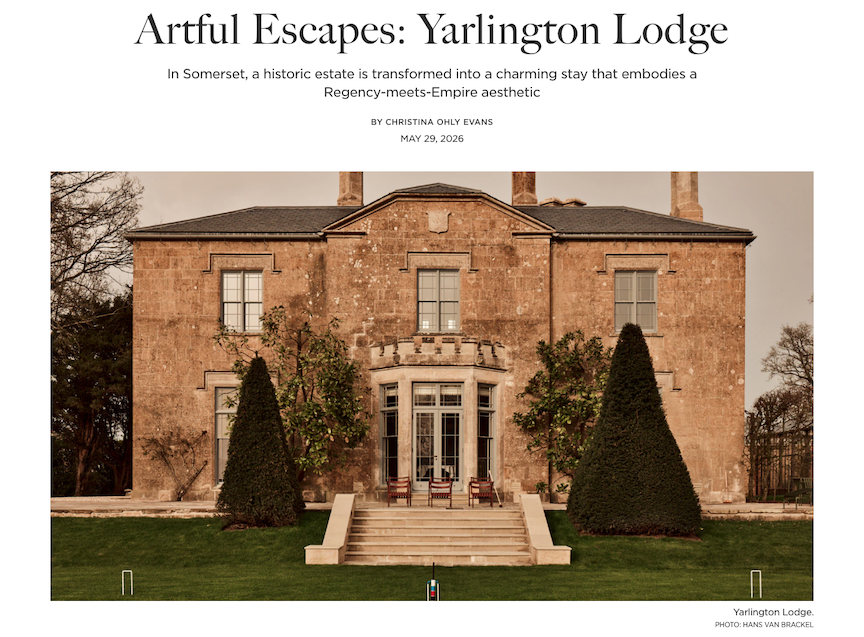
Artful Escapes: Yarlington Lodge
The landmark Yarlington Lodge, situated on an estate allegedly gifted by Henry VIII to his wife Katherine Parr, has been superbly metamorphosed into a sprawling compound. The expansive property—which includes an eight-bedroom manor house, a four-bedroom coach house in the former stables, and a four-bedroom gardener’s cottage as well as a lush walled garden—is the passion project of Karen Roos, co-owner of The Newt.
In Somerset, a historic estate is transformed into a charming stay that embodies a Regency-meets-Empire aesthetic
The landmark Yarlington Lodge, situated on an estate allegedly gifted by Henry VIII to his wife Katherine Parr, has been superbly metamorphosed into a sprawling compound. The expansive property—which includes an eight-bedroom manor house, a four-bedroom coach house in the former stables, and a four-bedroom gardener’s cottage as well as a lush walled garden—is the passion project of Karen Roos, co-owner of The Newt.
Working with Richard Parr Associates, she has created sumptuous, fabric-swathed rooms with canopy-tented ceilings and period paintings that embody a Regency-meets-Empire aesthetic that’s juxtaposed with stylish design touches.
A spacious library, a drawing room, and a formal dining room—all with views of the gardens beyond—invite guests (a maximum of 32) to linger, while a cozy cinema is ideal for screening current films. But it’s the grounds, boasting an arbor of laburnum and wisteria, a sleek swimming pool, and a charming greenhouse, that really dazzle.
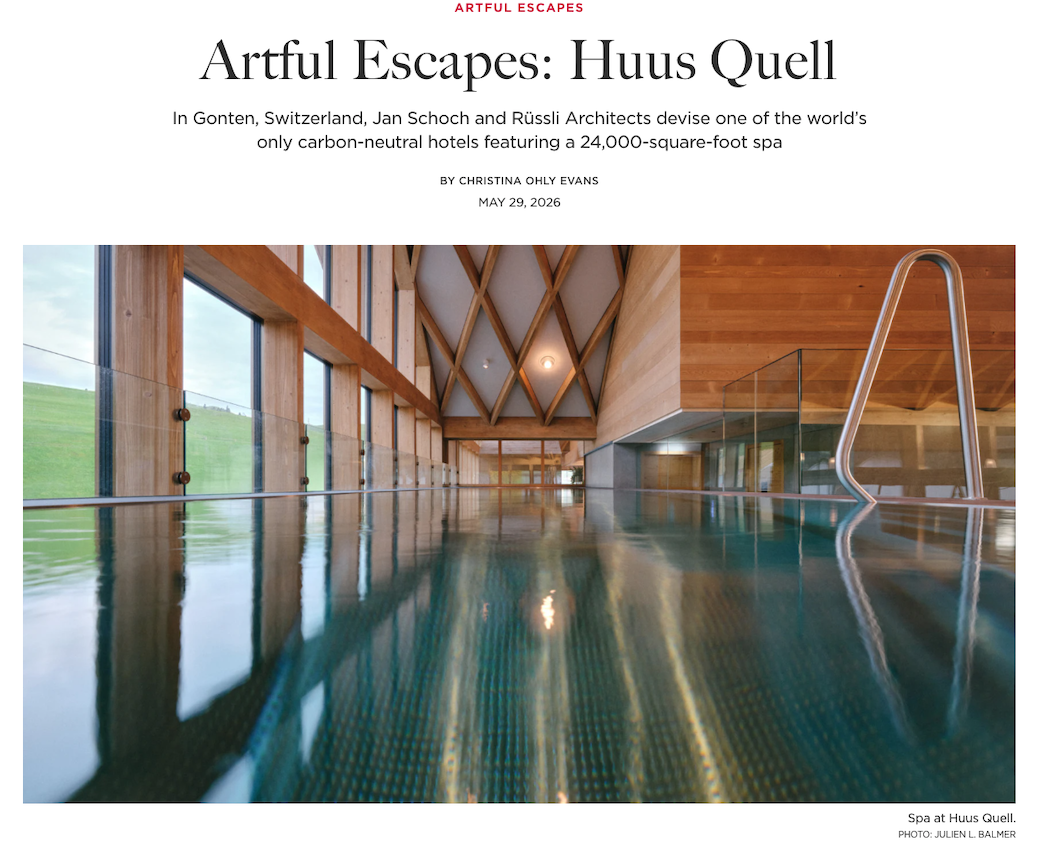
Artful Escapes: Huus QuellIn Gonten,
A biohacking devotee, former fintech mogul turned healthful hotelier, Jan Schoch devised Huus Quell alongside Lucerne-based Rüssli Architects as one of the world’s only carbon-neutral hotels, with wood sourced from local larch and pine trees, geothermal wells, and lime-based plaster that absorbs carbon dioxide.
Switzerland, Jan Schoch and Rüssli Architects devise one of the world’s only carbon-neutral hotels featuring a 24,000-square-foot spa
A biohacking devotee, former fintech mogul turned healthful hotelier, Jan Schoch devised Huus Quell alongside Lucerne-based Rüssli Architects as one of the world’s only carbon-neutral hotels, with wood sourced from local larch and pine trees, geothermal wells, and lime-based plaster that absorbs carbon dioxide.
Comprising 30 rooms and a 24,000-square foot spa, this Leading Hotel of the World invites guests to experience cryotherapy, hyperbaric oxygen therapy, and rhythmic movement that targets the lymphatic system as well as eight saunas and an impressive floating yoga platform with stunning views of the Alpstein massif.
Artful Escapes: Palazzo Santa Croce
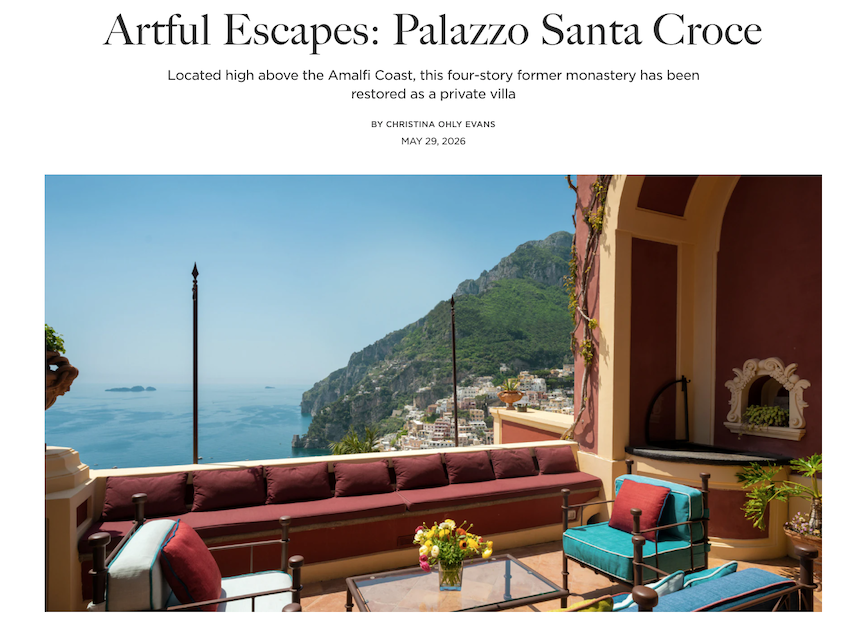
A four-story former monastery high above the Amalfi Coast has been lovingly restored by the Cinque family, owners of the nearby Il San Pietro hotel, and now operates as a private villa with full use of the hotel’s amenities. Palazzo Santa Croce comprises five bedrooms, including two main suites with original frescoes.
Located high above the Amalfi Coast, this four-story former monastery has been restored as a private villa
A four-story former monastery high above the Amalfi Coast has been lovingly restored by the Cinque family, owners of the nearby Il San Pietro hotel, and now operates as a private villa with full use of the hotel’s amenities. Palazzo Santa Croce comprises five bedrooms, including two main suites with original frescoes.
Living spaces are lavish, with Neapolitan rococo mirrors, silk, and velvet fabrics, and antique furniture. In the kitchen, chefs prepare seafood-centric meals using ingredients from the surrounding gardens. Of special note is an adjoining spa inspired by a Roman bath, which features an indoor pool, a sauna, a Turkish bath, and an outdoor jacuzzi with sweeping sea views.
Artful Escapes: The Huntington Hotel
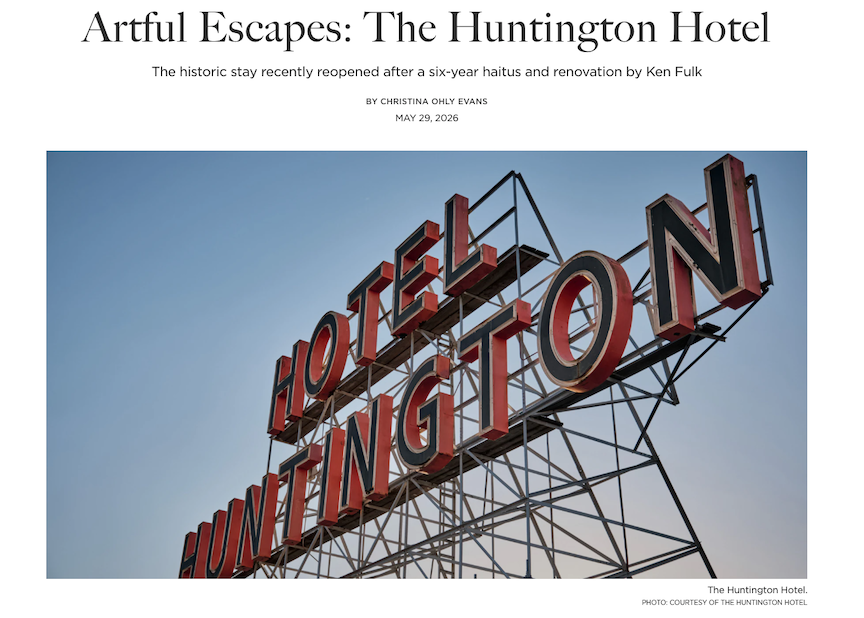
Built in 1922 as a luxury apartment building, The Huntington Hotel has reopened following a six-year hiatus and renovation by noted designer and Bay Area resident Ken Fulk. Plasterwork, boiserie panels, and celestial ceilings enliven public spaces, while marble, polished wood, brass, and deep cognac leather add to the grand environment. The new Arabella’s bar is an Art Nouveau jewel, complete with murals and excellent martinis.
The historic stay recently reopened after a six-year haitus and renovation by Ken Fulk
Built in 1922 as a luxury apartment building, The Huntington Hotel has reopened following a six-year hiatus and renovation by noted designer and Bay Area resident Ken Fulk. Plasterwork, boiserie panels, and celestial ceilings enliven public spaces, while marble, polished wood, brass, and deep cognac leather add to the grand environment. The new Arabella’s bar is an Art Nouveau jewel, complete with murals and excellent martinis.
An Insider’s Guide to Venice by Peter Marino
As president and chairman of the board of Venetian Heritage, Peter Marino is deeply committed to historical preservation—of art, architecture, and culture—in the most magical of Italian cities. In addition to his architectural design work for clients including Dior, Chanel, and Louis Vuitton, Marino is an avid collector of everything from Egyptian art to 17th-century French books to Renaissance bronzes to photography and modern painting and sculpture. For this consummate aesthete, the floating city made of 118 islands and endless canals and bridges never ceases to amaze and delight—especially during the vibrant Venice Biennale, on view from May 9—November 22, 2026.
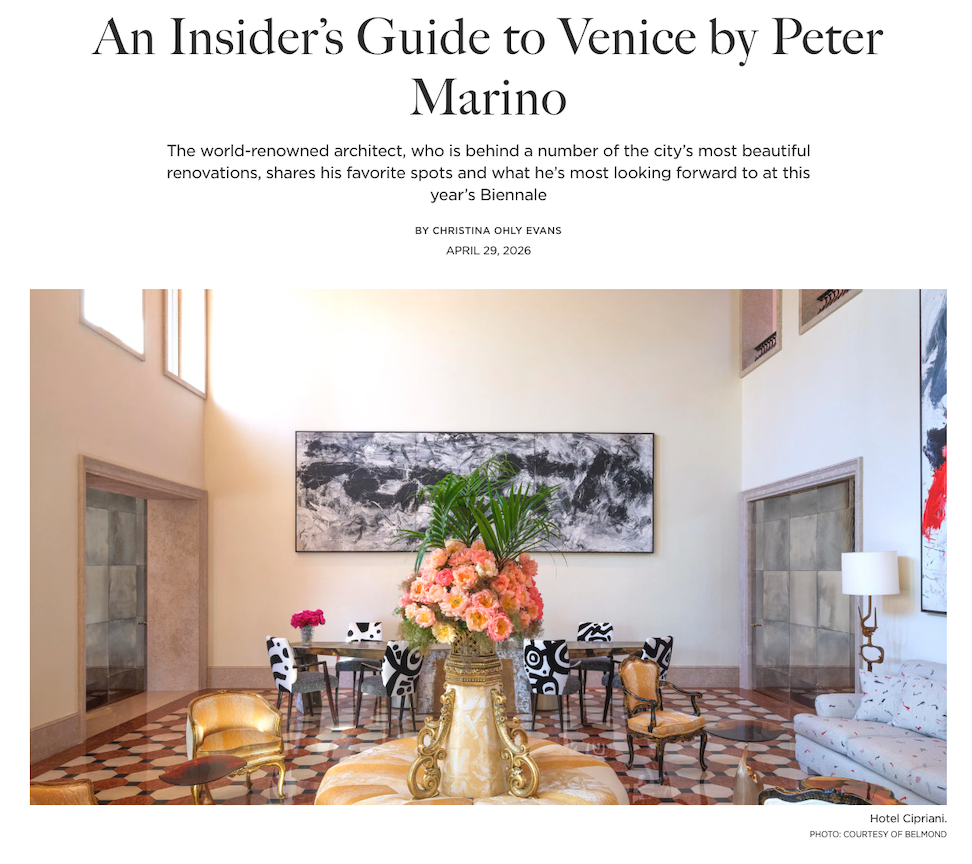
The world-renowned architect, who is behind a number of the city’s most beautiful renovations, shares his favorite spots and what he’s most looking forward to at this year’s Biennale.
As president and chairman of the board of Venetian Heritage, Peter Marino is deeply committed to historical preservation—of art, architecture, and culture—in the most magical of Italian cities. In addition to his architectural design work for clients including Dior, Chanel, and Louis Vuitton, Marino is an avid collector of everything from Egyptian art to 17th-century French books to Renaissance bronzes to photography and modern painting and sculpture. For this consummate aesthete, the floating city made of 118 islands and endless canals and bridges never ceases to amaze and delight—especially during the vibrant Venice Biennale, on view from May 9—November 22, 2026.
What makes the city so special for you?
Venice is eternally magical. It aligns in a unique way with one of my main fascinations: light. I want light in all my work, and the light on the water in the quiet canals makes me absolutely crazy with joy. The quality of the light—and the way it interacts with material—is fundamental to its beauty. It’s something I’ve explored through my textile collections for Rubelli, and in my vases and lighting collections with the Murano glassmaker Venini. This city is where craft and architecture come together in a very direct way.
How did you come to be involved with Venetian Heritage?
Venetian Heritage was founded by Larry Lovett in 1999. My love for Venice began when Larry called me to lead the design project for the 19th-century Palazzo Sernagiotto. He taught me so much and opened so many doors for me. My involvement with Venetian Heritage comes from a long-standing commitment to Venice and its cultural legacy.
Venetian Heritage focuses on restoration projects that are both historically significant and urgently in need of support—whether it be architectural elements, sculpture, or major works of art. The goal is not only preservation, but ensuring these works remain part of a living cultural context. Restorations have included the Gallerie dell’ Accademia, Palazzo Grimani, and now the Ca’ d’Oro—in addition to countless paintings, sculptures, and important churches.
What are your first memories of the Venice Biennale?
I remember visiting in the ‘90s and there was always this ‘which are the best pavilions to visit’ discussion. As the Biennale is so vast, I remember thinking that this smorgasbord of art is the most varied, universal, and interesting thing in the world.
Are there particular editions or exhibitions that stand out for you over the years?
Michal Rovner—the Israeli Pavilion—in 2003 was a standout. Erwin Wurm at the Austrian Pavilion in 2017 is another highlight, and Anselm Kiefer at the German Pavilion in 1980. I missed Warhol in 1976. I am now assembling a large collection of artists who represented Italy in the ‘50s and ‘60s for the legendary Hotel Cipriani’s renovation.
What are you excited about for this year’s Biennale, from installations to activations to museums and parties?
The Biennale is always about the contrast—the most contemporary work in one of the most historic cities in the world. This year, I’m especially focused on the way cultural programming is being anchored in historic Venetian settings. Through my work with Venetian Heritage, we’ve structured a series of events that move between conservation, contemporary art, and the social life of the Biennale.
There are moments that are very focused—like the visit to the restoration of Bellini’s San Giobbe Altarpiece at the Accademia—and others that activate historic buildings and spaces, such as the dinner at the Biblioteca Marciana or the reopening of Oro restaurant at Hotel Cipriani on Giudecca.
And then, of course, there’s the more theatrical dimension of Venice. This year’s collaboration with Dior culminates in the Casino Royale Ball on May 9 at the Palazzo del Casinò on the Lido—a setting that still retains its 1930s interiors, including gilded mosaics and Murano chandeliers.
What’s interesting to me is that all these moments—whether intimate or large-scale— are part of the same continuum. The Biennale isn’t just about exhibitions; it’s about how the city itself is experienced during that time.
Where do you recommend visitors stay?
Hotel Cipriani offers something rare in Venice—space, light, and a sense of retreat while remaining connected to the city. For my redesign, the intention was to create a world that belongs to Venice but also to the 21st-century traveler. When it was founded in 1958, the idea was to create a joyful place, different from the formal hotels of the city…imperfect but authentic.
Guests today crave a unique experience and authenticity. Art and architecture provide that. The future is about cultural specificity—bringing the DNA of a city alive through the combination of art and design.
Are there particular palazzos, churches or neighborhoods that aren’t to be missed?
The Galleria Giorgio Franchetti alla Ca’ d’Oro is a must-visit. It’s one of the great Late Gothic palazzos, and its ongoing restoration is a major focus of Venetian Heritage. The building itself—and its collection—offers a complete expression of Venetian culture at a very high level.
San Francesco della Vigna, where the architectural layering—from Sansovino to Palladio—is extraordinary as well. The cloisters and vineyard have also been the subject of careful restoration and enhancement, which brings a deeper understanding of how these spaces functioned historically.
Discover Why Marcel Is New York’s Most Sought-After Reservation
This week marks the highly anticipated opening of Marcel in the iconic Breuer building on New York’s Upper East Side. Set within Marcel Breuer’s 1966 brutalist masterpiece that was once home to the Whitney Museum of American Art, and now serves as Sotheby’s New York headquarters, it is already the most sought-after reservation in town. A vibrant setting for Modern and Contemporary marquee sales, the site will now house an all-day, convivial dining room-cum-gallery where art—and objects for sale—will meet French-inflected cuisine.
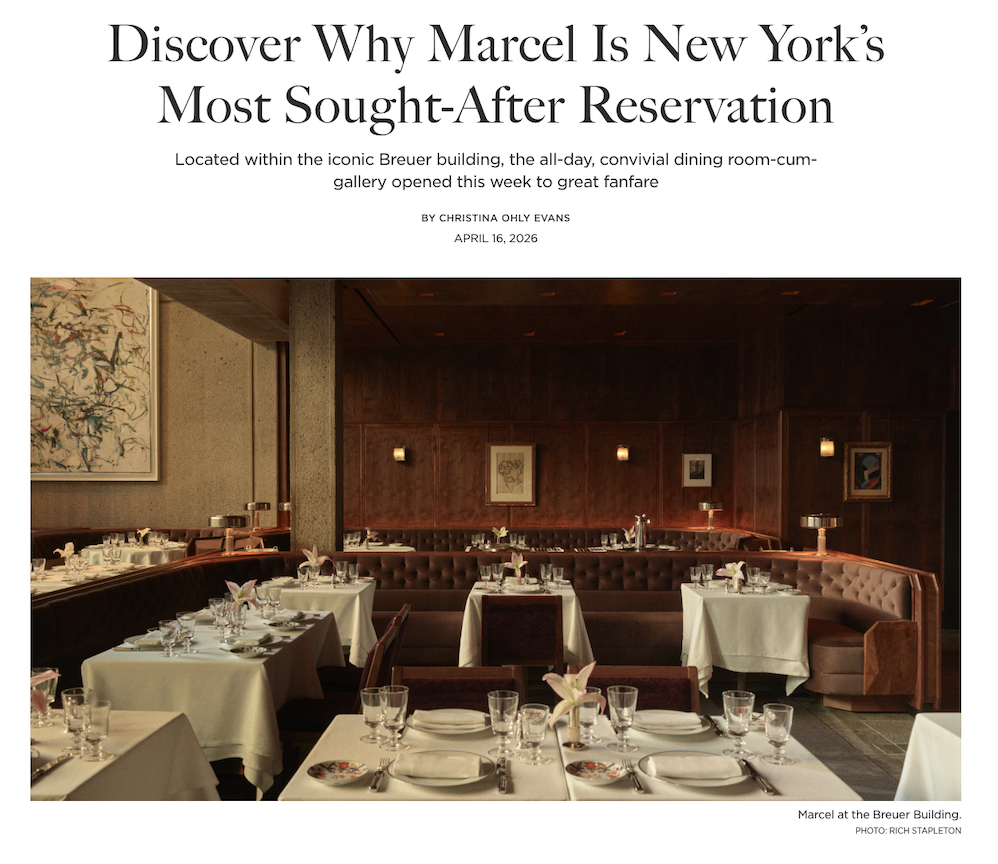
Located within the iconic Breuer building, the all-day, convivial dining room-cum-gallery opened this week to great fanfare.
This week marks the highly anticipated opening of Marcel in the iconic Breuer building on New York’s Upper East Side. Set within Marcel Breuer’s 1966 brutalist masterpiece that was once home to the Whitney Museum of American Art, and now serves as Sotheby’s New York headquarters, it is already the most sought-after reservation in town. A vibrant setting for Modern and Contemporary marquee sales, the site will now house an all-day, convivial dining room-cum-gallery where art—and objects for sale—will meet French-inflected cuisine.
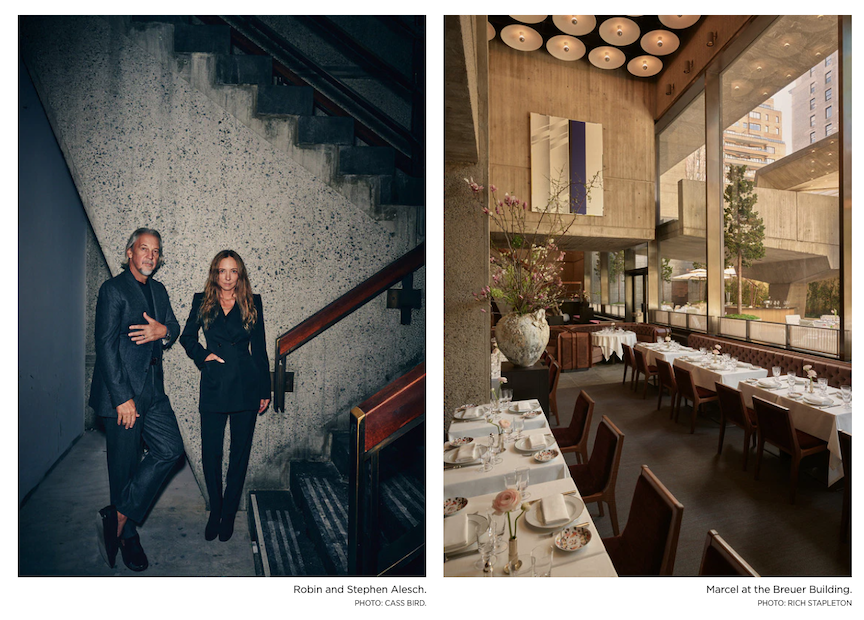
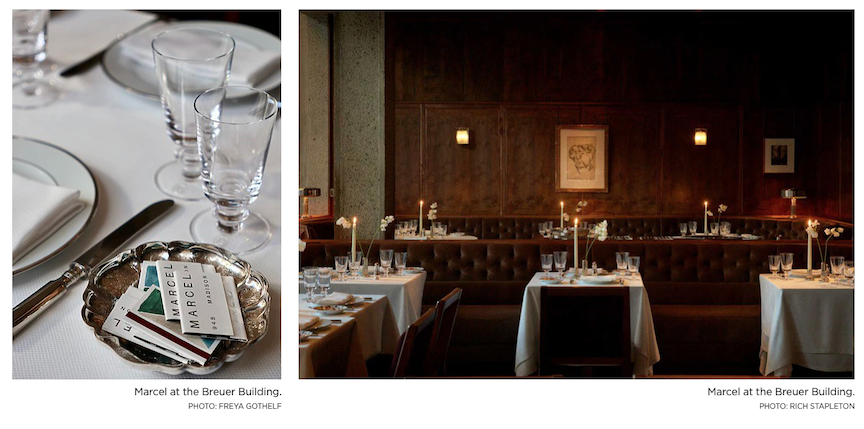
A partnership between Roman and Williams founders Robin and Stephen Alesch – the duo behind celebrated hospitality venues including Soho’s La Mercerie and the sublime Estelle Manor in the English countryside—and Sotheby’s, the restaurant named for the Bauhaus-trained architect, will welcome diners from morning through elegant evenings. The pair have embraced the midcentury aesthetic of the space and enhanced it with rich, walnut-paneled walls, warm candlelight (a Roman and Williams forte), and an open plan kitchen that adds to the theatrical hum.
A new, dedicated entry welcomes visitors with touches of walnut and bronze that set the stage for the big reveal downstairs. A central dining room highlights Breuer’s bush-hammered concrete columns, with all original lighting details thoughtfully preserved. The kitchen serves as the room’s focal point—one with space for 140 guests—with walls paneled in book-matched Black Figured and Claro walnut and sumptuous banquettes swathed in cocoa-tinged Pierre Frey mohair that are ideal for intimate conversation. A mirrored bar highlights vintage steel and leather Bauhaus stools paired with original Breuer lamps sourced at auction. Art takes center stage as well with objects displayed in Goppion-designed vitrines, and works of art hung on steel picture hangers—always in rotation like an ever-changing, dynamic gallery.
Equally spectacular is the food—from a dedicated La Mercerie Patisserie for all-day madeleines and casual coffee, to lunch and dinner that’s overseen by chef-partner Marie-Aude Rose. With menus conceived by executive chef Juan Moncalvo, continental classics such as ham and comté tartines at lunch and confit de canard will appear throughout the day—often with wine pairings in partnership with Sotheby’s specialists. Every tabletop detail has been thought through, from midcentury typefaces that appear on menus and packaging to the Roman and Williams-designed Hyssop vases and candlesticks that highlight the room in patinated bronze. Handcrafted flatware and exquisite glassware from Japan, as well as Arita porcelain in a slight silver hue, all add to the serene atmosphere.
Of special note is the original sculpture garden, which will now seat 70 additional guests for breakfast, lunch, and dinner. Just steps off bustling Madison Avenue and yet surrounded by nature and art, this garden oasis is the perfect spot for a casual morning coffee or plein air dinner. For lovers of great design—midcentury and contemporary—as well as delicious, creative cuisine, Marcel is New York’s new top table.